
How To Stay Biologically Young: Three Provocative Findings On How To Exploit Exercise
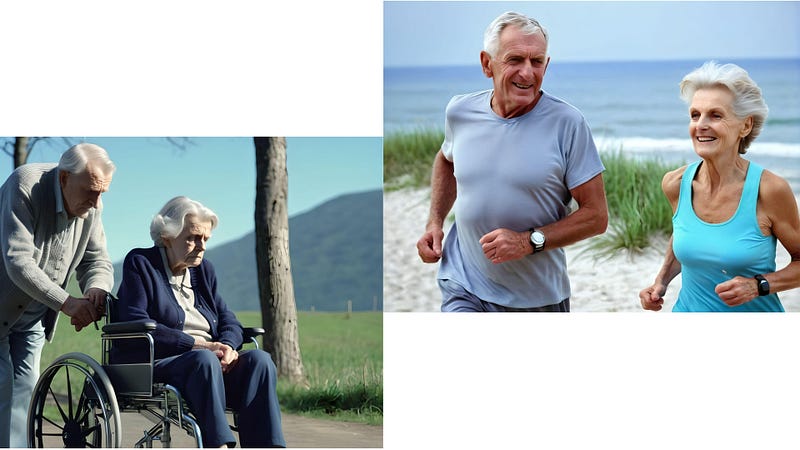
This is part 1 of a three-part series, in which I address three scientific insights about how to exploit exercise to stay biologically young.
- Part 1: Why you can out-exercise a poor diet but not out-diet a lack of exercise.
- Part 2: Why you can’t rely on one-size-fits-all exercise prescriptions.
- Part 3: There are time-saving exercise routines for you to stay biologically young.
Each part will be available in video and text formats.
In this first episode, I will answer the question:
To stay biologically young, can you out-exercise a poor diet?
The answer is, yes, you can (to some extent). But can you out-diet a lack of exercise?
No way. And you’ll know why at the end of this post.
Or watch the video:
In this episode, I will answer the question:
To stay biologically young, can you out-exercise a poor diet?
The answer is, yes, you can (to some extent). But can you out-diet a lack of exercise? No way. And you’ll know why at the end of this post.
What is the relevance of biological age?
Biological age vs. calendar age has become THE benchmark predictor for your future state of health. For a reason. To stay biologically younger is what keeps you robustly healthy, functionally fit, and amazingly independent into ripe old age. It might even make you live longer.
A longer life is a fringe benefit, but health, fitness, and independence are the prerequisites for enjoying life to its very end. The big question here is:
How to measure and improve the rate of biological aging.
“If you cannot measure it, you cannot improve it.” Lord Kelvin
Currently, the most practical proxy for biological age is vascular age (VA). The dominant driver of vascular age is endothelial function; the best biomarker for endothelial function is vascular arterial stiffness (AS); and the preferred benchmark for vascular stiffness is pulse wave velocity (PWV) [1] [2].
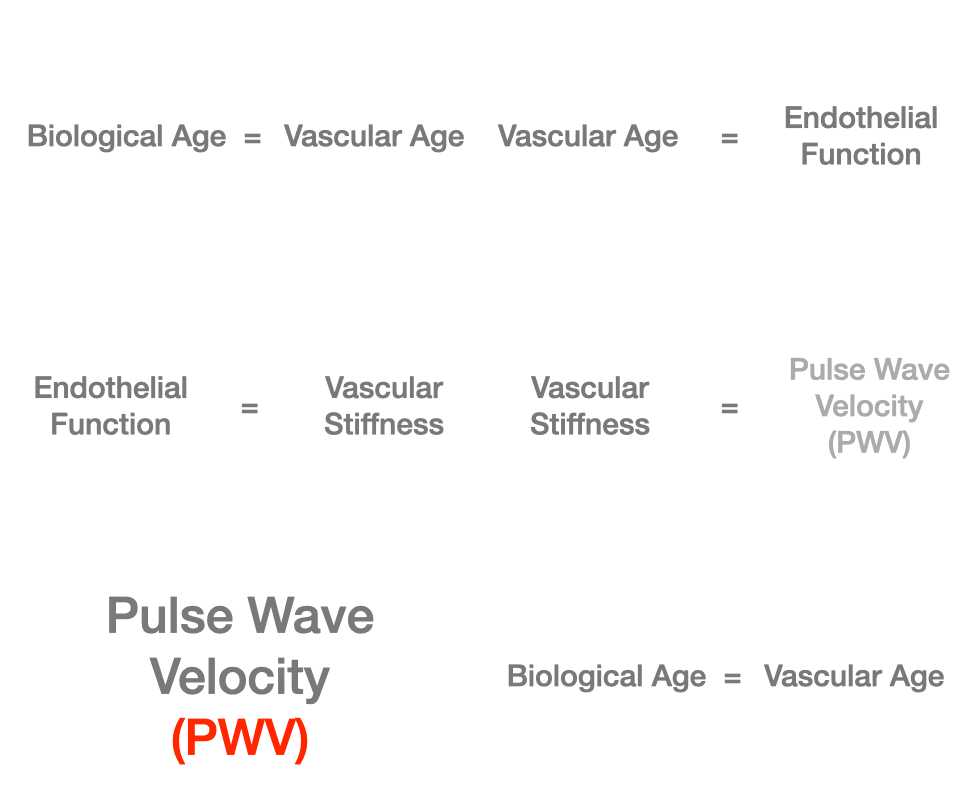
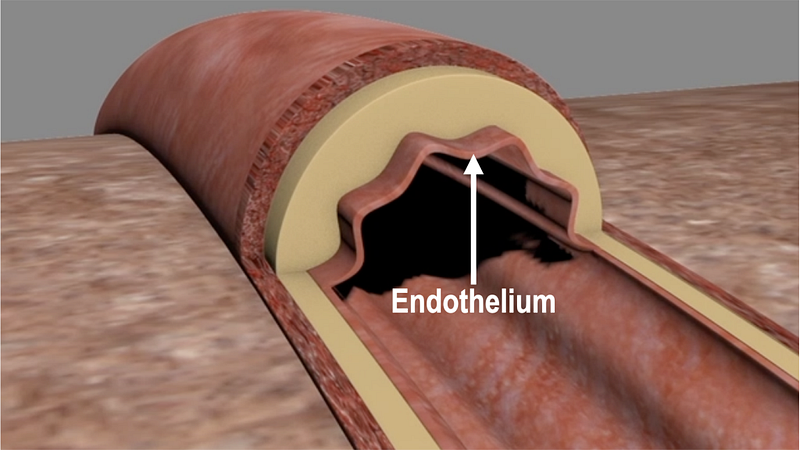
Now, let’s clarify some of these terms first. The endothelium is the innermost lining of the blood vessels,
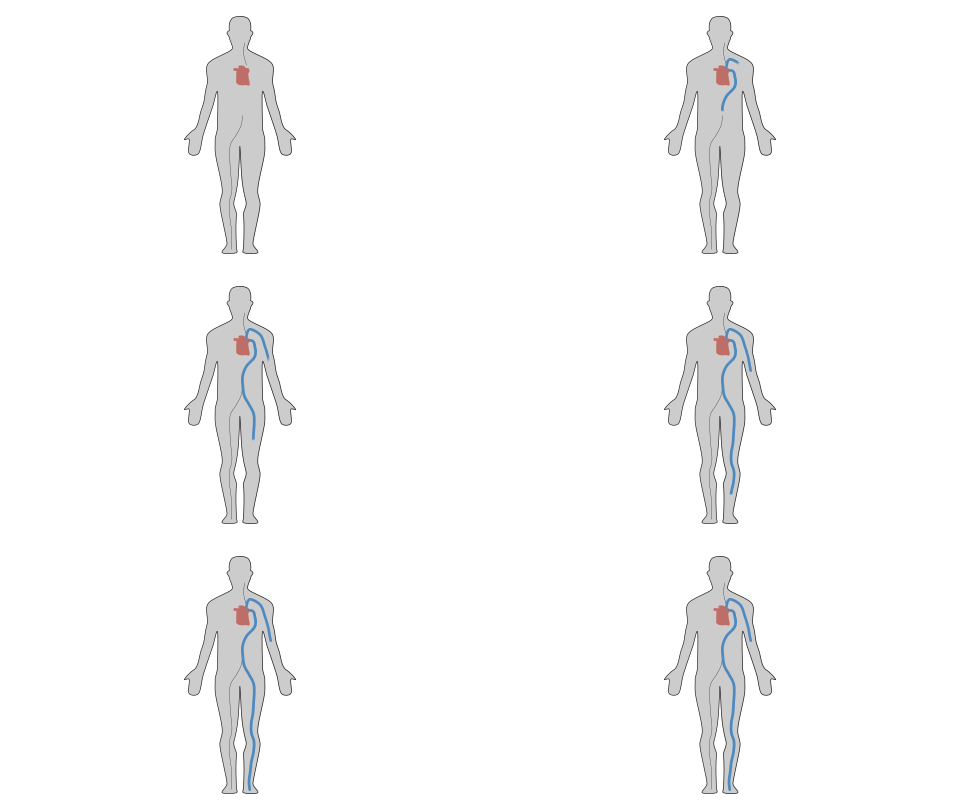
and pulse wave velocity (PWV) is the speed at which the blood pressure wave travels through the arterial tree.
Once you understand the effects of exercise on endothelial function, you understand my answer to the title question.
The effects of exercise on endothelial function and health
When you exercise, your working muscle needs a lot more blood than when it is at rest. This amping up of blood flow exposes the cells of the arteries’ inner lining (endothelium) to mechanical (shear) stress.
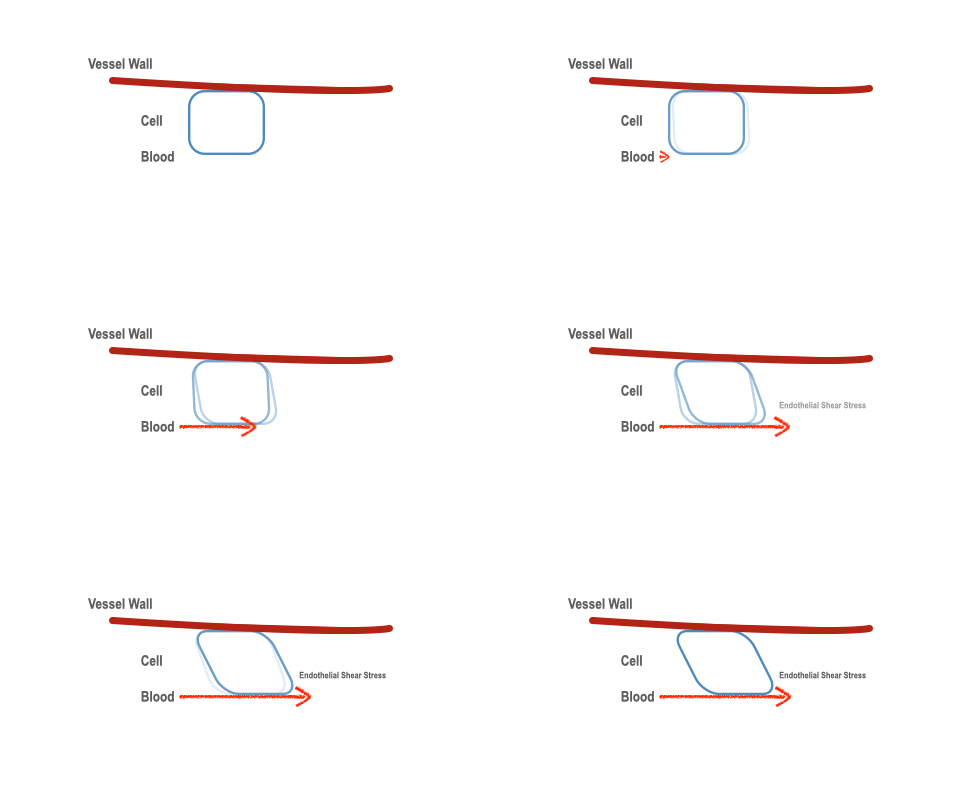
That stress triggers the so-called mechanoreceptors of the endothelial cells. Once triggered, the cells start producing a molecule called nitric oxide (NO). NO is our body’s most potent vasodilator. That is, it relaxes the arteries’ middle layer of smooth muscle cells.
The more relaxed these arterial muscles are, the less stiff the blood vessels; the less stiff the blood vessels, the lower the pulse wave velocity; and the lower the pulse wave velocity, the healthier the entire vascular system.
Maintaining an exercise schedule will maintain this NO-driven improvement of endothelial function. But once you stop exercising, these benefits will be lost within a matter of days.
Why you can out-exercise a less-than-prudent diet
Now here comes the curious thing. Even if you keep up the exercise, the NO activity will scale back to pre-exercise levels after a couple of months. And that’s good news: when you exercise regularly for a couple of months, your entire arterial structure will change.
- Vessel diameter increases
- Vessel walls become a little thinner
- Vessel walls increase their elasticity

That’s called arterial remodeling. It’s important because each of these three (larger radius, thinner walls, increased elasticity) reduces pulse wave velocity, which, remember, is the benchmark for arterial health.
Once this has happened, the endothelial cells can, and will, scale back their NO production.
When it comes to vascular aging there are three scenarios
The unfavorable remodeling, called EVA, the favorable remodeling called SUPERNOVA, and the one in-between, called “normal” vascular aging.
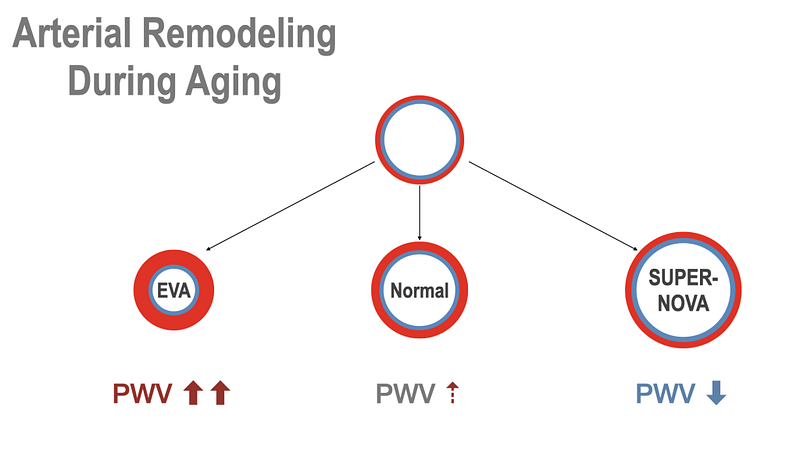
Now here comes the key insight:
The right volume of exercise will promote arterial remodeling in the SUPERNOVA direction.
But no matter how healthy your diet is, this sort of beneficial arterial remodeling is not on any diet’s menu. On the contrary. The worse your diet, the greater the chances that arterial remodeling goes in the EVA direction.
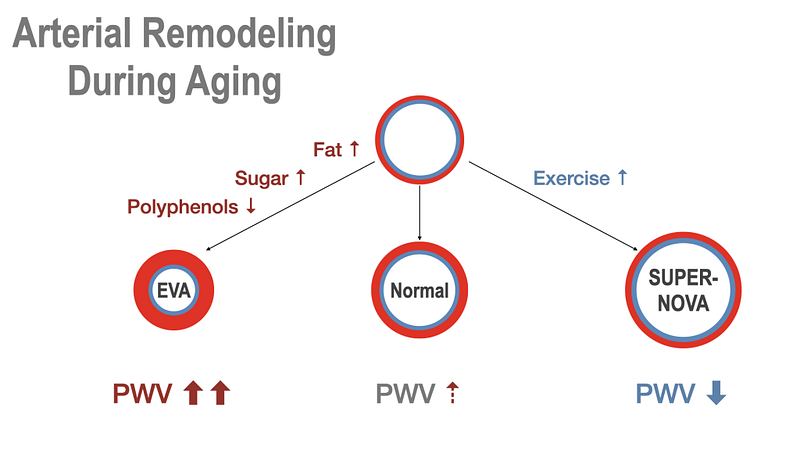
That’s why I said that you can out-exercise some dietary sins, but you can’t out-diet a lack of exercise. Now, the big question is,
What is the right volume of exercise?
In the next episode of this 3-part series, I’ll introduce the FITT principle (frequency, intensity, time, and type), how researchers use it to come up with exercise prescriptions, and why you can’t rely on them.
References
[1] González L del M, Romero-Orjuela SP, Rabeya FJ, del Castillo V, Echeverri D. Age and vascular aging: an unexplored frontier. Front Cardiovasc Med 2023;10:1–12. doi:10.3389/fcvm.2023.1278795.
[2] Weber T, Wassertheurer S, Hametner B, Moebus S, Pundt N, Mahabadi AA, et al. Cross-sectional analysis of pulsatile hemodynamics across the adult life span: Reference values, healthy and early vascular aging: The Heinz Nixdorf Recall and the MultiGeneration Study. J Hypertens 2019;37:2404–13. doi:10.1097/HJH.0000000000002178.


