
To Stay Biologically Young: Time-Saving Exercise Routines Beat General Guidelines
STORY AT-A-GLANCE
- What is new: Research shows that for most medically endorsed exercise guidelines there exist equally effective time-saving alternatives.
- Why it matters: Once-a-week exercise routines, high-intensity-low-volume training, and cardio-effective strength training are just some of the options that make the slowing-down of one’s biological clock accessible to time-starved individuals.
- What is next: Real-time feedback about one’s individual rate of biological aging will be the tool for “test-driving” evidence-based exercise routines.
In episode 2 of this 3-part series, I introduced the FITT principle and how researchers use it to study the effects of exercise interventions on vascular aging.
I also illustrated why you will be unable to exactly replicate the intervention effects of any published study.
So, take those studies as a compass, giving you general directions and vehicles to test drive on your way to the SUPERNOVA league of vascular aging.
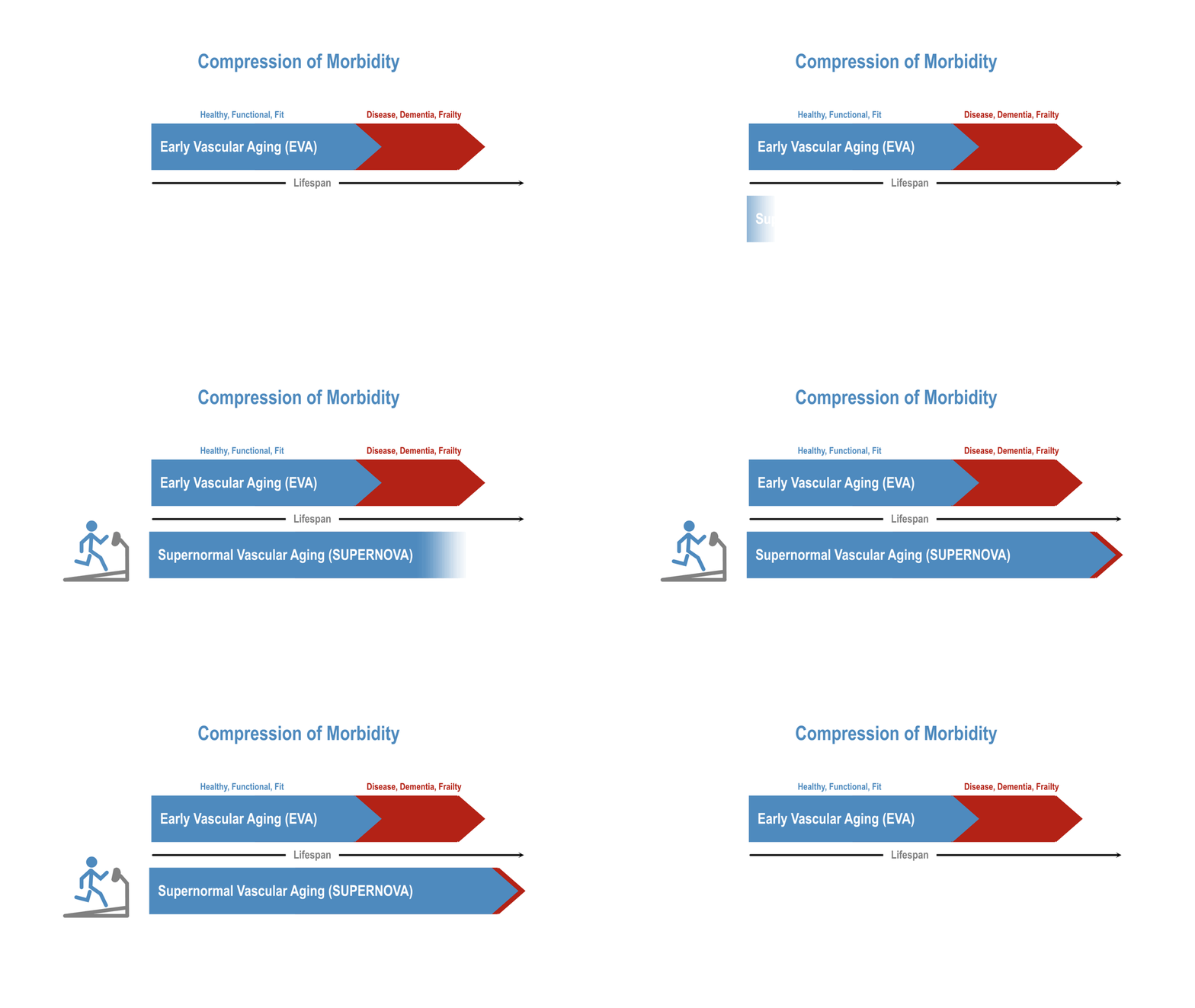
In this episode, I’ll show you five surprising conclusions that we can draw from those studies. Again, I’ll use the FITT components as our guide.
- Frequency: weekend warriors can benefit as much as others [1]
- Intensity: The higher the intensity the larger the effect [2]
- Time: There are time-efficient low-volume exercise configurations [3] [4]
- Type: Strength training can generate vascular benefits too [5]
- The mythical Non-responders to exercise: They don’t exist [6]
Let’s start with Frequency
Frequency — The Weekend Warrior
There is this widely held belief that cramming a week’s load of exercise into one or two days on the weekend will do you more harm than good. Quite the opposite is true:
A 2020 study on 1700 middle-aged to older adults showed two things [1]:
- The more exercise, the lower the pulse wave velocity
- There is no difference between the weekend warriors and the more frequent exercisers
“From the perspective of arterial stiffness, engaging higher intensity physical activity, regardless of the weekly pattern, may be an important strategy to reduce the risk of cardiovascular disease”
Which brings us to the next point.
Intensity — More Pain, More Gain
On first blush, it may sound like an uncomfortable truth: the harder you push yourself, the better the result. A 2014 review of randomized controlled trials concluded that the greater the intensity, the greater the cardiovascular benefits [2].
“All exercise modalities improve endothelial function significantly and there was a significant, positive relationship between aerobic exercise intensity and endothelial function”
The good news is that if you amp up the intensity, you can dial down the duration.
Time — Efficiency
In fact, you can reduce your time commitment to exercise AND get even better results. The magic behind this is called HIIT (High Intensity Interval Training). If you aren’t familiar with the term HIIT, here is what it looks like:
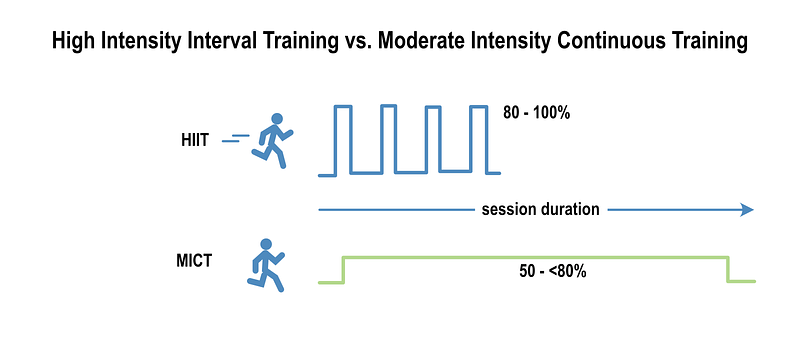
High-intensity intervals alternate with recovery intervals. While there is no uniform definition of HIIT, “high-intensity” means exercising between 85% and 100% of your maximum load
In the lab, we use incremental cycle tests to measure a person’s maximum load. It works like this: we gradually increase the load on the cycle ergometer in a stepwise fashion. Your maximal exercise load is the highest load (expressed in Watts) at which you can maintain a pedalling rate of 60 rounds per minute for one minute flat (but not longer).
In one of my next episodes, I’ll show you how you can approximate your maximum load by testing yourself and how to use this knowledge to pace your exercise.
There is also a more extreme version of HIIT called SIT, or sprint interval training.
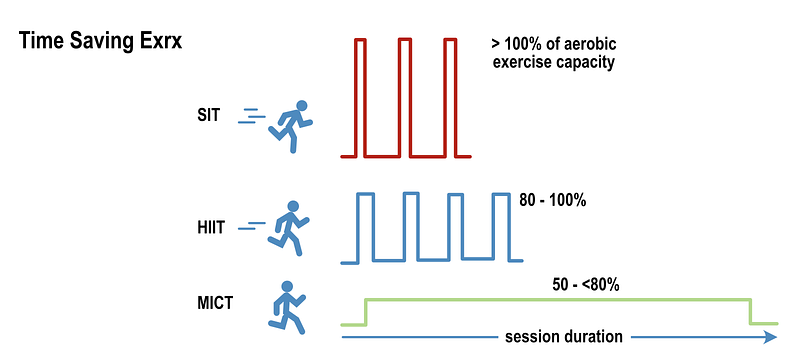
SIT utilizes the fact that you can sustain an intensity higher than 100% for a much shorter period of, say, 15–30 seconds.
Back to the evidence: A 2018 study used 21 young sedentary men to compare the effects of 45-minute moderate-intensity continuous training (MICT) with a 4-minute SIT routine [4]. The men in the MICT group exercised 3 days per week; the HIIT group exercised 4 days per week. So, the weekly exercise volume was more than 2 hours of MICT vs. 16 minutes of SIT.
The results were impressive:
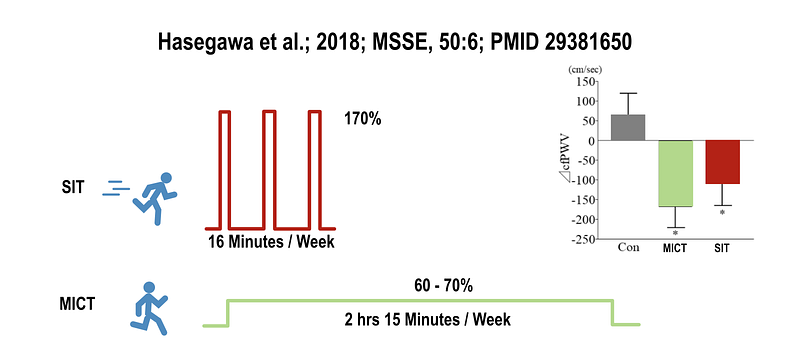
During their seven 20-second sprints, they maxed out intensity at 170%, followed by 10-second recovery phases. Trust me, that’s a brutal 3-and-a-half minutes. The study demonstrated that by notching up intensity, you can realize the same benefits as with continuous exercise, but at a much lower time commitment.
The beauty of HIIT is its versatility.
You can
- Apply it to virtually every aerobic or endurance type of exercise
- design the interval sequences in limitless configurations
As long as the high-intensity intervals get you above the 85% threshold. A good beginner’s configuration could be a 1-minute high-intensity interval at 85–100% of max, followed by a 3-minute recovery interval. A session of three intervals makes for a 12-minute commitment to exercise. At three times per week, your less than one-hour investment may yield the same or a better PWV dividend than the standard recommendation of 2.5 hours of moderate intensity exercise.
Of course, you won’t know until you start your very own “biohacking” self-experiment. Which brings us to the next point:
Type of Exercise–Strength Training
Challenging your muscles is a sine qua non for preventing old-age frailty. But challenging those muscles in the right way might also reduce arterial stiffness. A recent study observed that isometric strength training reduced the augmentation index, another marker of arterial stiffness, in healthy but sedentary men [5].
To summarize, for each of the four FITT components, there are variations that particularly suit time-starved individuals. But probably the most important observation is the following:
The myth of the non-responder
A 2019 paper in the Journal Sports Medicine summarized it as follows:
“…the term “non-responder” should be replaced by “low sensitivity”; … low-sensitivity individuals merely require increased volumes and/or intensity to drive favourable response.” [6].
In other words, if you have “low sensitivity” to some type of exercise, the authors suggest you increase the volume and/or intensity of that exercise. They forgot to tell you about another option: try something else.
By the way, that’s why we have created LiLo. It is your tool to trial-and-error your way to the Champions League of SUPERNOVA.
After knowing that you can out-exercise a not-so-prudent diet, that you can’t rely on replicating study results, and that there are time-efficient ways to exercise your way to stay biologically younger, what do you want to read about next?
How to biohack your way to staying biologically young.
- Accurate — With clinical precision
- Accessible — to everyone with no prior knowledge
- Affordable — at less than a 1-year gym-membership
More about time-efficient, low-volume exercise configurations
- Daily “exercise snacks”
- Inspiratory muscle strength training (IMST)
- Isometric strength training (DIY-suitable at home)
Whether too much exercise can reverse its benefits?
- How to make sense of the conflicting evidence about extreme exercisers
So, tell me, and I’ll cover the most-voted-for subject in the next post.
References
[1] Vandercappellen EJ, Henry RMA, Savelberg HHCM, van der Berg JD, Reesink KD, Schaper NC, et al. Association of the Amount and Pattern of Physical Activity With Arterial Stiffness: The Maastricht Study. J Am Heart Assoc 2020;9. doi:10.1161/JAHA.120.017502.
[2] Ashor A, Lara J, Siervo M, Celis-Morales C, Oggioni C, Jakovljevic D, et al. Exercise Modalities and Endothelial Function: A Systematic Review and Dose–Response Meta-Analysis of Randomized Controlled Trials. Sport Med 2014:1–18. doi:10.1007/s40279–014–0272–9.
[3] Craighead DH, Heinbockel TC, Hamilton MN, Bailey EF, MacDonald MJ, Gibala MJ, et al. Time-efficient physical training for enhancing cardiovascular function in midlife and older adults: Promise and current research gaps. J Appl Physiol 2019;127:1427–40. doi:10.1152/japplphysiol.00381.2019.
[4] Hasegawa N, Fujie S, Horii N, Miyamoto-Mikami E, Tsuji K, Uchida M, et al. Effects of Different Exercise Modes on Arterial Stiffness and Nitric Oxide Synthesis. Med Sci Sports Exerc 2018;50:1177–85. doi:10.1249/MSS.0000000000001567.
[5] Edwards JJ, Jalaludeen N, Sharma R, Driscoll JMO, Wiles JD. The effect of isometric exercise training on arterial stiffness : A randomized crossover controlled study 2023:1–8. doi:10.14814/phy2.15690.
[6] Pickering C, Kiely J. Do Non-Responders to Exercise Exist — and If So, What Should We Do About Them? Sport Med 2019;49:1–7. doi:10.1007/s40279–018–01041–1.


