
Ukraine War
Ukraine’s Ex-Soviet Air Defence Systems Have Worked Well
Apparently successful and feared by Russian aircraft, the range of Ukraine’s largely Soviet-designed equipment is vast
This article covers the makeup of Ukraine’s air defence systems including its Soviet era weapons. It does not cover command and control systems, wide area radar or satellite intelligence feeds.
To keep this story from turning into a book it does not include those air defence systems recently supplied by NATO countries — I’ll cover those in a later story.
Contents
What did Ukraine have at the start of the war?
Man portable air defence missiles
Self-propelled anti-aircraft guns
Destroyed and captured systems
Introduction
Unsustainable Russian aircraft losses
I’ve written a couple of stories about the fact that Russia now appears to be keeping its aircraft well away from Ukrainian anti-aircraft defences.
In one of the stories I plotted the weekly Russian aircraft losses as claimed by Ukraine as of June 6, 2022. This is how it looks now, 221 aircraft claimed excluding rotary wing (helos) and UAVs:
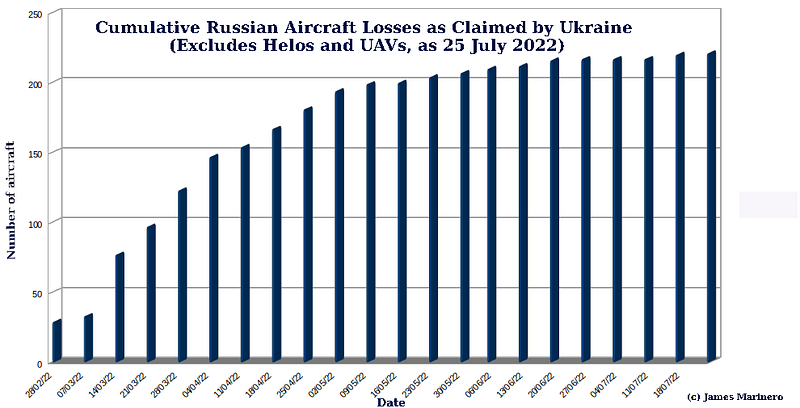
Since I first analysed the numbers, almost 8 weeks ago, Ukraine has claimed just another 9 aircraft, 222 in total as of today, 27 July 2022. What the exact numbers are is largely irrelevant. It’s the shape of the curve that interests me and I have no reason to believe that is being massaged.
If anything, you’d expect Ukraine to overclaim (there are arguments against that but I won’t go into them here).
Russian aircraft have backed off
The numbers show that Russian aircraft have backed off, at least in Ukraine’s airspace. I think that most commentators would agree that Russia was losing an unsustainable number of aircraft in the first few weeks of the war.
I would guess (reasonably, but I’m in an amateur armchair) that there was aerial parity when it came to aerial combat capability but with the Ukraine pilots having a higher degree of motivation.
But I would argue that it was the anti-aircraft defences of Ukraine —gunnery systems and missiles — that broke the back of Russian piloted aerial commitment. The missiles were ex-Soviet era, upgraded by Ukraine — they didn’t want IFF protecting the Russian aircraft. Ukraine has other AA defensive weapons, including towed and self-propelled anti-aircraft guns. Some of them are highly effective.
Air-to-air and ground-to-air, the air defence systems’ success pressured the Russians to back off.
Since late May 2022 Russia has, broadly, only been using aircraft to launch stand-off cruise and aero-ballistic missiles from a safe distance — like over the Caspian Sea or Belarus and not go anywhere near Ukraine airspace. The use of land attack cruise missiles (LACM) launched from other platforms — even submarines — has increased.
Surface-launched ballistic missiles such as the 9K720 Iskander have been used widely by Russia in the conflict.
Ukraine’s aerial defences are now focused on surface-to-air weapons to attack Russian missiles as the planes are staying away. I have no figures for Ukraine’s use of air-to-air systems to attack Russian cruise and ballistic missiles, other than rough estimates. Generally the systems are seen as successful — I’ve read numbers ‘4 out of 6’ and ‘6 out 8’ Russian missiles of various types being hit at various times.
What I’ll cover now is Ukraine’s ground-to-air defences. Disclaimer: I’m just an amateur in an armchair (on a boat actually).
What did Ukraine have at the start of the war?
Before the war (which actually started in 2014), Ukraine had a large inventory of air defence systems. The additional equipment that NATO and other countries have provided is in a separate section.
As I wrote earlier, these were ex-Soviet gunnery systems and missiles, some updated. Ukraine has the capacity to build its own missiles, largely based on ex-Soviet designs. Well, why not, they worked well? Just update them.
The ongoing war in eastern Ukraine since the Russian annexation in 2014 has eaten into missile stocks and I have no information about Ukraine’s missile manufacturing capacity. The Russians have targeted missile factories — for example the plant which produced the Neptune anti-ship missile was attacked shortly after a couple of them sank the Moskva, flagship of the Russian Black Sea Fleet.
Man portable air defence missiles
There was a huge number of these in Ukraine’s stockpile and the range of weapons is extensive. I have not gone into great detail, but they are all ex-Soviet era. Many of them are unreliable (Germany offered to supply 2,700 Kh-32 Strela-2 manpads, but 700 of them were found to be unusable).
In all, Ukraine has several thousand available before the conflict, but bear in mind that the older missiles have kill ratios of 5% on a good day against modern aircraft.
Briefly, they are:
9K32 Strela-2 (NATO: SA-7 Grail): First generation, old, unreliable and poor performance. IR homing.
9K34 Strela-3: (NATO SA-14 Gremlin): Much improved version of the Strela 2. IR Homing. Nitrogen-cooled IR sensor.
9K38 Igla (NATO reporting name SA-18 Grouse). Igla means ‘needle’ so called because of the needle-like projection from the nose, designed to modify the shock wave.
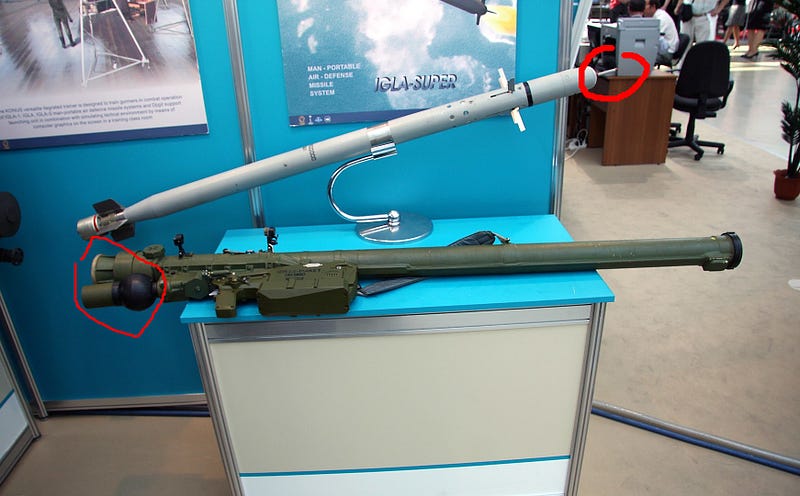
The Igla was a major step forward in technology using the 9M39 missile with terminal manoeuvring and a more lethal warhead, but still using infrared homing. It was the first Russian manpad to use the rolling airframe concept. A kill ratio of 24% against aircraft with ECM has been claimed.
That’s what Ukraine had in terms of ex-Soviet manpads at the outset of this war.
Towed anti-aircraft guns
Ukraine has 400 of the old AZP-S60 single-barreled weapons, but these are in storage according to Wikipedia.
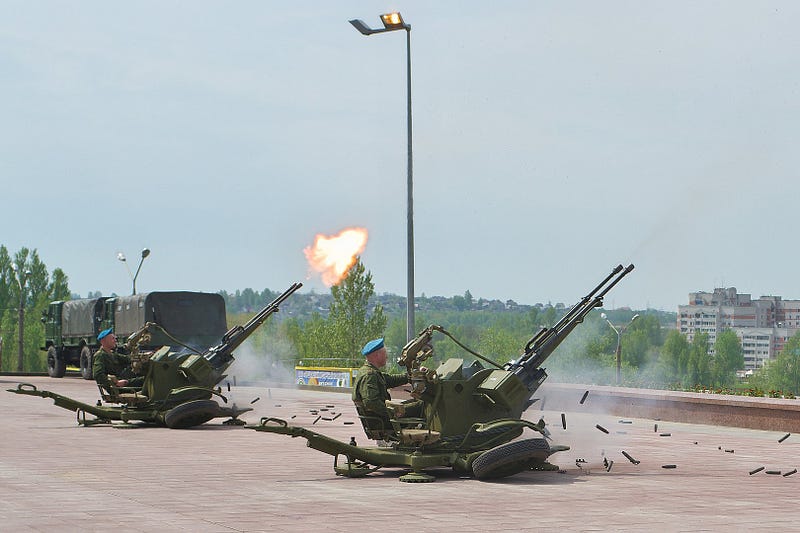
However, it has more than 1000 of the ZU-23–2 , a 23×152mm towed anti-aircraft twin-barreled autocannon.
Self-propelled anti-aircraft guns
ZSU-23–4
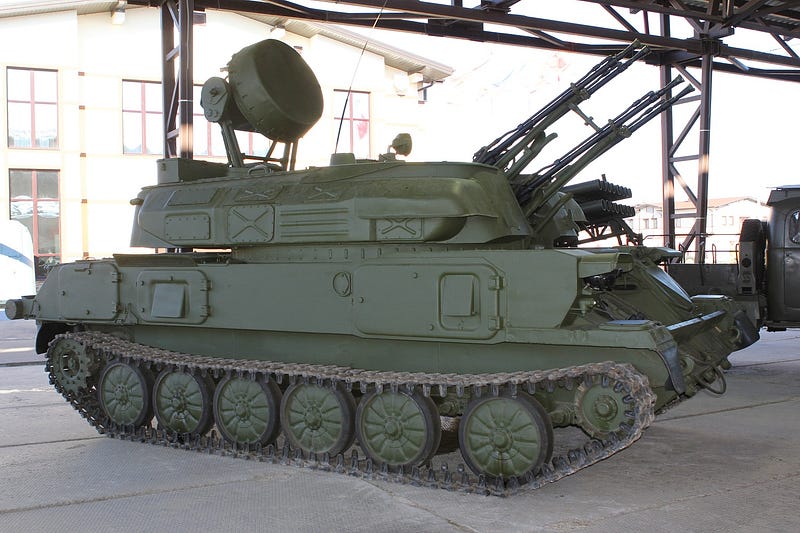
Apart from the fact that the ZSU-23–4 is tracked and four-barrelled (23 mm), the most obvious feature is that it is radar controlled. It carries 2000 rounds of ammunition and dates from the 1960s but is a highly effective weapon:
The ZSU-23–4 outclassed all NATO anti-aircraft guns at the time, and it is still regarded as posing a major threat for low-flying fixed-wing aircraft and helicopters. — Wikipedia
Its shortcomings are its short range and lack of an early-warning system. That lead to development of the 2K22 Tunguska.
Ukraine’s inventory of these is (was) 300.
Air defence missile systems
9K35 Strela-10 (NATO SA-13 Gopher)
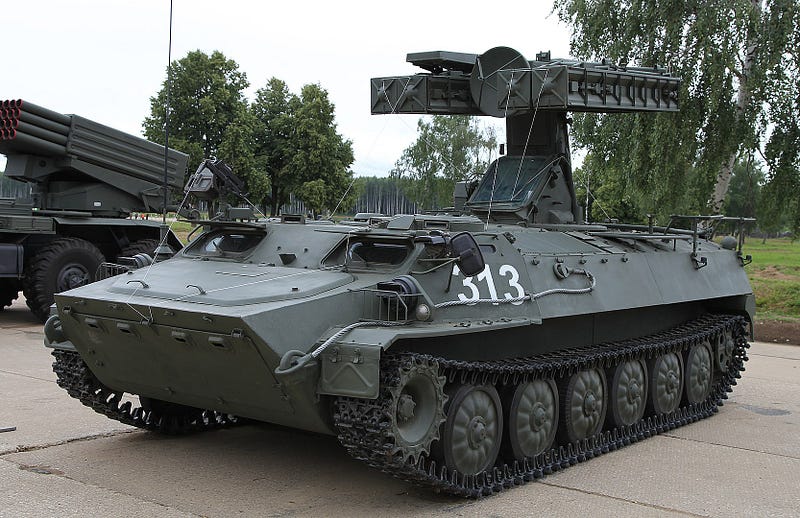
The 9K35 Strela-10 is a high mobility, short-range surface-to-air missile TELAR (transport erector launcher) system. Visually aimed it utilises optical/ infrared-guidance (night). It provides defence against low-altitude threats such as helicopters. Optical daytime guidance means that its missiles are almost impervious to ECM — IR can be jammed.
Ukraine’s defence force inventory is/was 75. The Czech Republic has supplied additional units (quantity not disclosed).
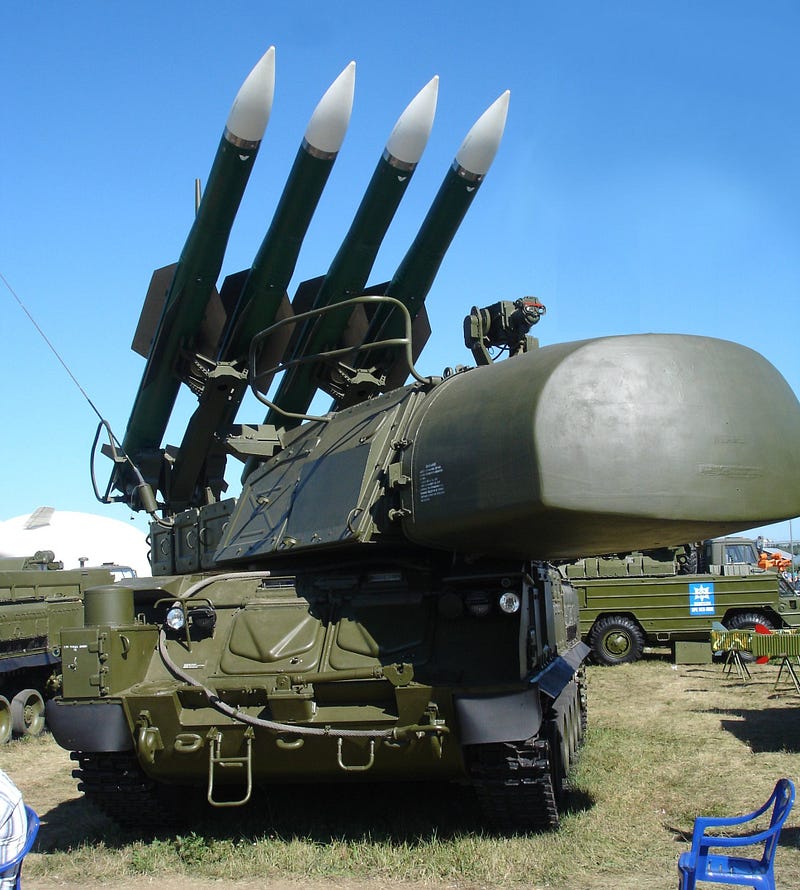
9K37 Buk (NATO: SA-17 Grizzly)
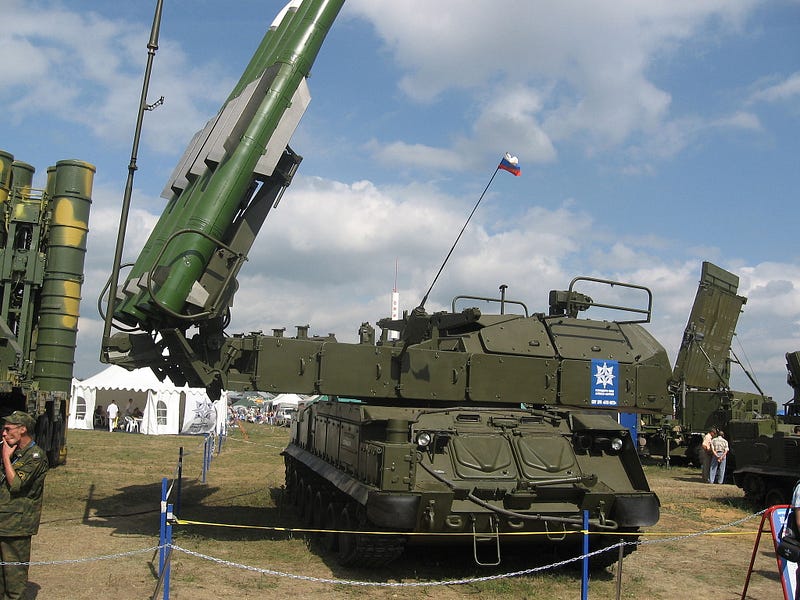
The Buk is a large family of self-propelled, medium-range surface-to-air missile systems originally developed by the Soviet Union. Design work started in 1972 with a brief to counter cruise missiles, smart bombs, fixed wing and rotary-wing aircraft, and unmanned aerial vehicles.
A Buk battalion comprises a command vehicle, target acquisition radar (TAR) vehicle, six transporter erector launcher and radar (TELAR) vehicles and three transporter erector launcher (TEL) vehicles. A Buk missile battery consists of two TELAR and one TEL vehicle. — Wikipedia
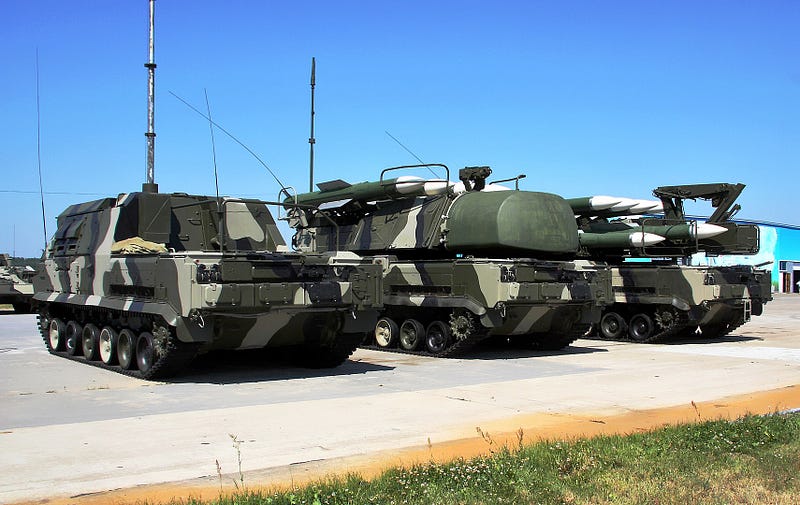
This is a very capable system with high kill probabilities for each missile, and can engage aircraft at over 40 km range (altitude dependent) but it does have shortcoming which have caused major problems.
This missile system is believed to be responsible for the destruction of Malaysian Airline flight MH17 over eastern Ukraine in July 2014 by Russia-aligned Ukrainian separatists. Part of the ‘problem’ with this system is that it has a non-cooperative threat classification system. This process relies on skilled human analysis of returned radar signals to identify and clearly distinguish civilian aircraft from potential military targets in the absence of IFF — it is not tied into national radar networks. The Daily Beast has good analysis of the circumstance that catastrophe.
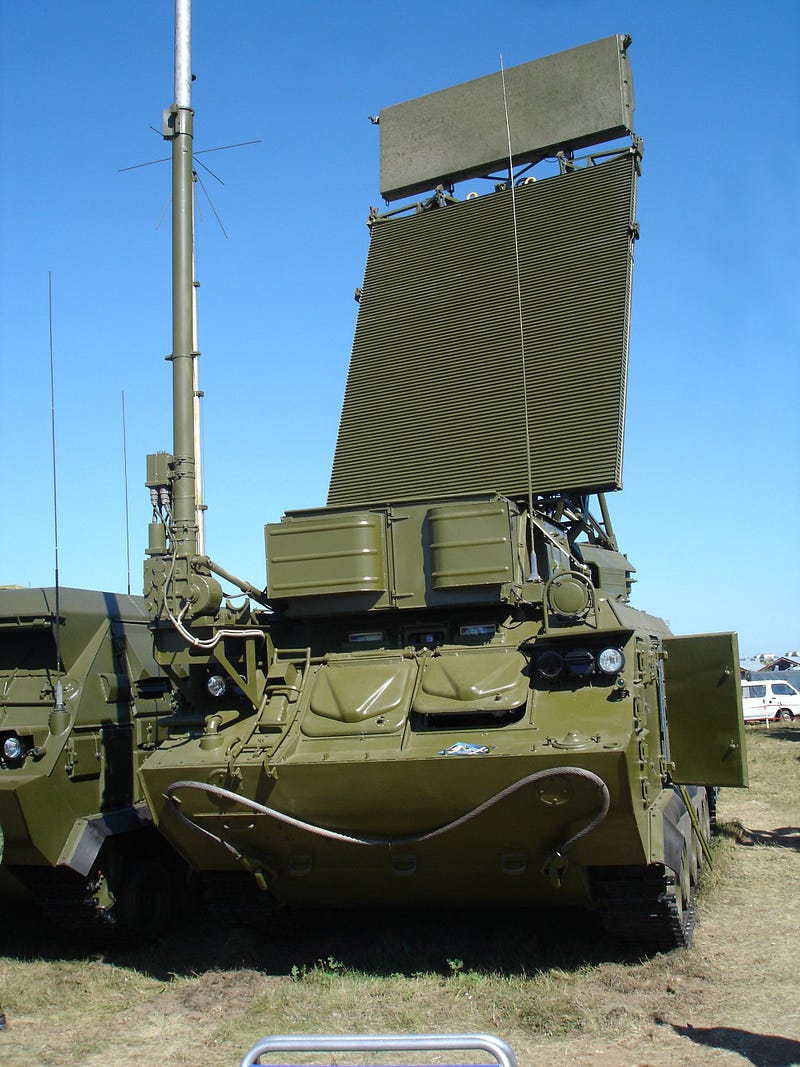
Ukraine had 72 of the 9K37M1 as of 2016 (Wikipedia). It has also built copies, number unknown.
2K22 Tunguska (NATO: SA-19 Grison)
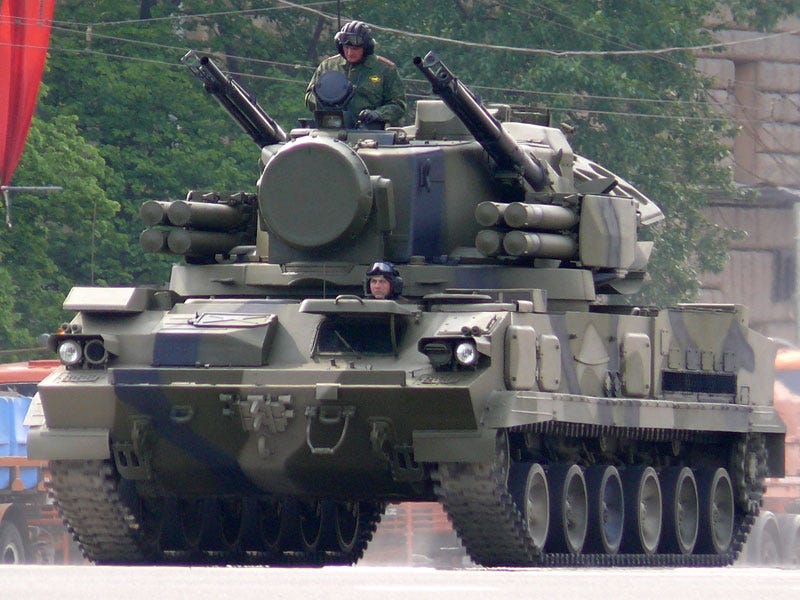
The 2K22 Tunguska is a Soviet era tracked, self-propelled anti-aircraft weapon armed with an onboard radar-directed surface-to-air gun and missile system. It was designed to provide all-weather 24 hour protection for infantry and tank regiments against low-flying aircraft, helicopters, and cruise missiles, particularly the US A10 Thunderbolt which was resistant to 23mm cannon fire. With 30mm shells and a less than 10 second engagement time for short range targets, and the 9M31 missile for long range engagement, it offers comprehensive aerial protection for formations of armour.
Ukraine had 70 of the 2S6 variant as of 2012, according to Military Balance 2012. At least one captured Tunguska-M1 is operational in Ukrainian service.
9K33 Osa ( NATO: SA-8 Gecko)
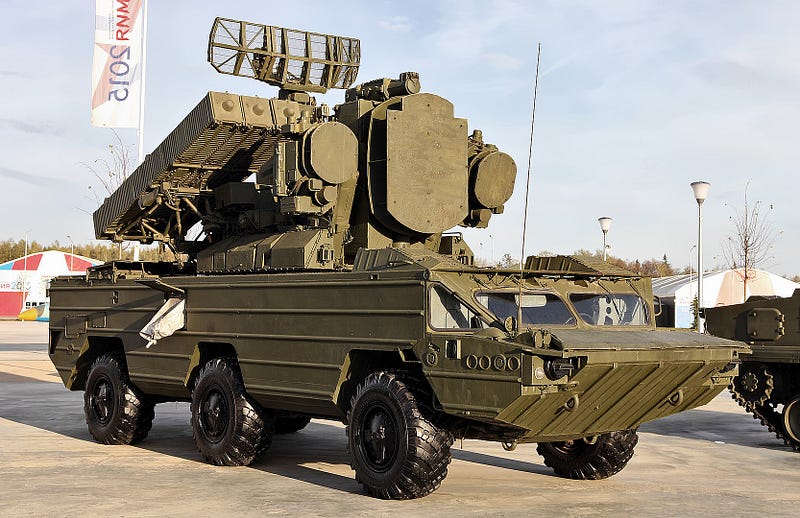
The SA-8 entered service in 1971 and was the first mobile air defense missile system incorporating its own engagement radars on a single vehicle. All variants comprise an all-in-one transporter erector launcher and radar (TELAR) which can detect, track and engage aircraft independently or with the aid of regimental surveillance radars. The 6x6 transport vehicles are fully amphibious and air transportable. The road range is about 500 km.
Each TELAR is able to launch and guide two missiles against one target simultaneously. Kill probability is quoted as 0.55–0.85 for the Osa-AK. The 9M33M3 missiles have a maximum practical range of 9 miles.
Ukraine had 125 units of the AK variant plus two captured as of June 2022.
S-125 Neva (NATO: SA-3 Goa/Pechora)
Another old system dating back to 1961, it looks like something from the Stalin era. It has a shorter effective range and lower engagement altitude than either its predecessors (S-25, S-75) and also flies slower. Due to its two-stage design it is more effective against more maneuverable and lower flying targets It is much more resistant to ECM than the S-75. The 5V24 (V-600) missiles reach around Mach 3 to 3.5 in flight, both stages powered by solid fuel rocket motors.
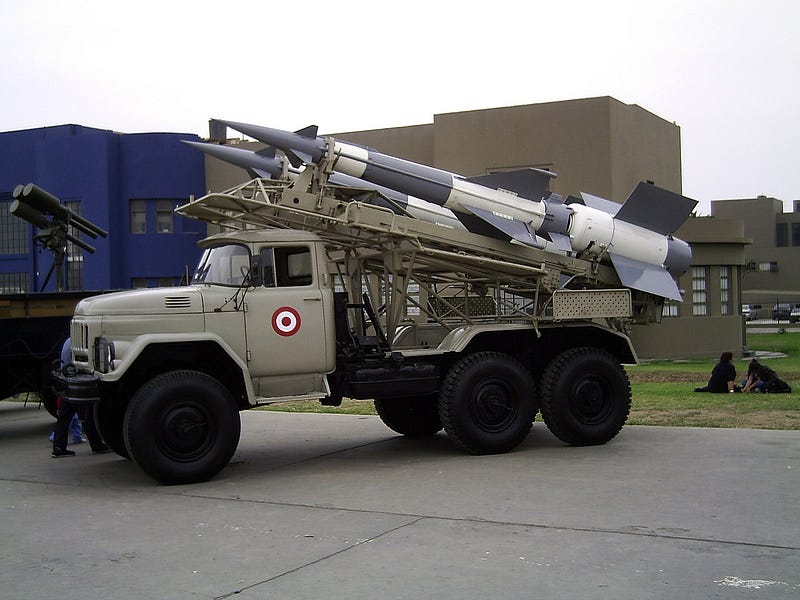
The minimum range is 3.5 km, and the maximum is 35 km (with the Pechora 2A). The intercept altitudes are between 100 m and 18 km — Janes.com via Wikipedia
It was the earlier S-75 that was used to shoot down Major Rudolf Anderson in a U2 over Cuba during the Cuban Missile Crisis. I saw the missile parts and plane wreckage in the Museum of the Revolution in Havana when I visited in 2017. Sobering stuff.
Ukraine’s inventory was 8.
9K330 Tor (NATO: SA-15 Gauntlet)
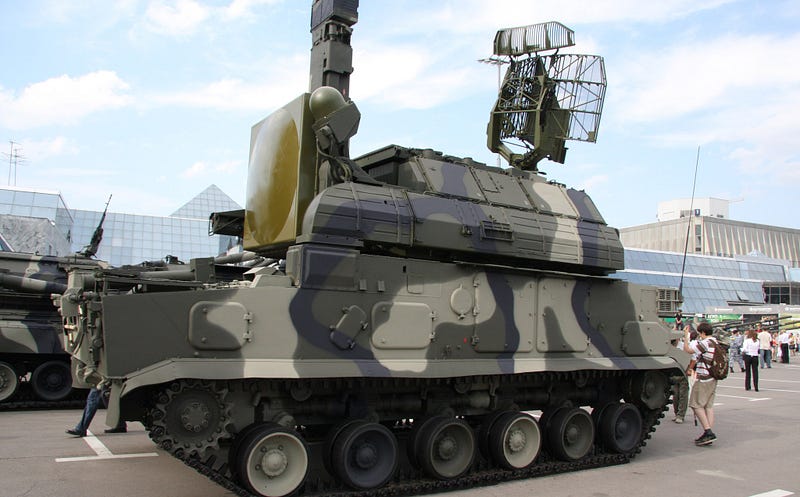
Designed as an all-weather short-range surface-to-air missile system designed for destroying airplanes, helicopters, cruise missiles, unmanned aerial vehicles and short-range ballistic threats (anti-munitions), it came into service in 1986.
It carries 8 ready-to-fire 9M330 family missiles in 2 x 4 round magazines and can track targets when moving but has to stop to fire. The maximum altitude is 6 km and the maximum range is 12 to 15 km depending on missile type. Missiles are highly agile and multiple guidance systems are used.
The Ukraine inventory included at least 6 operational with 100 claimed to be in storage.
S-300PT/PMU (NATO: SA-10/D/E Grumble)
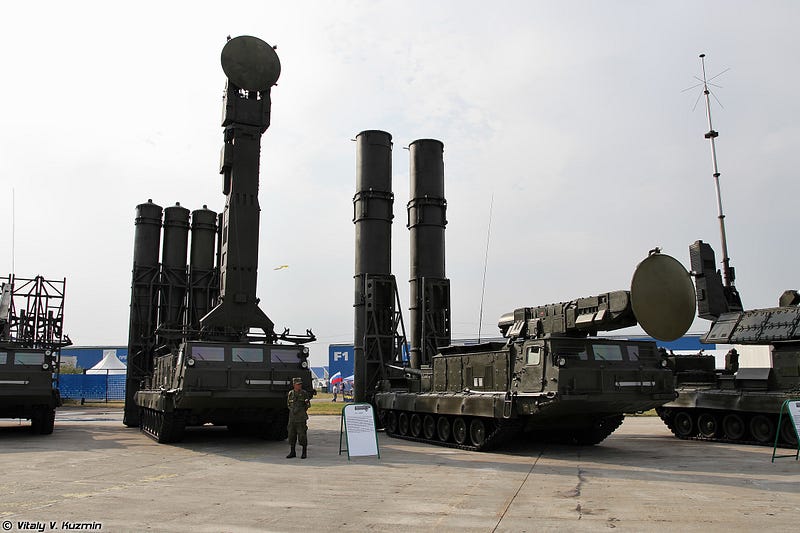
The S-300 is a family of Soviet-era long range surface-to-air missile systems. It was developed to defend against air raids and cruise missiles but later variants were also developed to be able to intercept ballistic missiles. First deployed by the Soviet Union in 1979, the design objective was the air defence of large industrial and administrative facilities, military bases as well as control of airspace against enemy strike aircraft.
The S-300P series as used by Ukraine saw the introduction of the TEL and mobile radar and command-post vehicles, This model also featured the new 5V55R missiles which increased the maximum engagement range to 90 km and introduced a terminal semi-active radar homing (SARH) guidance mode.
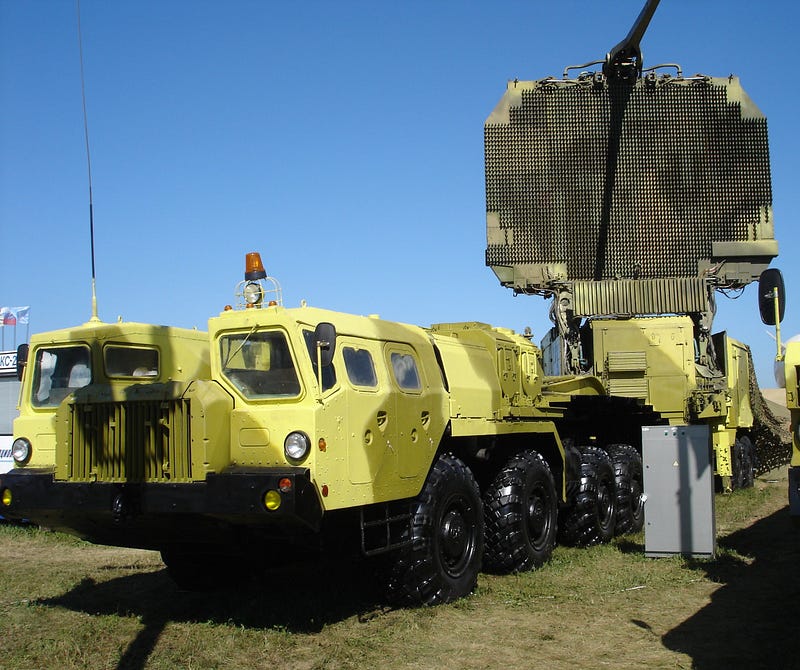
The system is fully automated, though manual observation and operation are also possible. Components may be near the central command post, or as distant as 40 km. Each radar provides target designation for the central command post.
The S-300 is considered to be one of the most potent anti-aircraft missile systems currently fielded anywhere and provides area defence for Moscow. It is used by some NATO members including Greece and Bulgaria.
Ukraine’s inventory included several variants: S-300PT, S-300PS, S-300PMU, S-300V1. Only six systems were kept in working conditions between 2004 and 2014; as a result, only 40% of Ukrainian S-300 systems were in good condition prior to 2014. Due to the war with Russia, Ukraine started repairing and pushing back to service several armaments, including several S-300 batteries, with at least 4 batteries overhauled in the period of 2014–15. 34 launchers remained in Crimea after the 2014 Russian annexation of Crimea. Prior to the 2022 Russian invasion of Ukraine, the country had around 100 batteries. It received an additional battery from Slovakia in April 2022. (Wikipedia).
Destroyed and captured systems
Ukraine has undoubtedly lost some of their air defence systems during the war. Oryx lists 43 SAM as destroyed or captured by Russian forces. Numbers may not be up to date; also Oryx only lists verifiable items (usually date- and/or geo-stamped images or videos).
Ukraine has also captured several systems. For example Wikipedia reports 5 ZU-23–2 captured and Oryx reports several other captures including 21 surface-to-air missile systems (Oryx numbers may be out of date).
The future
If the war is protracted much longer and Russia can access the sufficient numbers of components to build large numbers of Kinzhal aero-ballistic hypersonic missiles then the picture may well change.
So far, Russia has used them very sparsely, but they are almost impossible to intercept with the air defence weapons currently available to Ukraine.
The ability of NATO’s leading air defence systems to intercept hypersonic aero-ballistic missiles is largely unknown. And against hypersonic glide missiles? That’s a key question.
Conclusions
For me, the key conclusion is that the Ukrainian ex-Soviet air defence systems have worked really well against Russian air forces, after necessary modification by Ukrainian engineers.
The new systems now arriving from NATO and other countries (some are already operational) will help bolster Ukraine’s defences against Russia’s hail of cruise and ballistic missiles, the stocks of which must surely be running down.
I will take a detailed look at these NATO systems such as the British Stormer/Starstreak, US/Norwegian NASAMS, Germany’s IRIS-T and others in an upcoming story.
About me: If you follow me I guarantee variety in your inbox with some peculiar perspectives! I write on a wide range of topics including humor, tech, space, geopolitics and travel, together with daily news events and the minutiae of my daily life living on a boat. Yes, I really do live on a boat (some readers don’t believe that). I also write about…
…where our tax dollars go
If you appreciate stories like these and want to support other writers and me, consider signing up to become a Medium member. It’s only $5 a month, giving you unlimited access to incredible stories on Medium. If you sign up using my link below, I’ll earn a small commission at no extra cost to you.
Or maybe just buy me a coffee?


