avatarFabio Chiusano

Free AI web copilot to create summaries, insights and extended knowledge, download it at here

2475

Abstract

s, where many recent advanced deep learning techniques are integrated.</p><figure id="62a7"><img src="https://cdn-images-1.readmedium.com/v2/resize:fit:800/1*wocleouLiXZF4o8pdPtc1w.png"><figcaption>Categorization of research on knowledge graphs. Image from <a href="https://arxiv.org/pdf/2002.00388.pdf">https://arxiv.org/pdf/2002.00388.pdf</a></figcaption></figure><h2 id="ccfd">Knowledge Representation Learning (KRL)</h2><p id="b676"><a href="https://arxiv.org/abs/1812.10901">KRL</a> consists of the mapping of entities and relations into low-dimensional vectors while capturing their semantic meanings. It’s a critical research issue of knowledge graph which paves the way for many knowledge acquisition tasks and downstream applications.</p><p id="a697">KRL deals with:</p><ul><li><i>Representation spaces</i> in which the relations and entities are represented;</li><li><i>Scoring functions</i> for measuring the plausibility of factual triples;</li><li><i>Encoding models</i> (usually based on deep learning) for representing and learning relationships;</li><li><i>Auxiliary information</i> to be incorporated into the embedding methods, like properties of entities of relationships.</li></ul><h2 id="2b5e">Knowledge Acquisition</h2><p id="f1f0">Knowledge Acquisition deals with the creation of new entities and relations in the knowledge graph. Knowledge acquisition tasks include:</p><ul><li><a href="https://paperswithcode.com/task/knowledge-graph-completion"><i>Knowledge Graph Completion</i></a><i>: </i>inferring new entities and edges in knowledge graphs.</li><li><a href="https://en.wikipedia.org/wiki/Named-entity_recognition"><i>Entity Recognition</i></a><i>: </i>extracting new knowledge graph entities from the text.</li><li><a href="https://en.wikipedia.org/wiki/Relationship_extraction"><i>Relation Extraction</i></a><i>: </i>extracting new knowledge graph factual triplets from the text.</li></ul><h2 id="15db">Temporal Knowledge Graphs</h2><p id="83a6">Current knowledge graph research mostly focuses on static knowledge graphs where facts don’t change with time, while the temporal dynamics of a knowledge graph are less explored. However, temporal information is of great importance because the structured knowledge is true only within a specific period, and the evolution of facts follows a time sequence.</p><p id="0795">Recent research begins to take temporal information into knowledge representation learning and knowledge graph completion, whi

Options

ch is termed as <i>temporal knowledge graph</i> in contrast to the previous static knowledge graph.</p><p id="c361">Thank you for reading! If you are interested in learning more about NLP, remember to follow NLPlanet on <a href="https://medium.com/nlplanet">Medium</a>, <a href="https://www.linkedin.com/company/nlplanet">LinkedIn</a>, and <a href="https://twitter.com/nlplanet_">Twitter</a>!</p><p id="23d0"><b>Two minutes NLP related posts</b></p><div id="267a" class="link-block"> <a href="https://readmedium.com/two-minutes-nlp-how-the-deepmind-retro-model-decouples-reasoning-and-memorization-b393b6a8d07c"> <div> <div> <h2>Two minutes NLP — How the DeepMind RETRO model decouples reasoning and memorization</h2> <div><h3>Language Models, Retrieval Databases, GPT-3, Jurassic-1, and the Pile</h3></div> <div><p>medium.com</p></div> </div> <div> <div style="background-image: url(https://miro.readmedium.com/v2/resize:fit:320/0*eIGzMOECjyjo7eCb)"></div> </div> </div> </a> </div><div id="d4d1" class="link-block"> <a href="https://readmedium.com/two-minutes-nlp-relation-extraction-with-opennre-d22660efd1fd"> <div> <div> <h2>Two minutes NLP — Relation Extraction with OpenNRE</h2> <div><h3>Relation Extraction, Knowledge Graphs, Entities, and OpenNRE</h3></div> <div><p>medium.com</p></div> </div> <div> <div style="background-image: url(https://miro.readmedium.com/v2/resize:fit:320/0*pV1-8AyvZnT3Cj-g)"></div> </div> </div> </a> </div><div id="566c" class="link-block"> <a href="https://readmedium.com/two-minutes-nlp-easy-document-annotation-with-wikipedia-concepts-ad4e6cbbb204"> <div> <div> <h2>Two minutes NLP — Easy document annotation with Wikipedia concepts</h2> <div><h3>Semantic annotations, Wikification, Ontologies, and PageRank</h3></div> <div><p>medium.com</p></div> </div> <div> <div style="background-image: url(https://miro.readmedium.com/v2/resize:fit:320/1*F3ZriRJeavN64pN40o7zOg.png)"></div> </div> </div> </a> </div></article></body>

Two minutes NLP — A simple taxonomy of Knowledge Graph research

Knowledge Representation Learning, Knowledge Acquisition, and Temporal Knowledge Graphs
Photo by Nastya Dulhiier on Unsplash

This article is an excerpt of the paper A Survey on Knowledge Graphs: Representation, Acquisition and Applications.

Knowledge Graphs

A knowledge graph is a structured representation of facts, consisting of entities, relationships, and semantic descriptions. Entities can be real-world objects and abstract concepts, while relationships represent the relation between entities. It’s common for entities and relations to have properties or attributes.
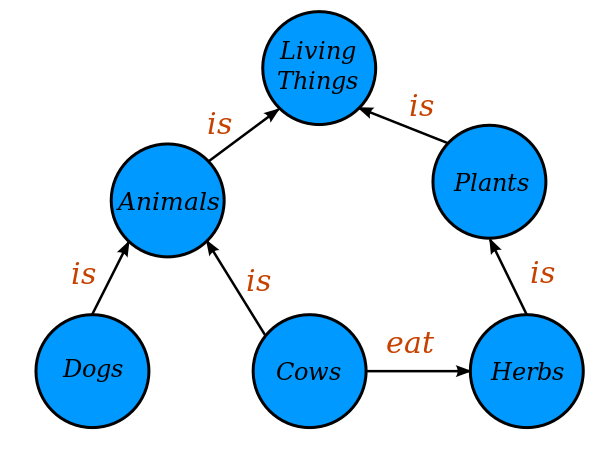
Example knowledge graph. Image from https://en.wikipedia.org/wiki/Knowledge_graph.

Knowledge Graph vs Knowledge Base

The term of knowledge graph is synonymous with knowledge base with a minor difference. A knowledge graph can be viewed as a graph when considering its graph structure. A knowledge graph can be taken as a knowledge base when interpretation and inference over facts are the goals.
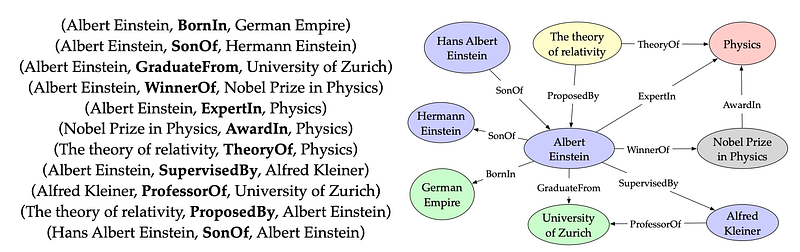
On the left, factual triplets in a knowledge base. On the right, entities and relations in a knowledge graph. Image from https://arxiv.org/pdf/2002.00388.pdf

Current research in Knowledge Graphs

Recent advances in knowledge-graph-based research focus on knowledge representation learning, knowledge acquisition, temporal knowledge graphs, and a wide range of downstream knowledge-aware applications, where many recent advanced deep learning techniques are integrated.
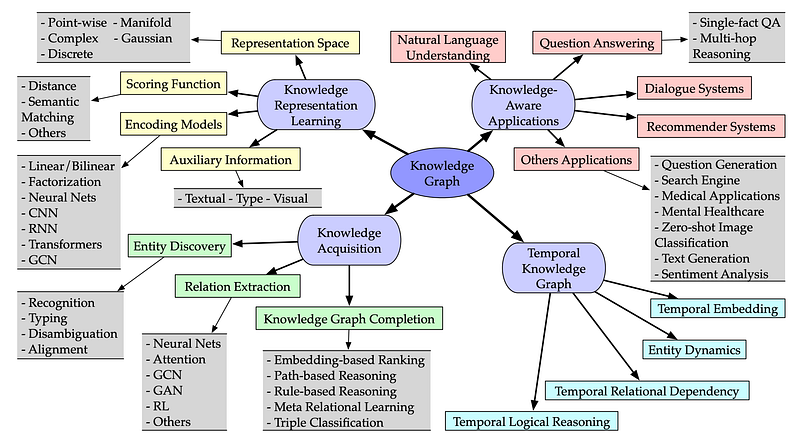
Categorization of research on knowledge graphs. Image from https://arxiv.org/pdf/2002.00388.pdf

Knowledge Representation Learning (KRL)

KRL consists of the mapping of entities and relations into low-dimensional vectors while capturing their semantic meanings. It’s a critical research issue of knowledge graph which paves the way for many knowledge acquisition tasks and downstream applications.

KRL deals with:

  • Representation spaces in which the relations and entities are represented;
  • Scoring functions for measuring the plausibility of factual triples;
  • Encoding models (usually based on deep learning) for representing and learning relationships;
  • Auxiliary information to be incorporated into the embedding methods, like properties of entities of relationships.

Knowledge Acquisition

Knowledge Acquisition deals with the creation of new entities and relations in the knowledge graph. Knowledge acquisition tasks include:

Temporal Knowledge Graphs

Current knowledge graph research mostly focuses on static knowledge graphs where facts don’t change with time, while the temporal dynamics of a knowledge graph are less explored. However, temporal information is of great importance because the structured knowledge is true only within a specific period, and the evolution of facts follows a time sequence.

Recent research begins to take temporal information into knowledge representation learning and knowledge graph completion, which is termed as temporal knowledge graph in contrast to the previous static knowledge graph.

Thank you for reading! If you are interested in learning more about NLP, remember to follow NLPlanet on Medium, LinkedIn, and Twitter!

Two minutes NLP related posts

NLP
Naturallanguageprocessing
AI
Artificial Intelligence
Data Science
Recommended from ReadMedium