TV Was About the World. The Internet Is About the Individual.
How different media environments create different societies
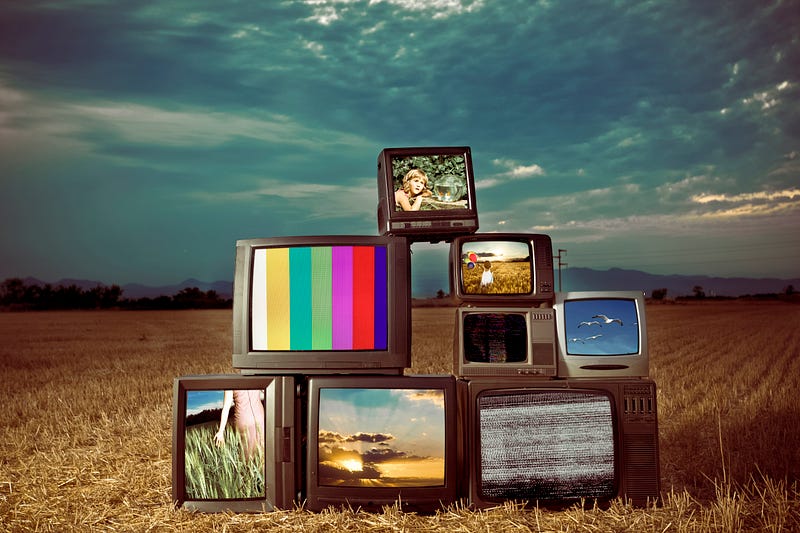
All media environments have better and worse things about them. Television helped us think of the planet as one big organism, but also promoted consumerism and neoliberalism. The internet helps decentralize power and thought leadership, but also atomizes and isolates us from one another. Neither environment is necessarily better, but each new one requires a different response.
The hardest part of learning to respond to a new medium is being able to see its effects in their own right, rather than through the lens of the prior era. When the internet emerged, most of us were living under the influence of the television media environment. The TV era was about globalism, international cooperation, and the open society. Television let people see for the first time what was happening in other places, often broadcast live, just as it happened. The whole world witnessed the same wars, floods, and revolutions together, in real time. Even 9/11 was a simultaneously experienced global event, leading to almost universally expressed empathy. Television connected us as a planet.
As if invented to continue this trend, the internet was supposed to break down those last boundaries between what are essentially synthetic nation-states and herald a new, humanistic, global community of peers. National governments were declared extinct, and a new self-organizing network of humans was on the way. Yet the internet age has actually heralded the opposite result. We are not advancing toward some new, totally inclusive global society, but retreating back to nativism. Instead of celebrating more racial intermingling, we find many yearning for a fictional past when — people like to think — our races were distinct, and all was well.
At the height of the television media era, an American president could broadcast a speech in front of the Brandenburg Gate in Berlin and demand that Russia “tear down this wall.” No more. Politicians of the digital media environment pull out of global trade blocs, and demand the construction of walls to enforce their countries’ borders.
This is very different from the television environment, which engendered a “big blue marble” melting pot, hands-across-the- world, International Space Station, cooperative internationalism that still characterizes our interpretations of geopolitics. Those of us flummoxed by the resurgence of nationalist, regressively anti-global sentiments are mistakenly interpreting politics through that now-obsolete television screen.
The first protests of the digital media landscape, such as those against the World Trade Organization in Seattle, made no sense to the TV news. They seemed to be an incoherent amalgamation of disparate causes: environmentalists, labor activists, even anti-Zionists. What unified them, however — more than their ability to organize collectively on the internet — was their shared anti-globalism. The protesters had come to believe that the only entities capable of acting on the global level were ones too big for human beings to control.
The breakdown of European cohesion extends this sentiment. The European Union was a product of the television environment: open trade, one currency, free flow of people across boundaries, and the reduction of national identities to cuisine and soccer teams. The transition to a digital media environment is making people less tolerant of this dissolution of boundaries. Am I Croatian or Serbian? Kurd or Sunni? Greek or European? The yearning for boundaries emerges from a digital media environment that emphasizes distinction. Everything is discrete. Analog media such as radio and television were continuous, like the sound on a vinyl record. Digital media, by contrast, are made up of many discrete samples. Likewise, digital networks break up our messages into tiny packets and reassemble them on the other end. Computer programs all boil down to a series of 1s and 0s, on or off. This logic trickles up to the platforms and apps we use. Everything is a choice — from font size to the place on a “snap-to” grid. It’s either 12-point or 13-point, positioned here or there. Did you send the email or not? There are no in-betweens.
A society functioning on these platforms tends toward similarly discrete formulations. Like or unlike? Black or white? Rich or poor? Agree or disagree? In a self-reinforcing feedback loop, each choice we make is noticed and acted upon by the algorithms personalizing our news feeds, further isolating each one of us in our own ideological filter bubble. The internet reinforces its core element: the binary. It makes us take sides.
This is section 40 of the new book Team Human by Douglas Rushkoff, which is being serialized weekly on Medium. Read the previous section here and the following section here.