It’s Undeniable: The Internet Has a Nationalist Problem
If we’re going to promote connection, we’ll have to recognize the biases of the digital media environment

Digital media pushes us apart, but it also seems to push us backward. Something about this landscape has encouraged the regressive sentiments of the populist, nationalist, and nativist movements characterizing our time. These sentiments grow in an ecosystem fed by the other main bias of digital media: memory. Memory is what computers were invented for in the first place. In 1945, when Vannevar Bush imagined the “memex,” on which computers were based, he described it as a digital filing cabinet — an external memory. And even though computers can now accomplish much more than data retrieval, everything they do — all of their functions — simply involves moving things from one part of their memory to another. Computer chips, USB sticks, and cloud servers are all just kinds of memory.
Meanwhile, unnerving revelations about cybersecurity and surveillance continually remind us that everything we do online is stored in memory. Whatever you said or did on your favorite social network or search engine is in an archive, timeline, or server somewhere, waiting to be retrieved by someone, someday. The unchecked exaltation of memory in a digital media environment, combined with a bias toward discrete boundaries, yields the political climate we’re witnessing: Brexiteers justifying isolation as a confirmation of distinctly British values and the return to a nationalist era when the rest of Europe was across the Channel; the United States’ alt-right recalling a clearly redlined past when being white and American meant enjoying a segregated neighborhood, a sense of superiority, and a guaranteed place in the middle class. Immigrants were fellow Germans, Irish, and Italians—not nonwhites, “foreigners,” refugees, or terrorists leaking illegally across permeable national boundaries.
To be sure, globalism had some genuinely devastating effects on many of those who are now pushing back. Wealth disparity is at an all-time high, as global trade and transnational banks dwarf the mitigating effects of local and national economic activity. But the way people are responding to this pressure, in the West anyway, is digital in spirit.
The digital media environment is hardly isolated, however, to Western, developed economies. Around the world, we see digital sensibilities promoting similarly impulsive, nativist behaviors. The rise of genocidal fervor against the Rohingya in Myanmar has directly correlated with the rise of social media use there. Similar tensions are rising in India, Malaysia, and Sudan, all fueled by digital media’s ability to provoke emotions, spread unchecked facts, and trigger false memories of a better, purer past.
Those of us who want to preserve the prosocial, one-world vision of the TV media environment or the reflective intellectualism of the print era are the ones who must stop looking back. If we’re going to promote connection and tolerance, we’ll have to do it in a way that recognizes the biases of the digital media environment in which we are actually living and then encourages human intervention in these otherwise automated processes.
Resistance is futile. The word “resistance” itself is a relic of the electronic age, where a resistor on a circuit board could attenuate the current passing through it. There is no resistance in a digital environment — only on or off. Anything in between is relegated to one or the other, anyway. We can’t attenuate the digital. There is no volume knob. There are no knobs at all; there are only switches.
In a digital media environment, there is no resistance, only opposition.
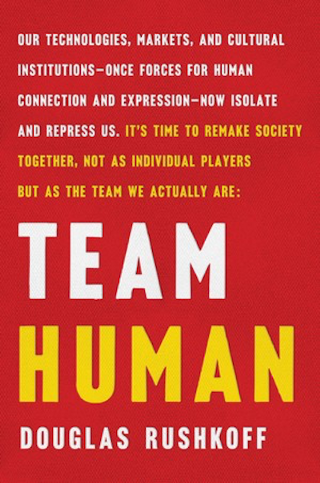
This is section 41 of the new book Team Human by Douglas Rushkoff, which is being serialized weekly on Medium. Read the previous section here and the following section here.