True Innovators Don’t Just Invent, They Retrieve
Success in the future depends on bringing forward the values of previous ages

We might say that reason is to Reason as revolution is to renaissance. A renaissance without the retrieval of lost, essential values is just another revolution.
The first individuals and organizations to capitalize on the digital era ignored the underlying values that their innovations could have retrieved. They childishly assumed they were doing something absolutely new: disrupting existing hierarchies and replacing them with something or someone better — usually themselves. The early founders merely changed the ticker symbols on Wall Street from old tech companies to new tech companies, and the medium used to display them from paper tape to LEDs.
The digital revolution was no more than a superficial changing of the guard. Yet if we dispense with the need to believe our innovations are wholly original, we free ourselves to recognize the tidal patterns of which they are a part.
The original Renaissance, for instance, retrieved the values of ancient Greece and Rome. This was reflected not just in the philosophy, aesthetics, and architecture of the period, but in the social agenda. Central currency favored central authorities, nation-states, and colonialism. These values had been lost since the fall of the Roman Empire. The Renaissance retrieved those ideals through its monarchies, economics, colonialism, and applied science.
So what values can be retrieved by our renaissance? The values that were lost or repressed during the last one: environmentalism, women’s rights, peer-to-peer economics, and localism. The over-rationalized, alienating approach to science is now joined by the newly retrieved approaches of holism and connectedness. We see peer-to-peer networks and crowdfunding replacing the top-down patronage of the Renaissance, retrieving a spirit of mutual aid and community. Even the styles and culture around this activity, from Burning Man and craft beer to piercing and herbal potions, retrieve the human-scaled, medieval sensibilities repressed by the Renaissance.
A renaissance does not mean a return to the past. We don’t go back to the Middle Ages, bloodletting, feudalism, or sword fights in the street. Rather, we bring forward themes and values of previous ages and reinvent them in new forms. Retrieval makes progress less purely linear — not so much a ladder as a spiral staircase, continually repeating the same pattern, but ascending all the way. Retrieval helps us experience the insight of premodern cultures that nothing is absolutely new; everything is renewal.
Our general lack of awareness about the values being retrieved by digital technology made it easy for status quo powers to co-opt our renaissance and reduce it to just another revolution. So, like a counterculture packaged and resold to teens at the mall, new, potentially transformative threads are exploited by those looking to win the same old games. The 1960s’ be-ins and free love communes were seized upon by lecherous men looking to leverage the openness of psychedelic culture for easy sex. The intellectual potential of the 1990s’ internet was exploited by stock traders looking to sell new stories to investors. The unprecedented possibilities for connection offered by social media in the 2000s were surrendered to the more immediately profitable pursuits of surveillance, data mining, and user control. And the sharing economy of the 2010s was handily put down by venture capitalists, who used these same principles to establish incontestable and extractive platform monopolies.
Possibilities for renaissance are lost as our openness to fundamental change creates footholds for those who would exploit us. Innovations are instrumentalized in pursuit of short-term profit, and retrieved values are ignored or forcibly quashed.
Retrieval matters. Without retrieval, all our work and innovation is just research and development for the existing, repressive system. Tellingly, the commercial uses for a technology tend to emerge only after it has been around for a while. That’s because they are not the reasons the technology was born in the first place.
Why is it so important to look back at what’s being retrieved? Because retrieval is what connects us not just to the past but to core human motivations and values. This is, at heart, a positive, conservative impulse, because each time we bring forward a fundamental human value, we are ensuring that we bring ourselves — as humans — into the next environment.
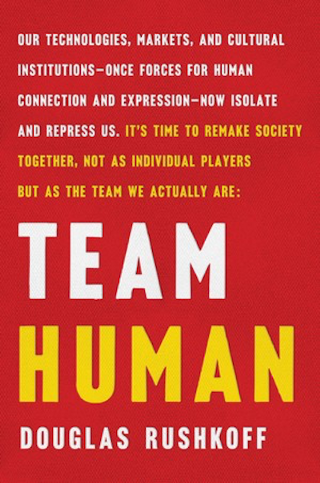
This was section 81 of the new book Team Human by Douglas Rushkoff, which is being serialized weekly on Medium. Read the previous section here and the following section here.