The ‘Self-Made Man’ Is a Myth
The myth of individuality made capitalism possible and has sustained it to this day

The most explicitly humanist value retrieved by the Renaissance, and the one we’re most hampered by today, was the myth of the individual.
Leonardo da Vinci’s iconic Vitruvian Man — the 1490 drawing of a man, perfectly proportioned within a circle and a square — presented the human form in the idealized geometric terms of the ancient Roman architect Vitruvius. The individual human body was celebrated as an analogy for the perfect workings of the universe.
Almost all of the period’s innovations retrieved some aspect of individuality. The printing press — much to the frustration of the priests — gave everyone Bibles and the opportunity to interpret the gospel for themselves. This led to Protestantism, personal salvation, and a more individual relationship to God. Reading a book was a personal activity. The gentleman reading in his study retrieved the image of the Greek citizen: a slave-owning white male who thinks he lives by the principles of democracy.
Perspective painting similarly emphasized the point of view of an individual observer, as well as a single best position from which to view a work. Likewise, the plays and epic poems of the Renaissance retrieved the tragic hero of ancient Greek drama and poetry. The character of Dr. Faustus in Marlowe’s play is often cited as the first to embody the Renaissance ideal of the individual. He is a self-made man, who has learned about the world through personal experimentation. But he also represents what happens when this commitment to selfhood goes too far: he makes a deal with the devil for total knowledge, and pursues his atomized self-interests over anything resembling social unity.
Marlowe was confronting something new to his society. It wasn’t until the Renaissance that people started to think of themselves as having personal lives, struggles, and destinies — and that these individual interests had to be weighed against the public good. This gave rise to the Enlightenment, human rights, democracy — all almost unequivocally positive developments.
When the individual’s needs are balanced with those of the collective, things stay in balance. But when people are understood as self-interested individuals in competition against one another for survival and dominance, we get into trouble. Yet that’s precisely what the economic reformations of the same Renaissance demanded. Central currency turned simple transactional tokens — a utility for exchange — into a scarce commodity. The Renaissance’s chartered monopolies transformed craftspeople and cooperative commons users into expendable employees, competing for a day’s work.
The myth of individuality made capitalism possible and has sustained it to this day. Economists modeled the market on the false premise that human beings are entirely rational individuals acting in their own self-interest. And corporations learned to stoke consumption by reinforcing our identities as individual consumers. Why sit on a streetcar with your friends when you can be driving your car, all alone? Why borrow your neighbor’s lawnmower when you can have your own? What’s a house in the suburbs without a fence defining your property?
Capitalism’s vision of the individual as a completely self-interested being, whose survival was a Darwinian battle royale, is at odds with our social evolution and our neurobiology. But unless we consciously retrieve the power inherent in our collective nature, we will remain unable to defend ourselves against those who continue to use our misguided quest for individuality against us.
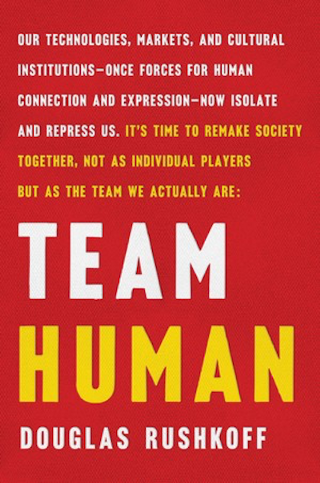
This was section 82 of the new book Team Human by Douglas Rushkoff, which is being serialized weekly on Medium. Read the previous section here and the following section here.