
Top 5 Books for the Ghosted and Heartbroken

Main message: You inherited this person, you did not raise this person, you did not create this person.
Source: Well, Judge Judy, of course!!!
Special disclaimer — this isn’t for the young folks who start and end a “relationship” on Facebook or a simple texting “relationship” where you’ve never met or spoken and are playing house and adulting. This is for people who truly believed they found the love of their lives and had a real commitment. Don’t go accusing immature jerks who blow you off willie nillie of having huge mental issues just because they suddenly unfriended you. This is real life.
If you’ve found your way to this article, I’m very sorry and heartbroken for you. It took me about a year and a half to finally come to terms with it. Please do some research on your own, but I sure hope this saves you time and energy so you can heal faster!! If you’re not going through this and know someone who is — please share. I’m taking a break from Donny Osmond to help you, so this is big!
Quick recap: After one month of online communication followed by 3 months of constant communication and togetherness, promises of marriage, house-hunting, talks of going into business together, family events, the whole shebang…this text comes in at midnight just two weeks before Christmas (after 4 days of radio silence from him):
Jennifer — (he never called me Jennifer; always baby or princess)…Jennifer — I’m safe. I’ve enjoyed the past 3 months together and you’ve always asked me to be honest and upfront with you. I need to move on and am no longer interested in pursuing this relationship. Please respect that.
The first question, of course, is why? What in the hell just happened? Rightfully devastated, I searched everything from Ghosting, Houdini, the Silent Treatment, the No Contact Rule and everything in between and felt “this much” less alone…I continued with what I knew of him. Links to all those topics will be presented later. Right now, I want to share what I’ve learned of “Psychology 101” with the top 2 critical elements of my findings.
In my case, he was always going on about communication. His words: Communication is key; not just communication, but communication STYLE. He’d emphasize “style” every single time, staring me directly in the eye, changing the tone of his voice to project power, like he was lecturing me on the difference. So, knowing that communication STYLE is KEY to him, I started there to identify the pattern. I wanted him to consider the whole picture, not the one or two challenges we’ve had before we knew what it was.
The first order of business was to do research on Communication Styles and Attachment Styles:
Communication Styles — The Four Basic Styles of Communication
Source — http://serenityonlinetherapy.com/assertiveness.htm
Source — http://www.angelfire.com/az2/webenglish/commstyles.html
Attachment Styles — The Four Basic Attachment Styles
Source — https://psychcentral.com/blog/archives/2016/03/12/how-childhood-trauma-affects-adult-relationships/
Source — http://www.helpguide.org/articles/relationships/attachment-and-adult-relationships.htm
Here is what I learned:
Communication Style: He is Passive Aggressive, and I am Assertive
Attachment Style: He is Fearful Avoidant and I am Anxious Preoccupied (working on Secure now that I’m aware of it!)
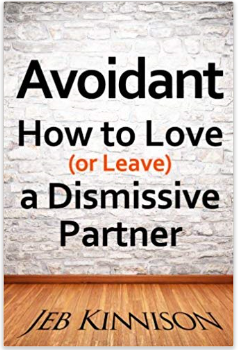
If your partner shows signs of anything other than Assertive and Secure — get this book right now on Amazon — it will change your life!
Jeb Kinnison — Avoidant How to Love (or Leave) a Dismissive Partner
Moving on…
His silence had power — my story has more power because now I can at least try to help people.
I’m not a psychologist, but I’ve put together a list of all the helpful books, articles, websites, and people who got me through this devastating time in my life. It’s not that I’m not strong or believe I don’t deserve better — it’s compassion and empathy to a FAULT. I’ve never really been good at knowing when enough is enough…but this “relationship” gave me a violent shove into understanding that it’s okay to love, it’s okay to give, hope, pray…it’s always okay to fight for someone who loves you. It’s NEVER okay to fight for someone TO love you.
Sometimes it’s just toxic. Sometimes it just doesn’t matter “why” anymore. You will NEVER win, but it won’t be your fault. Sometimes…that’s okay. Know when to let go of a Zero. You can’t make him love you any more than you can make yourself STOP loving him right now. You will find the strength, I promise!!!
I’m sharing these books with you because my brother-in-law said the wisest thing to me: “You’re going to have a full library and still no Sean!” So, let’s give you the best ones I came across and you can build your own library as you see fit!
Books You Need to Get with a Three Key Excerpts from Each:
1) Jeb Kinnison — Avoidant How to Love (or Leave) a Dismissive Partner. Yes, I said this already. That’s how important it is.
- “Even a Secure will have problems maintaining their sense of security in a relationship with an avoidant. If mutual happiness comes from a sense of teamwork and communication to solve both internal and external problems, what is the result when one member of the team refuses to help out emotionally most of the time? Relationships between and avoidant and another person tend to be unsatisfying and unhappy. This means these relationships are more likely to end, and end more quickly.” Chapter 16, pages 71–72
- “Remember that while attachment types are relatively fixed characteristics, almost everyone can display insecurities when the situation is stressful or their partner is triggering them: as when the Avoidant are withholding responses, creating anxiety in their partner.” Chapter 19, page 88
- “The studies cover what happens to relationships where the Preoccupied partner makes increasing demands for reassurance while the Dismissive partner fails to respond, either deflecting/avoiding or going silent — the “silent treatment.” ‘It’s the most common pattern of conflict in marriage or any committed, established romantic relationship,’ says Paul Schrodt, Ph.D., professor and graduate director of communication studies at Texas Christian University. ‘And it does tremendous damage.’” Chapter 19, pages 91–92
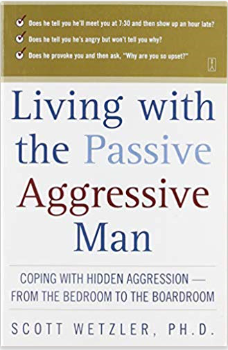
2) Scott Wetzler, Ph.D. — Living with the Passive Aggressive Man; Coping with Hidden Aggression — From the Bedroom to the Boardroom
· “Patterns of relating may be established during the earliest days of knowing each other, but terms of a relationship aren’t chiseled in stone and fixed in concrete. People are flexible — more than they believe — and conditions between men and women are more conducive to change than we suspect. Most of all, you are always entitled to renegotiate terms at any point, redefining a relationship until it is mutually acceptable. This means with any passive-aggressive man who’s part of your life.” Chapter 2, page 45
· “The passive-aggressive man prefers to stay aboard, half off and half on. IF he wants out, he’ll engineer the situation so you are forced to break up with him. Leaving is too real, too actively self-assertive, requiring too much initiative. It would allow you to actually blame him, something he doesn’t like at all. A passive-aggressive man wants you to take responsibility for the downfall of the relationship. This gives him the opportunity to feel sorry for himself and make you feel guilty for leaving him.” Chapter 5, page 99
· “But it is passive-aggression more than sex that triggers the single greatest cause of men’s fears of intimacy and commitment. Whenever relationships heat up (with you, his father/mother/boss or pals), the passive-aggressive man retreats, feels put upon, unappreciated and abused. His withdrawal is an attempt to shake off what he feels is the burden of being a fully engaged partner. It’s hard for him to satisfy your needs and wishes. Intimacy and commitment, he feels, ask too much of him.” Chapter 7, page 123
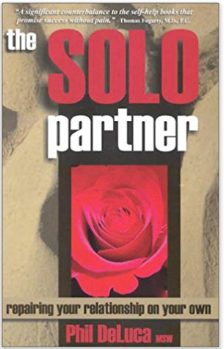
3) Phil DeLuca — The Solo Partner; Repairing Your Relationship on Your Own
- “One man put it like this: ‘My heart was never in my efforts to change, because some part of me always clung to the hope that my wife would change and that my marriage and life would improve without my having to work to make it better. When I finally gave up that hope, I realized my situation wouldn’t improve until I did something to improve it. At that point, I was able to follow through on changing.’ And for those who have put up an emotional wall to prevent themselves feeling any further hurt and anger, lowering their expectations also lowers this wall. They are forced to deal with their hurts, disappointments, and resentments, which, once faced, allow healing to begin and closeness to develop.” Chapter 7, page 151
- “Perhaps you are angry at your partner for being inconsiderate, unappreciative, moody, disrespectful, selfish, verbally abusive. Perhaps you are angry about your partner’s affairs, financial irresponsibility, relationship with the children, alcohol, gambling. You may be angry because your partner is cold, distant, and unloving. Instead of expecting this behavior to change, you must start thinking along the lines that your partner may not change. (It is safe to assume that if the disturbing behavior has been going on for some time, it is unlikely to change by itself.)” Chapter 7, page 155
- “At this point, if you identify yourself as a distancer, the most productive thing you can do is give this book to the pursuer in your life, who is the one most likely to initiate the necessary changes. If you have identified yourself as a pursuer and want to improve your situation, all you need to do is never pursue a distancer. However, following this guiding rule is not easy for pursuers.” Chapter 9, page 189
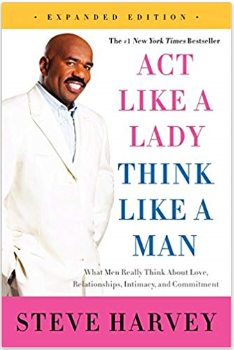
4) Steve Harvey — Act Like a Lady Think Like a Man; What Men Really Think About Love, Relationships, Intimacy, and Commitment
· “I’m telling you right now: if you go to your man with a situation that’s fixable and he doesn’t try to fix it, he is not your man — he is not in love with you.” Chapter 4, page 53
· “We men are very simple people: if we like what we see, we’re coming over there. If we don’t want anything from you, we’re not coming over there. Period. Please highlight this part right here so you can always remind yourself the next time a man steps to you: a man always wants something. Always. And when it comes to women, that plan is always to find out two things: (1) if you’re willing to sleep with him, and (2) if you har, how much will it cost to get you to sleep with him.” Chapter 5, page 64
“Don’t be another heartbreak story. Start putting yourself first — get where you want to be, and make your man be all that he can be. Remember this: the number one cause of failure in this country is the fear of failure. Fear paralyzes you from taking action. Don’t be afraid to lose him, because if a man truly loves you, he’s not going anywhere.” Chapter 14, page 203
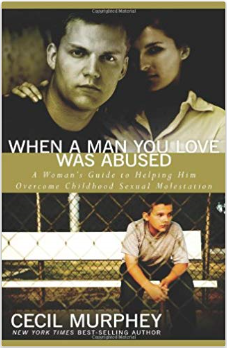
5) Cecil Murphey — When a Man You Love Was Abused; A Woman’s Guide to Helping Him Overcome Childhood Sexual Molestation
- “Regardless of how the adult survivor responds, for him to confront his feelings is important for his healing. He needs to become aware of his emotions now, because his feelings can enable him to move at his own pace in going back and reliving the pain he felt then. If he wants total healing, he will have to go back to that pain at some point. Re reexperiencing the pain one more time, he can be freed from it. He can also examine the feeling-avoidance patterns that he followed to survive childhood.” Chapter 17, page 125
- “If the man you care for tells you his secret, you might say, ‘I don’t understand all you’ve been through or how you must feel. But I love you, and I want to know, and I want to help you in any way I can.’ A simple statement like that might be enough. If he sees that you want what is best for him and have committed yourself to his healing, he can learn to trust you. Allow for his silences or mood shifts.” Chapter 24, pages 167–168
- “In adulthood, pain can be a warning of something seriously wrong with our bodies. So what enabled some of us to survive then, can impede or lives now. But we’ve grown up with our protective devices. We hugged them tightly and they enabled us to survive. An attitude of ‘You can’t hurt me; I won’t let you hurt me’ is an example of how we can eventually become invulnerable. If we shut down our pains and grief, we shut off the positive sides of our personality as well.” Chapter 34, page 206
- Special note on this. I do not have validation that this happened to the man I love; I asked him and he denied it. Then again, we weren’t together that long and the reason I suspect as much is because Chapter 12, pages 99–100 has a full list of long-term problems / effects that carry into adulthood…and he fit all 12 of the profile points. What I do know is that society gives abuse of girls / women attention in the media and the abuse of boys / men is rare — but it happens more often than you’d know and not something you’d think about for why your partner is distant. In my case, since I don’t have proof, the only thing that happened by believing this is that it made me feel that if he didn’t want to be with me, this must have been the reason for his Fearful-Avoidant nature (yes, I can admit that). If this is a possibility in your relationship, please, please, PLEASE do research on it before jumping to conclusions and confronting your loved one. You need to maintain lack of judgment and be super careful to be discreet, supportive, compassionate, empathetic, helpful and loving.
Books That I Feel are Useless and Overrated:
Men Are from Mars, Women Are from Venus
Wow. I thought that list would be longer…
Thanks for reading! And remember — Smart people read. Smarter people write!
I am a proud writer in the ILLUMINATION publication developed by Dr Mehmet Yildiz — join us!