
Toothful;
or, the Tot Tin
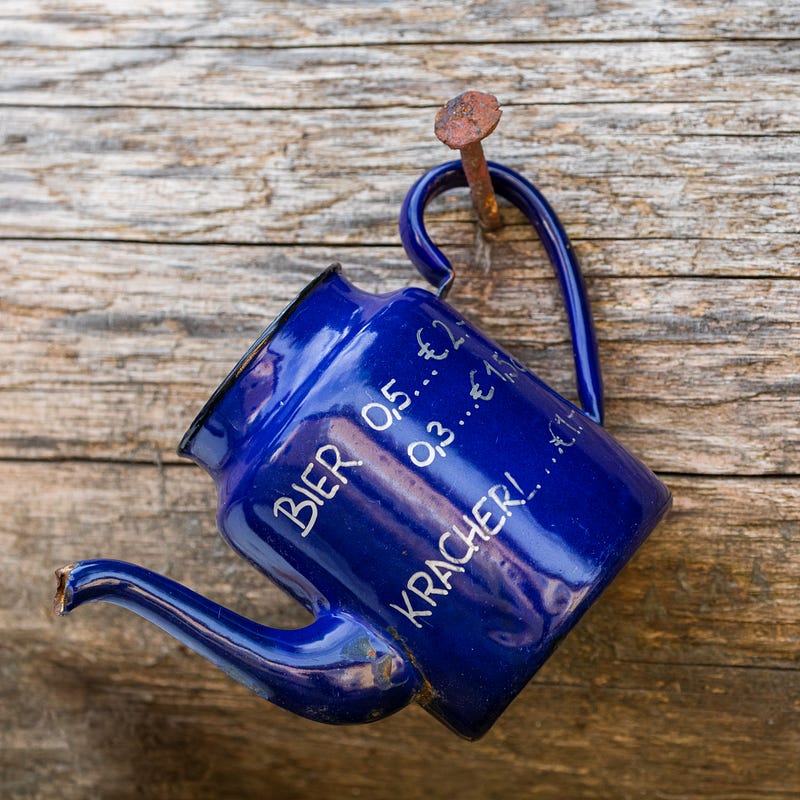
Today’s New York Times Spelling Bee letters: C, N, O, P, T, Y, and center E (all words must include E).
Merriam-Webster says…
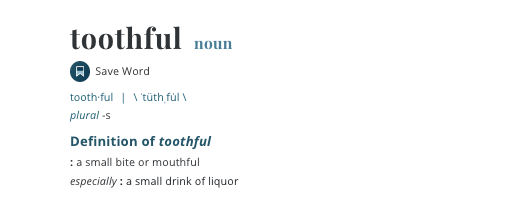
Silly little dictionary! Don’t you know toothful can’t possibly be a word if the New York Times says it ain’t?
For further fascinating facts, check out the Spelling Bee Master.
What’s your favorite g.n.a.w. from today’s puzzle?
My Two Cents
Although it’s tempting to use toothful in a sentence such as “I just came back from the dentist, and boy did he give me a toothful!”, please don’t. Unless, of course, your dentist gave you a nip of Jack Daniel’s instead of a lollipop after you rinsed.
Toothful’s claim to fame is appearing in a Herman Melville novel. No, not Moby Dick; or the Whale. A year earlier in White-Jacket; or, The World in a Man-of-War. Here is the scene:
“The grog gone!” roared an old Sheet-anchor-man. “Oh! Lord! what a pain in my stomach!” cried a Main-top-man. “It’s worse than the cholera!” cried a man of the After-guard. “I’d sooner the water-casks would give out!” said a Captain of the Hold. “Are we ganders and geese, that we can live without grog?” asked a Corporal of Marines. “Ay, we must now drink with the ducks!” cried a Quarter-master. “Not a tot left?” groaned a Waister. “Not a toothful!” sighed a Holder, from the bottom of his boots.
To clarify, these men are complaining that there is no more booze to get wasted on. This was such a strain on their miserable lives that one of them actually sighed from the bottom of his leather footwear.
As the book had just finished explaining: “In the American Navy, the law allows one gill of spirits per day to every seaman. In two portions, it is served out just previous to breakfast and dinner. At the roll of the drum, the sailors assemble round a large tub, or cask, filled with liquid; and, as their names are called off by a midshipman, they step up and regale themselves from a little tin measure called a “tot.”
From the above we can conclude the following: A large tub is equal to a cask, and is filled with hundreds of gills (since it lasts several men several days). A gill is equivalent to a dram. A tot must be half of that, since the men get one tot twice a day, and their daily dose is said gill, or dram. And as the boot-sighing man clearly explained earlier, there was not even “a toothful” left. So a toothful is smaller than a tot.
So… 1 gill = 1 dram = 2 tots = 8 toothfuls. I arbitrarily assigned the value of 4 toothfuls per tot, based on cursory research and the fact that this is my column and I must sometimes make these tough, life-saving calls.
The White-Jacket teaches us math! The novel is also known for exposing the horrors of flogging (also known as hiding) to every member of Congress, after which this barbaric custom was abolished from the U.S. Navy.
You’ll never sink this ship!
The USS Neversink was simply a code name for the USS United States, a redundant-y name since USS stands for “United States Ship”. It was the first of the original six frigates built per the Naval Act of 1794, and it’s name was approved by George Washington.
Being a friggin’ frigate, the ship usually carried three to five dozen guns. Her resume reads like a Hall-of-Fame baseball player’s:
▹ Launched in 1797 to protect merchant ships in the “we’re sort of having a war with France” period.
▹ Actively participated in the War of 1812, and had a certain lieutenant named Ichabod Crane serving on board. Crane is best known for having his name appropriated for the gothic story written by Washington Irving.
▹ Defeated the HMS Macedonian in the above mentioned war, earning her commodore, Stephen Decatur, a beaver hat. Decatur and the Macedonian’s captain had a running bet about who’s ship was more macho and would win if they ever duked it out.
▹ Sailed all the way to Gibraltar to fight in the Second Barbary War, only to find out the war was over when by the time she got there.
▹ Visited Chile and Peru during her squadron duty in the 1820s, then went back and froth between the Mediterranean and New York in the 1830s.
▹ Captured Monterey, Mexico, and restored the Kingdom of Hawaii from British rule in 1842.
▹ Was taken by Confederate troops during the Civil War.
And this is just an abridged list! For more information about the USS United States, check out her logbooks.
Finally, in May of 1862, and despite the nickname Melville had given her, the USS United States was sunk in the Elizabeth River of Virginia.
Warships and heavy metal bands and jellyfish and horses
Man-of-war. Manowar. Man o’war. Man o’War.
One word, four different spellings. Or are they four words with different meanings?
Man-of-war was an expression used by the cool clique in the British Navy when they discussed powerful warships and didn’t want the nerds to understand. To confuse the dweebs further, they interchangeably said men-of-war, man-o’-war, or just man. The latter could have been confusing in a phrase such as “Oh, man, I saw a man with a man on it.” Men-of-war had cannons and sails, while the wimpier galleys had guns and catapults.
Manowar is a 40-year old epic heavy metal band from central New York state, known for its swords and sorcery themes. And album covers that were probably cool way back when, but now are just weird. Unless you’re really into Conan the Barbarian.
Contrary to popular belief, the Portuguese man o’war is neither Portuguese nor a jellyfish. “It” is actually a “they”, a colonial organism know as a siphonophore, made up of separate parts called zooids. Their name comes from the fact that they resemble the Portuguese versions of the warships we discussed above. Their poisonous tips can sometimes kill humans, which is why they go by the more serious nickname “floating terror”.
Man o’ War (with a capital W) was horse that became an icon in post-World War I United States. Father of War Admiral and grandpa of Seabiscuit, he is considered to be one of the greatest racehorses in the 20th century. Shortly after he was born, his owner left to serve in France during World War I. His wife named the horse “Man o’War” in honor of her husband who was a… man of war.
Now you know that you need to be careful when you choose which word to use, and that you must also convey hyphens and apostrophes when you pronounce it. That way others will clearly know to which “man of war” you’re referring.
Today we’ve meandered around a bit aimlessly, in honor of Melville’s most famous novel, Moby Dick; or, the Whale. If you ever end up on a ship, be it a man-of-war or a more modern type, and someone offers a toothsome of liquor to you, please remind them they can’t use that word in the 21st century, as the New York Times said “Gee, Not A Word”.
Check out my previous entry on words that g.n.a.w. at you: