
Hided
Don’t worry, I know how to conjugate verbs

Today’s New York Times Spelling Bee letters: C, D, E, I, J, K, and center H.
Merriam-Webster says…
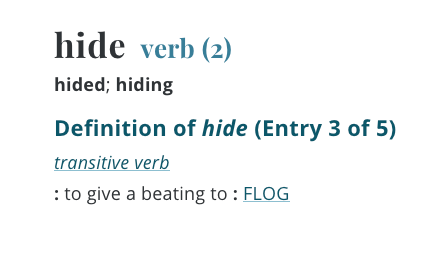
Silly little dictionary! Don’t you know hided can’t possibly be a word if the New York Times says it ain’t?
For further fascinating facts, check out the Spelling Bee Master.
What’s your favorite g.n.a.w. from today’s puzzle?
My Two Cents
I wonder if today I’ve hit upon my first controversial topic. The conceit of the g.n.a.w. (gee, not a word) is that the Spelling Bee editors exclude words they feel are obscure or offensive. I predict that, eventually, if we last long enough as a civilization — and 2020 certainly put a strain on that, bad pun intended — the Spelling Bee will stop existing for the simple reason that all words will be considered offensive. We will go back to communicating like cavemen, grunting our way through life as we mindlessly text each other only emojis.
I’m not sure to what category hided belongs. To be clear, I’m referring to the simple past tense of the above connotation (flog), not the grammar-challenged neanderthal conjugation of the meaning related to secrecy. Which again, leaves doubt in my mind as to whether Spelling Bee omitted the word because hided is obscure or because of the undertones of racial oppression the word raises.
I can’t wait until this pangram is repeated with center letter E, I or K. Then I can feature the word kike, which I’m allowed to say in the U.S. because 1) I have Jewish heritage 2) I’m a native Spanish-speaker, so I can explain how that’s a name in Latin America and Spain, and that I actually know a couple of people called Kike (pronounced key-keh).
Anyway, back to hide and hided. I’m not going to talk about slavery or corporal punishment for children in schools (that’s actually still a thing in certain parts of the world, I hear). Instead, let’s briefly tackle the politically safe world of…
BDSM
Speaking of safe, that’s the key. Actually, the key is consent, which the safeword helps guarantee. Safewords (or safe symbols/actions, when speech is restricted) are used to withdraw consent from whatever activity as being enjoyed up until that instant. The safeword needs to be unusual enough so that you won’t constantly or accidentally say it and cut short that orgasmic lava rising from your outer or inner volcano. But it shouldn’t be so unusual that you forget it five seconds into the punishment and end up having to give an embarrassing explanation to the attending doctor at the ER.
BDSM is an umbrella term for certain erotic activities, and it has many subcultures. The initials traditionally stood for B(ondage and discipline), D(ominance and submission), S(adism) and M(asochism).
The last two terms derive from actual people. Most of us are familiar with Sade, as in “the Marquis de”, and his sex & pain time stories, some of which were written in his own blood. He’s still so popular that he actually has an IMDB page. That’s where the term “sadism” comes from.
Masochism is a bit more obscure. We can thank psychiatrist Richard von Krafft-Ebbing for that. No, he wasn’t a masochist — at least, not that I know of. But he diagnosed Austrian writer and journalist Leopold von Sacher-Masoch with that “sexual anomaly”. This was in the late 19th century, remember, when everything but the missionary position was considered perverted.
Leo had written a novel called “Venus in Furs”, based on his experience of being a sex slave to his mistress Fanny Pistor. They even had a signed contract. Roughly one hundred plus years later, artist Guido Crepax adapted the story into a graphic novel. If you want a gander at Crepax’s talent as an illustrator, check out some images of hiding in his other famous comics adaptation, Story of O.
Turns out Sacher-Masoch felt hurt by the fact that the term “masochism” was derived from his name. In his case, though, that was probably also a source of pleasure.
Virgate and Carucate
No, these are not exotic names for even more exotic sexual pleasures.
They are synonyms of hide.
As in the noun. No, not either of these:

To the left, a hide used for hunting. On the right, a deer skin.
When I mention virgate and carucate, I’m also talking about yardlands, fyrds, hiwiscs, hiwans, bovates, sulungs, and yokes. Yokes, you think. Finally, a word I’ve heard of before! And there’s no trickery here, since it has to do with the wooden frame used to pair oxen.
Let’s start from the end:
- A yoke was a unit of land used in Kent, England at the time of the Domesday Book for tax purposes. It was a quarter of a sulung, which was the amount of land that could be ploughed by 4 ox-pairs. Simple division shows that a yoke was 1 pair of oxen and the amount of land that could be cultivated by them.
- A bovate was a land measurement formerly used in Scotland and England. It averaged between 15 and 20 English acres.
- A carucate is 8 bovates. It should have been similar to a sulung, but the clever people of Kent made it worth half that by declaring that a sulung was 2 hides.
- Hiwan and hiwisc are not measurements. Hiwan is an Anglo-Saxon root meaning family. Hiwisc derived from that root, as did its synonym, hid. And hid eventually became hide, the unit.
- The hide was divided into 4 yardlands, also known as virgates. Except in Sussex, where the hide was split into 8 yardlands. Perhaps they thought less was more?
- What about fyrd? Also not a unit. It’s an army, and I mentioned it because the hide was, in practical terms, a measure of tax assessment, which included food, rent, maintenance of certain structures, and manpower for… the army, or fyrd.
You’ve had enough for today? Have you? You want me to stop? You no longer want to be verbally hided? Okay, then, what’s the safeword? What. Is. The. Safeword. Say it. Say it! Saaaaay it!
We’ve covered five different meanings for the word hide, three of them nouns and two of them verbs, including hided.
But still the editors of the Spelling Bee said: “Hided? Gee, Not A Word.”