
Concent
No need to check the spelling; I already did, twice

Today’s New York Times Spelling Bee letters: C, N, O, P, T, Y, and center E (all words must include E).
Merriam-Webster says…
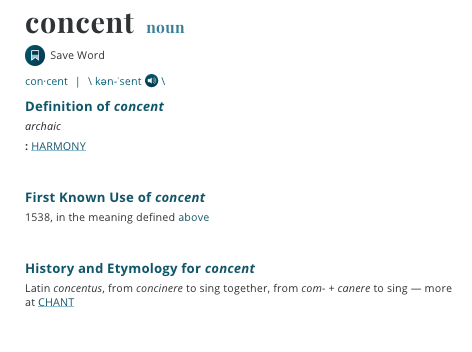
Silly little dictionary! Don’t you know concent can’t possibly be a word if the New York Times says it ain’t?
For further fascinating facts, check out the Spelling Bee Master.
What’s your favorite g.n.a.w. from today’s puzzle?
My Two Cents
Or, in this case, one -cent and one -sent, as in concent and consent.
Consent — with an “s” — has become one of the buzz words of the 21st century, and with good reason. It’s key to any relationship between human beings, and not just when it comes to sex. Seeking mutual respect and consent from the people you interact with forms the basis of healthy partnerships, healthy workplaces, healthy societies, and… yes, you guessed it, a healthy word.
Concent, on the other hand, is really not a buzz word at all. In fact, it’s an archaic term meaning “harmony”. As in music. But maybe we can somehow make a connection between them. Read on!
Consent
According to our faithful dictionary, consent the verb means (1) to give assent or approval; to agree and (2) to be in concord.
Concord? Not the airplane, spelled with an -e at the end, nor one of the many different cities or town in the U.S. Concord as in agreement of opinion or sentiment. Hmm, there’s a hint of harmony, right? As in, if everyone concords on something, everything will be all right.
The definitions of the word when used as a noun parallel the previously mentioned ones.
I got curious and looked up the extinct faster-than-the speed-of-sound airplane, and it turns out the name Concorde comes from the same word in French meaning “harmony or union”. Perhaps because the SST’s development and construction was a result of a treaty between Great Britain and France. Ironically, there was quite a brouhaha between the governments about the name, with the -e being dropped and added and dropped and added… well, suffice it to say there was not much concent there.
Back to consent, with an “s”. it originated with Middle English speakers who muddled the Anglo-French consentir, which in turn came from the Latin verb consentire, from com- (with) + sentire (to feel). To feel with… what? Oh, to feel with, as in to feel jointly, I guess.
Concent
“Celestiall harmonie, [o]f likely harts composed of starres concent, which ioyne together in sweete sympathie.”
That’s the type of sentence usually associated with concent. As I said before, archaic. Unless you’re Edmund Spenser and you live in the 16th century and you compose a poem about beauty and love, most people who live in the 21st century won’t get it, even if they care about poems and beauty and love.
Concent emerged from the Latin concentus, from concinere (to sing together), from com- + canere (to sing).
If you recognize canare (to sing) as the word from which the canary bird’s name come from, you are very… wrong.
Yes, the expression is “sing like a canary”, but the named of the bird comes from the Canary Islands, so called because of their…
Dogs.
Yep, many many centuries ago an Early Christian from Africa by the name of Arnobius went to the islands and was impressed by the humongous dogs the inhabitants kept there. Because Arnobius spoke Latin, he referred to the islands as those canariae insulae, or “islands of dogs”. Canis is the Latin word for dog.
Let’s get back on track here. Back to singing and music. Change the “n” in concent to an “r” and you get concert, which is also about music and — sometimes — singing. But concert also has a different etymology. And for some reason that origin is related to being certain. (Middle French concerter, from Old Italian concertare, perhaps from com- + certo [certain, decided], from Latin certus.)
Okay, so if concent — a musical term — has nothing to do with canaries or concerts, which are related to music, how can we possibly connect it to consent, which clearly has nothing to do with music.
Well, perhaps by not being so literal.
Think of concent as harmony in the “kumbaya” sense. Wait, scratch that. Not people actually singing “kumbaya”, but rather simply being harmonious with and to each other.
And if we are all concenting, or living in harmony as human beings should strive to do, we may eventually learn how to respect each other’s primordial right to consent.
Perhaps if enough people read this column and twitter or instagram or facebook or pinterest or email or fax or telegraph about today’s word, then maybe, just maybe one day concent will make a comeback as a synonym for harmonious living.
Or not. Because the New York Times said “Concent? Gee, Not A Word”.
Check out my previous entry on words that g.n.a.w. at you: