
Poon
You’re gonna get good wood from this one
Today’s New York Times Spelling Bee letters: A, E, H, M, N, P, and center O (all words must include O).
Merriam-Webster says…

Silly little dictionary! Don’t you know poon can’t possibly be a word if the New York Times says it ain’t?
For further fascinating facts, check out the Spelling Bee Master.
What’s your favorite g.n.a.w. from today’s puzzle?
My Two Cents
Yesterday I wrote about a slang word derived from the brand name of a popular 1970s sedative that was used as a recreational drug in nightclubs (see link at the end of this column).
Today we are not discussing a slang word, although I’m sure many of you are reading this because you saw the title and thought: “Oh, yeah, baby! Let’s get it on!” Please wipe the drool dribbling from your chin before we continue…
Poon is a Scottish variant of the word “pound”. More importantly, it’s an family of important trees known for their important wood used for several important things.
Here’s the thing: poon was a decent, hard-working, popular word before someone from Urban Dictionary came around and ruined it for us by defining it as a dirty term that’s actually a complement (not compliment) to the definition of wood your dirty mind keeps going back to.
Wood
Calophyllum is a genus in the family Calophyllaceae of the Malpighiales order.
The above is a good example of a sentence that is perfectly readable but mostly incomprehensible… even to me.
The poon belongs to a family composed of mostly trees and shrubs that belong to one of the largest subgroups of flowering plants on Earth.
That was better, wasn’t it?
If you had never ever heard of this wood used to build ships, you’re most likely not a shipbuilding aficionado, or you’re not Austronesian. Or you don’t have any Austronesian shipbuilding aficionado friends. The tree is native to Southeast Asia and was used thousands of years ago to build those nifty boats called outriggers, known for their lateral supports:
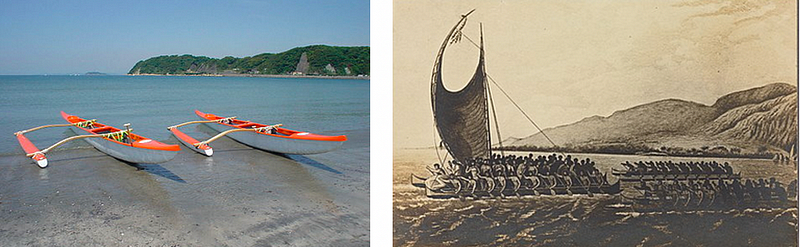
On the left, a modern Polynesian canoe. On the right, a rather macho Fijian boat from a hundred years ago.
Think of poon wood as the equivalent of oak in the Western Hemisphere timber industry. There are more than 300 species of the genus, of which only around 180 are recognized. (So… the other 120 are trees concocted by conspiracy theorists? I don’t know.) The tree is now found all over the world, having become a smashing international success story, although most of discovered it was called “poon” today.
The Calophyllum brasiliense might be known to Spanish-speakers as guanandí, calambuco, palo María, lagarto caspi, arary, árbol de Santa María or palo de aceite. Whew! Language can be beautiful… and confusing, too.
Poon is also used in:
▹ massage oil
▹ topical medicines
▹ lamp oil
▹ waterproofing
▹ cosmetics
▹ coastal landscaping, as a windbreak and to reduce erosion
Oh, did I mention it’s also used for building sturdy ships that can cross entire oceans in a very macho-looking way? (Again, see photo above.)
Wood + Astronaut Drink
Is the above deconstruction of the word poontang too clever for my own good? Here’s a trivia freebie for today that had nothing to do with what we’re discussing. Did you know that Tang, the famous astronaut drink, was not invented by NASA?
Tang was the brainchild of a cool scientist named Bill Mitchell, who most-awesomely gave us Pop Rocks and and Instant Jell-O and Cool Whip (of Family Guy fame), and less-awesomely came up with powdered egg whites. This was in 1957 while he worked for General Foods Corporation. But the drink sold poorly until John Glenn used it in his Mercury and Gemini missions. The space program authorities never did much to dispel the rumors that it was their creation, so now, whenever people mention Tang, they wink at you and add, “You know, the drink NASA invented for astronauts”, not realizing how deeply they are soiling William Mitchell’s memory.
So, Calophyllum plus powdery drink equals…
Okay, I lied earlier: we will be discussing a dirty word. Namely, the abbreviation of a slang term for (non-feline) pussy: poontang.
Poontang is defined simply as “sexual intercourse” by Merriam-Webster, but it’s usage traditionally referred to “sex with a woman”. This inevitably went down the chauvinist road of “woman regarded as a sex object” and, eventually, “female genitalia”. All this began around 1910, although no one is sure how. Most sources put the blame on New Orleans Creole, from French putain (“prostitute”) from very old French pute (whore), likely from even older Italian putta (“girl”), from the ancient Latin putus (“pure, bright, splendid”).
Yes, you read that correctly. What started out as a clean word used to describe anything dazzling and precious became filthy slang for describing a female body part that is… well, dazzling and precious.
In any case, you know have the the botanical and etymological skills to use poon when talking about either wood or pussy. Except for the fact that the New York Times Spelling Bee editors already declared: “Gee, Not A Word”.
Check out my previous entry on words that g.n.a.w. at you:


