avatarAvi Kotzer

Free AI web copilot to create summaries, insights and extended knowledge, download it at here

2727

Abstract

rhaps <i>lude</i> is looked down upon due to its “commercial name” origins?</p><h2 id="6e42">Disco Inferno</h2><p id="35b9">The brand name Quaalude became popular in the 1960s and 1970s because 1) people started using it as a club drug 2) the name has two <i>a</i>’s in it! Aren’t you curious about something called a “quaalude”. I’m sure if they had inserted another <i>u</i> between the <i>l</i> and the <i>d</i>, it would have been an even bigger hit.</p><p id="8e20">In the U.S., Quaalude was the commercial name for methaqualone, a sedative that works in similar ways to benzodiazepines (Valium). Methaqualone’s net effect is dropping your blood pressure and a relaxing your heart beat and breathing. If you’re thinking this is an excellent way to sedate people or simply help them fall asleep, I quote Colonel Hans Landa from <a href="https://www.sensesfive.com/2010/07/26/glourious-homage-quentin-tarantinos-love-letter-to-cinema-by-avi-kotzer/">Inglourious Basterds</a>: “It’s a bingo!”</p><p id="723f">Researches discovered the sedative–hypnotic effect of methaqualone in the mid-1950s 1955. As with Viagra and Rogain, scientists were looking to find a cure or treatment for something else — in this case, chemists in India were looking for the next new drug to fight malaria. A decade later methaqualone was widely use to treat people with anxiety and/or insomnia. Then the 70s rolled around and disco became popular. So did recreational use of Quaalude.</p><p id="dbad">Because of their widespread adoption as the “fun drug” of choice in nightclubs, Quaalude pills became known as the “disco biscuits”. It’s likely that around this time that the slang names came about. Probably because people who are relaxed and falling asleep are more prone to uttering mumbo-jumbo when they talk.</p><p id="330d">Aside from <i>lude</i>, in the U.S the drug was known as <i>soper</i> or <i>soap</i> because the other brand name methaqualone was sold under was Sopor. Because Quaaludes had the digits 7-1-4 stamped on the tablets, that number also became a code reference. In the U.K. it was Mandrax, which resulted in Brits, Aussies, and Kiwis slurring <i>mandrake</i> and <i>mandie</i> while dancing and falling asleep at the same time.</p><h2 id="8b53">Rise and Fall of a Drug and an American Icon</h2><p id="a086">In the United States, Quaalude was first commercialized 1965 by the Pennsylvania-based pharmaceutical firm William H. Rorer, Inc. Their other famous product: Maalox. See their pattern there, with the double vowels they like to use in drug names? Brilliant!</p><blockquote id="6a7d"><p>“Quaalude accounted for less than 2% of our sales, but created 98% of our headaches.”</p></blockquote><p id="781d">The above quo

Options

te came from Rorer chairman John Eckman, explaining why they sold their product to another Pennsylvania company, called Lemmon. This added to the slang references for the drug: <i>lemmons</i>, <i>lemmon 7s</i> (they were also stamped 714).</p><p id="c54f">Quaaludes were withdrawn from most developed countries in 1980, and from in the United States two years later. By working with other countries and governments, the DEA succeeded in eliminating the production of methaqualone almost entirely around the world. Underground labs in Mexico still produced some until the 1990s, but the waning popularity of ludes and the rising popularity of other drugs took care of that.</p><p id="4059">Everything was pretty quiet until the Cosby sexual assault trial a few years ago. Ludes got the spotlight again, as the comedian’s extensive use of this drug to rape women came to light. In a 2005 deposition that was (unfortunately) sealed for many years, Cosby admitted under oath: “I give her Quaaludes. We then have sex.”</p><p id="710a">This was probably the final nail in reputation coffin of <i>lude</i>.</p><p id="5d17">Perhaps that’s why the Spelling Bee editors said: “<b>G</b>ee, <b>N</b>ot <b>A</b> <b>W</b>ord”.</p><p id="0866">Check out my previous discussion on words that g.n.a.w. at you:</p><div id="2e9a" class="link-block"> <a href="https://readmedium.com/outroot-692765edf440"> <div> <div> <h2>Outroot</h2> <div><h3>When you just gotta get rid of everything</h3></div> <div><p>medium.com</p></div> </div> <div> <div style="background-image: url(https://miro.readmedium.com/v2/resize:fit:320/0*_8b2dsSBTs0AwWIs)"></div> </div> </div> </a> </div><p id="6a29">And for a personal take on why meth could go the way of Quaaludes… but won’t, check out Missouri Review-published writer Shawn Schmid:</p><div id="d8c0" class="link-block"> <a href="https://readmedium.com/do-you-know-the-big-pharma-quaalude-meth-story-you-ought-to-know-66b5c3670376"> <div> <div> <h2>Do You Know the Big Pharma Quaalude Meth Story? You Ought To Know</h2> <div><h3>I am writing because methamphetamine use has stolen my brother’s brain, and my heart hurts when I think he may not get…</h3></div> <div><p>medium.com</p></div> </div> <div> <div style="background-image: url(https://miro.readmedium.com/v2/resize:fit:320/1*[email protected])"></div> </div> </div> </a> </div></article></body>

Lude

A biscuit for disco dancers

Photo by David von Diemar on Unsplash

Today’s New York Times Spelling Bee letters: D, F, L, O, U, Y, and center E (every word must include E).
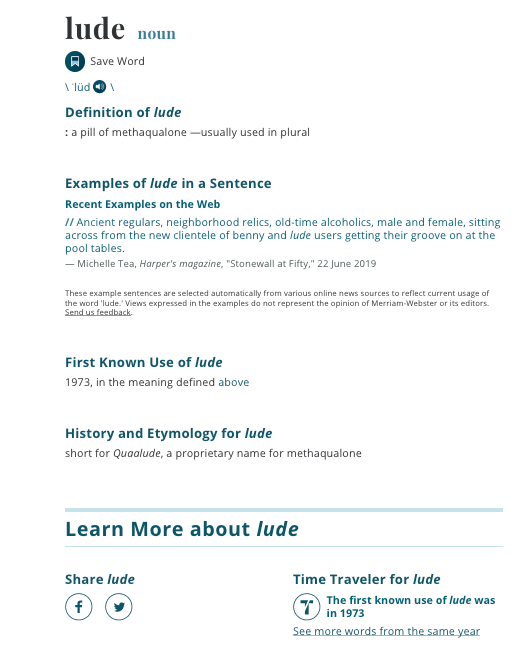
Merriam-Webster says…

Silly little dictionary! Don’t you know lude can’t possibly be a word if the New York Times says it ain’t?

For further fascinating facts, check out the Spelling Bee Master.

What’s your favorite g.n.a.w. from today’s puzzle?

My Two Cents

What makes a slang word acceptable? I don’t mean as far as usage goes; we know English’s modern growth is largely due to usage, which is why that language is at the top of the list when it comes to its number of noninflected words. (And also why it’s practical to have as a global language.)

When I talk about acceptable slang I’m not referring to words that can be used in polite company, either. I mean lingo that gets enough street cred that dictionaries feel forced to include it, despite the protests of certain editors of a certain newspaper game that shall remain nameless (at least, in this paragraph).

I was glad to see that lude appeared not only in Merriam-Webster, but also in a few others that I checked, including the eponymously-named dictionary.com. It also appears in wikipedia. I don’t have a subscription to the O.E.D., but I’ll lay 10-to-1 odds it’s in there somewhere between lube and luge.

I know phat is accepted slang by the editors of Spelling Bee, while hella isn’t, for example. I have tried both words in recent puzzles and confirmed this. (By the way, I love the word hella!) So lude is not the only slang word that’s excluded. Maybe it’s not worthy because it’s a drug? I think coke has appeared in the puzzle, although it could be in reference to its non-illicit-drug meanings. Perhaps lude is looked down upon due to its “commercial name” origins?

Disco Inferno

The brand name Quaalude became popular in the 1960s and 1970s because 1) people started using it as a club drug 2) the name has two a’s in it! Aren’t you curious about something called a “quaalude”. I’m sure if they had inserted another u between the l and the d, it would have been an even bigger hit.

In the U.S., Quaalude was the commercial name for methaqualone, a sedative that works in similar ways to benzodiazepines (Valium). Methaqualone’s net effect is dropping your blood pressure and a relaxing your heart beat and breathing. If you’re thinking this is an excellent way to sedate people or simply help them fall asleep, I quote Colonel Hans Landa from Inglourious Basterds: “It’s a bingo!”

Researches discovered the sedative–hypnotic effect of methaqualone in the mid-1950s 1955. As with Viagra and Rogain, scientists were looking to find a cure or treatment for something else — in this case, chemists in India were looking for the next new drug to fight malaria. A decade later methaqualone was widely use to treat people with anxiety and/or insomnia. Then the 70s rolled around and disco became popular. So did recreational use of Quaalude.

Because of their widespread adoption as the “fun drug” of choice in nightclubs, Quaalude pills became known as the “disco biscuits”. It’s likely that around this time that the slang names came about. Probably because people who are relaxed and falling asleep are more prone to uttering mumbo-jumbo when they talk.

Aside from lude, in the U.S the drug was known as soper or soap because the other brand name methaqualone was sold under was Sopor. Because Quaaludes had the digits 7-1-4 stamped on the tablets, that number also became a code reference. In the U.K. it was Mandrax, which resulted in Brits, Aussies, and Kiwis slurring mandrake and mandie while dancing and falling asleep at the same time.

Rise and Fall of a Drug and an American Icon

In the United States, Quaalude was first commercialized 1965 by the Pennsylvania-based pharmaceutical firm William H. Rorer, Inc. Their other famous product: Maalox. See their pattern there, with the double vowels they like to use in drug names? Brilliant!

“Quaalude accounted for less than 2% of our sales, but created 98% of our headaches.”

The above quote came from Rorer chairman John Eckman, explaining why they sold their product to another Pennsylvania company, called Lemmon. This added to the slang references for the drug: lemmons, lemmon 7s (they were also stamped 714).

Quaaludes were withdrawn from most developed countries in 1980, and from in the United States two years later. By working with other countries and governments, the DEA succeeded in eliminating the production of methaqualone almost entirely around the world. Underground labs in Mexico still produced some until the 1990s, but the waning popularity of ludes and the rising popularity of other drugs took care of that.

Everything was pretty quiet until the Cosby sexual assault trial a few years ago. Ludes got the spotlight again, as the comedian’s extensive use of this drug to rape women came to light. In a 2005 deposition that was (unfortunately) sealed for many years, Cosby admitted under oath: “I give her Quaaludes. We then have sex.”

This was probably the final nail in reputation coffin of lude.

Perhaps that’s why the Spelling Bee editors said: “Gee, Not A Word”.

Check out my previous discussion on words that g.n.a.w. at you:

And for a personal take on why meth could go the way of Quaaludes… but won’t, check out Missouri Review-published writer Shawn Schmid:

Quaalude
Lude
Dictionary
Spelling Bee
Disco
Recommended from ReadMedium