
Outroot
When you just gotta get rid of everything
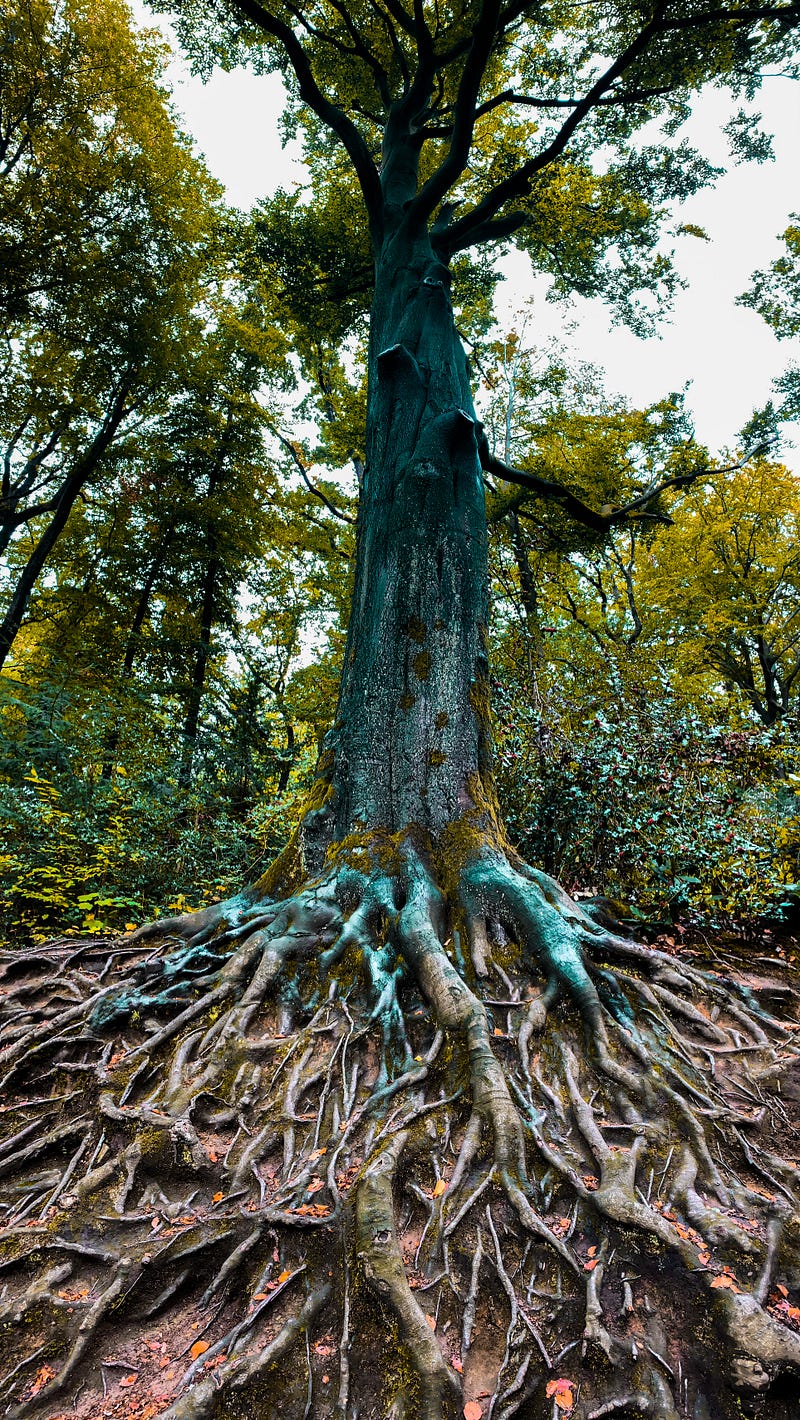
Today’s New York Times Spelling Bee letters: G, N, O, R, U, W, and center T (every word must include T).
Merriam-Webster says…
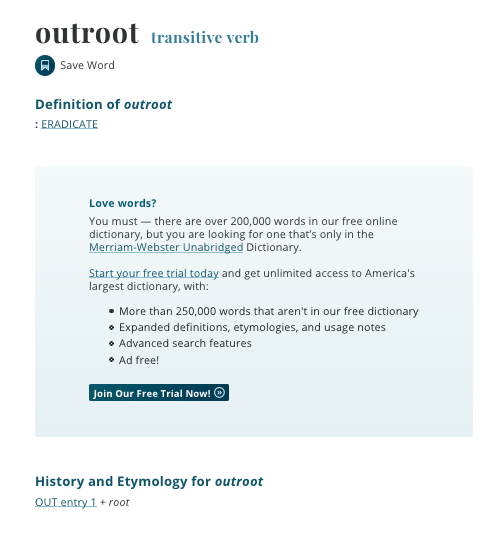
Silly little dictionary! Don’t you know outroot can’t possibly be a word if the New York Times says it ain’t?
For further fascinating facts, check out the Spelling Bee Master.
What’s your favorite g.n.a.w. from today’s puzzle?
My Two Cents
I was very, very tempted to go with turgor. Get your mind out of the gutter! Now please understand that the main reason I wanted to go with turgor was… because it was going to lead your mind into the gutter. Because, if you’re like me, the first thing you thought was that turgor must somehow be related to turgid. And if you’re around my age, turgid brings to mind those old videos you were shown in Health class; you know, the ones about how your body was changing in wonderful and mysterious ways. Or maybe it brings to mind other images — which we won’t get into detail in this column.
So, you may be disappointed to find out that although turgor has to do with swelling, it refers to tension and distension within cells. And since yesterday’s article was already peppered with enough microbiology terms, I won’t torture you with more science stuff today.
Today's puzzle already appeared four times before, with center letters G, N, U, R. I can wait for it to appear again with center letter O to write about turgor.
The -roots
Uproot, unroot, outroot. Guess which one is not a word.
Trick question!
They’re all words, at least according to our silly little dictionary. But only one of them — uproot — is an acceptable answer in the Spelling Bee game. And since the letter p is not included in today’s puzzle, uproot is not even spellable. (Is… that… a word?)
The three are all synonyms, sort of. Unroot is defined as “to tear up by the roots”, and its listed alternatives are eradicate and uproot. When you check out outroot, as you saw in the screenshot above, you are directly directed to eradicate.
Unroot is the more interesting of the group when it comes to etymology. Uproot and outroot are simply prefix + root word (no pun intended) constructions. Unroot, on the other hand, has a Middle English ancestor in unrooten.
However, uproot does seem to have the more nuanced meanings: (1) to remove as if by pulling up; (2) to pull up by the roots; (3) to displace from a country or traditional habitat. However, there seems to be a definition missing, since one of the “can you please use it in a sentence?” examples given by Merriam-Webster is: Will we ever be able to uproot racial prejudice?
Now, I’m all for eradicating racial prejudice, but this usage does not thoroughly match up with any of the three definitions listed above. Perhaps we need to read definition (2) not literally, but figuratively. Or perhaps the dictionary is missing a reference to the key word that unites all three “-roots”: eradicate.
The root of the root
I found eradicate to be a most curious word. And when I explored a bit, I found out it was related to a word I tackled the previous week:
Turns out root is the root of uproot, unroot, outroot, and… eradicate. Which sounds nothing like root, until you start thinking in Latin. Sort of like Clint Eastwood, when he piloted the Firefox and had to think in Russian.
This is a great example of the importance of being multilingual. You can destroy enemy fighter jets by just thinking about it!. That’s pretty awesome, but let’s get back to my point here…
When you read eradicate and your mindset is Latin, you’ll think of eradicatus, a past participle of the verb eradicare. That verb, in turn, traces its root to radix, which was used to talk about both a “root” and a “radish”, that pungent, crisp veggie that no one but me seems to appreciate.
Today radix is a math term, as is radicand (the word I discussed last week).
When it comes to eradicate, most people think only of it’s meaning “to exterminate or do away with”. Would you be surprised to find out it also means “to pull up by the roots”? Next time you do some gardening, you can tell your nosy neighbor you are eradicating your carrots as you yank them out of the ground. Your neighbor will probably not bother you the rest of the day.
So, we’ve managed to expand your options for synonyms you can use when you want to talk about eliminating something, whether it be a weed, an old tree stump, or a pervasive element in society (like racial prejudice). You can choose eradicate or uproot or unroot or outroot.
Oh, wait… you can’t use unroot or outroot, because the Spelling Bee editors took a look at each one and said: “Gee, Not A Word”.
Check out my previous discussion on words that g.n.a.w. at you:


