han one cell, they have internal cross-walls called <i>septa</i> (fancy plural of <i>septum</i>). These internal walls usually have pores large enough lo allow the flow of all that good stuff you don’t remember from high-school biology: ribosomes, mitochondria, and nuclei.</p><figure id="b144"><img src="https://cdn-images-1.readmedium.com/v2/resize:fit:800/1*NknA6jUzrO66LHC0HnIvlA.png"><figcaption>Credit: wikipedia.com</figcaption></figure><p id="4dac">The guy with the weirdest name, Mr. Spitzenkörper (German for “<a href="https://www.imdb.com/title/tt0077713/">I spit on your grave</a>”) initiates tip growth. It does that by releasing vesicles that travel to the cell membrane and release their contents <b>outside</b> the cell. Meanwhile, the membranes of these vesicles contribute to the growth of the larger cell membrane.</p><p id="fa84">I know, that was a tough read. (And an even tougher write, for me.) To make up for it, here’s some microscopic fungal growth for you to enjoy:</p>
<figure id="7f26">
<div>
<div>
<img class="ratio" src="http://placehold.it/16x9">
<iframe class="" src="https://cdn.embedly.com/widgets/media.html?src=https%3A%2F%2Fwww.youtube.com%2Fembed%2FZIutFBqI6GM%3Ffeature%3Doembed&display_name=YouTube&url=https%3A%2F%2Fwww.youtube.com%2Fwatch%3Fv%3DZIutFBqI6GM&image=https%3A%2F%2Fi.ytimg.com%2Fvi%2FZIutFBqI6GM%2Fhqdefault.jpg&key=a19fcc184b9711e1b4764040d3dc5c07&type=text%2Fhtml&schema=youtube" allowfullscreen="" frameborder="0" height="480" width="640">
</div>
</div>
</figure></iframe></div></div></figure><p id="4551">As I mentioned before, the the white fuzz that grows on a rotting tomato is the mycelium, which is made up of a ton of these teensy-weensy branches. Yecccccch!</p><h2 id="99f8">Not a port, not a dash either</h2><p id="3712"><i>Hypha</i> sounds exactly like the <a href="https://israelcities.com/haifa/">port city</a> in the north of Israel, but the word has nothing to do with the place. Although being so close to the water, I’m sure Haifa has its share of mold issues.</p><p id="3ca5">Perhaps <i>hypha</i> reminds you of the word <i>hyphen</i>, and you think they must be related somehow because 1) the first four letters are the same 2) they both sound Greek and must therefore have the same old European root.</p><p id="af5d">Here’s the interesting thing: although hyphae look a lot like hyphens, that’s just a coi
Options
ncidence. They are not remotely related. Or maybe very remotely, but the point is they have different roots.</p><p id="804d"><b>Hyphen</b> originates from Late Latin/Greek’s <i>hyph’ hen, </i>or “under one”, which in turn came from <i>hypo</i> “under” + <i>hen</i>, a form of the word for “one”. In ancient Greek a hyphen was an undertie-like sign, like this: <b>‿</b> (so, a smiley face without the nose or the eyes). It was placed below two adjacent letters to indicate that they belonged to the same word, in case there was any doubt. This was back before some genius finally came up with word spacing.</p><p id="9fb5"><b>Hypha</b>, on the other hand, is from New Latin that used the Greek word for web, <i>hyphos</i>. Which makes sense since the microscopic limbs end up forming a huge, messy, disgusting web that covers your spoiled food.</p><p id="eb65">So next time you see a piece of moldy bread, you’ll be able to sound real scholarly when you point out: “Hey, there’s a bunch of <i>hyphae</i> on my sandwich!”</p><p id="7b89">Or maybe you won’t… because the Spelling Bee editors read <i>hypha</i> and said: “<b>G</b>ee, <b>N</b>ot <b>A</b> <b>W</b>ord”.</p><p id="0f85">Check out my previous discussion on words that g.n.a.w. at you:</p><div id="1afd" class="link-block">
<a href="https://readmedium.com/palmball-e6d1ded70b1">
<div>
<div>
<h2>Palmball</h2>
<div><h3>A change in a change-up led to the Hall of Fame</h3></div>
<div><p>medium.com</p></div>
</div>
<div>
<div style="background-image: url(https://miro.readmedium.com/v2/resize:fit:320/0*tNOCaGfaACnzT0GT)"></div>
</div>
</div>
</a>
</div><p id="b056">And check out the interesting articles by Daniel DeMarco here:</p><div id="d3d0" class="link-block">
<a href="https://everydayjunglist.medium.com/">
<div>
<div>
<h2>Daniel DeMarco - Medium</h2>
<div><h3>Intelligent Nonsense Do you care? Cause that would be great. No? Oh. Damn. Will you still be my friend? No? Oh, ok…</h3></div>
<div><p>everydayjunglist.medium.com</p></div>
</div>
<div>
<div style="background-image: url(https://miro.readmedium.com/v2/resize:fit:320/0*alfZ1OaBrYzABNms)"></div>
</div>
</div>
</a>
</div></article></body>
What’s your favorite g.n.a.w. from today’s puzzle?
My Two Cents
Ever wonder what that greenish fuzzy stuff on moldy bread is called? No? You’ve probably just thrown away that slice, along with the rest of the loaf, without thinking twice about learning a new word.
Mycelium.
Wait a second! You’re thinking that’s not today’s word. And you are correct.
Today’s word is hypha, plural hyphae. (Ah, these Greek words with their fancy plurals…)
Here I pause to give a shout-out to research scientist Daniel DeMarco for pointing out the importance of using said plural, as one itsy-bitsy lonesome hypha does not a mycelium make, to paraphrase Aristotle.
A mycelium is a flock of hyphae. Well, maybe not a flock, since we are talking about mold and not an English 80s new wave band. In most fungi — remember, fancy plurals here — hyphae are the main mode of vegetative growth, and are collectively know as a mycelium.
Hot fuzz
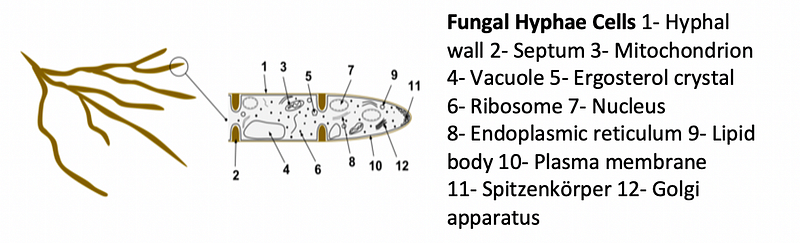
A hypha usually consists of one or more tubular cells surrounded by a rigid cell wall. When hyphae have more than one cell, they have internal cross-walls called septa (fancy plural of septum). These internal walls usually have pores large enough lo allow the flow of all that good stuff you don’t remember from high-school biology: ribosomes, mitochondria, and nuclei.
Credit: wikipedia.com
The guy with the weirdest name, Mr. Spitzenkörper (German for “I spit on your grave”) initiates tip growth. It does that by releasing vesicles that travel to the cell membrane and release their contents outside the cell. Meanwhile, the membranes of these vesicles contribute to the growth of the larger cell membrane.
I know, that was a tough read. (And an even tougher write, for me.) To make up for it, here’s some microscopic fungal growth for you to enjoy:
As I mentioned before, the the white fuzz that grows on a rotting tomato is the mycelium, which is made up of a ton of these teensy-weensy branches. Yecccccch!
Not a port, not a dash either
Hypha sounds exactly like the port city in the north of Israel, but the word has nothing to do with the place. Although being so close to the water, I’m sure Haifa has its share of mold issues.
Perhaps hypha reminds you of the word hyphen, and you think they must be related somehow because 1) the first four letters are the same 2) they both sound Greek and must therefore have the same old European root.
Here’s the interesting thing: although hyphae look a lot like hyphens, that’s just a coincidence. They are not remotely related. Or maybe very remotely, but the point is they have different roots.
Hyphen originates from Late Latin/Greek’s hyph’ hen, or “under one”, which in turn came from hypo “under” + hen, a form of the word for “one”. In ancient Greek a hyphen was an undertie-like sign, like this: ‿ (so, a smiley face without the nose or the eyes). It was placed below two adjacent letters to indicate that they belonged to the same word, in case there was any doubt. This was back before some genius finally came up with word spacing.
Hypha, on the other hand, is from New Latin that used the Greek word for web, hyphos. Which makes sense since the microscopic limbs end up forming a huge, messy, disgusting web that covers your spoiled food.
So next time you see a piece of moldy bread, you’ll be able to sound real scholarly when you point out: “Hey, there’s a bunch of hyphae on my sandwich!”
Or maybe you won’t… because the Spelling Bee editors read hypha and said: “Gee, Not AWord”.
Check out my previous discussion on words that g.n.a.w. at you: