
Palmball
A change in a change-up led to the Hall of Fame
Today’s New York Times Spelling Bee letters: A, B, E, I, L, M, and center O.
Merriam-Webster says…
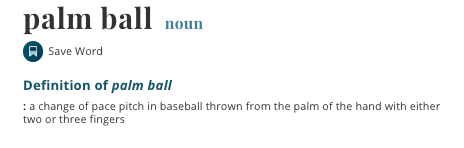
Silly little dictionary! Don’t you know palmball can’t possibly be a word if the New York Times says it ain’t?
For further fascinating facts, check out the Spelling Bee Master.
What’s your favorite g.n.a.w. from today’s puzzle?
My Two Cents
First things first. If you’re a regular Spelling Bee player and enthusiast, I can hear you groaning and thinking, “Of course that’s not a word… it’s two words!” Since Spelling Bee rules do not allow for hyphenated words, one would assume two separate words would not count as one. And one would be correct.
Except sorry not sorry… palmball is one word.
In this case, both the Spelling Bee editors and the Merriam-Webster proofreaders are wrong. Wrong, wrong, wrong I tell ya! Wikipedia’s entry on the term lists it as a single word. More importantly, both MLB and the Baseball Hall of Fame spells it without a space or a hyphen. And since they are the authorities on baseball, logically they are also the deciders on how spelling works in baseball.
Palmball.
Oneword. Sorry… one word.
I mean, if fastball and curveball and forkball are single words, why does palmball all of a sudden get a space between its syllables? To quote the great Rock of philosophy, Dwayne Johnson: “Success isn’t always about greatness. It’s about consistency.” And although Oscar Wilde complained that “Consistency is the last refuge of the unimaginative”, I prefer a certain coherence when it comes to baseball terms.
Variety is the Spice of Life
So what is this palmball I keep talking about? If you’re picturing the pitcher slapping the ball towards the catcher’s mitt, you’re off… by a lot.
The palmball is a type of change-up.
Here are some of the basics. (Baseball intellectuals and jocks can move along to the next section if they so desire.)
Most people know what a fastball is. The pitcher winds up and lets loose as hard as he can. Today many MLB flamethrowers can reach 100 m.p.h. or more on their fastballs. Most respectable fastballs end up in the mid-90s. The hardest ones to hit have some movement to them.
The change-up is designed to seem like a fastball until the very end. The goal is to fool the hitter. It’s most effective if thrown immediately before or after a fastball. The pitcher changes the grip on the ball but not his windup and throwing motion. The finger placement makes the ball lose speed several feet before it reaches the batter. But by then it’s too late, and the hitter will swing sooner, calculating the ball will arrive before it does.
The off-speed pitch can be achieved in several ways.
- With the traditional change-up, you grip the ball with four fingers on the top and the thumb below, like with a fastball. Then you slide your index finger down slightly towards your thumb. Some pitchers also slide the pinky finger off the top of the ball, too.
- To throw a circle-change — probably the most popular version now — you move your index finger almost off the ball and onto your thumb, forming a small circle (hence the name).
- The three-finger change-up is used by many young pitchers or those with smaller hands. Only the index, middle, and ring finger grip the ball at the top, with the pinkie and the thumb underside.
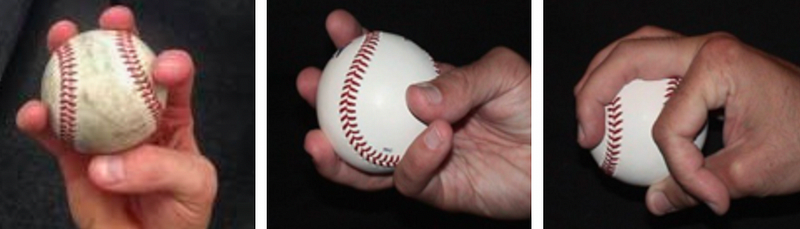
The palmball is very similar to the traditional change-up, except the ball is pressed against the palm of the hand. This makes it harder to throw, but also more effective. If you have any doubts, you can ask:
The Hoff… of Baseball
Trevor Hoffman spent most of his career as a relief pitcher with the San Diego Padres. Specifically, he was their closer, the guy in charge of shutting down the opposing team late in a tight game. During his career, he appeared in 1,035 games and got 601 saves. In 2018 he was elected to the Hall of Fame.
The palmball saved his career.
In 1994 the players declared a strike. While relaxing on the beach, Hoffman injured his right shoulder. After rehabbing it and returning to the game, he discovered his fastball had withered from 95 mph to just below 90 . As I mentioned before, respectable fastballs are in the mid-90s. Anything below, especially for a closer, can be potentially career-ending.
As he searched for options, teammate Donnie Elliott recommended a pitch he used, essentially a palmball. Once he had mastered the grip, Hoffman’s career changed forever.
His fading mid-70s change-up proved nearly unhittable for National League hitters. In fact, it made them look silly. To quote Mike Piazza, another hall-of-famer:
“Some pitchers fool you and some guys overpower you. Hoffman embarrasses you.”
The palmball effectively extended Hoffman’s career by 16 years and landed him in the Mecca of baseball.
The editors of the Spelling Bee saw palmball and sighed: “Gee, Not A Word”.
Someone needs to send them the link to Trevor Hoffman’s bio on the Baseball Hall of Fame website.