
Games and Money
Too Rich to Lose: The Hidden Meaning of Monopoly Cheaters Edition
Also, messing around with The Game Changers
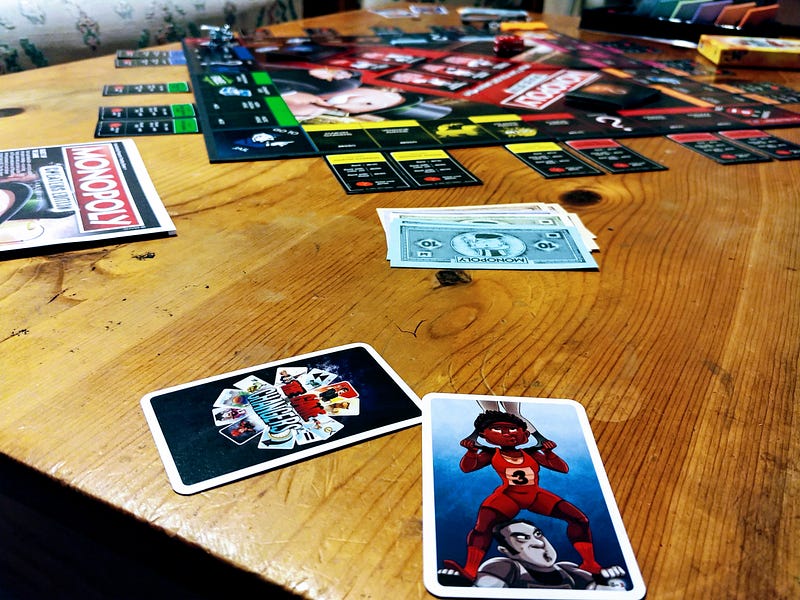
I’ve written about Monopoly Cheaters Edition before, but here’s a crash course on how it differs from the original.
- Cheat Cards allow players to legally cheat in specific ways.
- You don’t build houses on Properties. Only Hotels.
- Players that are in Jail put on a plastic Handcuff. It’s mostly a gimmick, but it does tie into one of the Cheat cards.
- You don’t have to Bankrupt everyone else to win. The game ends when all properties have been purchased and the players have returned to Go. Whoever has the most cash wins.
I felt a burning need to play Cheaters again after reading some other essays on Monopoly’s history and the meaning of the mechanics. That inspiration was compounded by a recent purchase I desperately wanted to test drive.
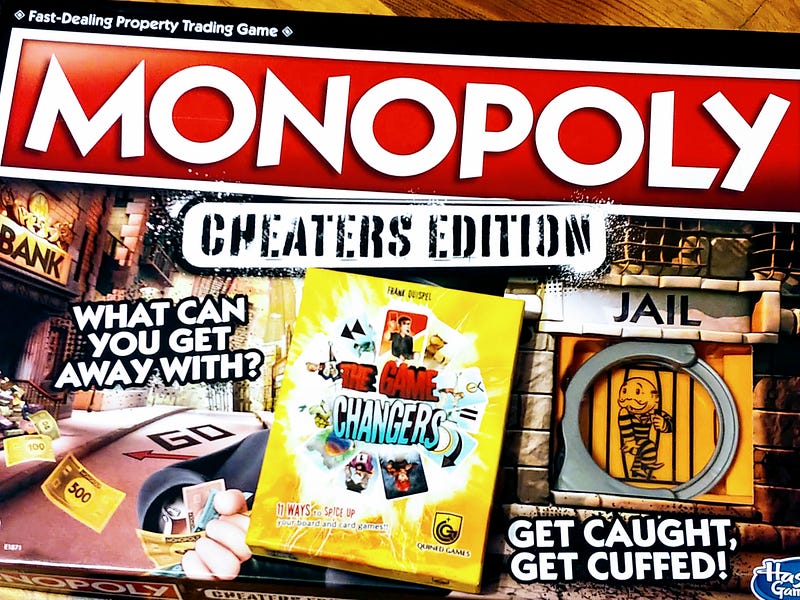
The Game Changers is a deck of cards that hack, modify, alter, and otherwise fuck up your game. 80 cards, split into 11 different modules. There’s no listed limit to how many you should add to a game, but I held my self back and used only two:
- Play Together — turns the game into a cooperative challenge
- Saboteur — introduces a traitor mechanic (maybe)
Wheeling and dealing has always been part of Monopoly, but the Play Together module hammers home the idea that rich bastards collude (there’s that word) as much as they compete. Now the players have to end the game in a particular financial order. Otherwise they all lose.
The Saboteur represents the possibility that someone intends to screw the other two. The rules say you’re supposed to definitely use the Saboteur card, but I shuffled it in with the four non-saboteurs and dealt the cards randomly. That way there’s a 40% chance that NO ONE is a Saboteur. This injects a LOT of uncertainty and distrust into the game.
Combined, the two modules change the whole point of Monopoly. Players are supposed to win or lose together. But is someone trying to take it all? And if no one is trying to screw the other two, can the distrust still ruin the plan?
The players were to come in like so:
- The Car: 1st
- The Dinosaur: 2nd
- The Hat: 3rd
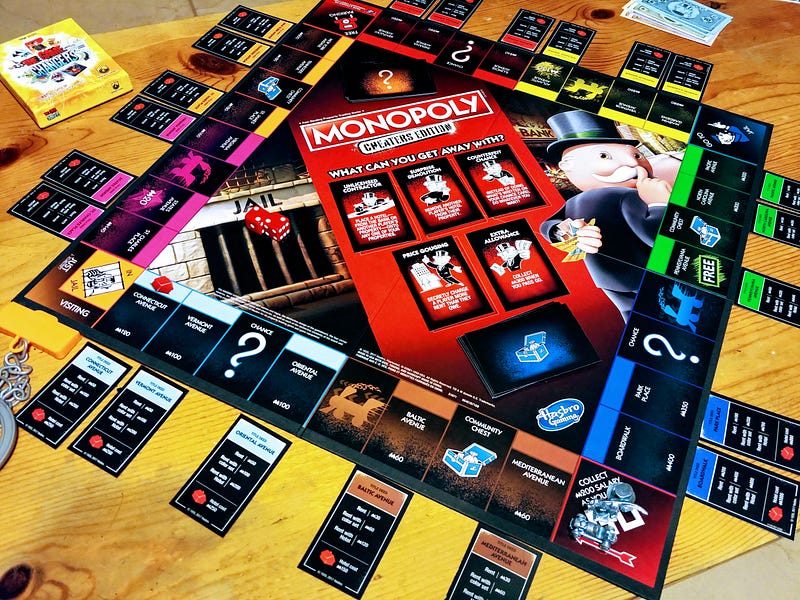
The first few turns went pretty quick. At first, it seemed like the only thing we had to keep track of was how much money each of us had. If everyone kept to the agreed upon financial hierarchy, then no one was the Saboteur. But as we continued, the flaws in our ad-hoc variant became clear.
Bankruptcy added a potential hiccup to this remix. We established at the start that if a player goes Bankrupt, everyone loses. Because they don’t finish “third”, they simply don’t finish at all. But a Saboteur could have Bankrupted themselves and crashed our little cartel.
But that didn’t happen. As we collected more and more properties, everyone maintained the hierarchy. Any time the wrong person pulled ahead, they just gave money to someone else. Trading cash and property was still allowed.
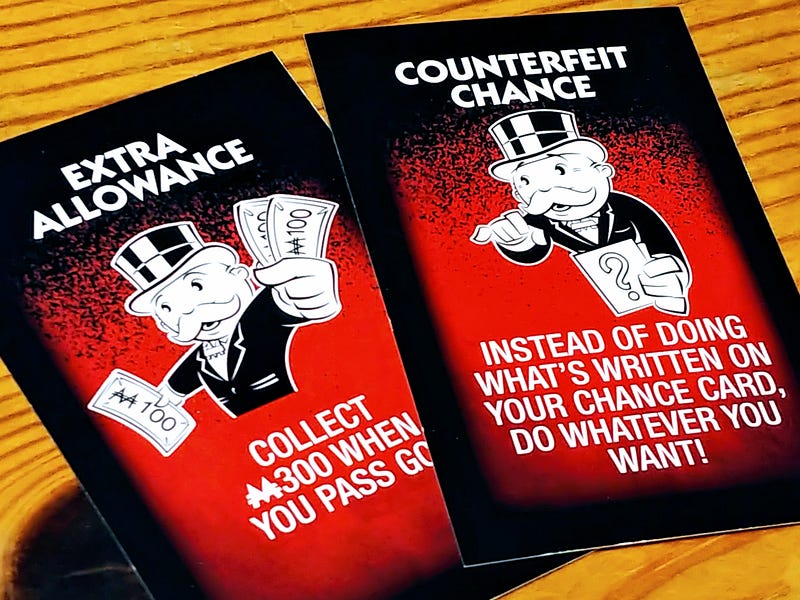
On top of that, because we were all dirty bastards, The Car could cheat without fear of anyone calling them out. If anyone did, they’d out themselves as the Saboteur.
About 20 minutes in, we realized the game was TOO easy. The Dinosaur suggested we change the rules mid-game to disallow “deals”, which were just money transfers at this point.
That’s when the trust stopped.
I, The Hat, shot The Car a glance, and The Dinosaur immediately tried to reassured us that he just wanted to add spice to the game. But the damage was done. Suddenly the game felt like financial Werewolf crossed with, Dog help us, TRADITIONAL Monopoly. Not only did we suspect our so-called partners, we were committing to a game what wasn’t all that fun mechanically. But we continued, now with an eye on everyone’s cash, property, Chance and Community Chest cards.
Another reason I’d been thinking about Cheaters was because of the election, and specifically Elizabeth Warren’s proposed tax bill. Warren’s bill would take a chunk out of the super-rich, staff-up the IRS to hunt down overseas and hidden assets, and take a 40% cut from any oligarchs that try to flee the country.
Libertarians and fiscal Conservatives say that the extra tax revenue won’t cover all the programs she wants to fund with it, even if she eliminates tax avoidance and evasion. They might be right, but I don’t care. Just making them less rich is good enough.
People don’t realize how the rich warp everything simply by being rich. Markets, economies, culture, politics, elections, governments, society. The super-rich are in the catbird seat of every deal they make with almost everyone else. They can say no to everything until they get the deal they want. They can horde that potential capital until everyone agrees to give them everything they want. Like a monopoly on money itself.
Normally, Cheaters ends when all properties have been snapped up and all players return to Go. Then, everyone collects Rent one more time and counts their loot. Whoever has the most cash, wins. Yes, you can be knocked out of the game, but total victory isn’t required to win.
But in this game, we had to end in a certain order. If we were out of order and there was a Saboteur, the Saboteur would win. If there was a Saboteur in the first place.
The game had turned into a process. Do your turn. Pay or collect money. If you were out of place, give money to the player above you. It went quick, but playing the actual game wasn’t the point anymore. Waiting for someone to subvert the process was the new game. We didn’t even build any Hotels.
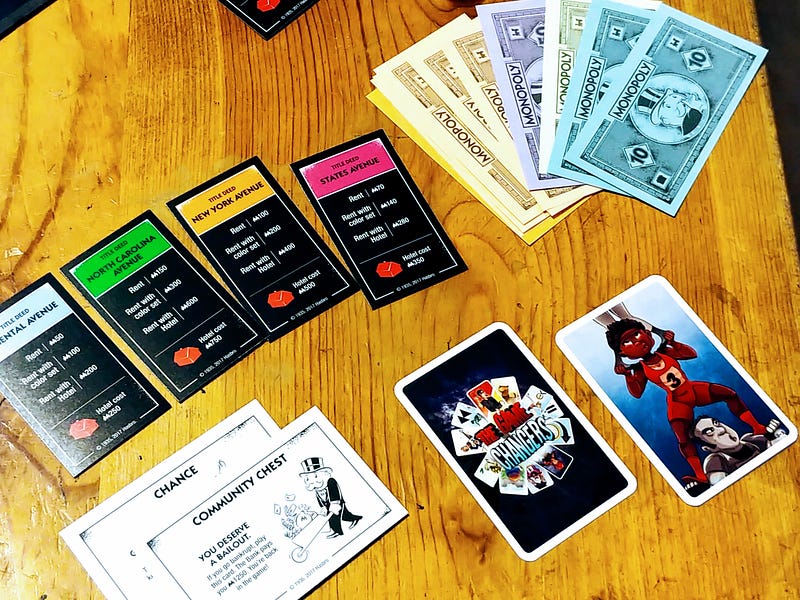
After another 20 minutes of play, which now felt like work, we finally cleared the board of property and headed back to Go. At this stage we were extra aware of everyone’s cash. We were also looking at Property values, which we overlooked before. To ensure the hierarchy was maintained, I gave almost all my cash to The Car, leaving myself just enough to pay Rent and not go Bankrupt.
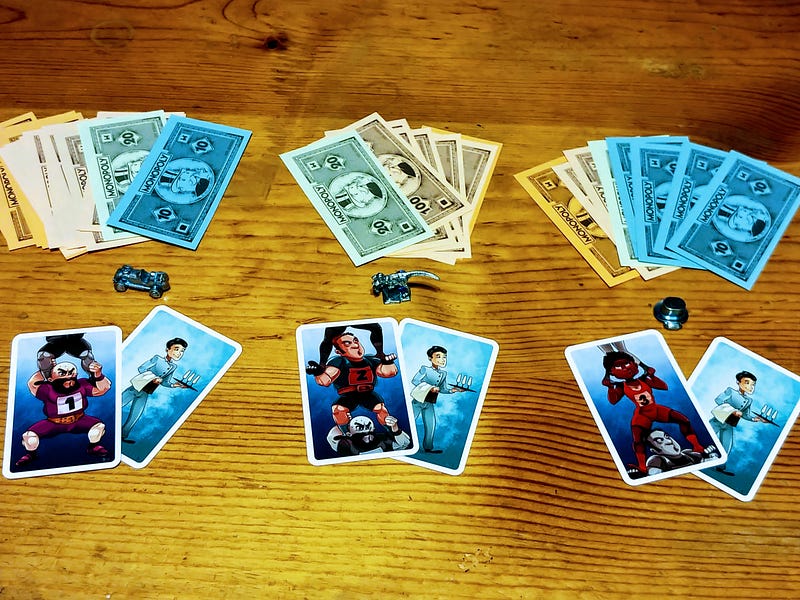
In the end, of course, there was no traitor. The Car ended with $3,930, The Dinosaur with $1,220, and I, The Hat, with $830. Did we win? Yes. Did we have fun? Not really. The experience was interesting, and the absurdity of locking ourselves into this game was kinda entertaining, but this variant requires some more tweaking.
Which brings me back to the biggest difference from traditional Monopoly. It’s entirely possible to survive until the end of the game without going Bankrupt. You can lose, but only compared to other super-rich people. You still have tons of cash. You are still rich.
In Cheaters, as in the real financial world, even the losers are still rich. So rich they will never need to worry about health insurance, mortgages, car payments, or dying cold and hungry underneath a bridge. Traditional Monopoly leaves fictional people in fictional bankruptcy. Cheaters Edition’s ultimate lesson is that even when they lose, if they’re rich enough, cheaters still prosper. Just look at everyone that works in White House.


