
Monopoly’s Anti-Monopoly Roots
Today, there is a concern floating around about the state of massive corporations such as Facebook and Amazon. There have been calls to break them up, people looking at anti-trust and anti-monopoly laws, and concerns about competition and labor. All of this would sound very familiar to Elizabeth Magie, the original inventor of the board game Monopoly. In fact, that’s why she invented to game; to call attention to the consequences of putting all the money and power into the hands of one person.
Elizabeth, Lizzie, Magie was born in 1866. Her father, James Magie was a newspaper publisher and an abolitionist, and raised her to question everything. She was independent, outspoken, and politically minded; despite the norms and expectations of her time. It was her father who inspired Lizzie to create her game by giving her a copy of Henry George’s classic novel Progress and Poverty.
Henry George was was an American political economist and journalist. While traveling around America, George witnessed the absolute destitution of working class people alongside growing wealth of a few upper class families. He came to believe this disparity was caused by the inequity of land ownership. Because of this conclusion he started calling on the state to tax the land and reinvest the taxes for the good of all. He argued that much of the land’s value didn’t com from what was built on the plot, but from the availability of natural resources, or from its surroundings. Things like nearby roads and railways, a thriving economy, a safe neighborhood, good local schools and hospitals; many of the things we look for when buying a home today. George argued that taxing the land was the best way to correct the growing disparity he saw.
Lizzie Magie was instantly on board with this idea and looked for a way to make the case to as many people as possible. In 1904, she invented and patented the Landlord’s Game.
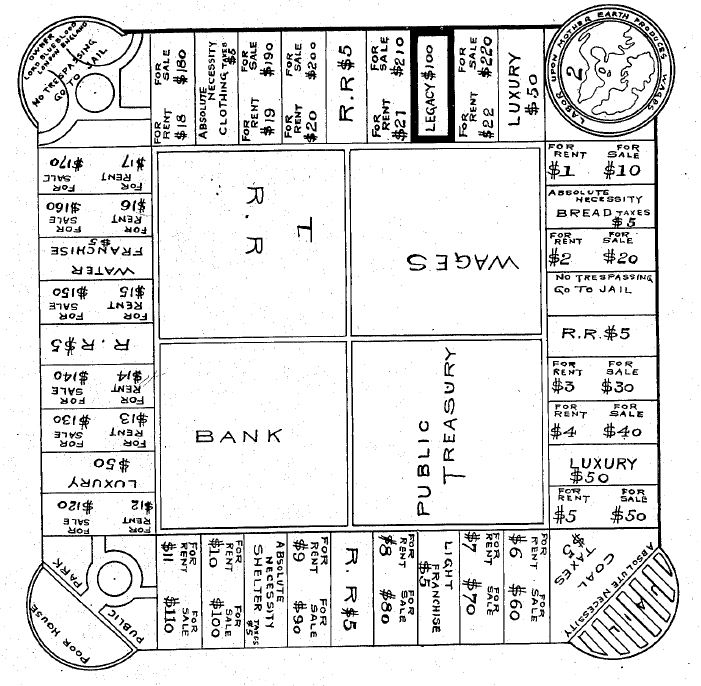
The board was laid out in a circuit, which was unique at that time, and contained streets for sale as well as several taxes and other events. The key mechanic of the game was the two sets of rules for the game.
With the Prosperity rules, each player was paid when anyone acquired a new property. This was to reflect George’s policy of taxing the value of land and redistributing the gains. The game ended when the player who had started out with the least money had doubled it. Under these rules everyone was a winner.
In the Monopolist rules players competed to acquire properties and collect rent from all other players who landed on their properties. Whoever managed to bankrupt the rest of the players was declared the winner. Hmmm… sounds familiar… and friendship ending.
The contradicting sets of rules were created to allow players to experience the difference between the pure competition capitalist model and the ideas that George presented and how they could benefit everyone. The game was a big hit in many left-leaning circles. It was played on college campuses and at intellectual gatherings. Because the board was so simple it was easy to reproduce on a sheet of paper and pass from friend to friend at parties and dinners. It was also well loved among Quaker communities. It was one of these communities who gave the properties the names we know today, naming them after streets in Atlantic City.
It was a Quaker version of the game that eventually made its way into the hands of a man named Charles Darrow. Darrow was unemployed at the time, not uncommon in 1932, smack in the middle of the Great Depression. He had been introduced to the game at a dinner with friends and enjoyed it so much he made himself a copy of the board.
Darrow’s group of friends referred to the game as a real-estate game called The Monopoly Game. He quickly realized that none of his friends knew exactly where the game came from and that they all were using handwritten boards and none had written rules. With this in mind he approached the US patent office with a slightly modified, handmade copy of the game board and pieces.
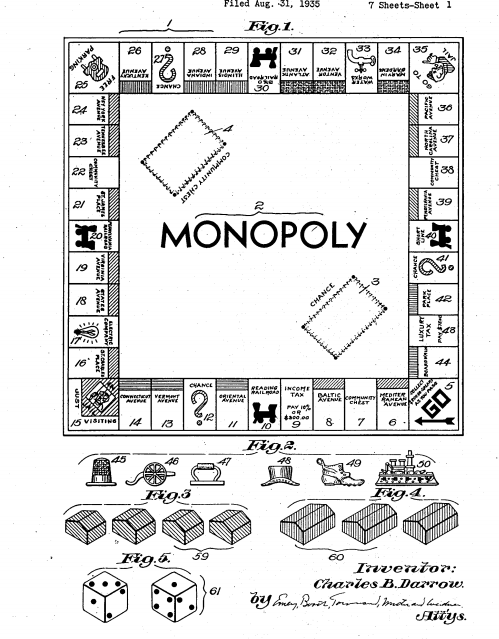
It wasn’t long before Darrow was able to broker a deal with Parker Brothers, one of the largest game producers in the country. Almost immediately, Monopoly was a hit. Whenever he was asked how he came up with such an amazing game Darrow would simply say “It’s a fluke!” and that he had created it in his basement. Parker Brothers was a bit more careful though. When they found out about the game’s actual origins they made sure to buy up any of Lizzie’s patents to ensure they held all the rights. They paid her $500 and even made her a copy of The Landlord’s Game to make it seem as legitimate as possible. She never saw any royalties and her name was never listed as a creator on Monopoly. The Landlord’s Game was never put into production.
Parker Brothers even used the myth of Charles Darrow as part of the marketing of the game. They used his rags-to-riches story as backdrop to a game that told you to chase wealth and crush your opponents if you want to come out on top. Even today the Hasbro website, who now owns Parker Brothers, gives credit for the game to Charles Darrow in 1935.
So the next time you sit down to a game of Monopoly, maybe try something new. As you set out the Chance and Community Chest cards, maybe make a third pile for Land-Value Tax. Each time a property owner charges rent to another player they have to contribute to the Land-Value Tax pile. How high should that tax be? And how should the pile be distributed? A game that makes you think about the value of money and how to benefit the most people? That sounds like exactly what Lizzie was hoping for.
This story is based on the amazing book The Monopolists: Obsession, Fury, and the Scandal Behind the World’s Favorite Board Game by Mary Pilon. All facts and quotes are credited to her. If you want to know the whole story, including how Lizzie and others have fought back against the Charles Darrow myth, this is the book for you!


