
Games and Money
Rich People Cheat Fair and Square
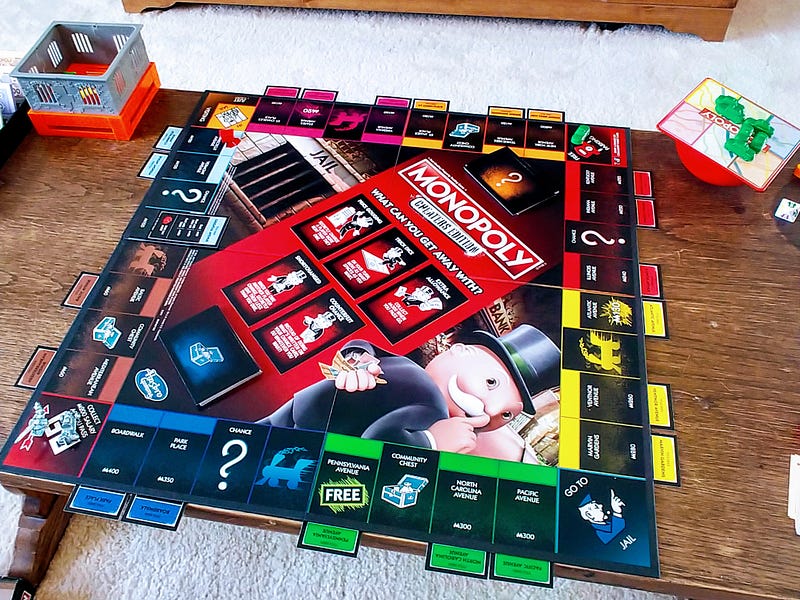
Monopoly: Cheaters Edition
FRAUD, n. The life of commerce, the soul of religion, the bait of courtship and the basis of political power.
— from The Devil’s Dictionary
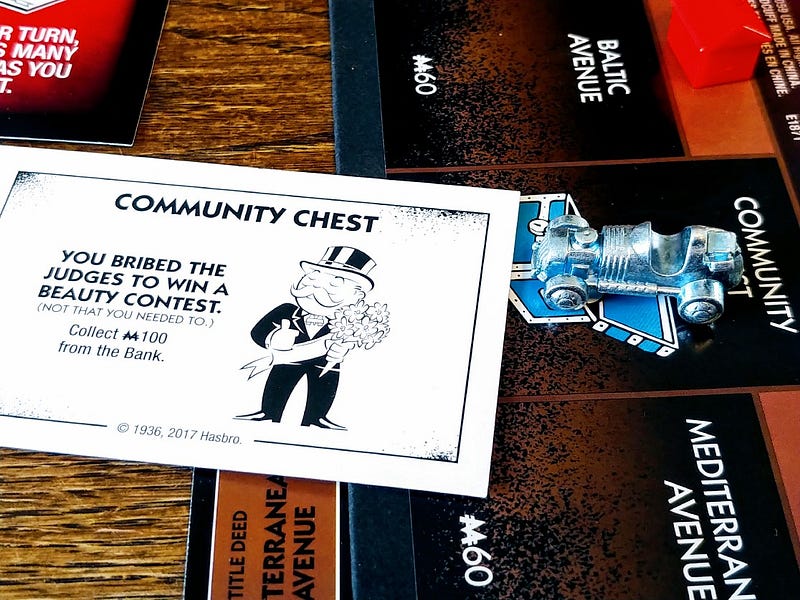
A few years back, researchers ran a series of social experiments involving Monopoly. Some players started with twice as much cash, while their unlucky opponents started with the standard amount. The Poors were further hobbled by being limited to rolling only one die instead of two. You’d think that when the advantaged players inevitably took the lead, they’d chalk it up to those advantages. That’s not what happened.
Most of the “winners” played down their starting advantages. Instead, they attributed at least some of their success to their superior gamesmanship. Further, they couldn’t help but act like alpha apes. When they moved their tokens, they slammed them down on the board harder and louder. They started bragging. They even made fun of their opponents’ inability to buy property. This isn’t all that different from the real world.
I played Monopoly once. It ended with my friend-with-benefits punching me in the face. Not because I won, but because we spent 20 minutes yelling at each other because I was too dumb to count right. I didn’t realize what I was doing wrong until the next day. My takeaway from the experience is that Monopoly destroys friendships and families. I had no intention of ever playing again until Monopoly: Cheaters Edition was announced.
“Behind every great fortune there is a crime.”
― Honoré de Balzac
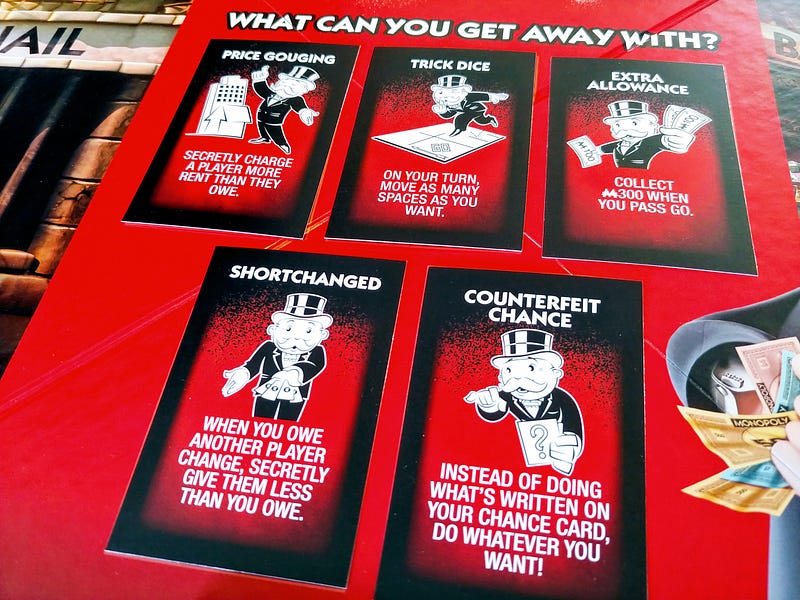
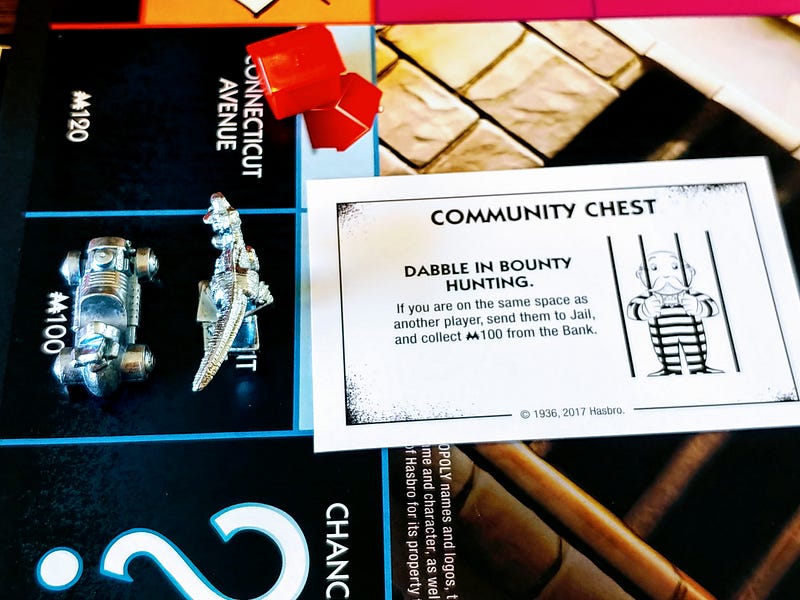
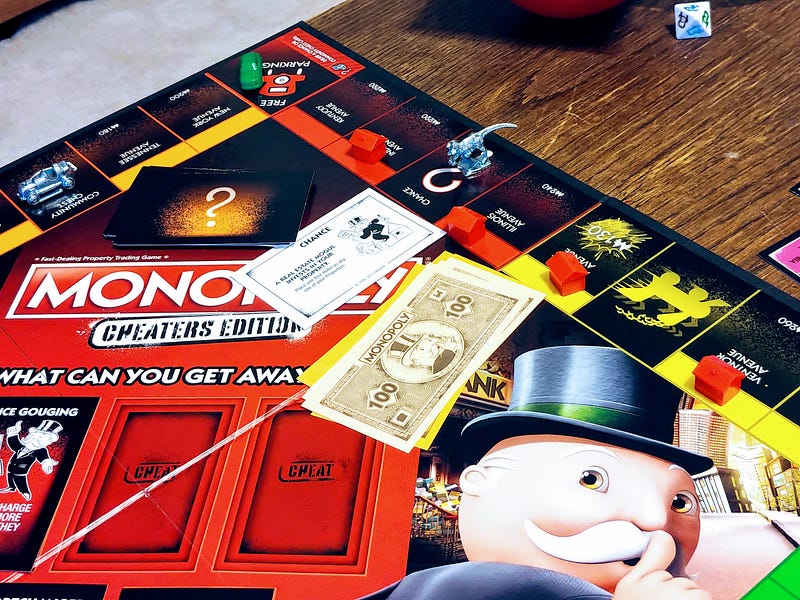
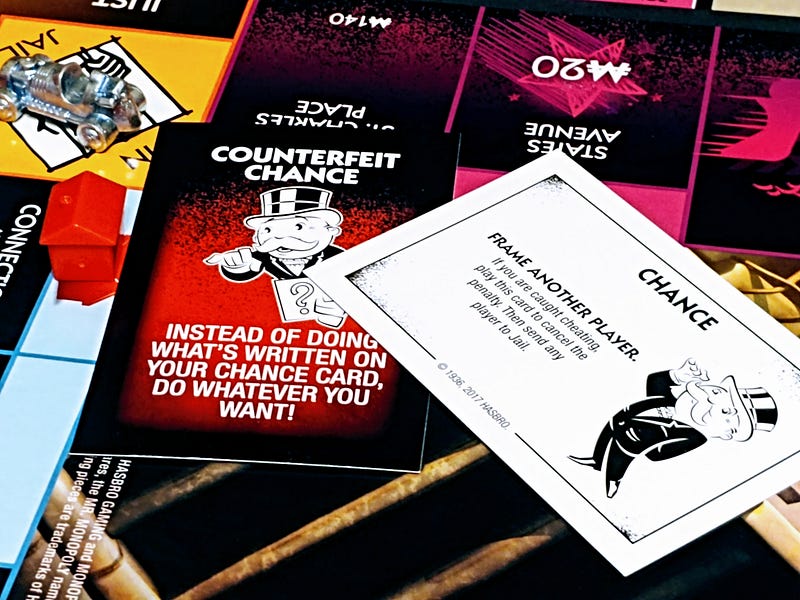
The Cheater’s Edition features 15 Cheat cards. Each has a prerequisite cheat, a reward for getting away with it, and a penalty for getting caught. If you complete the task, you can announce your deed at the end of the turn and collect the reward. If you get caught before the end of the turn, you pay a penalty. Most of the penalties are material, like returning stolen property deeds to the bank or paying fines to other players. Only 7 (maybe 8) out the 15 Cheat cards send you to Jail if you’re caught. Because Jail is for Poors.
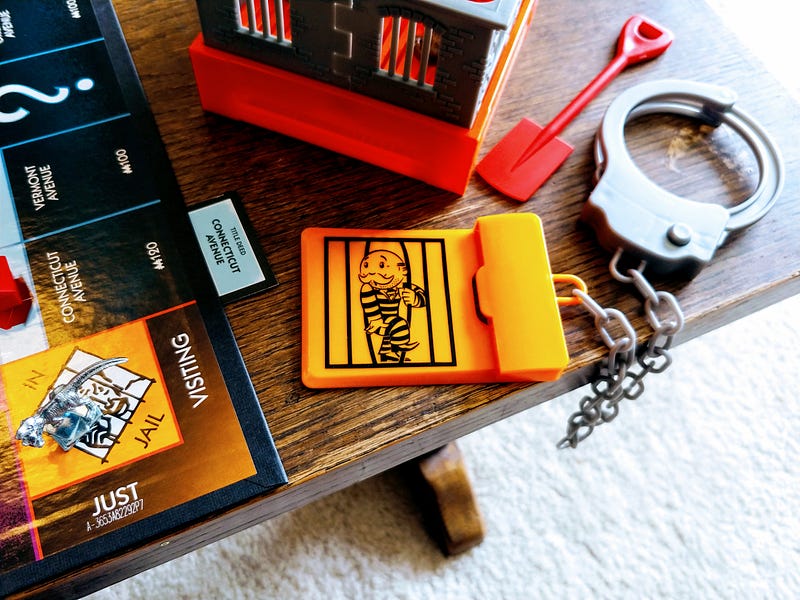
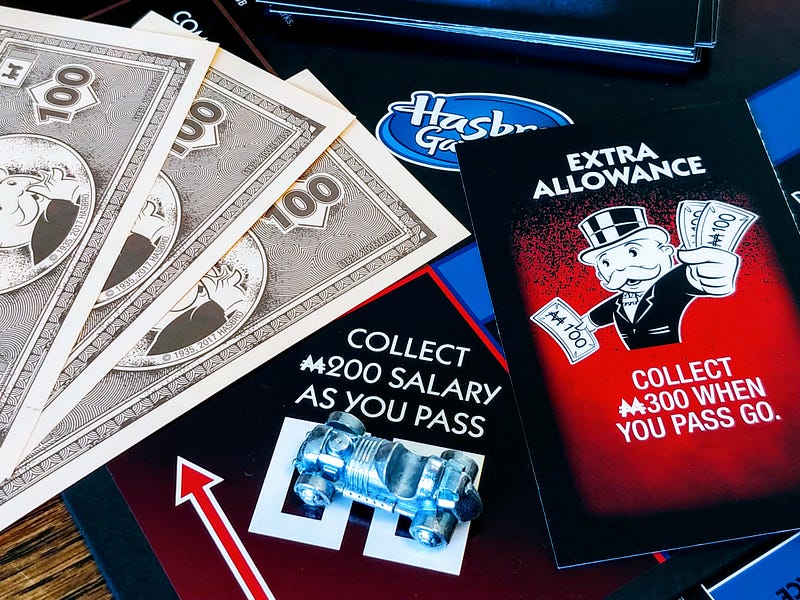
The game also includes a toy handcuff. Whoever is in jail has to wear it. The base slips under the board near the player, tethering them to the table. Other than being a pain in the ass, the gimmick has a bit of gameplay value. One of the Cheat cards rewards whoever can get it off without being noticed. If you slip if off undetected, you can get out of jail without paying or waiting.
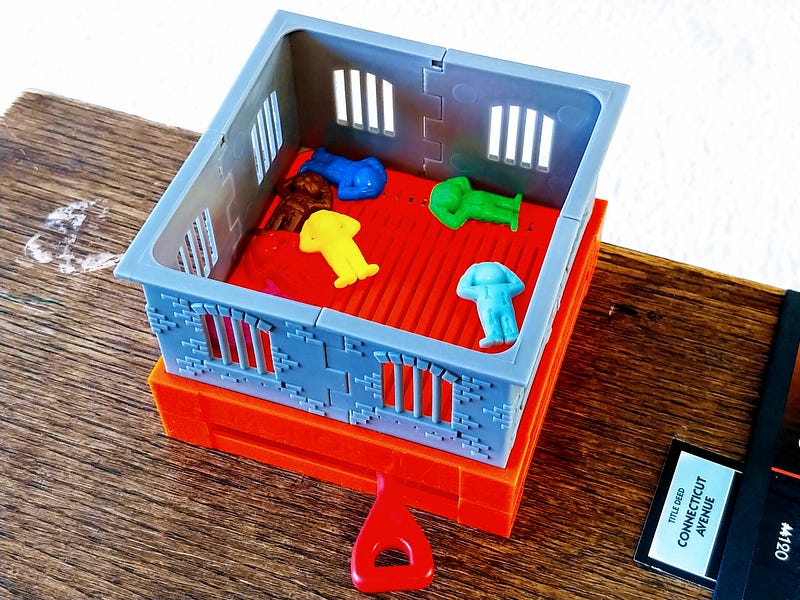
Because it’s me, I bolted on two lesser known expansions for classic Monopoly: Get Out of Jail and Free Parking. Get Out of Jail replaces the “roll doubles to get out of jail” rule with a dexterity challenge. If you successfully launch a prisoner out of the cell, you get to roll and move normally. You do this by hitting the bottom of the cell with a spatula-thing. Note that this replaces the rolling-doubles rule, but you can still pay $50M or wait three turns to leave. It’s not great. To spring a prisoner, you have to hit it just right. Combined with wearing the handcuff, completing the challenge is even harder.
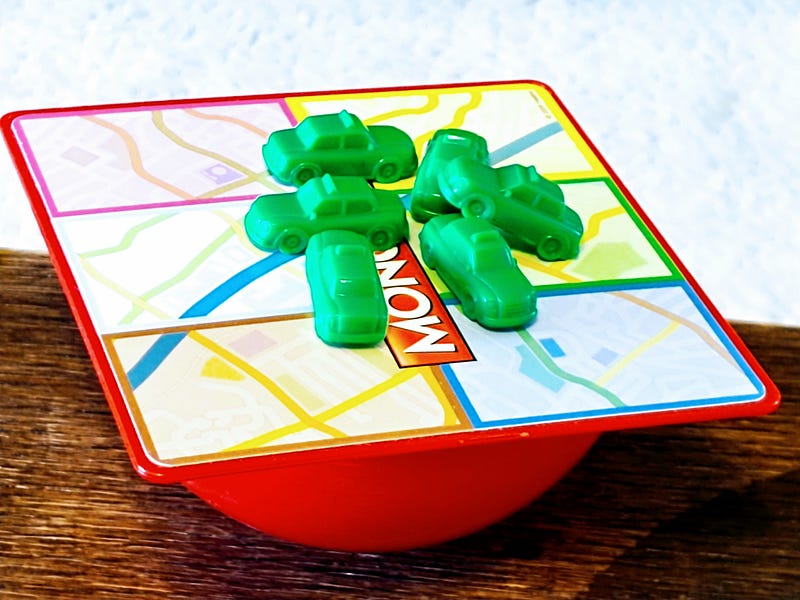
Free Parking worked way better. When you land on Free Parking, you can take the Free Parking Challenge. If you can balance 6 taxis on the wobbly board, you get a free cab ride to any other space. This was stacked on top of another change to the Cheaters Edition. Landing on Free Parking now lets the player draw a Chance or Community Chest card.
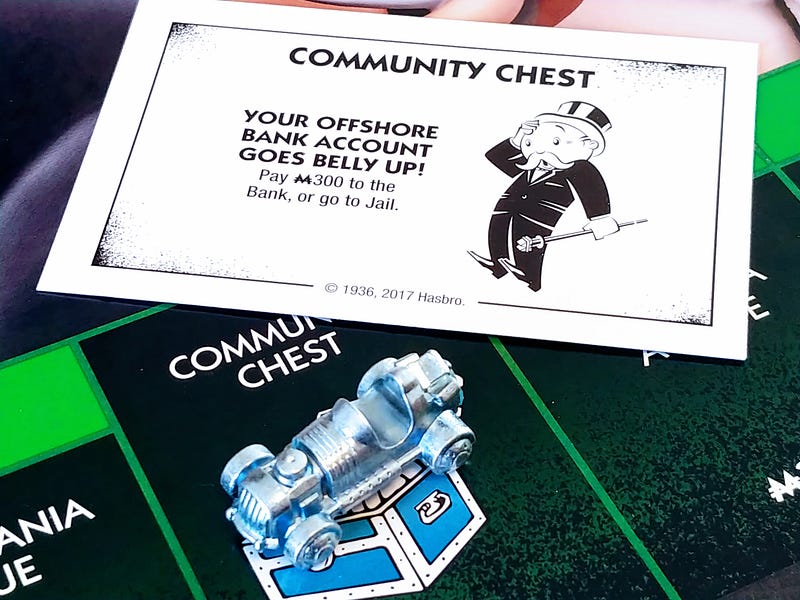
Historically, community chests “collected money from local businesses and workers”. That money was later distributed for community projects or aid. Conservatives love to say that private organizations would take up the slack of community support in the absence of government programs. If only people and businesses weren’t taxed so much! This, of course, is bullshit. Most rich people think charitable givers are suckers.
“A Monopoly loss is dark.”
— Louis C.K.
The Landlord’s Game, the precursor to Monopoly, was intended to be a teaching tool. The lesson was that Robber Barons had too much and left too little for everyone else. Sadly, that lesson never really sunk in.
Hyper-capitalism and Monopoly share the same flaw. Academics call it the Mathew Effect. Gamers call it the Runaway Leader Problem. This is when whoever is in the lead continuously increases their lead because they have more resources. In Monopoly, as in capitalism, that resource is money. The more money you have, the more properties you can buy and the more Hotels you can build. The additional properties and Hotels lead to increased income, which leads to more properties and Hotels. And so on. At some point, the leader doesn’t even need to play well. They become too rich to lose.
“Sure, the Trumps might have swindled various tax collectors out of hundreds of millions, but even devoted followers of the news have trouble following a narrative dealing in grantor-retained annuity trusts, illegal loans, dubious gifts, and fraudulent mark-ups of expenses. If only Trump had robbed a bank!”
— from Politico
Most of The Rich tell themselves that they deserve their wealth. They believe that they’re smarter, more disciplined, and more talented than everyone else. Even if they cheat, and they do, it just shows how clever they are. But a lot of them aren’t. Most of them are simply lucky enough to be born with advantages. Advantages so enormous that they can be monumentally stupid and still remain rich. Trump is the most obvious example, but he’s not alone. On the rare occasion that a Not-Rich becomes a Rich, it’s often because they got lucky in finding an exploit no one had ever thought of. Either way, it’s mostly luck.
Monopoly: Cheaters Edition neatly frames the lesson that the mega-wealthy rarely play fair. A lot of them cheated to get where they are and the vast majority of them continue to cheat to stay there. Trump embodies this lesson. The New York Times’ story on Donald and Fred’s decades-long con reads like a Monopoly horror story. Donny helped Fred cheat, then Fred loaned Donny as much cash as he wanted after teaching HIM how to cheat.
The rules we play by today were meant to be a variant of the original Landlord’s Game. In the beginning, Elizabeth Magie’s game played more like Anti-Monopoly. Charles Darrow’s knock-off doubled down on the monopolistic angle. His brutally capitalist version became the Monopoly we know today. What’s really ironic, tragic, and unsurprising is that Darrow made a killing from selling the patent to Parker Brothers. Magie got a pittance for The Landlord’s Game.


