
Todoist now puts Things 3 in the shade.
Todoist and Things 3 are two of the most popular task and project management systems. They offer just the right amount of basic features to ensure they deliver an effective task management solution for most people. Things 3 reserves itself for those that exclusively use Apple devices, whereas Todoist takes a more relaxed view, welcoming you whether you prefer Windows or Android over Apple.
I’ve used them both for well over 6 years, but only one seems to have continued to evolve by offering more features to enhance the user experience, and to bring users on a continued journey of improved productivity techniques.
Let me explain
Things 3 is an attractive and capable task management system. Some say it feels the most ‘Apple’ by design — which I suppose is a feature in itself, particularly as it dwells exclusively on Apple devices. But it shares more than design language with Apple, also sharing a philosophy. Apple is known to Android users as being the product that insists that you do things one way, the Apple way.
If you take the iPhone for example, it offers perhaps the most polished and smooth experience of all phones, but the trade off is that you’re limited in how you set things up. You can’t place apps where you want them, you can’t resize widgets, and Apple will ensure your experience is greatly reduced if you want to use alternative apps to their own, in certain circumstances — think Siri v Google Assistant, or Google Pay over Apple Pay. And Apple conditions users to question why you’d even want to have choice in the first place.
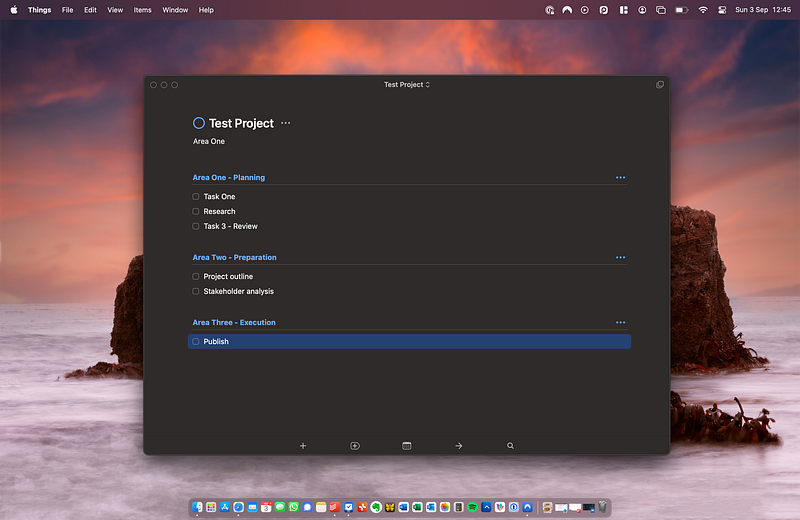
Things 3 is a bit like this. You do things their way. Your tasks will be managed in a list format and you’ll be happy with it.
For most people that wont make much difference — in the same way that placing apps freely doesn’t make much difference to iPhone users, but like Apple, Cultured Code have removed that option from you.
I also think that Things 3 has taken a mantra of evolution and not revolution. That is they take the polishing cloth out rather than the tool box.
Updates typically go unnoticed and additional features seldom arrive. But for the majority of people, that’s probably perfect. If it aint broke don’t fix it right?
Todoist revolution
That doesn’t seem to be the case with Todoist. Doist, the clever people behind the app keep adding features to it. It feels more akin to Android than iPhone where the developers aren’t afraid to add something new and change their users’ experience.
There are now a number of features found in Todoist that simply don’t exist in Things 3 and for me, this now makes it the stand out product and one I’d recommend every time. Some examples of these include:
- Collaboration. With Things it’s a solo task management system but with Todoist you can share tasks, projects, and boards, with others
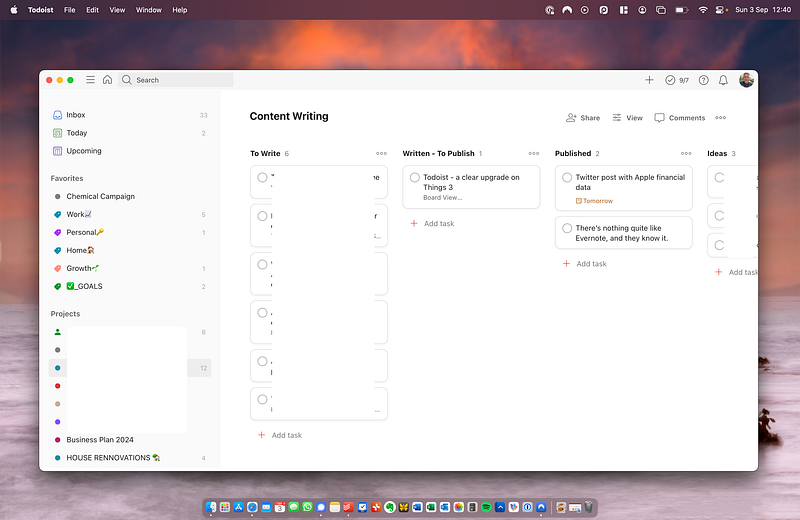
- Board or List View — Todoist introduced a kaban view, meaning projects can be managed as a list or a board [see image above]. I’d not experienced or used these boards before. I was aware of them, but hand’t used them as they didn’t feature in the products I use. So by implementing this feature, Doist educated me on a new and different way to manage tasks
- Comments and Attachments — you can add comments to tasks as well as attachments. This is really useful should a task require you to review a document (attach it and save time for later). I use the comments on shared project boards. Whether that’s giving a team member a nudge or referencing some additional information.
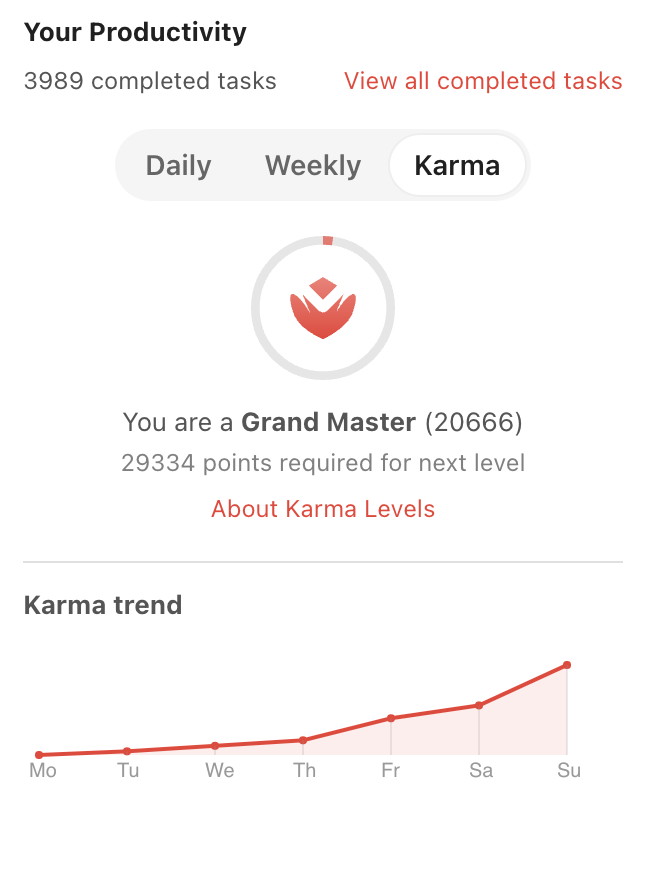
- Karma — this may sound shallow, but Todoist rewards the user for managing tasks, by rewarding points that lead to progression through productivity levels. This may not seem that important, but when a colleague says they’ve just started using Todoist and you can respond with “great news, I’m a grand master”, it’s kinda nice. It also gives me extra motivation to do tasks on time (you can lose Karma points if you’re not on top of things — no pun intended)
- OS Agnostic — this is a big one. I’m someone that gets bored with an operating system pretty easily. I own a Mac and a PC and usually have an iPhone and an Android. Yeah it’s probably overkill, but tech is a passion and hobby of mine. Being able to manage my tasks without any restriction on hardware is a big deal. When I used Things, it was when I felt that Android was not a credible alternative to Apple. But things have changed and in many ways it’s better. So I wanted the freedom to pivot.
I’ve written a bit about my own journey, which you can read here.
So while Things 3 remains a great task manager, one that will enable you to actively manage your task load, there are limitations, and as a long time user, I got to the point where I accepted that there will probably not be any major upgrades any time soon. Perhaps Things 4 will bring a new expereince with some additional features, but until then, I doubt it.
It’s this reason that I moved to Todoist a year or so ago (though I started using it around 2015) and it’s why I recommended Todoist in my book Effectively Productive. It’s the best product for most people.
There are plenty of alternatives available and you don’t have to go further than a Google search to discover a list of alternatives, some of which offer a great deal extra than Todoist. But for me Todoist strikes the perfect balance of features, efficiency, value, portability, and design.
Your mileage may vary, so I’m interested to hear your thoughts on the subject. Do you prefer Things? Tell me why in the comments.
You can check out my book, Effectively Productive, and how I believe effective productivity is very different to productivity. For about the cost of a cup of coffee.


