
Machine Learning
to Survive We Need Medieval Bells
Can ML Prevent Climate Catastrophes?
This summer’s floods in Germany have killed over 210 people, and the economic costs are high. Many have been wondering why the emergency systems didn’t work.
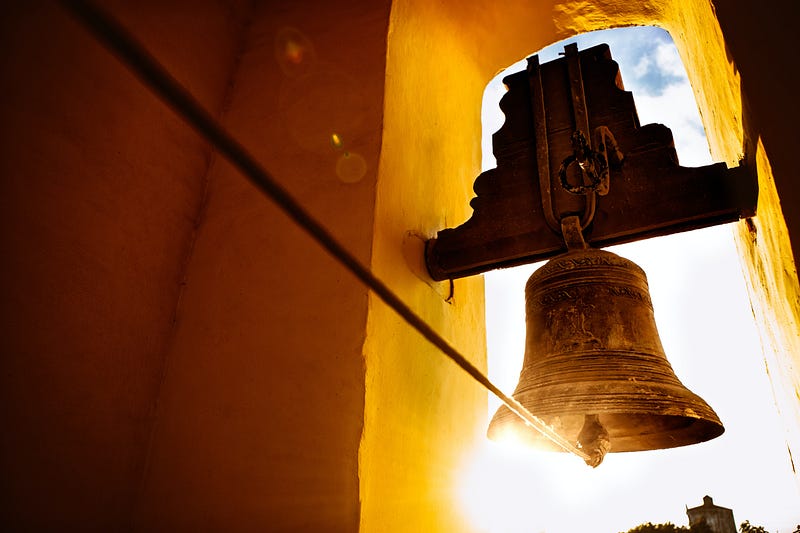
In some communities in which power was disconnected, the sirens failed. In some places, there were no sirens to warn people. Instead, volunteer firefighters had to knock on doors to tell people what they should do. The German press reported that in the suburbs of Wuppertal, north of Cologne, a monk warned people with a medieval church bell. The sound of a centuries-old bell saved many people’s lives.
The greatest threats to humanity in the next 20 years: 1. Climate Change 2. Pandemic 3. Nuclear Accident
I will not write about all 3 points in this article but will focus on the first. You have already experienced the other two points/disasters.
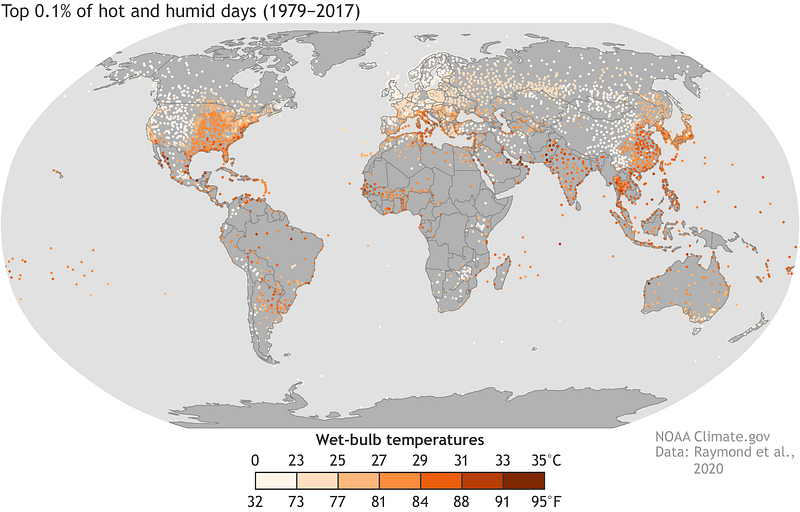
I conceive that the pinnacle risk in the event of a climatic catastrophe is the wet-bulb temperature.
What is the wet-bulb temperature? The higher the temperature, the more difficult it is to cool your body by sweating. If the temperature is too high, your body will overheat and die. So, it is a matter of life and death to keep the temperature from rising too high. A wet-bulb thermometer is a thermometer that is covered in water-soaked cloth. It is used to measure the temperature of air that is cooled by water. If it is 100% humid, the wet-bulb temperature is equal to the air temperature. If it is less humid, the wet-bulb temperature is lower than the air temperature because of evaporative cooling. The wet-bulb temperature is the temperature you get when you take the air temperature and add the humidity. It’s a measure of how hot it feels. The theoretical limit to human survival for more than a few hours in the shade, even with unlimited water, is 35 °C (95 °F), which is the same as a heat index of 70 °C (160 °F). If it’s hotter than that, people can’t survive in the shade. Even people who are used to hot weather cannot do things outside when it is very hot. Parts of the world could become uninhabitable in the future due to deadly wet-bulb temperatures, according to a 2015 study. A 2020 study documented that cases of a 35 °C (95 °F) wet-bulb temperature had happened.
It foreshadows the catastrophe to come. Will there be enough monks with medieval bells to warn humanity?
The problem with the people is that they are not getting themselves to know what is actually happening, they are being afraid of things that have never happened yet. I believe that machine learning is the most appropriate tool to expand our imaginations. The collective knowledge gathered in ML models allows you to get rid of the limitations of personal experience. The brightest protein minds are no match for NLP models trained on 410 billion byte-pair-encoded tokens.
Machine learning allows you to expand your imagination. It gives you a chance of living without having everything be stagnant and confined by your own perceptions. It asks questions and it asks questions until you discover new things about yourself without even noticing it at first sight. So while I do not think it is possible for all the people in the world to suddenly change their perception about risks, it is possible for them to take more risks.
Machine Learning (AI) is like this medieval bell in the hands of a matured data scientist. Ring the alarm to notify everyone of the danger. Use visualization, prediction, and analysis to see the future
It is undeniable that machine learning has the potential to change things, but it is also true that not everyone will make use of this technology. As such, it’s up to us to save the world with what we currently know and what we know how to do. And since machine learning cannot stop climatic catastrophes from occurring on its own, all we can do is prepare for it. What are you doing to prepare?
The Wuppertal monk knew how to use the bell, do we know how to use our ML tools to warn “our neighbors” I am curious about your thoughts
- Check out my instagram with new material every week
- If you enjoyed this, follow me on Medium for more
- Want to collaborate? Let’s connect on LinkedIn
- https://linktr.ee/datasculptor
- 3D Machine Learning generated model on sketchfab


