
To All the Camels I Rode
And why I will never do it again
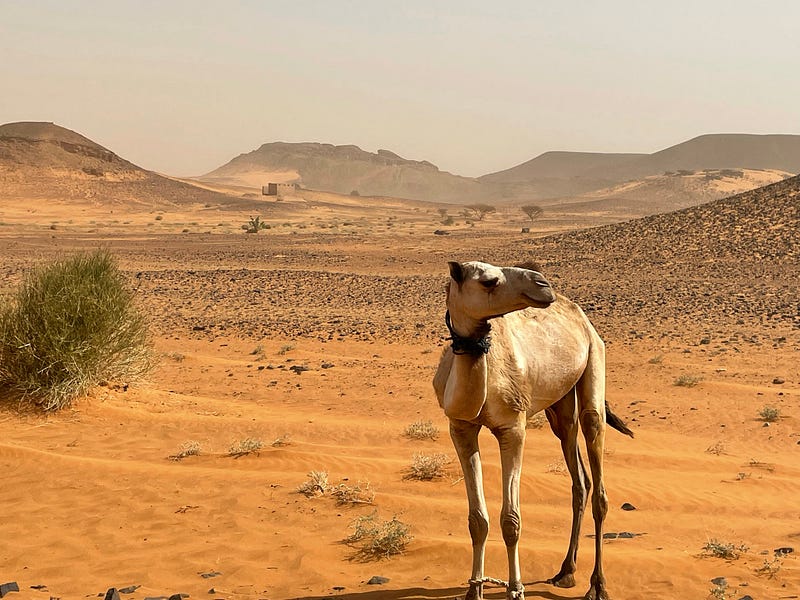
Let’s just say it outright. Camels are tall. And I am scared of heights. So, there is that. I get scared when they rise from the ground, front legs first, and suddenly I am facing the sky. Even worse is the moment when they kneel down. The front legs are the first to hit the ground and I feel I am about to fly overboard before the back legs settle down too. This is one of the reasons why now I prefer to walk alongside a camel rather than on top, but it is not the only one. Truth is I still love camels. Apart from the two naughty cats I room with, they are my favorite animals in the whole world.
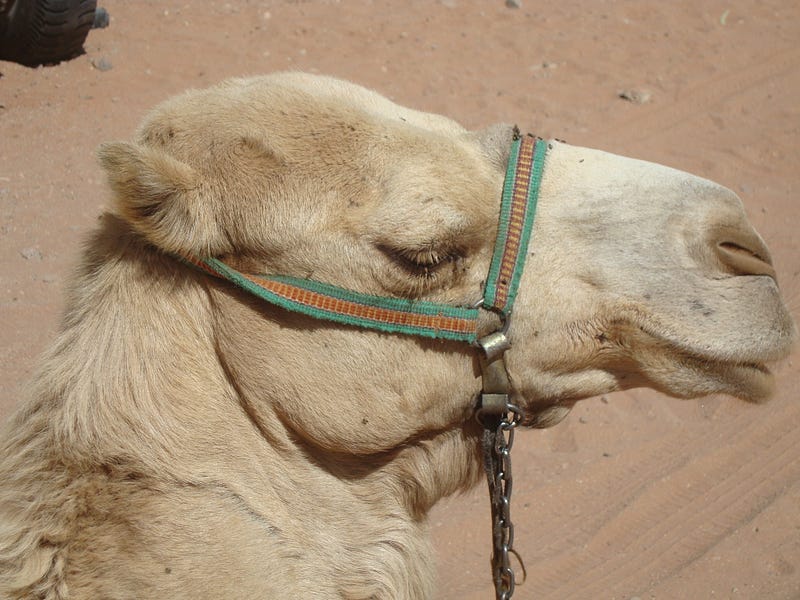
I was never shy around camels. I met them in Morocco, Jordan, Egypt, and Sudan. The sand is always different, silky in Morocco, brownish in Jordan, yellow in Egypt, red in Sudan. And so are the camels. I am not a biologist or a camel expert, so my observations are purely anecdotal. This is simply what they looked like to me. The camels in Jordan were the furriest, with soft long hair, and small in size. In Egypt, they were tall with shorter hair barely giving the impression there was something covering the skin. The camels in Sudan were similar but looked lighter on their feet, not so much garments weighing them down. In Morocco, they were the most orderly, probably because they were tied to each other by a long rope.
I love them all, tall, short, elegant, hairy, skinny. But does that mean I need to climb on top of them on every occasion? Or can I simply be content to admire them from afar? Perhaps I should, because it is the treatment of camels in the tourism industry that deters me.
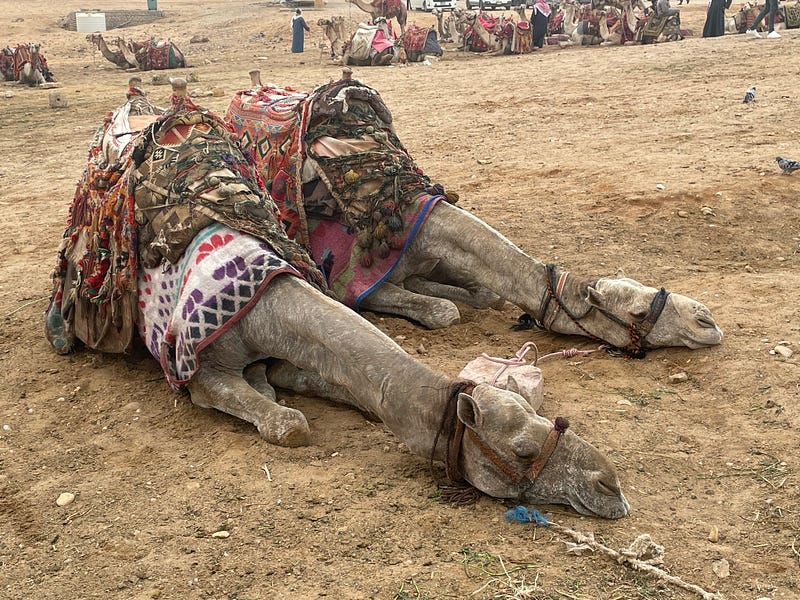
I began asking questions. Usually, I am quite shy but on these occasions, I couldn’t help myself. In Jordan, I saw a camel collapse. This followed a horse and a donkey that gave in under their rider’s weight in Petra. I couldn’t help myself: How can you treat them this way? Don’t you see they are tired? I was young and my parents pulled me away before I could get myself in trouble. In Egypt, I saw a camel bleed from the nose. A thick metal ring jabbed inside. I asked the owner. Your camel is bleeding, shouldn’t we do something about it? It’s normal. It doesn’t hurt them. This was the answer. I am no expert, maybe camels don’t feel pain. But blood is something that shouldn’t leak. Eye infection, showing rib cages, flaring whips. Sure, some camels looked young, well-fed, and healthy. But it’s that “some” that worried me.
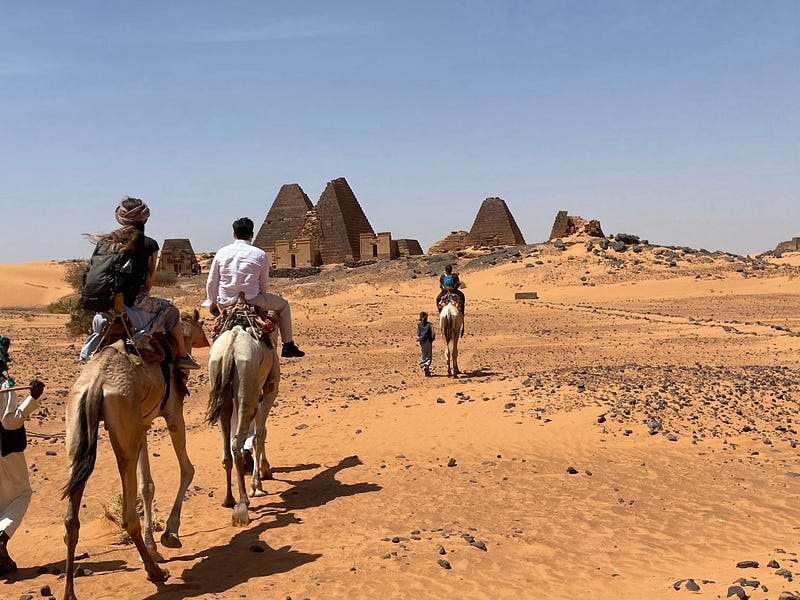
So, I started refusing rides. In Sudan, I told my friends I preferred to walk to the pyramids. It was a place where we hardly walked anyhow, so I craved the exercise. I found no resistance and I enjoyed my paced walk next to the tour guide, while my friends were trotting on top of the light-foot camels. Resistance, however, is what I found in Egypt. There was no way I was going to climb on top of the bleeding camel. My guide however insisted and insisted. I suspect she had some kind of arrangement with the camel owner. Splitting a tip or something. Thankfully, I was traveling with my dad who has some mobility issues and there was no way he could climb on a camel, so the guide resigned to offering us a carriage ride. I think about those horses too. Somehow, I doubt they were treated any better...
We have long accepted that tourists should refrain from riding elephants. The weight of humans hurts their backs, and more and more people are refusing those rides. So, the question is: Are camels more like elephants or more like horses?
Given their nickname “the ships of the desert,” one might think, and rightfully so, that they are accustomed to carrying humans from one side of the desert to the next. Camels are incredible creatures. For five thousand years, they have been the trusted companions of nomadic people, providing them with transportation, and nourishment in the form of milk, meat, leather, and fuel. They can store up to 80 pounds of fat in their hump and can drink up to 40 gallons of water. They can travel 40 kilometers a day, hold 1300 pounds of weight, and go 10 days without drinking. But should they be lugging tourists on back-to-back rides to visit pyramids, sleep in beduin camps, and such?
The issue comes down to the treatment of camels. Just to reiterate, I am not a camel expert. I am not able to look at them and be sure they are happy, well-fed, healthy, and treated with respect (apart from you know… evident bleeding or collapsing to the ground). The best option is to inform ourselves before we book a camel tour, Google the tour company, and see if animal rights groups condone them or not. Is the tour company abiding by animal welfare rules? Are the camels broken and trained with violence? Are there laws regulating the employment of animals in the tourist industry? Some preparation can ensure we are comfortable with our choices as tourists. If we are not sure, if we see more than one person on a single camel, it is okay to say no, even when we meet resistance. It is okay to ask questions and speak up. Animals shouldn’t suffer just so we may travel.
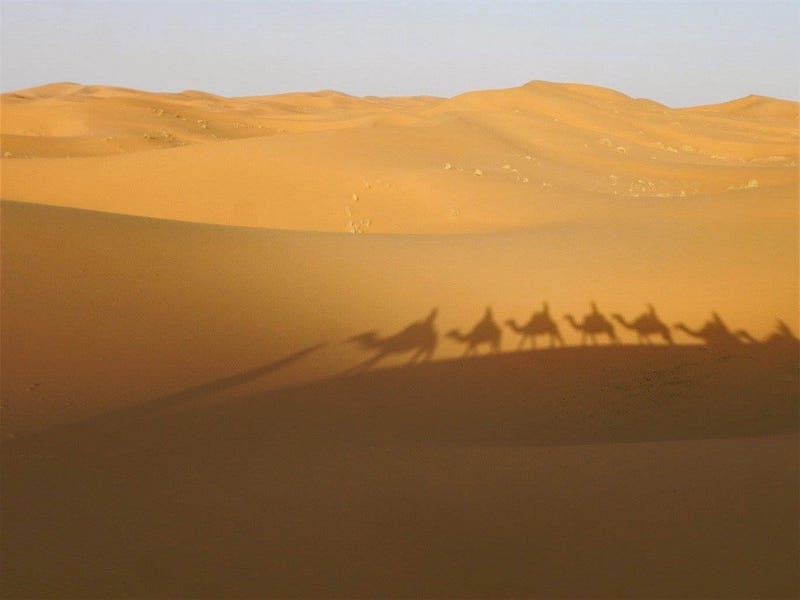
I love camels to their very core, but personally, I am done with camel rides. Next time I will be fortunate enough to encounter another camel, I will be sure to admire it from afar. Envious of that devil-may-care look that teaches us petty humans to glide over things from above, rather than bearing the weight of the world on our heart.
“Le plus difficile, dans le désert, c’est de trouver la sortie.” — Philippe Alexandre
I loved the opportunity to write and read about animals encountered on our trips.
Seeing gorillas is a dream of mine and I hope I will manage one day!