
Sitting with Mountain Gorillas
A story for the Globetrotters Monthly Challenge
The drive from Kabale is beautiful, up through forests of bamboo, over a mountain pass cut through thick vegetation, and down into the lowlands on the western side. But the pickup truck driver is unhappy because the eight of us in the back don’t fill all the seats. He slows down in the village of Kisoro, honking to get more passengers.
A man standing next to a crate of live chickens leans out, waving. However, when he picks up the first crate to shove in the back with us, it breaks open and the contents flap out, startled, and scatter on the road. We all wait while he chases them around. After five minutes he is missing only one, but the driver, now visibly agitated, says something under his breath and we lurch off westward toward the border. The chicken owner looks after us, downcast and still minus one chicken.
Half an hour more and we are at the immigration post, a sorry, broken-down building along the muddy road. Young men jostle for our attention, pushing close and whispering hoarsely “change money?”, impervious to my obvious disinterest. I’m not looking forward to this crossing, because while Uganda is relatively orderly with predictable transport, currency value, and infrastructure, Zaïre is not.
We stand in line forever on the Uganda side to get the outgoing stamp, but in the end, the customs agent passes over the opportunity to paw through my dirty backpack. On the Zaïre side things go much faster, they don’t seem to care much about anything, barely checking to see if I have a visa. At the customs table, the agent rests his hand on my pack and asks politely,
“Voulez-vous changer d’argent?”
I pause to consider if this is some kind of trap, sprung by the law enforcers themselves. But this is Zaïre! No one cares. I nod and he writes 180000 on the palm of his hand with a pen. This rate is about what I expected so I hand over a $20 bill. He tucks it away and pulls out a stack of Zaïres notes. Or rather a pile. I shove it all wherever I have space and walk out.
Our little traveler group assembles outside the building. Three Kiwis, two Aussies, a father and son duo from the US, and me. We are besieged by would-be guides, shouting and gesturing. They know exactly what we are here for. After some negotiation we settle on two boys who puff up in importance, now waving off other hangers-on with fresh authority.
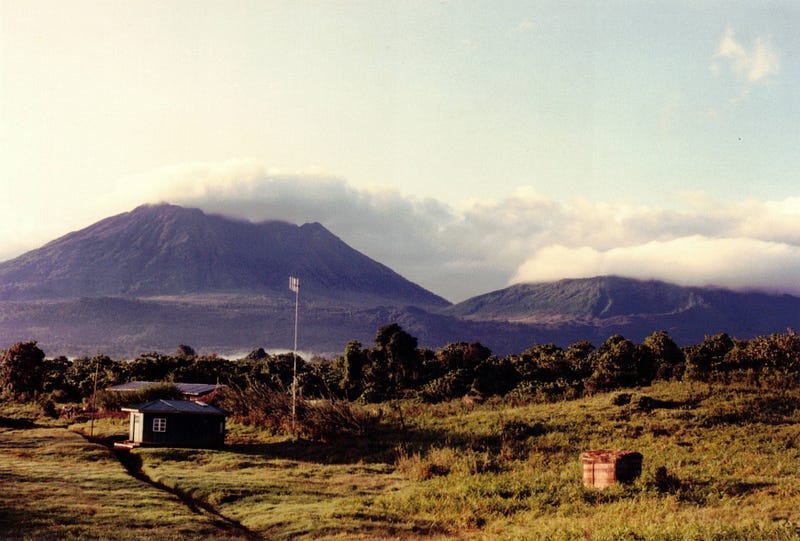
We start off immediately up the slope on the right side of the main road, through a village, and up, up, through the dense forests. It takes two hours to arrive in Djembe, just north of the Parc National des Volcans, where the game lodge and national park offices are.
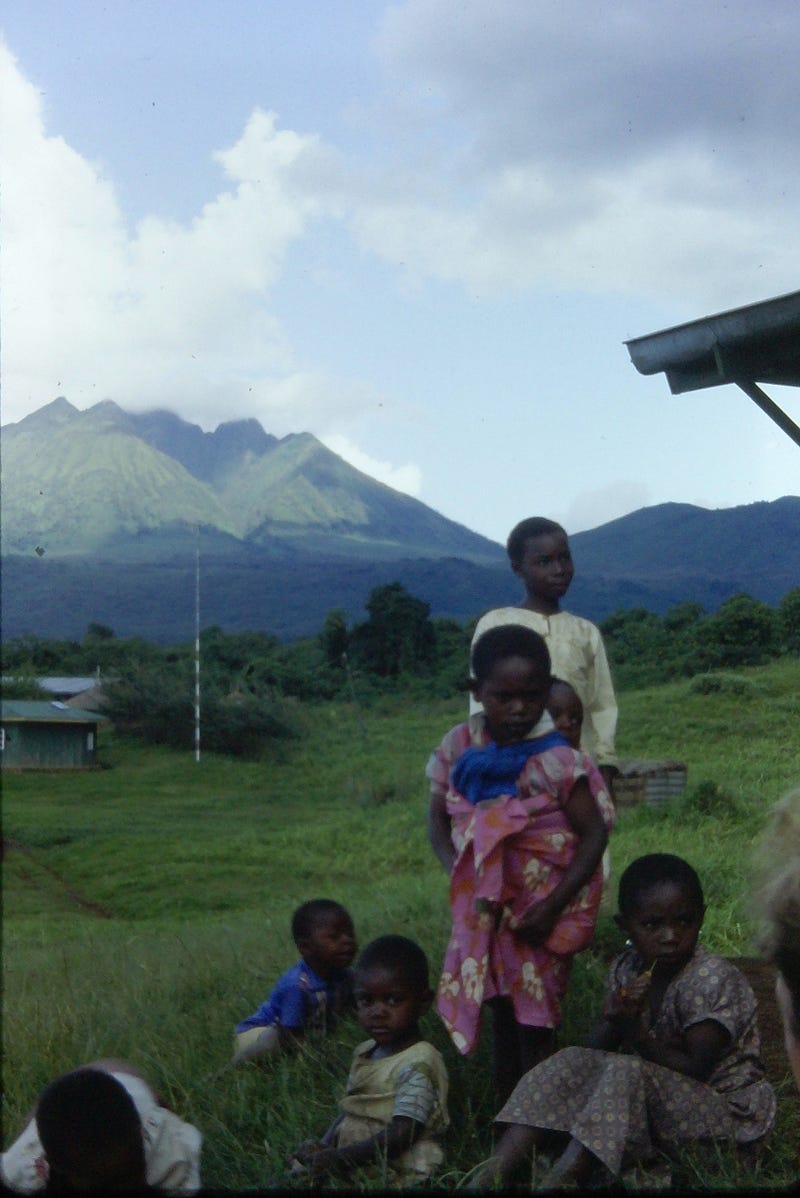
After paying the guides, we troop into the office. The park ranger sits behind a worn desk with a stack of pink cardboard permits by his side. He asks each of us for our passports and scrawls the names on the permits. He then crosses out the printed park fee of US $100 on each and writes in $120. The groaning and cursing passes down our line. No one really believes that all this money really goes to the park. There is a mumbled joke about helping to pay an installment on Mobutu Sese Seko’s yacht in Monaco.
For me at the time, $120 was worth about six days of travel costs. But I went to the trouble of getting here, and now I was a captive audience for however this was going to work out. Africa is like that, you just take the chance.
We set up in one large room of the lodge, the only available spot for all of us. There are only two beds, so once those are doubled up, the rest of us roll out sleeping bags on the floor.
A group of muddy, exhausted tourists stumbles in and collapses in the common area, just in from their day tour. It is almost dark outside. Of course, we are full of questions. Did they see the gorillas? How hard was it to find them?
They did, but it took many hours. The guides generally know where the groups frequent, but they move every night and one can never be sure what direction they’ve gone since the day before. Today the guides chose the wrong direction and this led to hours hacking through the undergrowth. Coupled with heavy rain, it made for a tough day.
A few of us share a cursory meal of sardines and crackers, and I climb into my sleeping bag. I’m glad that a sighting was made, as this (hopefully) will make tomorrow’s expedition successful.
Everyone up and ready to go at sunrise. The ranger who will be our guide today appears, friendly and professional, and off we go. We cross the invisible barrier that separates the denuded village fields from the undisturbed mountainous jungle.
Before going very far, our guide gave us a few rules. One is to never look an adult gorilla in the eyes. Another is not to reach out and touch them. A third is, that in the event a gorilla walks straight at us, we are to move slowly to the side. This establishes a pecking order and we won’t be perceived as challenging them.
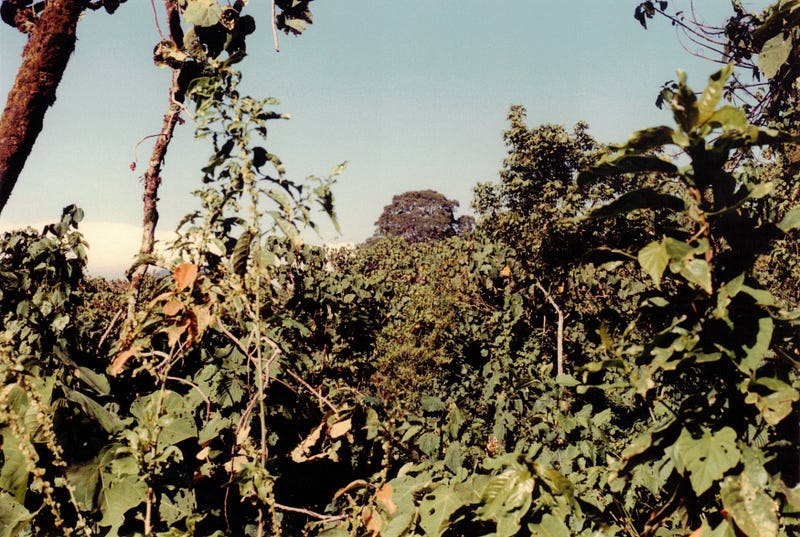
This is not a lowlands rainforest, with tall trees, a blanketing canopy, and a walkable understory. Rather it is a thick mass of tangled vines, bushes, and short trees. The guide leads us down some previously cut paths for an hour, then we dive off into to one side. He chops his way along, gazing up into the trees.
After a half hour of this, he stops and points with the machete. A nearby tree has a matted collection of branches and leaves wedged in a spot where the trunk splays into parts.
“Is a nest,” he nods, “they sleep here last night. We go quiet now.”
Mountain gorillas, though they are large and spend a lot of their day on the forest floor, prefer to sleep in the trees. They collect twigs and make places for themselves to safely pass the night. We pass more nests as we move silently along.
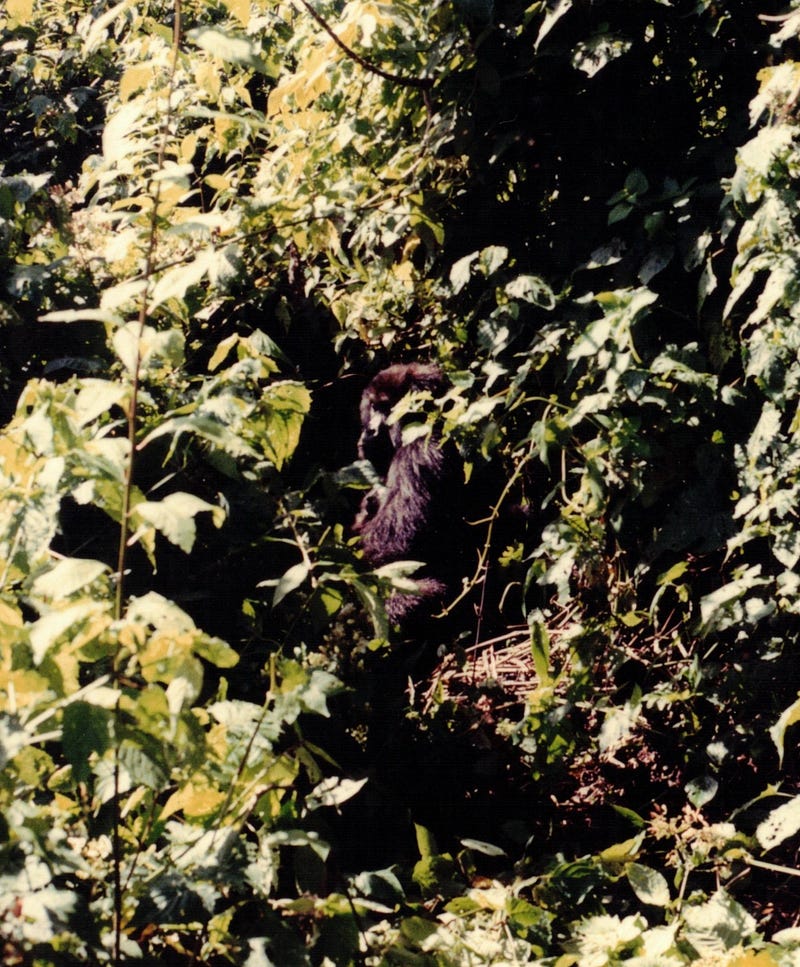
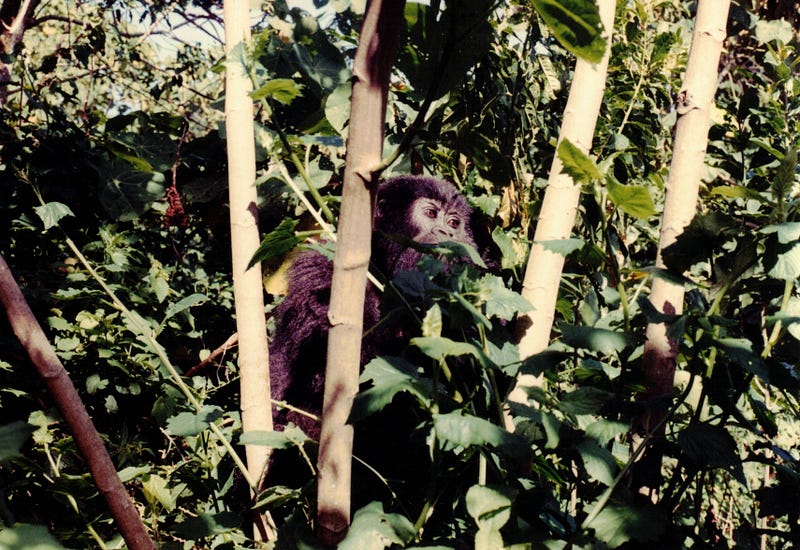
Our first encounter is with an adult female with her offspring. The mother sits quietly, chewing leaves, not bothering to acknowledge our presence. The young one, however, comes within a few meters and makes a show of beating his tiny chest. We try hard not to laugh at the comedy of it, but silence, after all the anticipation of seeing these amazing animals, is impossible.
We next go past an adolescent gorilla in a tree, just hanging out and looking bored. The next three are very young, on the ground playing together. One turns a few somersaults. Is he doing them for the benefit of his companions or for us?
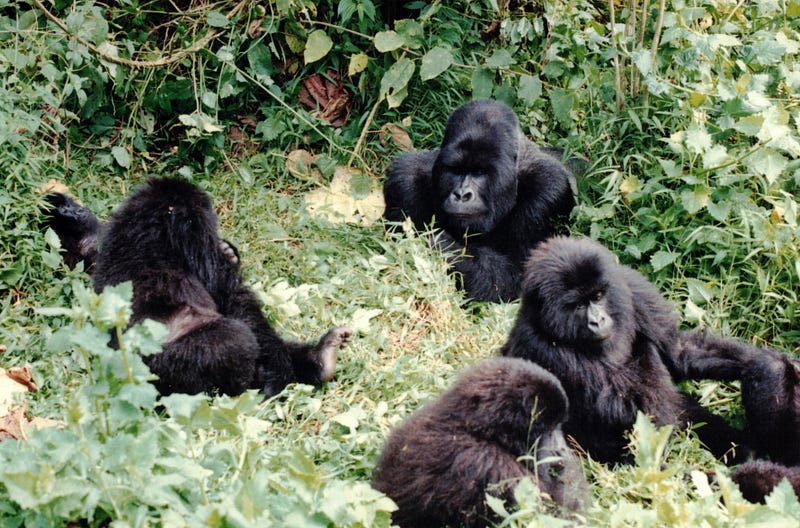
Presently we arrive in a small clearing, and our guide motions us to sit. Six full-grown gorillas are lounging in the grass, picking leaves. A few ‘toddlers’ hang close to them. There is such peace how they conduct themselves. There is also the weird sensation of being in the presence of a race of highly sentient creatures, just going about their business, fully aware of us but finding it of little importance.
Sitting there with the troop, I mentally run through the rules that were explained by the guide. One of the babies ambles over and goes close to the person sitting next to me. Before he can move away as we were instructed, the little guy licks his arm. Then the baby turns and brushes up against me. I am expecting the spiky black fur to be coarse, but it feels more like being swiped with a cotton ball.
The guide scoots over and points a stick at the baby. Somehow it knows what this means and moves back to its mother.
After about ten minutes of reveling in this unique wildlife experience, the silverback male makes an appearance. It feels staged, like he was waiting for us to take our seats and focus to guarantee our undivided attention. He ambles into view, gives two lazy beats on his massive chest, then sits down and looks everywhere except at us. The whitish band across his back, his size, and his long sloping forehead sets him apart from the others.
I do worry a bit at this point because the silverback male, undisputed alpha male of the troop, is unpredictable. He could stand up suddenly, make a lot of noise, show his teeth, rip branches and throw them, or charge at us. I had heard of all these things happening to other visitors. And any of it could cause mayhem. There are no physical barriers between human and gorilla in this clearing, and our guide does not have a weapon. But after ten minutes it was obvious that today he doesn’t want any drama, just lazing about and gazing at his females.
The guide motions us to scoot back out of the clearing. Our visit is over. I want to sit there for hours, but I understand why we leave. As much as all of us, sitting there in the undergrowth, just want to experience these creatures with no inkling of harming them, other humans see them as either a threat or as profitable poaching, with predictably dire results. Excessive habituation of gorillas to humans only endangers them in the longer term. We trudge the two hours back to Djembe.
Epilogue:
The mountain gorilla (Gorilla beringei beringei) occurs only in a few places of what is now the Democratic Republic of Congo (DRC), Rwanda, and Uganda. Their habitable area has shrunk down to a few mountainous parks. There may be about a thousand individuals left in the wild. Historically, Uganda has been the most reliable place to see them, as both Rwanda and DRC have seen sporadic armed conflict in this region over the last 30 years.
I made the above visit in the early 1990s when the DRC was still called Zaïre. I had originally planned to see the gorillas in Rwanda, but a civil war erupted and made that impossible. The account I give is a reconstruction from my journal entries, and the few crappy photos I took that I could find.
Thank you Anne Bonfert for this fun monthly challenge. It has already produced some great articles and we aren’t even a week into Sepetember.
For example, to see many amazing animal photos, have a look through the following by Joel R. Dennstedt:
For some great North American wildlife, see the article by Michele Maize linked below:
And some from Africa by Anne Bonfert, wildlife that has been close to my heart since an early age:
Macaques are all over Southeast Asia, causing both humor and trouble. As Luda Zueva tells us, even in highly urbanized Singapore:
I’ve had the opportunity to hold a two-toed sloth only once in my life, and enjoyed this article by Jillian Amatt - Artistic Voyages where she is visited by some in Costa Rica:
Please check my profile for other travel-related articles at Brad Yonaka , and consider joining Medium to read many great stories by using my referral link. I receive a portion of your subscription fee.


