
Tips on The Importance Of Mantras
The highway of the soul
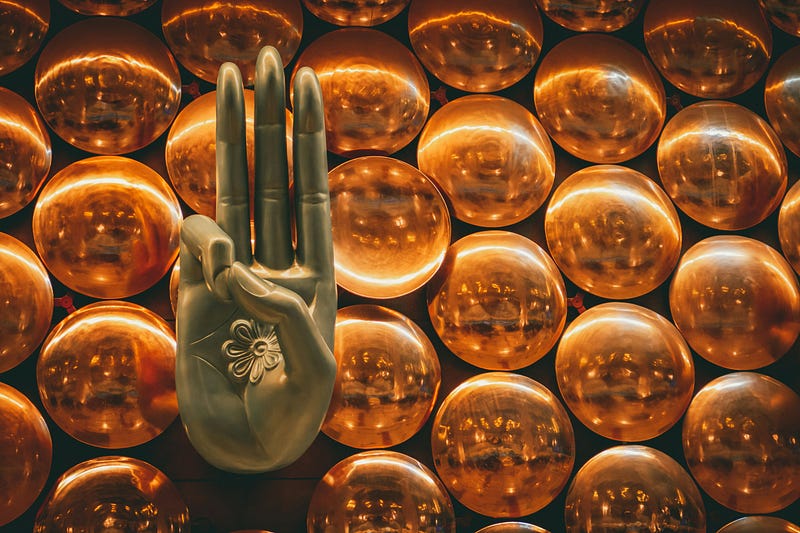
Mantras form the center of much of my life.
A mantra is a sacred numinous sound, utterance, group of words, syllable, word, or phonemes, (believed by some practitioners to have sacred, religious, magical, or spiritual influence. Some mantras have a syntactic structure and literal meaning. while others do not. ꣽ, ॐ (Aum, Om) serves as an important mantra in various Indian religions, and for beginner meditators.
Mantras hold spiritual and psychological powers. Each mantra is equipped with its own particular intention and meaning behind it.
Mantras can either be recited in repetitions or chanted with melody. Repetition of a mantra can be used to evoke higher states of consciousness, channel the power of intentions, manifest positive affirmations, and enter deeper states of spiritual awareness.
Each mantra is designed to help practitioners access a higher power and their true natures. A mantra is a sound vibration through which we mindfully focus our thoughts, our feelings, and our highest intentions. With time that vibration sinks deeper and solidifies into your consciousness, helping you to eventually feel its presence as Shakti (Kundilini, qi) — a power, an invoked force that was always working inside each of us.
To this day Mantras are an important feature of authentic rites, rituals, and even non-dogmatic domestic ceremonies. In many mystic, shamanic, and metaphysical schools, mantras are thought to be truly efficacious only when they are received verbally from one’s living teacher, guru or other spiritual preceptor.
When one meditates with a mantra, it induces a trance-like state in the participant and can lead them to a higher level of spiritual awareness.
Besides bringing a state of flow, and spiritual Awakening, different kinds of mantras are used to work many spiritual purposes, such as protecting oneself from negative energies of all types. One of the most powerful and widely used mantras is the sacred “om” or “pranav”, In Hinduism this is considered to be the sound of the creation of the universe. It is prefixed in most of the mantras and thus it is the powerful root of other longer mantras.
Mantras have deep roots in every major spiritual tradition and can be found in many foreign languages as well including Hindi, Hebrew, Latin, Arabic, Mandarin, Cantonese, and English.
I often recommend my student explore mantras from their own religious tradition. For instance, I use a number of mantras because I want to guide my mind into contemplation while also quieting the mind.
For example, my Catholic students may repeat the Ave Maria prayer or Ave Maria, I, as a Jew recite Barukh atah Adonai (“Blessed art thou, oh Lord”); Many in the Japanese Buddhist community repeat “Nam-myoho-renge-kyo. In Zen, some schools use a mantra, yet most simply focus on the breath and guide the student to remain in the present moment.
Muslims repeat the name Allah. In Islam, there are 99 names through which Allah [God] is recognized. sort of a mantra. In traditional Indian Buddhism, it’s “om maṇi padme hūṃ”.
There are many Taoist schools. One school I came across uses this manta “Ching Mei Lai Dau Foh”, meaning, “Pure and refined”.
No matter what the mantra may be, or the tradition, reciting various names, words, or sounds, as mantras, is believed to be the best way to attain spiritual growth, satisfaction, purification, rejuvenation, and protection from “shadow” voices.
“You are a cosmic flower. Om chanting is the process of opening the psychic petals of that flower.” ― Amit Ray, Om Chanting and Meditation
The Science of Mantras
Using advanced brain-imaging tools, studies are starting to quantify and ensure a number of the health benefits of this ancient practice. it’s been discovered and emphasized that chanting a mantra helps free your mind of background chatter (Moneky Mind in Zen) and calms your system nervosum .
In one study published in the Journal of Cognitive Enhancement, researchers from Linköping University, in Sweden, measured activity during a region of the brain called the default mode network — the area that’s active during self-reflection and mind wandering — to determine how practicing mantra meditation affects the brain. From a psychological state perspective, an overactive default mode network can mean that the brain is distracted — not calmed or centered.
Since the 1970s, Herbert Benson, an American medical doctor, cardiologist, and founder of the Mind/Body Medical Institute at Massachusetts General Hospital (MGH) in Boston conducted extensive research on the power of mantras. Benson was a professor of mind/body medicine at Harvard Medical School and director emeritus of the Benson-Henry Institute (BHI) at MGH. Professor of Pharmac at Harvard School of Medicine and founding father of the Benson-Henry Institute for Mind Body Medicine at Massachusetts General Hospital.
He researched how meditation and prayer might alter mental and physical states. He was particularly curious about what brings on a meditative state, which he called “the relaxation response.” Benson experimented with subjects repeating Sanskrit mantras also as nonreligious words, like “one.” He’s found that no matter what mantra the practitioner repeats, the word or phrase has nearly an equivalent effect: relaxation and therefore the ability to better deal with life’s unexpected stressors.
To conclude, the soothing and harmonious combination of sound, breath and rhythm has a profound impact on the parasympathetic nervous system, in layman’s terms on the “rest and digest” system. The inevitable outcome is that it slows the heart rate and triggers the body’s healing response.
By focused and repetitive mantra chanting a person can gain concentration, helping them to bring the mind into the present moment. Modern mantras are commonly used to still the mind for meditation, exactly in the same way that some practitioners concentrate on the breath.
It is not only mantras that have a robust impact on your being, but every vibration holds a critical value. It is a complete cycle. SEE. When you think negatively, you attract the negative vibration. The longer this vibration persists, the more it affects you. The vibration of the thought then creates an emotional vibration, which generates a vibration in the physical body, most likely on the Astral plane and in Lucid Dreaming states.
The Takeaway
In the same way that chanting mantras impacts your consciousness, so do your thoughts, words, and actions. This is how habits in your life become patterns. You create vibrations and then, consciously and unconsciously, you react to them. Repeating mantras can help liberate you from these deep-rooted intrinsic patterns.
This story is an excerpt from my course “The Mystics Academy”
©Lewis Harrison, all rights reserved.
Here are a few stories in a similar vein
@rkeland
@LewisCoaches
Before you go…
I am Lewis Harrison, a teacher of Essential Zen and Mystic Taoism. I am also the award-winning author of over twenty books on business, leadership, personal growth and strategic thinking. For over a decade I was the producer and host of the show “What’s Up” on NPR-affiliated WIOX FM in New York. I teach seminars and speak on personal development, life strategies, and mindfulness throughout the world.
Here are links to three of my best-selling books on mysticism: