avatarAvi Kotzer

Free AI web copilot to create summaries, insights and extended knowledge, download it at here

3627

Abstract

</i> the common era!</p><p id="38b5"><i>Tings</i> were multi-purpose vessels, used for storing things, cooking things, and also for making ritual offerings to the gods or one’s ancestors. There were two styles of construction. The <i>li-ding</i> had the rounded bowl with three legs…</p><figure id="5db4"><img src="https://cdn-images-1.readmedium.com/v2/resize:fit:800/0*g_MNpLxrcV0Ie6TE.jpg"><figcaption>Photo by Mountain</figcaption></figure><p id="4330">…while the <i>fang-ding</i>, had a square or rectangular box resting on four legs.</p><figure id="119a"><img src="https://cdn-images-1.readmedium.com/v2/resize:fit:800/0*wdePh-oZQqgKhXLW.JPG"><figcaption>Photo by Hiart</figcaption></figure><p id="b33c">The online Britannica explains this about the <i>ting</i>. (Again, just bear in mind that they spell it “ding”.)</p><blockquote id="5fa5"><p>The <i>ding</i>, with many variations of silhouette, was present in virtually all early ages of China, including in pottery ware from the Neolithic Period (c. 5000–2000 bc) and bronzes from the Shang (18th–12th century bc) and Zhou (1111–256/255 bc) dynasties, as well as in the bronze and glazed pottery imitations of many later periods. The <i>ding</i> was often used in divinatory ceremonies for sacrificial offerings, or it was buried with its owner in a tomb as a spiritual utensil (<i>mingqi</i>). The number of <i>ding</i> a person owned was determined by his rank in the social and political hierarchy.</p></blockquote><p id="2c68">The picture at the top of today’s column shows the <b>Da He ting</b>, unearthed in the province of Hunan in 1959. It’s famous for being (so far) the only ancient Chine bronze cauldron with a human face carved for decoration. Here is another view of it:</p><figure id="66a7"><img src="https://cdn-images-1.readmedium.com/v2/resize:fit:800/0*hoN8YMK3xvPX0o5-.jpg"><figcaption>Photo by Zanhe</figcaption></figure><p id="525c">Yes, I know I’m posting these pictures in a larger size than I usually do, but that’s so you can see the details of the relief work. You’re quite welcome.</p><p id="88a7">This angle shows the above face carving and the one from the very top:</p><figure id="50c6"><img src="https://cdn-images-1.readmedium.com/v2/resize:fit:800/0*NVPfeIWLKG3mVTXV.jpg"><figcaption>Photo by Zanhe</figcaption></figure><p id="fddf">Thank you, Zanhe!</p><h2 id="45bc">Uppercase T</h2><p id="4224">I found several Tings that start with a capital T, among them a couple of rivers, a Chine admiral from the 19th century, a Chinese-American physicist from the 20th century (still alive as of this writing!), and a former administrative unit in China. But there were two Tings that stood out.</p><p id="d391">§ Merle Tingley, known as “Ting” by his followers was a Canadian cartoonist who worked for the London, Ontario newspaper <i>The London Free Press</i> from 1948 to 1986. (He was also syndicated in a few dozen other publications.) Ting’s mascot was a worm called Luke (so yes, Luke Worm) that he hid in each cartoon to the delight of the fans who would then try to find it.</p><p id="70ec">Merle lived to the ripe old age of 95, passing away in 2017. A few years vefore that, the TAP Centre for Creativity in London started the annual “Ting Comic & Graphic Arts Festival”, or <a href="https://www.tapcreativity.org/tingfest">Tingfest</a>. The website for this seems not to have been updated since 2020, so I’m not sure if Covid put a damper on things. You can read more about Merle and the festival in <a href="https://lfpress.com/2014/01/25/former-london-free-press-editorial-cartoonist-merle-tingley-attracted-loyal-following/w

Options

cm/202f67ef-a5ac-5020-0037-faa9f1a77d3d">this article</a> that also includes a picture of him and Luke Worm.</p><p id="1ad8">§ There is a popular carbonated beverage in the Caribbean called Ting. It’s been around for almost fifty years and has a sweet/tart flavor from the concentrated Jamaican grapefruit juice used in its preparation. Ting was originally made by Jamaican brewer Desnoes & Geddes, who were bought by Guinness in 1993. The soft drink portion was later acquired by Pepsi.</p><figure id="ae77"><img src="https://cdn-images-1.readmedium.com/v2/resize:fit:800/0*8H8oviLHXQkDyqoM.jpg"><figcaption>Photo by BilCat</figcaption></figure><p id="b770">Ting is sold in some parts of the U.S., but it’s unrelated to another soft drink with the same name that was made in Wisconsin. That Ting came in other flavors besides grapefruit, such as orange, grape, and cream soda. Their trademark lapsed in 2009, however, allowing Pepsi to take it over for selling the Jamaican Ting in the United States. You can check out their website here:</p><div id="3861" class="link-block"> <a href="http://www.jamaicating.com/"> <div> <div> <h2>Ting - Sparkling Grapefruit Flavoured Drink</h2> <div><h3>1 Introduction 1.1 Our lawyers tell Us that Our Website rules aren't enough and that We also need to have a Privacy…</h3></div> <div><p>www.jamaicating.com</p></div> </div> <div> <div style="background-image: url(https://miro.readmedium.com/v2/resize:fit:320/0*gI8oO6io1glUOJ6H)"></div> </div> </div> </a> </div><p id="a376">Ting is typically used as a mixer with <b>vodka</b>, and that combination is known as… what else? Ving!</p><p id="de99">Why they never thought of using actor Ving Rhames to promote the stuff is beyond me.</p><p id="3e40">Now you know. Next time you’re in on a museum tour and the guide points to an antique vessel and explains that it’s called a ding, you can show off your knowledge by saying “It’s also known as a <i>ting</i>.” Don’t be surprised if they kick you out of the museum. Not because you’re being obnoxious… but because the editors of the Spelling Bee decided that <i>ting </i>is a dord*.</p><p id="927c">You can check out my previous entry on another <b>dord* </b>here:</p><div id="b370" class="link-block"> <a href="https://readmedium.com/devon-e16d07a59047"> <div> <div> <h2>Devon</h2> <div><h3>The cow, not the actor</h3></div> <div><p>medium.com</p></div> </div> <div> <div style="background-image: url(https://miro.readmedium.com/v2/resize:fit:320/0*Bzb77H1LABuZYRZu)"></div> </div> </div> </a> </div><p id="a260">*What the heck is a <b>dord, </b>you ask? Here’s the answer:</p><div id="01dc" class="link-block"> <a href="https://www.merriam-webster.com/words-at-play/dord-a-ghost-word"> <div> <div> <h2>'Dord': A Ghost Word</h2> <div><h3>One of the questions people like to ask lexicographers is this: Can you sneak something into the dictionary? Can you…</h3></div> <div><p>www.merriam-webster.com</p></div> </div> <div> <div style="background-image: url(https://miro.readmedium.com/v2/resize:fit:320/0*zOYxI2Lmx5-UXR3Z)"></div> </div> </div> </a> </div></article></body>

Ting

A ringing sound, an ancient vessel… and a soft drink?
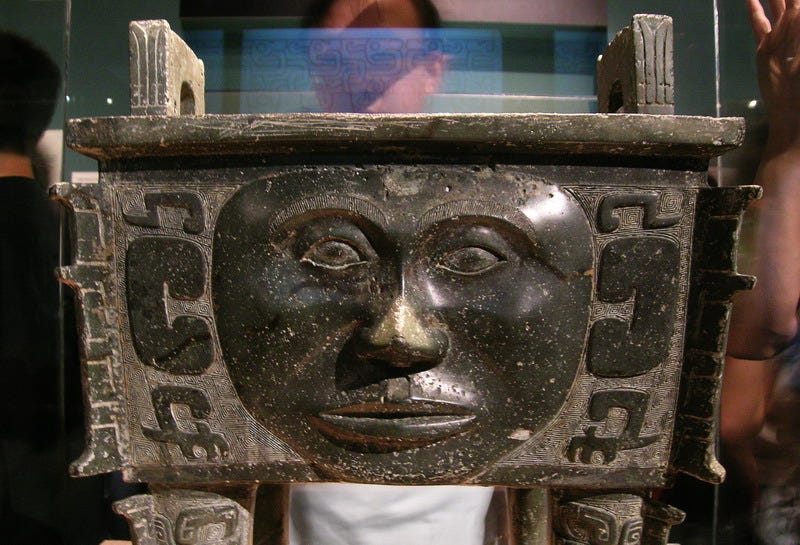
Credit: user:smartneddy

Today’s New York Times Spelling Bee letters:
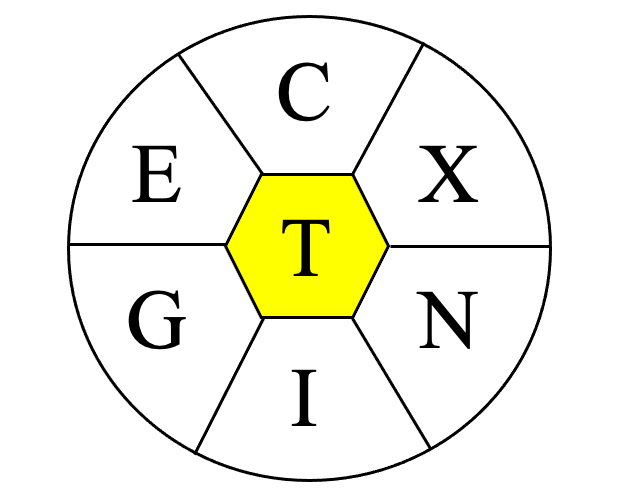
Art: Iva Reztok

C, E, G, I, N, X, and center T (all words must include T)

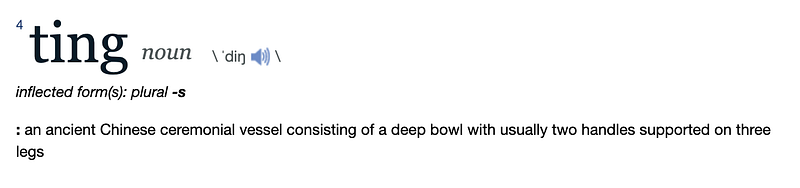
Merriam-Webster says…
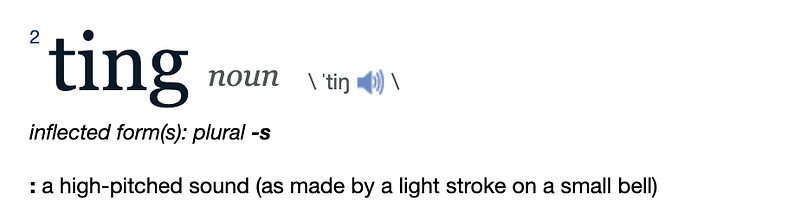
Credit: merriam-webster.com

…and…

Credit: merriam-webster.com

Silly little dictionary! Don’t you know that ting can’t possibly be a word if The New York Times says it ain’t?

For a complete list of rejected words, check out the Spelling Bee Master.

What’s your favorite dord* from today’s puzzle?

My Two Cents

Although most sources now use the term “ding” for the Chinese vessel ting, I’m going to stick with the dictionary’s spelling for today. Otherwise, I would have to choose a different word, like exegetic or enceinte. Oh, wait… I already wrote about enceinte last year, when this same puzzle appeared, only with center letter N.

If you do click on the link above, please make sure to return to this article, scroll down slowly, and help me earn my daily 13 cents.

Now, as far as the first definition of ting given by the dictionary — “a high-pitched sound (as made by a light stroke on a small bell)” — I have no idea why the editors of the Spelling Bee would consider this obscure. Perhaps, as with the Chinese vessel, they consider ding already covers it. Still, I’m sure many players were frustrated (like I was) when they typed in t-i-n-g only to see the Not in word list sign flash.

lowercase t

Our friends at Merriam-Webster tell us that ting was borrowed from the Chinese (Pekingese) word. I assume it was originally transcribed into English with a “t”, and then later this was changed to a “d” because the latter letter is closer to the actual phonetic sound made when saying the word in its native language. But this is all speculation on my part, so don’t go quoting me.

Simply put, tings are old-fashioned cauldrons. Really old-fashioned, like thousands of years old. The earliest examples are thought to be from before the Shang era, which ruled during the second millennia… before the common era!

Tings were multi-purpose vessels, used for storing things, cooking things, and also for making ritual offerings to the gods or one’s ancestors. There were two styles of construction. The li-ding had the rounded bowl with three legs…
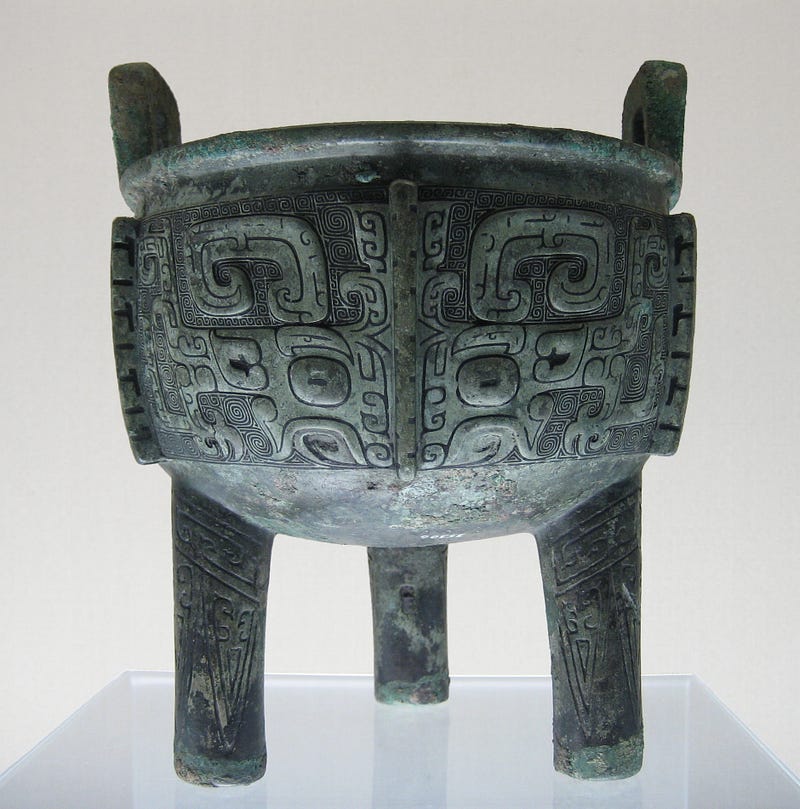
Photo by Mountain

…while the fang-ding, had a square or rectangular box resting on four legs.
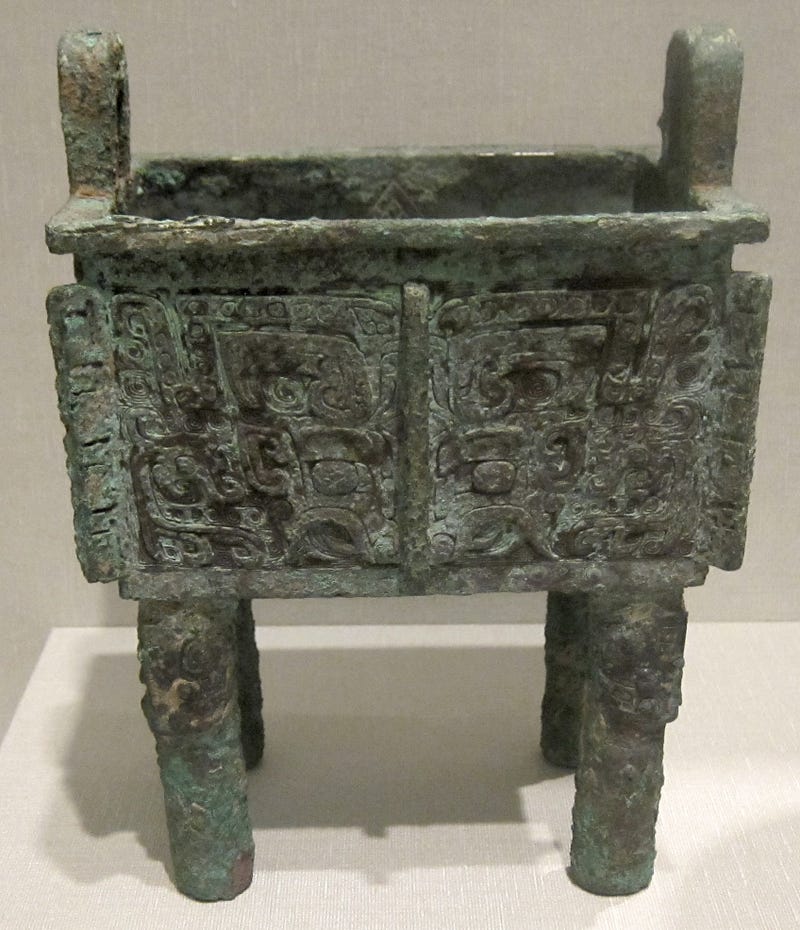
Photo by Hiart

The online Britannica explains this about the ting. (Again, just bear in mind that they spell it “ding”.)

The ding, with many variations of silhouette, was present in virtually all early ages of China, including in pottery ware from the Neolithic Period (c. 5000–2000 bc) and bronzes from the Shang (18th–12th century bc) and Zhou (1111–256/255 bc) dynasties, as well as in the bronze and glazed pottery imitations of many later periods. The ding was often used in divinatory ceremonies for sacrificial offerings, or it was buried with its owner in a tomb as a spiritual utensil (mingqi). The number of ding a person owned was determined by his rank in the social and political hierarchy.

The picture at the top of today’s column shows the Da He ting, unearthed in the province of Hunan in 1959. It’s famous for being (so far) the only ancient Chine bronze cauldron with a human face carved for decoration. Here is another view of it:
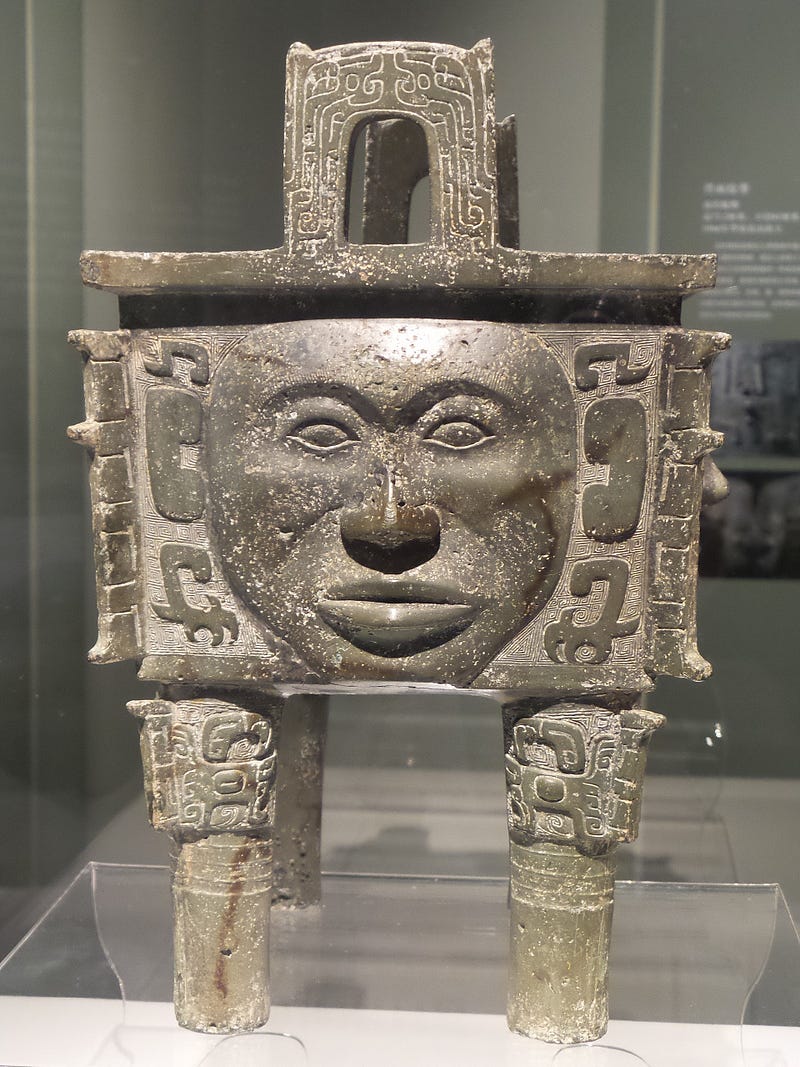
Photo by Zanhe

Yes, I know I’m posting these pictures in a larger size than I usually do, but that’s so you can see the details of the relief work. You’re quite welcome.

This angle shows the above face carving and the one from the very top:
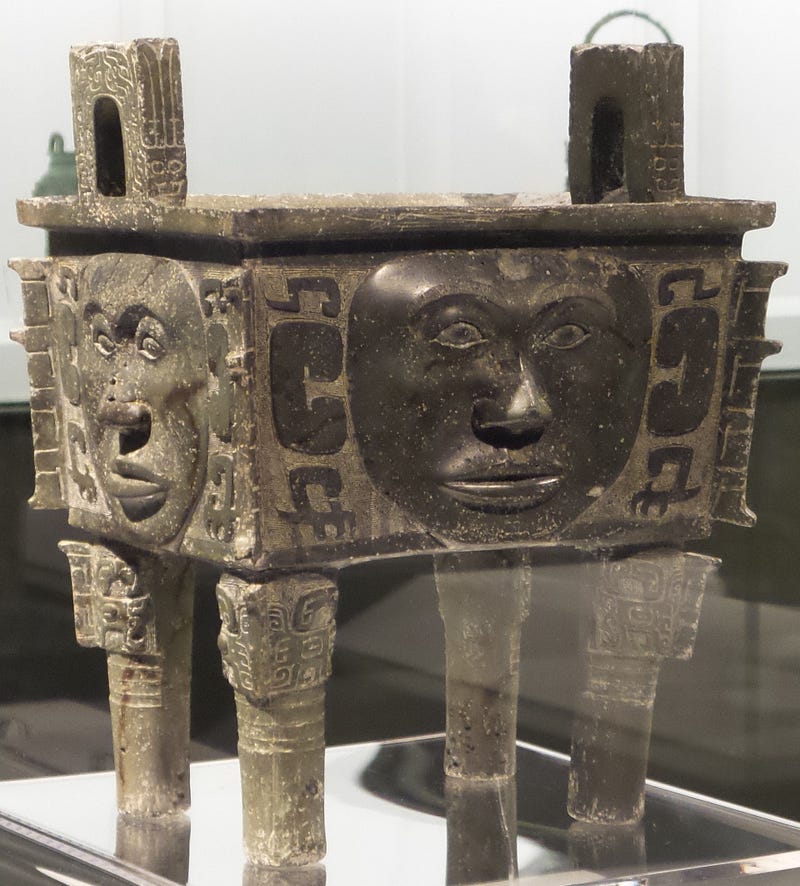
Photo by Zanhe

Thank you, Zanhe!

Uppercase T

I found several Tings that start with a capital T, among them a couple of rivers, a Chine admiral from the 19th century, a Chinese-American physicist from the 20th century (still alive as of this writing!), and a former administrative unit in China. But there were two Tings that stood out.

§ Merle Tingley, known as “Ting” by his followers was a Canadian cartoonist who worked for the London, Ontario newspaper The London Free Press from 1948 to 1986. (He was also syndicated in a few dozen other publications.) Ting’s mascot was a worm called Luke (so yes, Luke Worm) that he hid in each cartoon to the delight of the fans who would then try to find it.

Merle lived to the ripe old age of 95, passing away in 2017. A few years vefore that, the TAP Centre for Creativity in London started the annual “Ting Comic & Graphic Arts Festival”, or Tingfest. The website for this seems not to have been updated since 2020, so I’m not sure if Covid put a damper on things. You can read more about Merle and the festival in this article that also includes a picture of him and Luke Worm.

§ There is a popular carbonated beverage in the Caribbean called Ting. It’s been around for almost fifty years and has a sweet/tart flavor from the concentrated Jamaican grapefruit juice used in its preparation. Ting was originally made by Jamaican brewer Desnoes & Geddes, who were bought by Guinness in 1993. The soft drink portion was later acquired by Pepsi.
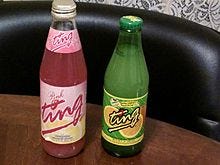
Photo by BilCat

Ting is sold in some parts of the U.S., but it’s unrelated to another soft drink with the same name that was made in Wisconsin. That Ting came in other flavors besides grapefruit, such as orange, grape, and cream soda. Their trademark lapsed in 2009, however, allowing Pepsi to take it over for selling the Jamaican Ting in the United States. You can check out their website here:

Ting is typically used as a mixer with vodka, and that combination is known as… what else? Ving!

Why they never thought of using actor Ving Rhames to promote the stuff is beyond me.

Now you know. Next time you’re in on a museum tour and the guide points to an antique vessel and explains that it’s called a ding, you can show off your knowledge by saying “It’s also known as a ting.” Don’t be surprised if they kick you out of the museum. Not because you’re being obnoxious… but because the editors of the Spelling Bee decided that ting is a dord*.

You can check out my previous entry on another dord* here:

*What the heck is a dord, you ask? Here’s the answer:

Spelling Bee
Language
China
Beverage
History
Recommended from ReadMedium