
Enceinte
A pregnant castle. Say what?

Today’s New York Times Spelling Bee letters:
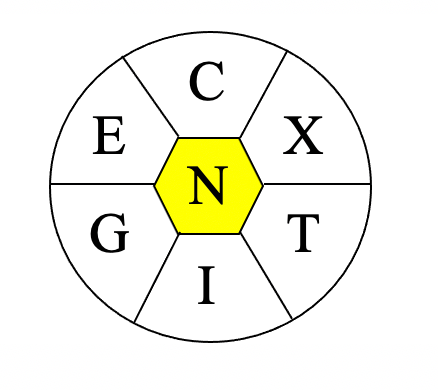
C, E, G, I, T, X, and center N (all words must include N)
Merriam-Webster says…

…and also…
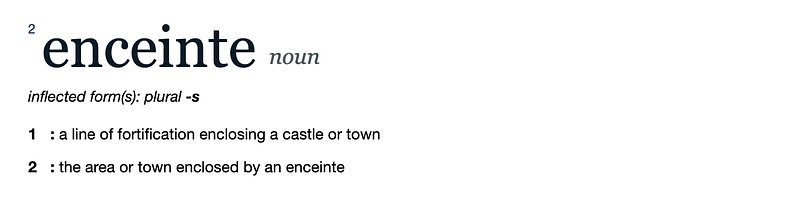
Silly little dictionary! Don’t you know that enceinte can’t possibly be a word if the New York Times says it ain’t?
For further fascinating facts, check out the Spelling Bee Master.
What’s your favorite dord* from today’s puzzle?
My Two Cents
Don’t you just love it when one word has two completely different and unrelated meanings? There’s a term for that. Or two. Or three.
Homophones, homographs, and homonyms have caused great strife amongst the lexicographic community. There have been great, prolonged arguments about the use of these terms, some of which have even ended in pistol duels — in my very active imagination, of course. This issue may not be as hot-button as the serial comma, but it’s up there when it comes to language-related feuds.
The key to understanding these words is realizing they are just combinations of Greek-originated prefixes and suffixes. Homo-, which means “one and the same” or “similar” appears in all three. The suffix -phone means “sound”, the suffix -graph means “something written”, and the suffix -onym means “name” or “word”.
So homophones are words that “sound the same”, homographs are words that “are written the same way”, and homonyms are… “the same word”? That’s when things get heated.
The key element is that sets of words that are “homo- something” always have different meanings. Otherwise, they would be exactly the same word.
In the case of homophones, it does not matter whether or not the words have the same spelling–-although they could be. So, for example, to, too, and two are homophones that have different spellings. But quail (meaning “to cower”) and quail (the bird) are also homophones. They just happen to share the same spelling.
In the case of homographs, spelling is king. So sets of words are written exactly the same, may or may not be pronounced identically, but do have different meanings. When bow refers to a ship it’s pronounced differently than when it refers to the instrument used to shoot arrows. But the two quails I mentioned earlier share the same pronunciation.
So, quail and quail are both homophones and homographs.
Which brings us to the homonym. Regarding its definition, there are three schools of thought (only two of which advocate using pistol duels to resolve issues).
The first says that homonym can be used to refer to either homophones or homographs. This is called the “peace and love” approach. The second school of thought says the use of homonym should be restricted to words that have the same spelling but different sounds and meanings. (That would be the example of bow I explained before.) The third philosophy is that homonyms have only different meanings but everything else is the same: spelling and sound.
I’m sure someone will eventually come up with an online personality test based on which of the three schools of thought you subscribe to. If you want to be classified as an outlier, just answer “none of the above”.
With child
Enceinte is both a homophone and a homograph. Whether or not it’s a homonym is… well, kinda up to you, my dear reader. We can do a poll here in the comments section. Let me know what you think.
In the sense of being pregnant, the adjective enceinte — pronounced roughly like “un-scent” and precisely like “\äⁿ(n)-ˈsant\” — comes from Middle French, from (assumed) Vulgar Latin incienta, and alteration of the Latin incient-, inciens, meaning “being with young”, from in + -cient-, -ciens (akin to Greek kyein to be pregnant).
It may not sound familiar to English speakers, but francophones obviously know what the enceinte means. It’s likely Spanish and Italian speakers do, too. The word rang a bell as soon as I saw it. In Spanish, we use the term encinta to describe a person who is pregnant. There are other words, too, like preñada (colloquial), grávida (medical), and embarazada (most neutral), but encinta is probably the most elegant of the choices.
Speaking of embarazada, don’t be embarrassed if you thought it meant… “embarrassed”. It’s one of those false friends that Spanish students learn about early on. However, it’s not strictly true that you can’t translate embarrassed as embarazada.
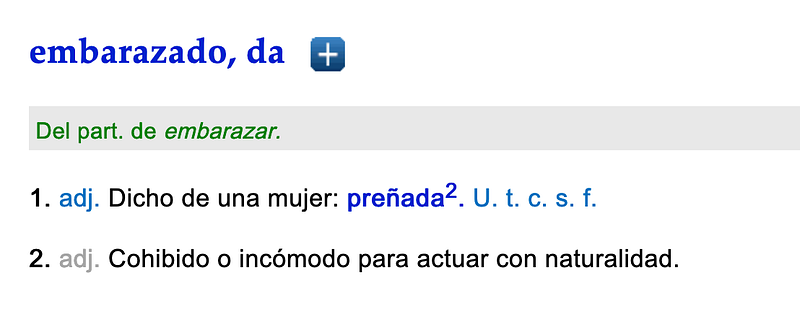
The above is the entry from the “official” Spanish dictionary of the Real Academia Española de la Lengua, or Royal Spanish Academy of Language. The second definition can be translated as: “feeling too self-conscious or uncomfortable to act naturally”.
Sounds a lot like embarrassed to me. How embarrassing for all those teachers who lied to you all these years!
With castle
In the sense of a castle’s fortification, the noun enceinte — pronounced roughly like “un-scent” and precisely like “\äⁿ(n)-ˈsant\” — comes from Old French word meaning “enclosing wall or fence”, itself a feminine form of enceint, the past participle of enceindre, meaning “to enclose”, from the Latin incingere, “to gird, surround,” from in + cingere, “to gird”.
So, the two enceintes are spelled the same and pronounced the same, but have different meanings and different etymologies. This not only makes them homophones, homographs, and possibly homonyms, but also false cognates.
The always cool 1911 edition of the Encyclopædia Britannica explains this about castle-related enceinte:
ENCEINTE (Lat. in, within, cinctus, girdled; to be distinguished from the word meaning “pregnant,” from in, not, and cinctus, i.e. with girdle loosened), a French term used technically in fortification for the inner ring of fortifications surrounding a town. Strictly the term was applied to the continuous line of bastions and curtains forming the “body of the place,” this last expression being often used as synonymous with enceinte. The outworks, however, close to the enceinte were not considered as forming part of it. In modern fortification the enceinte is usually simply the innermost continuous line of fortifications. In architecture generally an enceinte is the close or precinct of a cathedral, abbey, castle, &c.
Notice anything interesting there? Aside from the “&c”. The etymology given does not match the one Merriam-Webster provided, but is also different from the etymology of enceinte meaning “pregnant”.
Anyway, here are a couple of enceintes. First up is the Khotyn Fortress in Ukraine.

Next is the keep of Château de Vincennes protected by “its own isolated enceinte”.

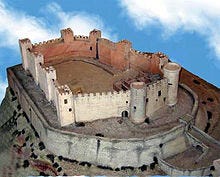
Here is one in Alicante, Spain, at the Castle of Elda. Or rather, a scale model of how the castle looked about 700 years ago.
Well, that’s about it for today. We’ve defined two meanings of enceinte; discussed whether or not enceinte is a homophone, a homograph, or a homonym; talked about false cognates and false friends; and even busted a common myth about the interchangeability of embarrassed and embarazada.
Despite all that effort, the editors of the Spelling Bee still decided that the word enceinte is a dord.*
You can check out my previous entry on another dord* here:
*What the heck is a dord, you ask? Here’s the answer: