
Devon
The cow, not the actor
Today’s New York Times Spelling Bee letters:
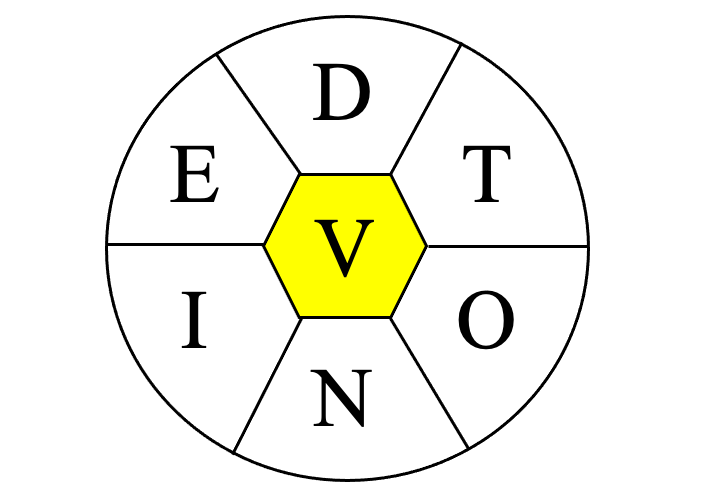
D, E, I, N, O, T, and center V (all words must include V)
Merriam-Webster says…
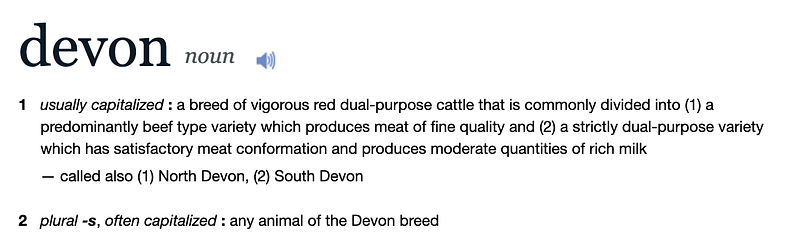
Silly little dictionary! Don’t you know that devon can’t possibly be a word if The New York Times says it ain’t?
For a complete list of rejected words, check out the Spelling Bee Master.
What’s your favorite dord* from today’s puzzle?
My Two Cents
One of the few rules of the Spelling Bee game is that proper nouns are not accepted. Proper nouns are, as I’m sure you know nouns “that designate a particular being or thing, do not take a limiting modifier, and are usually capitalized in English.”
I wonder if devon was rejected because the editors of the Spelling Bee consider it to be a proper noun. In definition 1 of the dictionary, the qualifier “usually capitalized” is used. This makes sense, as that definition describes the breed. However, in definition 2 — the dictionary says “often capitalized”, which is a good enough excuse for me to consider the word a common noun. Hey, we here at Silly Little Dictionary! don’t have the same resources The New York Times does, so we take what we can get.
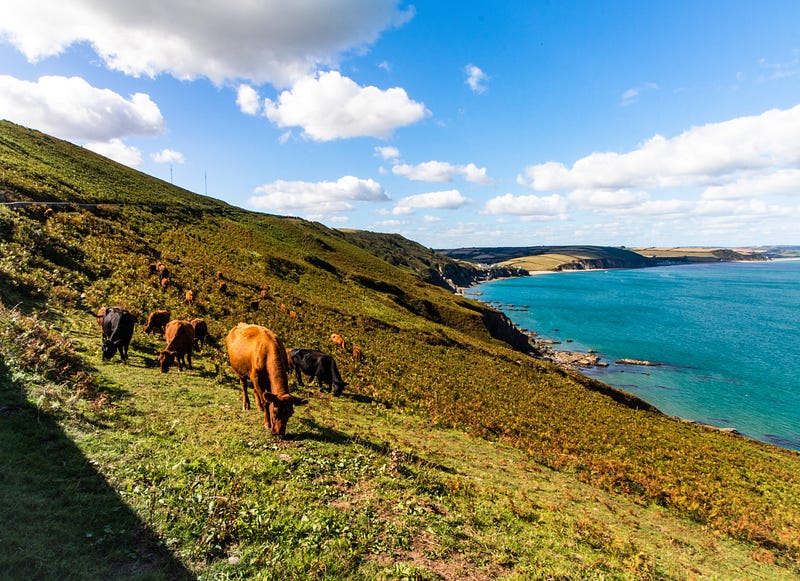
The picture at the top of today’s column shows a pasture with cows in it. It was one of the results I got when I typed “devon” into the Unsplash search feature. I’m not sure if it popped up because the landscape is in Devon or because of the cattle, or both. Again, I’ll take what I can get.
Oh, and I mentioned that the devon I’m discussing is the cow, not the actor. As in Devon Sawa:

I’m sure many of you would like me to discuss this Hollywood heartthrob born in Vancouver, Canada… but I’m going to have to disappoint the lot of you.
North and South
Our friends at Merriam-Webster tell us devon comes from the eponymous county — formerly known as Devonshire — in South West England, bounded by the Bristol Channel to the north, the English Channel to the south, the county of Cornwall to the west, and the counties of Somerset and Dorset on the north-east and east, respectively.
The devon cattle breed was developed in Devon. No surprise there. It’s sometimes referred to as North Devon to distinguish it from the South Devon breed developed later in both Devon and Cornwall. According to the Domestic Animal Diversity Information System of the Food and Agriculture Organization of the United Nations (what a mouthful!), North Devon cattle came about as an incrossing from Limousin and Salers breeds, around the year 1500. It took another 351 years, however, for the herdbook to be established. (A herdbook contains an official record of the individuals and pedigrees of a recognized breed.)
The South Devon breed has more uncertain origins. One theory says it was via cross-breeding between the local devons and an extinct breed known as the Alderney.
Here is a tale of tape, so to speak of both cattle breeds:
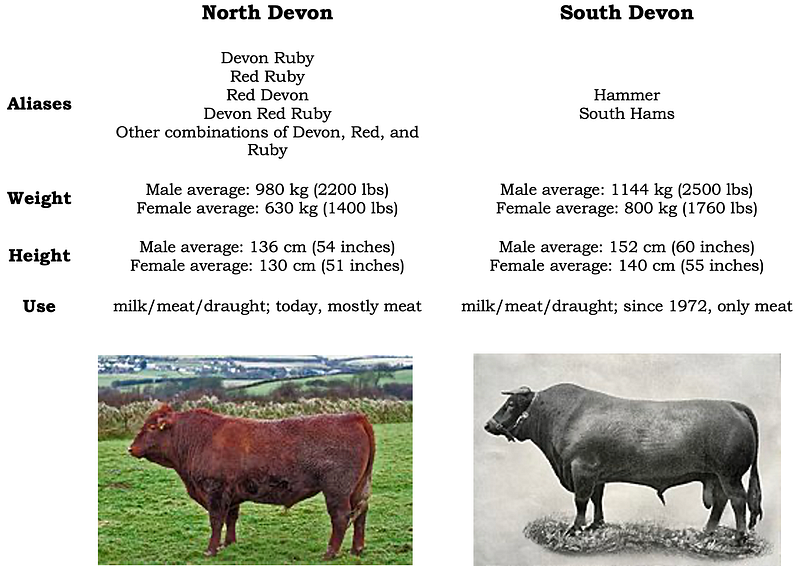
The South Devon has the upper hoof in size, but the North Devon breed clearly wins when it comes to nicknames… and more current photo IDs.
One interesting thing about the South Devon cattle is that just over 1 in 3 have a genetic mutation which causes the absence of the myostatin gene. Myostatin is a protein that acts on muscle cells to inhibit muscle growth. It is present in humans, but also in many other animals, including some fish. Cows with no functional myostatin develop bovine muscular hypertrophy, a condition in which their muscle cells multiply more than normal. They are sometimes called “double-muscled cattle”, and in Devon are sometimes known as buffalo.
The benefit of said cows is that they yield more beef; the downside is the meat tends to be tougher.
Red, white, and moo
The U.S. has its own version of devon cattle, but there is some doubt as to whether or not they originated from the Devon breeds across the pond. In 1623 a shipment of two cows and a bull was brought over to Plymouth Colony… from Plymouth, England. Some experts say they were called devons because they had been shipped from the south coast of Devon. Others believe that because devons already existed as a breed, the cattle shipped to the American colony was indeed a purebred.
The cows and bulls thrived over the next couple centuries and spread across the East Coast down to Florida. In the nineteenth century, other British breeds — namely English longhorns and Durham shorthorns — were brought over and mixed with the American devon. A herd-book for the “new and improved” cattle was first published in 1855, and the American Devon Cattle Club was formed a few decades later.
In 1978 the American Milking Devon was established as a separate breed, along with its own association, to try and preserve the older colonial type of multi-purpose cattle. So far, this effort has proved to be not so easy, and the milking devon has recently been given a “critical” conservation status label.
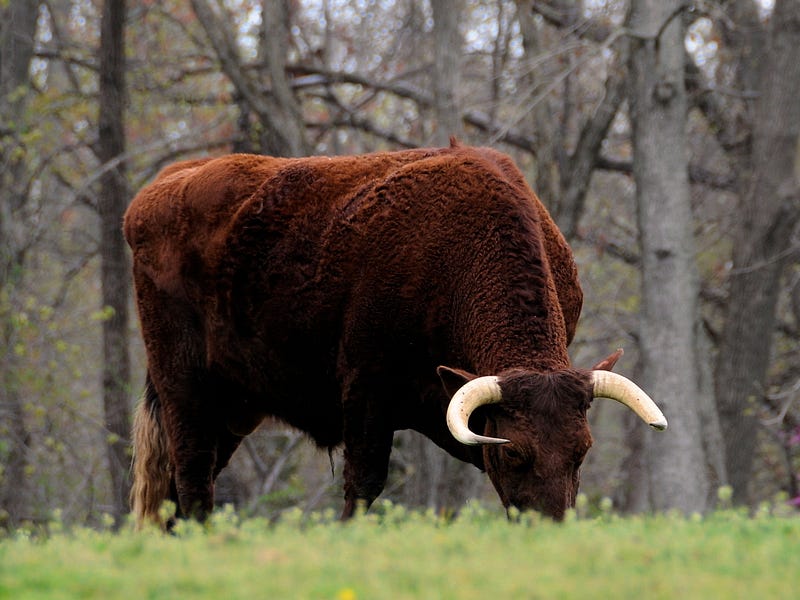
As you can see, this cattle is reddish like its North Devon cousins. They are somewhat smaller, though, weighing in at a couple hundred kilos less than their English counterparts. Although it has “Milking” in its name, this American breed is also used for meat.
No article about cattle is complete without mentioning cow tipping, a countryfolk pastime that may actually be an urban legend. Or, in this case, a rural legend. To learn more about cow tipping —and Medium tipping — check out this article by the offbeat but always funny Michael Burg, MD (Satire Sommelier):
Now you know. Next time you’re in England and you want to order some steak, you can ask that they serve you a cut of a devon cow. Don’t be surprised if the chef can’t get you what you want. Not because you’re in a vegan restaurant… but because the editors of the Spelling Bee decided that devon is a dord*.
You can check out my previous entry on another dord* here:
*What the heck is a dord, you ask? Here’s the answer: