
Hadal
This word is quite deep
Today’s New York Times Spelling Bee letters:
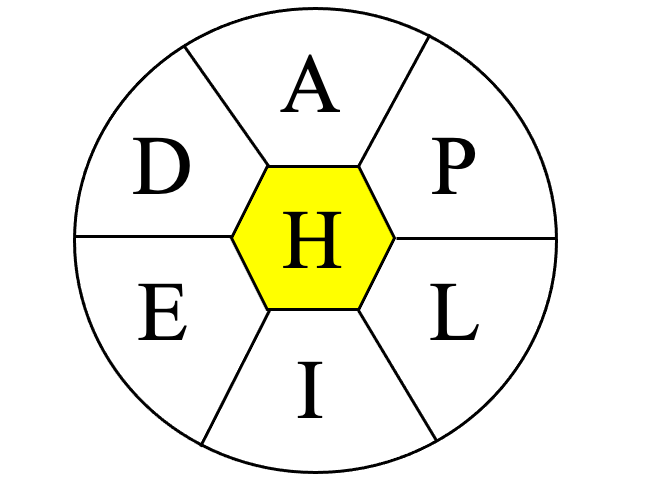
A, D, E, I, L, P, and center H (all words must include H)
Merriam-Webster says…

Silly little dictionary! Don’t you know that hadal can’t possibly be a word if The New York Times says it ain’t?
For a complete list of rejected words, check out the Spelling Bee Master.
What’s your favorite dord* from today’s puzzle?
My Two Cents
Here’s an interesting word that can be formed in today’s game: Philadelphia. It’s also a pangram, a Spelling Bee term that refers to any word that includes all seven letters at least once. Every puzzle has at least one pangram. For more on that, and my rant about a rejected pangram, please see yesterday’s column.
Philadelphia is not acceptable as an answer because proper nouns (i.e., names) are now allowed. Perhaps one day, however, my favorite cream cheese brand will become a generic term, like kleenex, popsicle, dumpster, or aspirin, and will be lowercased. Then, when the word is rejected by Sam Ezersky and his team, I’ll be able to write an article about philadelphia.
Today, I’ll stick to writing about hadal. During my 15-minute intensive online research I discovered something interesting about a beloved Star Trek character. And any time I hear the name Jean-Luc Picard, the first thing that pops into my mind is this awesome meme created to trigger fans of four different pop-culture franchises:

Anyway, on with our daily dord*!
Deep waters run deep
One of those famous sayings that people like to repeat is “We know more about the Moon than the deepest part of the Earth’s ocean.” It could be true. I have no idea, being an expert on neither the ocean nor the Moon. I’ve been to the beach a lot, taken a couple of cruises, and gone boating a handful of times. I haven’t been on the Moon, and my bid to be the guest passenger on Jeff Bezo’s first space flight fell awfully short at just $13.13 (which happened to be my total Medium earnings at the time.)
I guess how true that saying is would depend on what you define as “the deepest part of earth’s ocean”. Are you talking about the deepest-known depth of seabed, the Challenger Deep, located in the Mariana Trench of the western Pacific Ocean? Or any hadal zone in its entirety?
That area of the ocean, usually constituting v-shaped depressions (because of the shape of the trenches), is considered to be beyond the six-kilometer (20,000-foot) limit of the abyssal zone, which about seventy or eighty years ago was thought to be the deepest part.
Here, this chart showing the different layers of the ocean might help you visualize what I’m talking about:
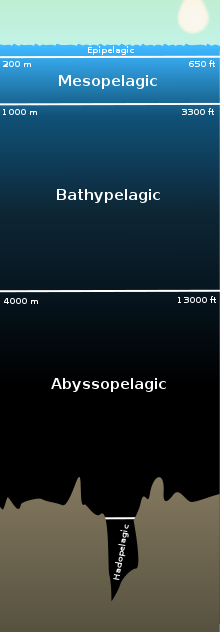
The suffix -pelagic means “related to the sea” and comes from the Greek word, pelagos, which means, well, sea. Doh! The hadal, or hadopelagic, zone is named after Hades, the netherworld in Greek mythology.
The uppermost epiplagic zone, also know as the photic zone receives sunlight allowing phytoplankton to perform photosynthesis. Because of this, the majority of aquatic life can be found in this superficial part of the ocean, whose depth reaches some 200 meters, or about 650 feet.
The mesopelagic zone is delimited by light. It begins where only 1% of sunlight reaches, and ends where there is no light at all, around 1,000 meters below the surface. That’s where the bathypelagic area begins, extending some 3,000 meters (10,000 feet) more. The abyssal zone (from the Greek word for “bottomless”) has depths between 4,000 to 6,000 metres (13,000 to 20,000 ft) and remains in perpetual darkness. It’s home to some odd sea life, like the tripod fish, the cusk eel, and the dumbo octopus.
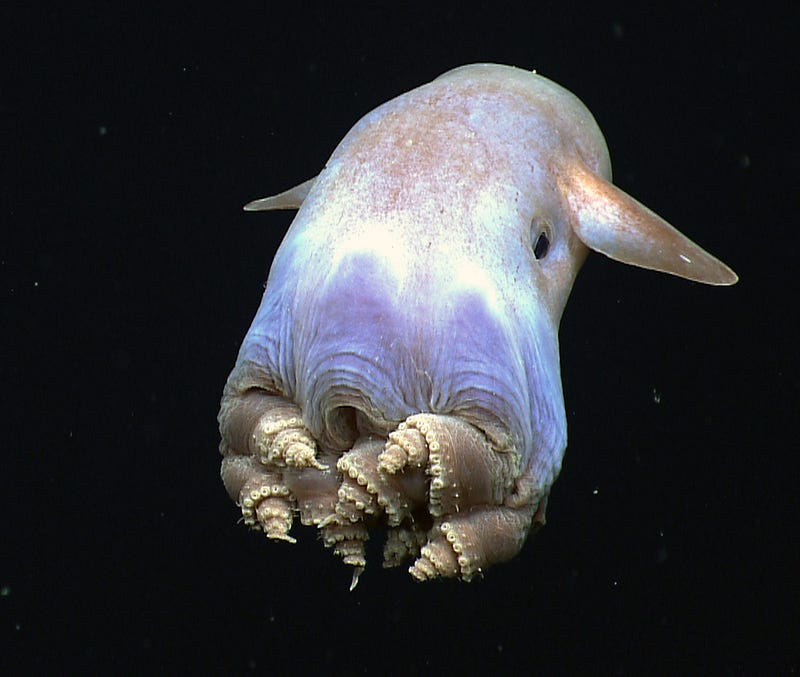
Yeah, I can’t unsee that, either.
Ocean water below the lower limit of the abyssal zone (6,000 meters or 20,000 feet) is considered to be in the hadal zone. As I mentioned ealier, most of these areas are found in trenches, which have rarely been explored. What is known is that there is absolutely no sunlight, temperatures are very low, animal and plant life is almost absent, and hydrostatic pressure is really, really high. Like one thousand atmospheres. To give you an idea of what that’s like, one atmosphere is the pressure you would feel at the bottom of a 10-meter (33-foot) pool. The deep ends of Olympic pools are usually between 3.5 and 9 meters. If you’ve ever been at a depth of 9 to 10 meters, just remember what that felt like… and multiply it by one thousand.
Submarines cannot reach the hadal zone without collapsing. But that doesn’t mean no human has ever gone all the way down.
Jean-Luc Piccard’s cousin, one hundred times removed
Human beings have a thing for trying to be the first ones to do something. Like reaching the North Pole, or the top of the tallest mountain on Earth… or the Moon.
Jacques Piccard, born 100 years ago this past July, wanted to be the first person to reach the deepest part of the ocean. I’ll save you the suspense: he was successful. Piccard helped his father, Auguste, design a deep-water vessel known as a bathyscaphe. As the Britannica explains:
The first bathyscaphe, the FNRS 2, built in Belgium between 1946 and 1948, was damaged during 1948 trials in the Cape Verde Islands… A second improved bathyscaphe, the Trieste, was launched on August 1, 1953, and dived to 3,150 metres (10,300 feet) in the same year. In 1958 the Trieste was acquired by the United States Navy, taken to California, and equipped with a new cabin designed to enable it to reach the seabed of the great oceanic trenches. Several successive descents were made into the Pacific by Jacques Piccard, and on January 23, 1960, Piccard, accompanied by Lieutenant Don Walsh of the U.S. Navy, dived to a record 10,916 metres (35,814 feet) in the Pacific’s Mariana Trench.
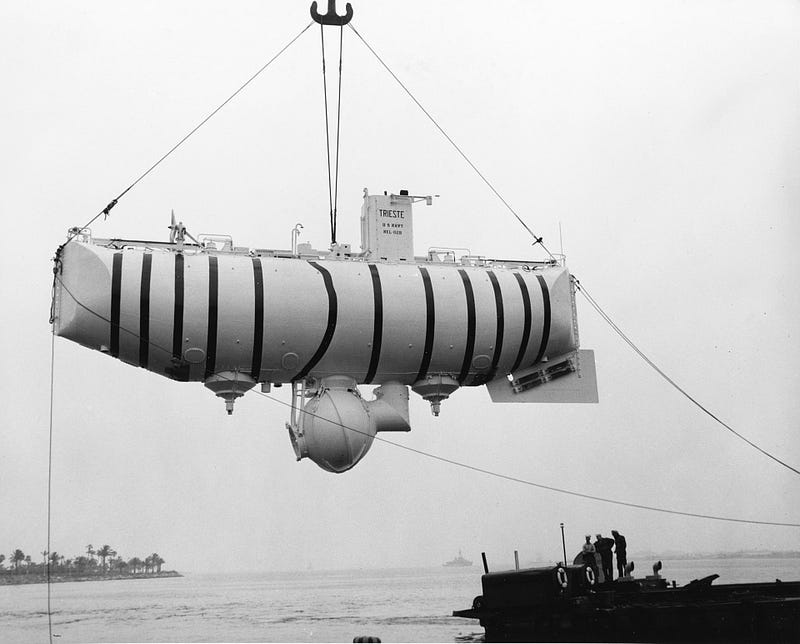
Later, more accurate, measurements made during 1995 found the Mariana Trench to be slightly less deep: 10,911 m (35,797 ft). Piccard and Walsh’s descent took almost five hours. Unfortunately, the Trieste had no scientific equipment and so no experiments were conducted and no photos of the ocean were taken. The sole objective was to prove that the depth could be reached. Interestingly, at 30,000 feet the crew heard a loud noise. (One of the acrylic windows cracked) They continued the dive, however, touching down and then returning to the surface safely.
As I mentioned before, Jacques’ dad was Auguste, a Swiss physicist, inventor and explorer known for his record-breaking hydrogen balloon flights. His twin brother, Jean Felix, was a chemist, engineer, professor and high-altitude balloonist. He invented clustered high-altitude balloons, and with his wife Jeannette, the plastic balloon.
Both seemed to have been Gene Roddenberry’s inspiration for the name of Captain Jean-Luc Picard of the Star Trek franchise.

Supposedly one “c” was taken out of the last name to avoid lawsuits. In any case, according to Star Trek lore, Capt. Picard is related to the twin brothers… which means that the fictional character who explored the outermost reaches of space came from the same family that produced the man who first explored the deepest-most part of the seven seas.
Now you know. Next time you think swimming in the ocean with family or and friends, ask someone if they want to try to dive down with you all the way to the hadal zone. Don’t be surprised if they say no. Not because it’s impossible, of course… but because the editors of the Spelling Bee decided that hadal is a dord*.
You can check out my previous entry on another dord* here:
*What the heck is a dord, you ask? Here’s the answer: