
This market’s gonna die!!! Should I invest now?
Reflections on the market and investing

1. The wisdom of the crowds…
Here is a chart of the S&P500 stock index since March 23 of this year:
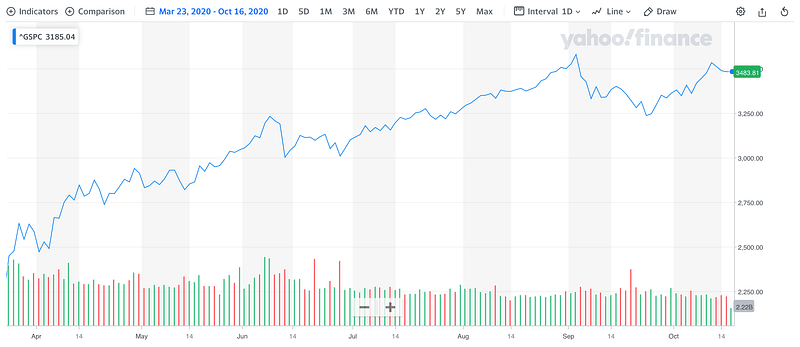
Does that make sense to anyone? The stock market is the wisdom of the crowds, eh? Like the Dot Com “who needs a business plan or customers” Crash of 2001 was wisdom? Like the Housing Market “house prices never go down” Crash of 2008 was wisdom? Like voting President “I could stand in the middle of Times Square and shoot someone” into office in 2016 was anything like wisdom?
Duuudes…. Crowds prefer to be separated, as far as possible from the concept and the reality, and even if within a sentence, even if uncomfortably ungrammatically so, as diametrically opposite as can be, from the word: wisdom. Like that. The two words can’t stand one another.
While crowds bid up prices of stocks in the US markets, US coronavirus daily new cases has accelerated like the stock market itself:
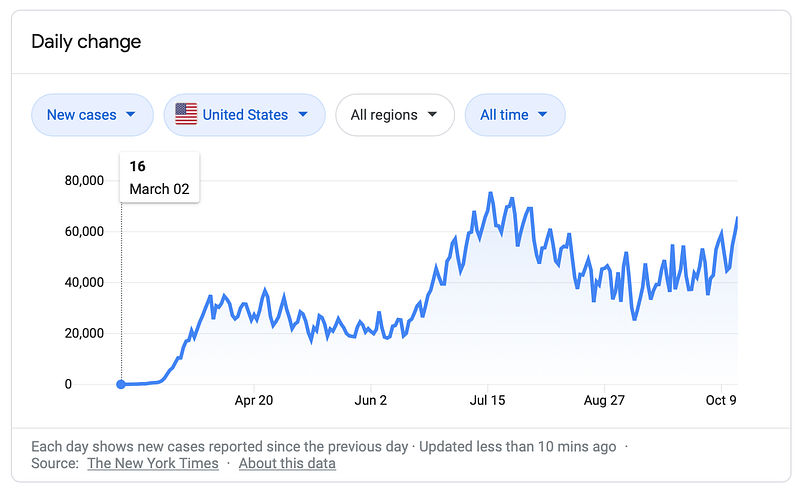
The “conventional wisdom” of the crowds asserts that the stock market is valuing future returns… oh really? Do you see that upturn in the number of Coronavirus cases? It is now Fall, 2020. What else happens this time of year? The Flu. Flu plus coronavirus does not add up to a bright and productive future in any kind of mathematics I can conceive of. Wisdom of the crowds my @$$. Pardon my Latin.
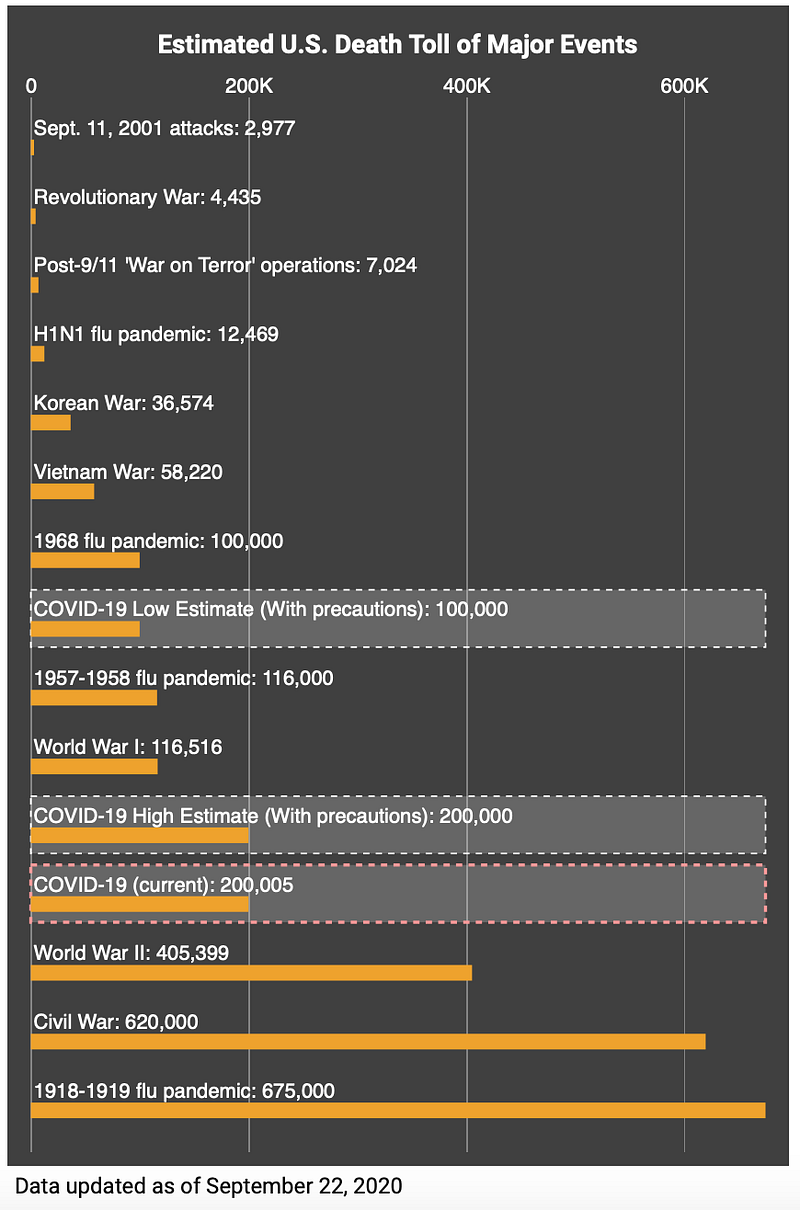
And that’s just cases. While Emperor Nero played the fiddle, I mean while the President twiddled his little thumbs, and implemented the weakest and most ineffective “policies” in response to the most virulent infectious agent since the 1919 Spanish Flu, we have now lost more American civilians to coronavirus than we lost American soldiers during the First World War!!!
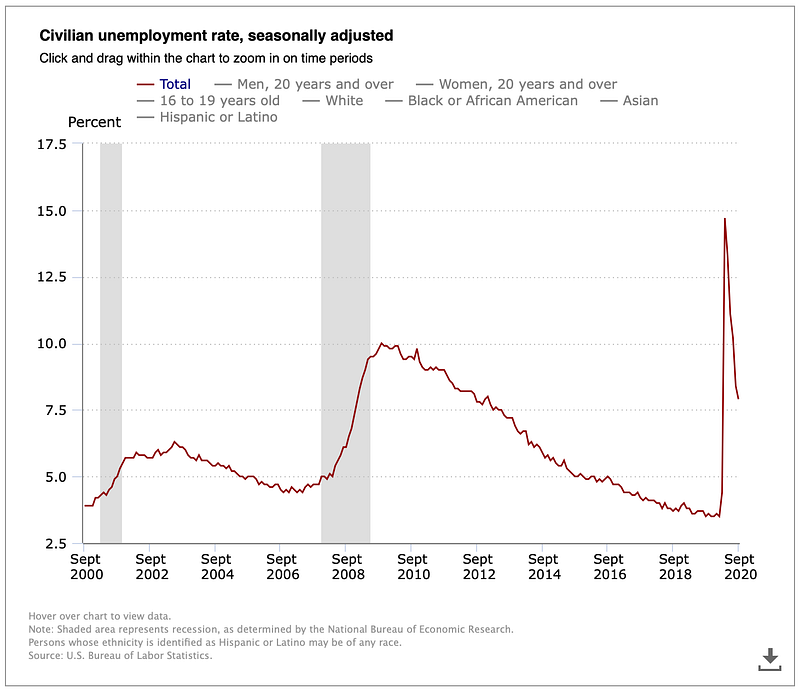
While the wisdom of the crowds might be pardoned for not quite understanding the ramifications of an invisible, undead package of RNA otherwise known as the coronavirus (SARS-CoV-2 to you hoighty toighty hyper-educated science dweebs), there is nothing freakin’ imaginary or invisible about lost freakin’ jobs.
In the next chart marked in gray vertical bars are the two recessions and market crashes I referred to up top — the Dot Com and Housing Crashes. And you see unemployment surging up with each. At the time, the Housing Crash was the most painful unemployment situation our country experienced since the Great Depression of the 1930s. And what has pole-vaulted right over the Housing Debacle caused by the wisdom of crowds who thought home prices would never decline? Today’s unemployment caused by the pandemic which was exacerbated by the ineptitude of the President elected by the wisdom of our crowds.
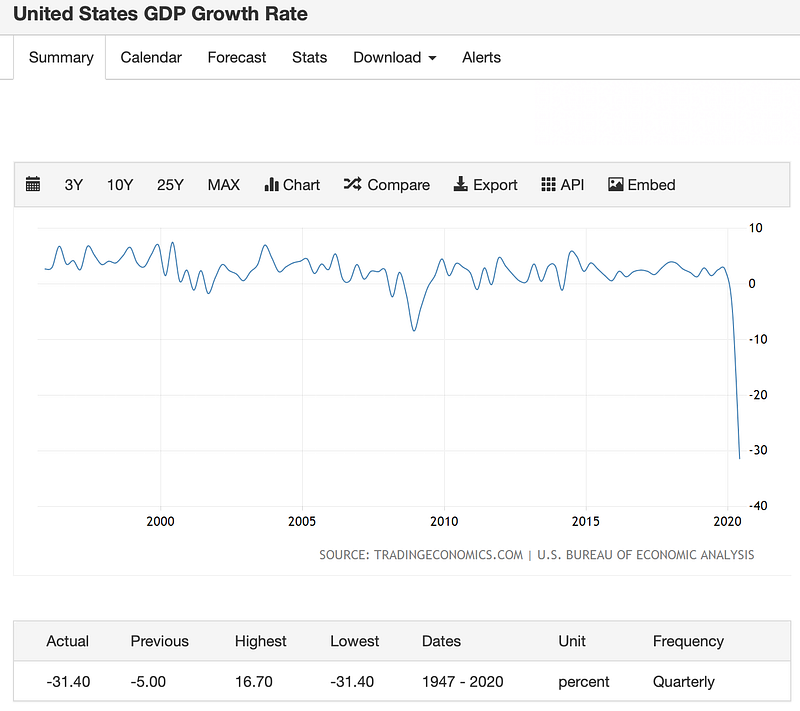
The crowds are at least vaguely aware of the growth of the economy, because when the economy tanks, so does the market (because future returns for the immediate future tanks with the economy). When the unemployment rate skyrockets like in the previous graph, what do you think happens to the economy as measured by gross domestic product — driven mostly by every day folks like you and me buying toilet paper and cereal and gasoline. You got it — it is like a mirror image:
2. The prediction…
So. What the heck do you think is gonna happen to the stock market?
It is gonna get demolished. It should get demolished. It’s gonna get killed so bad, they’re gonna have to invent a new word for how bad it died. Recession is downright cheerful by comparison. Depression ain’t nearly catastrophic enough of a word. Death is too kind. Destroyed is so over-used it has lost any extremity of meaning. The stock market is gonna git killed dead.
As for how that might look, a good example, as a bare minimum, is this minor tweak of the market:
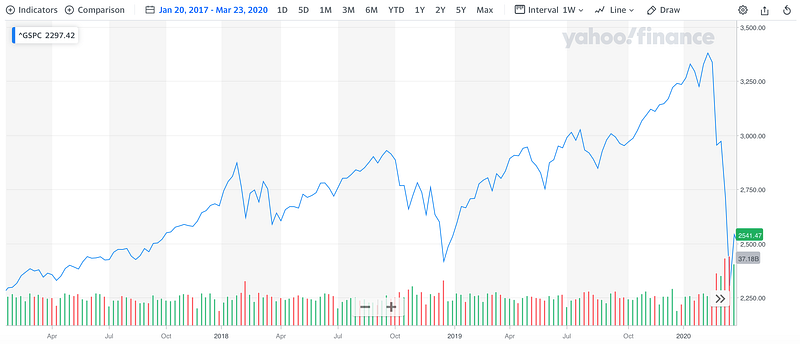
That there, the right-hand side of the chart, the cliff, was the market’s response this past February and March. It was the correct response, when the coronavirus first became a vague reality in the public’s consciousness. The market experienced the sharpest, fastest, deepest drop in recorded market history.
So, then what happened?
The graph at the very top of this story is what happened. The fastest, unexplained recovery from a market destruction ever recorded. Does that make any sense?
The respectable, staid, mature, well-coiffed market analysts are too reluctant to be seen as wingnuts dabbling in conspiracy theories, conspiracies like those the supporters of this President eat and breathe.
But I don’t have a reputation to uphold. Duuudes with conspiracy theories are like Chicken McNuggets with BBQ sauce. I’ve read everything about the Knights Templars, the Illuminati, the Area 51 aliens, and the Deep State. I am deeply educated.
Anyone who thinks clearly and without bias will see that the market is being propped up by this administration, who has made it clear that the stock market is more important than the people of America. The stock market is this President’s idea of what getting elected is all about and is his symbol of masculinity. So, when he saw the big droop in the market, he called for his market Viagra.
What is the best way to prop up an old sagging market? You flood the market with cash. And when you add cash to the market you lower interest rates… this was Quantitative Easing (QE) initiated by Bush and continued by Obama in order to support a flagging economy — but one of the unintended consequences of easy QE money was inflated asset (including stock) prices.
Stock prices go up because when you add cash to the economy, interest rates (the price of money) goes down. When interest rates go down, people look for other places to earn returns, and the natural place is the stock market and other assets, anything besides cash.
But this President is not trying to rescue an economy. An economy filled with suckers who have to actually work every day for a living. He doesn’t care about regular Joes. No. This President desperately wants the stock market schwinging up and rigidly to the right. So, any interest rate easing from this administration is all about that asset inflation. Not about the economy and the people.
And who controls money supply and interest rates? The Federal Reserve. This was the body that implemented the Bush and Obama QE policy. And who runs the Federal Reserve? Jerome Powell. And who appointed Jerome Powell as Chairman of the Federal Reserve? Our ever so wisely elected President “I could shoot someone in the middle of Times Square”.
Is there any evidence of lower interest rates? Check this out — the inter-bank rate which is what banks charge each other to borrow:
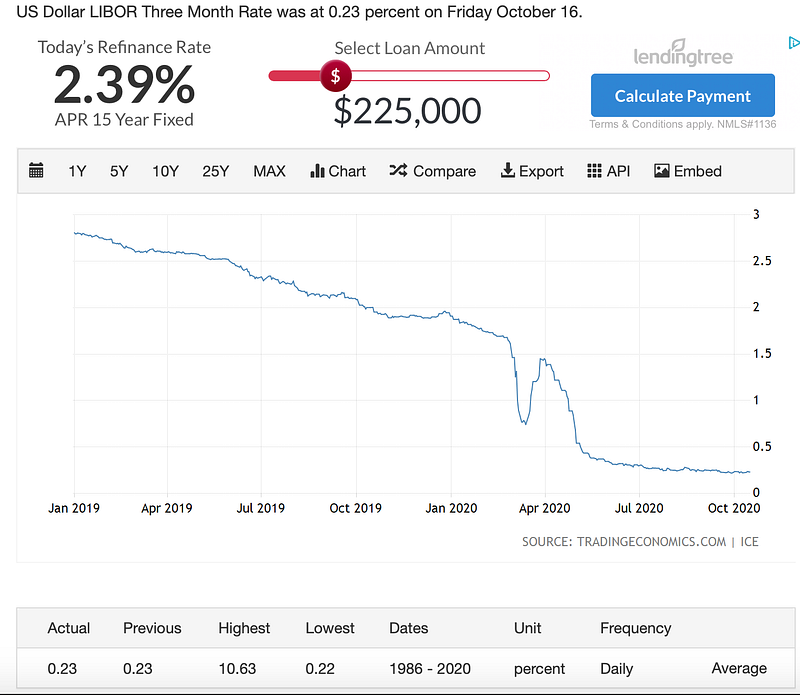
Notice the dramatic drop in interest rates right when the stock market has been on a tear?
Interest rates are a secondary effect of the Fed pouring money into the market — is there evidence of a large increase in the money supply? Check out the next two charts:
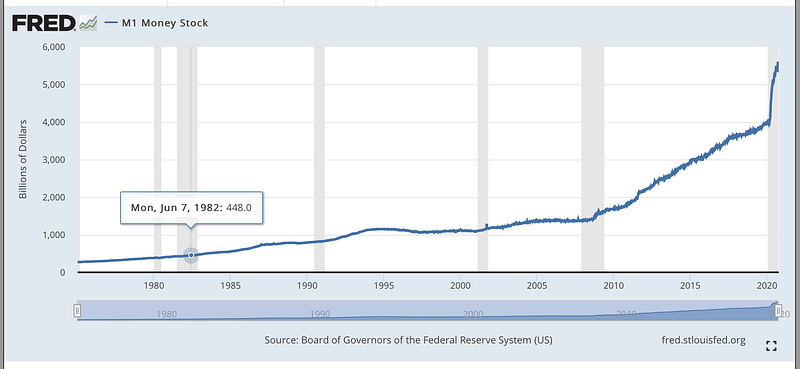
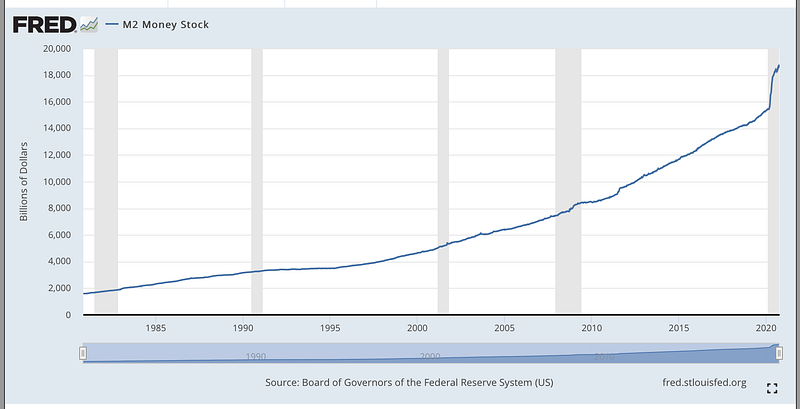
See the almost vertical step change in the money supply in 2020, way to the right?
So now we know this administration is artificially inflating the stock market by increasing the money supply, thus lowering interest rates, and forcing market players to re-direct away from investing in cash towards the stock market.
But stock investors demand growing earnings from the companies they invest in. How have corporate earnings done this year?
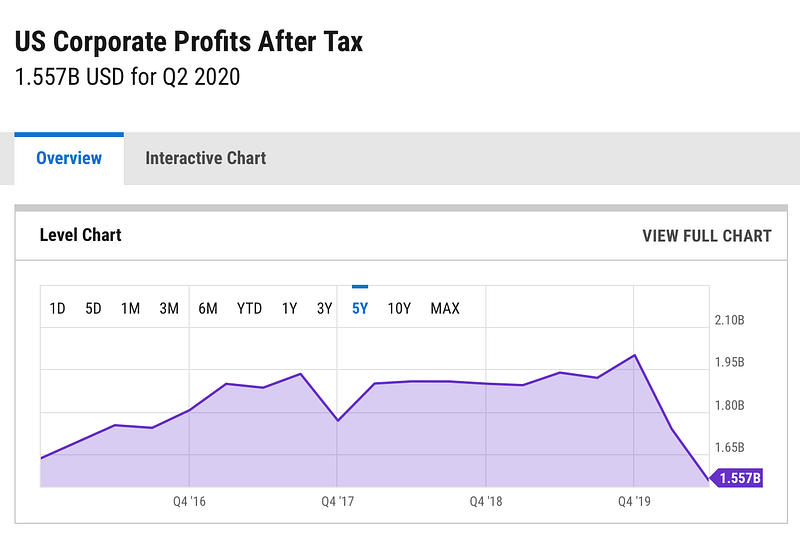
See the cliff to the right? Crowds, clearly, are not wise. But they are also not stupid. When they realize that earnings are going to keep declining, they’ll realize they are left holding the bag. They’ll eventually bail.
And the stock market will be kilt dead.
3. What to do, what to do…
Hopefully y’all realize these are my own personal reflections, opinions, and ravings on the market, the economy, and related topics. Each of you has to decide what’s right, what makes sense, and what to do.
Personally, I am a long-term buy and hold investor. That means that the data shows that over time, a diversified portfolio of stocks beats every single asset class, hands down. The book that started me thinking and examining the data was Jeremy Siegel’s old chestnut, Stocks for the Long Run, now I think in its 5th edition. Worth your time.
During previous pandemics, recessions, depression, world wars, small wars, good presidents, bad presidents, a broadly diversified stock portfolio over time — over time — has always been the best asset class to own. Period.
Not housing, not gold, not bonds, not art, not fancy cars… a diversified portfolio of stocks. Boring actually.
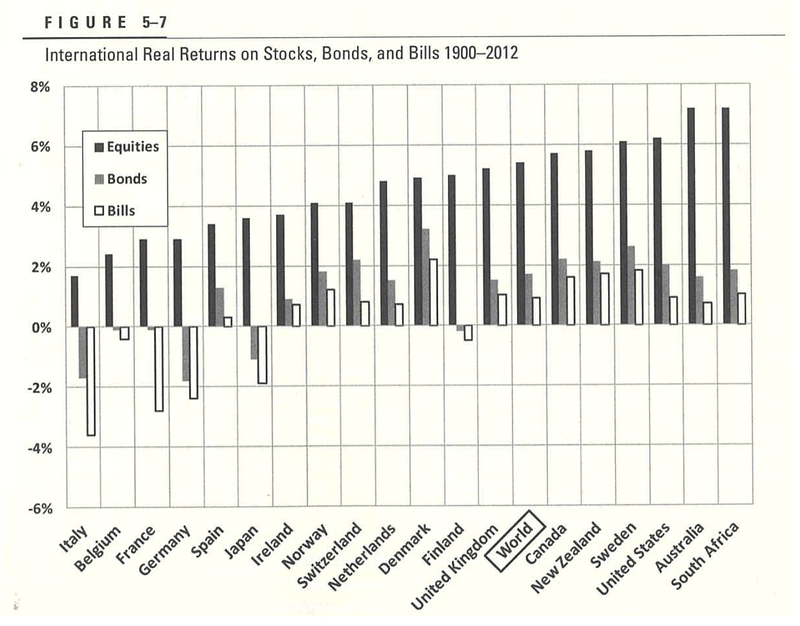
But boring means that a patient and conscientious investor is actually a better investor than a smart investor. Smart investors get into trouble all the time because they think they can outwit the market. They know what I’ve been saying out loud in this article — that crowds are not wise. But the mistake smart people make is believing that they can outwit the market nonetheless. Here, smart people also lack wisdom.
The wise course of action is to look at the data (go see Siegel’s book). Based on the data, determine the best course of action.
There are several properties of markets that are important to understand.
1. Markets are unpredictable. Markets are made by people, lots of people, who make individual decisions. Sometimes they act like a mob, and all move in a common direction. Sometimes they act like a totally random Jackson Pollock painting.
2. Short term, markets are often wrong. Prices are a reflection of popularity, not knowledge. However, there are limits to the stupidity. Mechanisms like buying short a stock that is running too hot, or conversely buying long stocks that are un-fairly flogged. But in general, short term prices are only a reflection of crowd-sentiment, and not much else. Short term is less than a decade.
3. Long term, the trend of a stock will converge and approach the true value of a company. Long term is decades.
4. Most important, the information available to make good investing decisions is fundamentally lacking. Most critical information is locked away, proprietary, within the company who only releases information required by regulation. So none of us are making truly informed decisions, and any arguments we may have on a company are like flies buzzing over horsesh!t. The horse itself, the meat of the argument, is galloping off over there, and here are us flies buzzing over a pile of crap that the company disclosed because it has to do so regularly.
Since markets are unpredictable, the wise duuude realizes it doesn’t make sense to try to time the market. To say that we are at a market top or market bottom. That’s a sure way to ruin and misery, and living in a cardboard box eating cold cat food.
Since short term, markets are often wrong, and they can remain wrong for longer than your portfolio can last, the wise duuude ignores the market, the noisy crowds.
Since long term the market will converge towards the true value, the wise duuude realizes that total time in the market is the real power behind total returns.
So, patience (not hurrying to get rich), and independence (ignoring the crowds), are the two key attributes for a good investor (not necessarily smarts).
Despite my conviction that this President is a Crook and is meddling with the markets, I am not making investing decisions for today. I am making investing decision for decades out, for a time when this President will thankfully be buried and dust. Sure, this moment in time sucks for many of us. But this too will pass. We live in the greatest country in the world, no thanks to this President and the poor wisdom of the crowds who elected him (or failed to vote for an imperfect candidate — and got over 200 thousand coronavirus dead instead).

I have not sold a single share of my stocks in response to the virus or this President.
Despite this President’s reign of terror, I have bought shares of TSLA and AMZN despite believing from the start that he will cause the economy to crash and burn (as we are seeing).
I wrote about TSLA here showing how they are growing exponentially despite the economy going to hell, and in contrast to the rest of the auto industry which is in sharp decline:
There are always great companies like TSLA and AMZN who will perform well despite recessions and other calamities. When you find great companies, invest no matter what the moment is like.
Anyways, that, very roughly, is my approach.
Good luck and good wisdom to each and every one of you out there.
Thank you for reading, and please share! Also, if you liked this, please check out my recent musings on loans — you’ll enjoy that even more!


