avatarBen Jones MD PhD

Free AI web copilot to create summaries, insights and extended knowledge, download it at here

4990

Abstract

a. [<a href="https://pubmed.ncbi.nlm.nih.gov/28118781/">1</a>]</p><p id="e8ec">Given these perplexities, the burning question remains: If some are biologically wired to find coffee more bitter, why do they gravitate towards it?</p><h1 id="576c">Decoding the caffeine attraction: More than just good taste</h1><p id="135c">When you sip your morning brew, are you truly enamoured by its taste?</p><p id="2b70">The more likely reason behind our coffee loyalty isn’t its flavour but the invigorating buzz it brings. This hypothesis gains weight when you consider that those most sensitive to coffee’s bitterness consistently opt for caffeinated over decaf variants, even though they are more bitter.</p><h1 id="d8e3">Unravelling the CYP1A2 enigma</h1><p id="e081">At the heart of our caffeine saga is an enzyme: CYP1A2.</p><p id="046a">In the liver’s bustling workspace, the enzyme CYP1A2 diligently breaks down caffeine. The efficacy and speed at which this enzyme operates are dictated by the CYP1A2 gene.</p><figure id="e834"><img src="https://cdn-images-1.readmedium.com/v2/resize:fit:800/1*_IAnboW_S-SFREnAmI2kCw.jpeg"><figcaption>The CYP1A2 enzyme: Nature’s barista guiding our coffee cravings | Images: Adobe stock and Wikimedia Commons</figcaption></figure><p id="7eac">But not all CYP1A2 is made alike.</p><p id="54ae">The CYP1A2 gene exists in multiple variants: the rapid metabolisers, the sluggish ones, and those that fall in between.</p><p id="5a67">Those armed with the speedier version find their caffeine buzz fleeting. The enzyme flies through their recently ingested caffeine, forcing them to refill their mugs more often. On the flip side, individuals with the leisurely variant might find their nerves fraying after just a couple of cups.</p><p id="bd72"><b>Wondering where you stand?</b></p><p id="5cd7">Your daily caffeine ritual might offer some clues. If a single coffee sends you climbing the walls, you’re probably equipped with the slower variant of CYP1A2. However, the rapid variant might be at play if you find yourself constantly refilling that mug.</p><h1 id="2add">Beyond CYP1A2: The broader genetic landscape</h1><p id="c0b3">While CYP1A2 may be our central protagonist, the genetic narrative of caffeine is rich with other characters.</p><p id="4a22">One of caffeine’s primary roles in our system is to stymie adenosine, nature’s tranquiliser. As adenosine melds with its brain cell receptors, it ushers in drowsiness. Think of it like a warm blanket settling over your brain cells.</p><p id="9d64">Enter caffeine, stuck into the adenosine receptors like chewing gum in a lock, ensuring adenosine can’t induce its soporific effect.</p><p id="b364">But there’s more — caffeine amplifies adrenaline production and gifts us a surge of dopamine, solidifying its rank as our top psychoactive of choice.</p><p id="10d8">Navigating this dynamic is the ADORA2A gene, governing our adenosine receptors. Certain variants can predispose to caffeine-triggered anxiety. If that rings true for you, chances are you’ll choose tea over coffee.[<a href="https://pubmed.ncbi.nlm.nih.gov/34903748/">3</a>]</p><p id="d913">But the genetic tapestry doesn’t end there. The AHR gene can ramp up your CYP1A2 activity, while PDSS2, crucial for Coenzyme Q10 synthesis, might dictate how leisurely you metabolise caffeine. The more active your PDSS2 gene, the slower you metabolise caffeine and the less coffee you’ll likely drink.</p><h1 id="d430">From coffee to dark chocolate: Shared bitter pleasures</h1><p id="f1e3">Do coffee enthusiasts naturally gravitate toward other bitter foods?</p><figure id="95d1"><img src="https://cdn-images-1.readmedium.com/v2/resize:fit:800/1*TsIRRNo_eth_4V3JzdQQdA.jpeg"><figcaption>Dark roast, dark cocoa: What’s the shared secret? | Image: Adobe stock</figcaption></figure><p id="570d">You might expect so, but the answer is no. While their taste buds might embrace the robust notes of a dark espresso, that same affection doesn’t extend to broccoli, sprouts, or tonic water.</p><p id="cc35">Nor, for many, does it include tea. Courtesy of those genetic arbiters of taste, most of us fall squarely into one of two camps: tea lovers or coffee aficionados.</p><p id="b16d">However, there’s one notable exception to this trend: dark chocolate.</p><p id="36b6">Those who relish the complexities of coffee also tend to appreciate the nuanced bitterness of dark chocolate. Yet, they aren’t necessarily fans of milk chocolate. So if it’s not the chocolate they’re enjoying, would you like to speculate on the attraction to dark chocolate?</p><p id="1ca2">The shared ingredient between coffee and dark chocolate: caffeine.</p><h1 id="3ed6">When coffee meets cigarette: More than just a habit</h1><p id="d26d"><i>Certain clichés carry a core of truth.</i></p><figure id="7d57"><img src="https://cdn-images-1.readmedium.com/v2/resize:fit:800/1*v_YjjeBPiK3H_ir4BeEA-w.jpeg"><figcaption>A timeless pairing: A connection deeper than culture? | Image: Adobe Firef

Options

ly</figcaption></figure><p id="91d2">The image of someone relaxing with a coffee in one hand and a cigarette in the other is well-entrenched in our collective consciousness. But is this pairing simply about habit, or is there more going on?</p><p id="fb30">Science suggests the latter.</p><p id="f882">Cigarette smoke boosts the activity of our trusty CYP1A2 enzyme — the very one responsible for breaking down caffeine. If you’re a smoker, the stimulating effects of a cup of joe dissipate quicker, leaving you yearning for the next caffeine fix.</p><p id="0325">This accelerated metabolism may be why, more often than not, smokers seem inseparable from their coffee cups.</p><h1 id="e885">The coffee-gout paradox: A genetic tangle</h1><p id="8767">Coffee’s myriad health benefits are increasingly recognised and celebrated.</p><p id="8e4b">Among these benefits, coffee’s potential to deter gout stands out. Peak protective effects appear at about four daily cups. Yet, as with many aspects of our biology, a more profound, intricate story is hidden in our genes.</p><p id="ec58">Diving into the genetic maze, four primary genes determine the levels of urate in our body, the crystals of which cause gout’s agonising joint pains.</p><p id="b2ce">The twist? All four genes are associated with a dislike of coffee.</p><p id="2bf3">Ponder the irony: those with a condition that coffee can alleviate are genetically programmed to avoid it. Is this nature’s sense of irony?</p><h1 id="5a81">Want a little more time to savour that caffeine lift?</h1><p id="c6f8">You can use this genetics knowledge to your advantage. Did you know you can slow down those liver enzymes giving you more time to enjoy the caffeine buzz?</p><p id="265d">Does it mean a foray into the web’s dark Wonderland for a little red pill? Nope. Just a trip to the corner shop. A daily glass of grapefruit juice can gently tap the brakes on your CYP1A2 enzyme, prolonging your caffeine high.</p><figure id="ef6d"><img src="https://cdn-images-1.readmedium.com/v2/resize:fit:800/1*lG6kOc4yt9S5r8T0HnLmkg.jpeg"><figcaption>The perfect chaser: Coffee’s new best friend? | Image: Adobe Firefly</figcaption></figure><p id="9328">But a word of caution: before you indulge, be sure to review any medications you’re on. The versatile CYP1A2 isn’t just about coffee — it’s involved in metabolising many medicines too.</p><blockquote id="b83d"><p>The next time you ponder between an Americano or an Earl Grey, remember: it’s not your refined palate leading the way, but rather the genetic wizard behind the curtain orchestrating your preferences.</p></blockquote><p id="2f38"><b>Free will? Who are you kidding?</b></p><p id="8897"><i>If you enjoy the intersection between science and food, you may also enjoy these articles:</i></p><div id="151c" class="link-block"> <a href="https://readmedium.com/butter-or-margarine-a-doctor-explores-what-the-science-tells-us-538d1d8da501"> <div> <div> <h2>Butter or Margarine? A Doctor Explores What the Science Tells Us</h2> <div><h3>Are you making a healthy choice, or are you shortening your life?</h3></div> <div><p>medium.com</p></div> </div> <div> <div style="background-image: url(https://miro.readmedium.com/v2/resize:fit:320/1*jPgqLYBP9nFs3046rKdyTg.jpeg)"></div> </div> </div> </a> </div><div id="b795" class="link-block"> <a href="https://readmedium.com/i-researched-bread-additives-as-an-md-phd-heres-why-i-now-bake-my-own-bread-97d6da1b7966"> <div> <div> <h2>I Researched Bread Additives as an MD/PhD — Here’s Why I Now Bake My Own Bread</h2> <div><h3>Is even ‘healthy’ supermarket bread ultra-processed food? Does that mean we shouldn’t eat it?</h3></div> <div><p>medium.com</p></div> </div> <div> <div style="background-image: url(https://miro.readmedium.com/v2/resize:fit:320/1*J6ghp7j08JutCHl_QpN1vQ.jpeg)"></div> </div> </div> </a> </div><div id="3002" class="link-block"> <a href="https://readmedium.com/unseen-toxins-a-doctor-reveals-the-disturbing-science-of-grilled-fried-smoked-and-browned-food-86d7687df57b"> <div> <div> <h2>Unseen toxins: A doctor reveals the disturbing science of grilled, fried, smoked and browned food</h2> <div><h3>Buckle up for a journey into the kitchen’s dark secrets. How you cook your food may be shortening your life.</h3></div> <div><p>medium.com</p></div> </div> <div> <div style="background-image: url(https://miro.readmedium.com/v2/resize:fit:320/1*BCGDuayQI6P45ix0DyN8aw.jpeg)"></div> </div> </div> </a> </div></article></body>

Your genetic puppet masters

Think you chose coffee this morning? Your genes might disagree

Each morning, as you’re drawn to the beckoning aroma of your coffee, pausing to appreciate that first sip, it might not be habit calling you. Behind the scenes, your genes, like hidden puppeteers, whisper their demands, giving you only the illusion of free will.

Our morning ritual is more than just habit; it’s written in our DNA | Image: Adobe stock

Headlines frequently declare, ‘Your coffee addiction? It’s in your DNA!’

While there’s truth to these claims, such catchy headlines barely graze the surface of the control genetics has over our relationship with coffee. Dive deeper, and the story is far richer and more aromatic than it first appears.

Coffee: A global love affair

Every day, the world indulges in a colossal coffee fest equivalent to 200 Olympic-sized swimming pools.

Nearly a billion people between them pour two billion cups. Sixty-four percent of Americans start their day with a coffee, with women slightly out-sipping the men. In Britain, the nation of supposed tea lovers spends £1 billion each year on coffee, 2.8 kg per person.

While the Brits sip moderately, the Finns are in a league of their own, guzzling a staggering 12.2 kilograms every year. Close behind are Swedes and Norwegians, while Americans average 4.5 kg. Those in Finland surely ride a caffeinated high throughout their day!

Any Finns here? How do you manage it?

Coffee’s redemption: From villain to health hero

More than just a morning kickstarter, coffee has been heralded for its potential health benefits.

Plentiful studies demonstrate its protective effects against type 2 diabetes, Parkinson’s, Alzheimer’s, adult leukaemia, liver and mouth cancers, cirrhosis, gout, kidney stones, and even fatal cardiovascular disease.

But java wasn’t always in the good books.

In 1991, the World Health Organisation tagged coffee as a possible carcinogen. By 2016, however, the tides turned in its favour, recognising coffee for the potential health benefits we know today.

An unlikely hero

Bitterness is more than just a taste; it’s a sensory warning. Nature has wired us to be wary of bitter tastes — much like our innate fear of snakes.

Both are evolutionary survival tactics. Keeping anything bitter out of your mouth is an excellent way to avoid being poisoned. But here’s the conundrum: coffee, with its distinct bitterness, is adored by many.

So what’s nudging us to ignore this powerful evolutionary warning?

Bitter science

The tongue comes equipped with bitterness receptors. Some are tailored to detect specific chemicals, while others serve as generalist bitterness watchdogs. The greater their number, the more intense the bitter experience. A higher receptor count means more messengers alerting the brain of potential danger. [1]

Twin studies reveal that more than a third of the variance in how we perceive caffeine’s bitterness is down to genetics. [2]

This genetic encoding lies in the TAS2R gene family. Comprising about 25 genes, most cluster on chromosomes 7 and 12. How you perceive bitterness is influenced by the type, number, and variations of these genes. [1]

If you’re genetically predisposed to being sensitive to bitterness, logic would dictate you’d shun coffee. But in a strange twist, regular coffee enthusiasts find caffeine twice as bitter as do occasional drinkers.

Paradoxically, those most sensitive to caffeine’s bitterness often become its most ardent aficionados.

If we encounter bitter foods early, do we appreciate them more later? | Image: Adobe stock

Bitter childhood encounters

Another counterintuitive observation: you might assume that early exposure to bitter compounds could desensitise you to them. Yet, it appears the opposite is true.

Early exposure seems to boost the production of bitter receptors, amplifying the sensation. To be fair, that work has mostly been done in chickens, but there are obvious ethical constraints on experimenting on children, not least because coffee increases the risk of childhood leukaemia. [1]

Given these perplexities, the burning question remains: If some are biologically wired to find coffee more bitter, why do they gravitate towards it?

Decoding the caffeine attraction: More than just good taste

When you sip your morning brew, are you truly enamoured by its taste?

The more likely reason behind our coffee loyalty isn’t its flavour but the invigorating buzz it brings. This hypothesis gains weight when you consider that those most sensitive to coffee’s bitterness consistently opt for caffeinated over decaf variants, even though they are more bitter.

Unravelling the CYP1A2 enigma

At the heart of our caffeine saga is an enzyme: CYP1A2.

In the liver’s bustling workspace, the enzyme CYP1A2 diligently breaks down caffeine. The efficacy and speed at which this enzyme operates are dictated by the CYP1A2 gene.
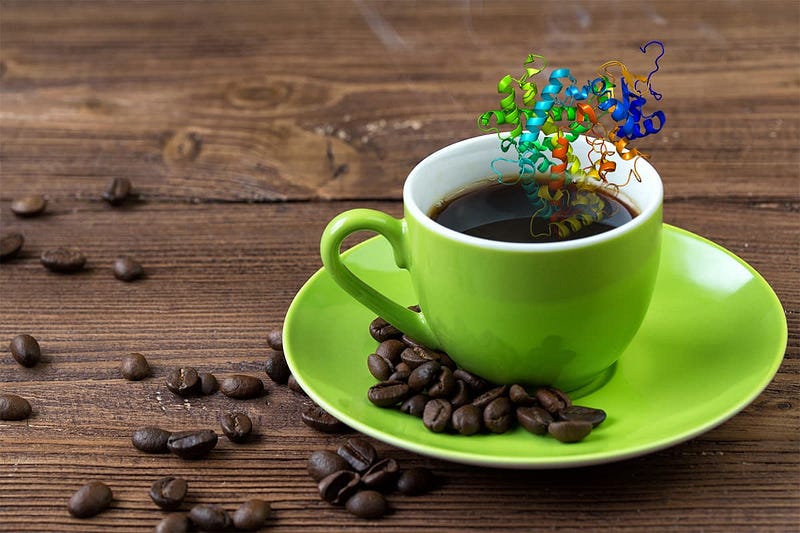
The CYP1A2 enzyme: Nature’s barista guiding our coffee cravings | Images: Adobe stock and Wikimedia Commons

But not all CYP1A2 is made alike.

The CYP1A2 gene exists in multiple variants: the rapid metabolisers, the sluggish ones, and those that fall in between.

Those armed with the speedier version find their caffeine buzz fleeting. The enzyme flies through their recently ingested caffeine, forcing them to refill their mugs more often. On the flip side, individuals with the leisurely variant might find their nerves fraying after just a couple of cups.

Wondering where you stand?

Your daily caffeine ritual might offer some clues. If a single coffee sends you climbing the walls, you’re probably equipped with the slower variant of CYP1A2. However, the rapid variant might be at play if you find yourself constantly refilling that mug.

Beyond CYP1A2: The broader genetic landscape

While CYP1A2 may be our central protagonist, the genetic narrative of caffeine is rich with other characters.

One of caffeine’s primary roles in our system is to stymie adenosine, nature’s tranquiliser. As adenosine melds with its brain cell receptors, it ushers in drowsiness. Think of it like a warm blanket settling over your brain cells.

Enter caffeine, stuck into the adenosine receptors like chewing gum in a lock, ensuring adenosine can’t induce its soporific effect.

But there’s more — caffeine amplifies adrenaline production and gifts us a surge of dopamine, solidifying its rank as our top psychoactive of choice.

Navigating this dynamic is the ADORA2A gene, governing our adenosine receptors. Certain variants can predispose to caffeine-triggered anxiety. If that rings true for you, chances are you’ll choose tea over coffee.[3]

But the genetic tapestry doesn’t end there. The AHR gene can ramp up your CYP1A2 activity, while PDSS2, crucial for Coenzyme Q10 synthesis, might dictate how leisurely you metabolise caffeine. The more active your PDSS2 gene, the slower you metabolise caffeine and the less coffee you’ll likely drink.

From coffee to dark chocolate: Shared bitter pleasures

Do coffee enthusiasts naturally gravitate toward other bitter foods?
Dark roast, dark cocoa: What’s the shared secret? | Image: Adobe stock

You might expect so, but the answer is no. While their taste buds might embrace the robust notes of a dark espresso, that same affection doesn’t extend to broccoli, sprouts, or tonic water.

Nor, for many, does it include tea. Courtesy of those genetic arbiters of taste, most of us fall squarely into one of two camps: tea lovers or coffee aficionados.

However, there’s one notable exception to this trend: dark chocolate.

Those who relish the complexities of coffee also tend to appreciate the nuanced bitterness of dark chocolate. Yet, they aren’t necessarily fans of milk chocolate. So if it’s not the chocolate they’re enjoying, would you like to speculate on the attraction to dark chocolate?

The shared ingredient between coffee and dark chocolate: caffeine.

When coffee meets cigarette: More than just a habit

Certain clichés carry a core of truth.

A timeless pairing: A connection deeper than culture? | Image: Adobe Firefly

The image of someone relaxing with a coffee in one hand and a cigarette in the other is well-entrenched in our collective consciousness. But is this pairing simply about habit, or is there more going on?

Science suggests the latter.

Cigarette smoke boosts the activity of our trusty CYP1A2 enzyme — the very one responsible for breaking down caffeine. If you’re a smoker, the stimulating effects of a cup of joe dissipate quicker, leaving you yearning for the next caffeine fix.

This accelerated metabolism may be why, more often than not, smokers seem inseparable from their coffee cups.

The coffee-gout paradox: A genetic tangle

Coffee’s myriad health benefits are increasingly recognised and celebrated.

Among these benefits, coffee’s potential to deter gout stands out. Peak protective effects appear at about four daily cups. Yet, as with many aspects of our biology, a more profound, intricate story is hidden in our genes.

Diving into the genetic maze, four primary genes determine the levels of urate in our body, the crystals of which cause gout’s agonising joint pains.

The twist? All four genes are associated with a dislike of coffee.

Ponder the irony: those with a condition that coffee can alleviate are genetically programmed to avoid it. Is this nature’s sense of irony?

Want a little more time to savour that caffeine lift?

You can use this genetics knowledge to your advantage. Did you know you can slow down those liver enzymes giving you more time to enjoy the caffeine buzz?

Does it mean a foray into the web’s dark Wonderland for a little red pill? Nope. Just a trip to the corner shop. A daily glass of grapefruit juice can gently tap the brakes on your CYP1A2 enzyme, prolonging your caffeine high.
The perfect chaser: Coffee’s new best friend? | Image: Adobe Firefly

But a word of caution: before you indulge, be sure to review any medications you’re on. The versatile CYP1A2 isn’t just about coffee — it’s involved in metabolising many medicines too.

The next time you ponder between an Americano or an Earl Grey, remember: it’s not your refined palate leading the way, but rather the genetic wizard behind the curtain orchestrating your preferences.

Free will? Who are you kidding?

If you enjoy the intersection between science and food, you may also enjoy these articles:

Coffee
Genetics
Free Will
Lifestyle
Healthy Lifestyle
Recommended from ReadMedium