
There’s More to Eating Matzah Than You Think
A look at how the symbolism of matzah compared to leavened bread can help us become more humble and treat others — and ourselves — with kindness.
This morning I read an article written by Kat Kou called, There Are Good People Out There, in which she talks about creating interactions without expectations by changing the way we view others. She mentions the idea of doing things for others with no personal motives and how this comes about by changing the way we see those around us. As I write this, I am celebrating the holiday of Passover, and Kat’s article called to mind one of the fundamental aspects of the holiday.
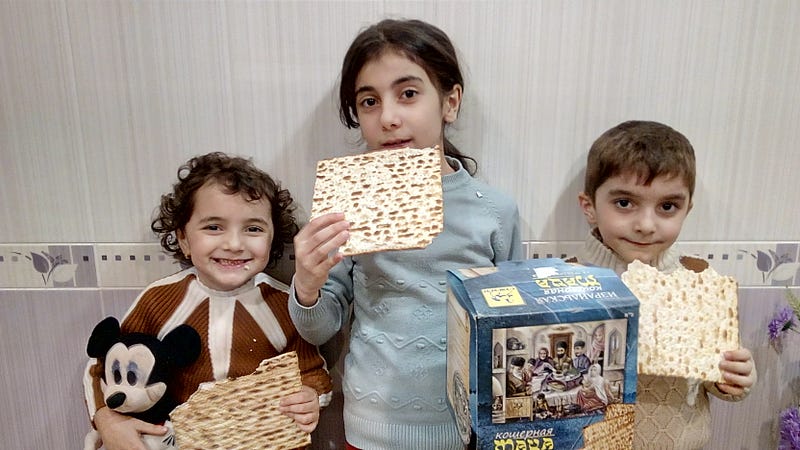
People of all faiths around the world are aware of some of the main parts of Jewish holiday of Passover. Even if you don’t know anything else, you are likely familiar with the practice of not eating bread during the length of the holiday. Some may also be aware of the surface reason for this.
When Pharaoh finally agreed to allow the Jews to leave Egypt they didn’t want to tarry since they feared he could change his mind at any second. After all, it had taken ten plagues which resulted in all kinds of chaos and hardship, including the death of Pharaoh’s own first born son to get him to agree in the first place. So there was no time to let the bread rise as the Jews rushed to leave Egypt and when they baked it, it became matzah. Yet this speaks more to why we specifically eat matzoh, not why we don’t eat bread.
With regard to the question, there is a misconception about what it is exactly, that Jews are prohibited from eating. Matzoh can technically be considered bread as it is made of water and flour and baked. Today we even have flatbread which, when toasted, can look quite similar to Matzoh.
So then it’s not actually bread that’s the problem. The problem is the leavening agents such as yeast. This is what Jews aren’t allowed to eat on Passover. Or drink for that matter, as beer is off the menu as well, being made with yeast. So what’s so offensive about leavening agents that Jews have to avoid it at all costs during this holiday?
The difference between bread that is leavened and matzah is that leavened bread rises while matzah lays flat. Leavened bread represents arrogance, egotism, and the tendency to get puffed up with self importance. People characterized by a leavened personality fail to understand that their accomplishments were not just their own doing, that no matter what they may have achieved in life, others had a hand in it. “Leavened” people perceive themselves as better than others and as entitled to special privileges and benefits as a function of how very special they are.
A side-effect of this viewpoint is that leavened people are so self absorbed, they fail to see others for who they are, have no interest in knowing about the special nature of those around them and see no need to be concerned with others wellbeing. Just as they’ve come to believe they have accomplished all their achievements solely through their own wherewithal, so too do they believe that others should take care of themselves and their own needs by themselves.
Even when they are capable of helping others and even when it will cost them nothing, they won’t do so out of principle. This is the multimillionaire who allows their sibling to become homeless because they don’t think it’s right or fair to be expected to help them out. It’s the person who bought far too much food who refuses to give it to someone who is hungry on the street despite the fact that it will go bad before they reach home. It is each of us who have it within us to say things to others that will help build them up and feel good about themselves but don’t do so, even though it costs nothing and takes only mere seconds of their time.
Matzah on the other hand, represents humility, the ability to understand we are all connected and responsible for each other. The “Matzah personality,” is someone with the constant desire to relate to others and the willingness to commit to helping others better themselves and their lives even as the matzah person does likewise.
Whereas the leavened personality is falsely causing themselves to always remain loftily about others because they believe themselves to be better, the matzah personality always sees that there is a possibility to rise higher but only through hard work on correcting their own flaws and putting others first even as others do for them.
So for eight days (in the diaspora, seven in Israel), we eat only matzah in order to have the time to work on ourselves, to gain insight and understanding into that which is standing in the way of our ability to truly connect with others and provide the kindness they deserve. During these days we also work to find ways to strengthen ourselves so that when we once again are confronted with the seductive promise of an easy way to self-fulfillment and happiness while justifying it being at the expense of others, we are able to resist the temptation.
The Takeaway
I think one of the most important implications of these ideas was expressed by Kat in the article I mentioned at the beginning. When we see others positive behavior as nothing more than efforts to manipulate the situation to gain something, we actually prevent people from practicing random acts of kindness. If our acts of kindness are turned into something ugly and negative then we will be reluctant to continue performing them.
This isn’t because we aren’t able to get something out of them — this is the thinking of the leavened soul. It’s because when we try to do something nice for someone such as providing money when they don’t have enough to cover a cup of coffee but someone comments on it making it seem like a come-on for example, the recipient may not accept the help.
Losing out on the cup of coffee isn’t the worst part of this. Instead of feeling the glow from knowing that someone wants to help, wants to connect, that someone stepped outside of themselves and their own needs to really see them and do something that said they are important, they will feel unworthy of kindness. They may also feel like someone just perceived them as an easy mark. This could lead to them being less likely to want to interact with others in the future to avoid that kind of hurt. The person who had been trying to extend kindness might avoid doing so in the future to avoid causing unintentional hurt.
At the same time, the opposite is true. I think that making it not just okay to be kind to others in a selfless manner but making it something that is valued, remarking on it when we see it, can go a long way to correcting some of the evil that we find in this world.
It takes the ability to step outside oneself, to shed the arrogance and self-serving nonsense to realize that all of us are equally important in the world and that we all benefit when we treat each other with kindness. Being able to view others positively comes from seeing ourselves positively which is a realistic view, not one of entitlement. We need to find way to steal ourselves against the unhealthy forces that aim to falsely build us up and make us feel like we are above others and automatically deserve everything good and desirable in life no matter who is hurt in the process. Only then will we be able to see the good in everything and everyone around us and be able to experience all that life holds.

If you enjoyed this article, you might also like reading these:
You can find links to my other work on Medium and follow me here. Thanks for reading!


