
‘The Year Without A Summer’: The Climatic Origin of Mary Shelley’s Frankenstein
How climate change caused by the largest volcanic eruption in recorded history inspired the first modern science fiction novel
Highlights
- The dust plume created by The Mount Tambora eruption in Indonesia in 1815, the largest volcanic eruption in recorded history, led to a global climate-cooling event in 1816, later known as ‘the Year Without a Summer.’
- Central Europe was especially impacted, becoming much colder, rainier, and stormier than normal, resulting in extreme thunderstorms and flooding in the region.
- The work of many artists in Europe was influenced by these climate-related events: The early 19th century writers Lord Byron, John Polidori, Percy Shelley, and Mary Shelley all happened to be together in Switzerland at the same time, and all were inspired by the extreme weather events to write their most famous work, including Mary Shelley’s Frankenstein.
- Frankenstein would eventually be recognized as the first science fiction novel ever written, as it dealt with the perils of scientists overreaching their knowledge and harnessing the power of technology, without an understanding of the ethical consequences of their actions.
- But the disorientation caused by the extreme rain, flooding, harvest failures, famine, and cold during that so-called Year Without a Summer, and the terrifying and fantastical art that it inspired, reveals a deeper insight into science fiction as a form of storytelling that helps us to envision both the worst and best of possible futures we might reach for in a time of climate crisis.
The largest volcanic eruption in recorded history
On April 5th, 1815, Mount Tambora on the island of Sumbawa in present-day Indonesia erupted. The eruption was so powerful it was heard in the Maluku Islands, 870 miles (1,400 kilometers) away, and would later be recognized as the largest volcanic eruption in recorded history. Ash and magma continued spewing from the mountain for several days, and by the evening of April 10th, the eruption reached a dramatic climax. Stamford Raffles, a British colonialist stationed in Java, recorded his experience of the April 10 eruption in his memoir:
“About seven, P.M. on the 10th of April, three distinct columns of flame burst forth, near the top of Tomboro mountain, all of them apparently within the verge of the crater; and after ascending separately to a very great height, their tops united in the air in a troubled confused manner. In a short time the whole mountain…appeared like a body of liquid fire extending itself in every direction.”
Over the next several weeks, the ash from the Mount Tambora eruption would indeed “extend itself in every direction,” dispersing dust high in the atmosphere around the world. The vast dust plume obscured the sun and reduced global temperatures by 0.72–1.26 °F (0.4–0.7 °C) leading to global cooling over the next year. The colder temperatures that resulted led to harvest failures, famines, and extreme weather events from China to Canada. In Europe, 1816 would come to be known as the “Year without a Summer.”
Otherworldly Colors
The Mount Tambor eruption and the global transformation in climate it caused had another curious effect. In Europe, evidence suggests that the 1.7 million tons of volcanic ash it dispersed into the planet’s atmosphere influenced the work of artists and writers.
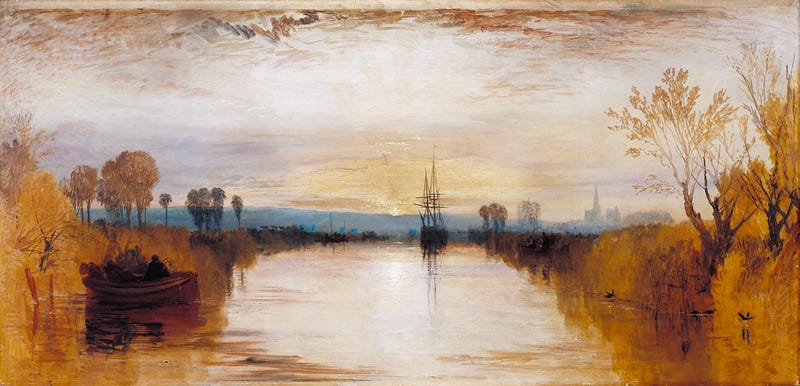
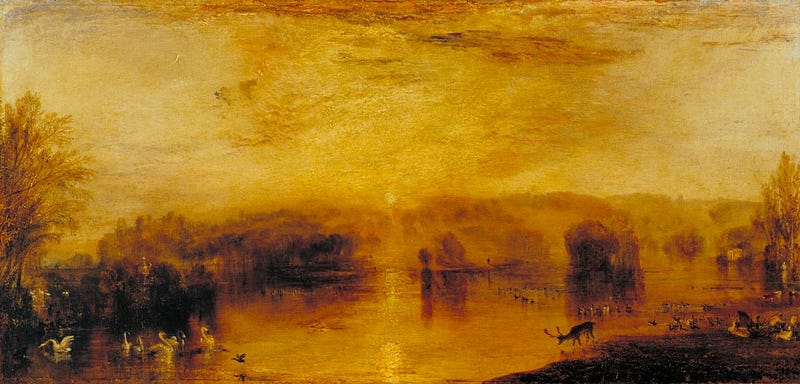
A paper in the journal Atmospheric Chemistry and Physics gives evidence that an increase of warm and opaque hues to depict sunsets in the paintings of famous artists throughout history offer “proxy information for the aerosol optical depth after major volcanic eruptions.”
In other words, the intense, orangish hues depicted in the paintings of sunsets by famous artists at the time – artists like J.M.W. Turner – point to artists’ rendition of the otherworldly colors created by volcanic ash suspended in the global atmosphere from the Mount Tambora eruption.
‘An almost perpetual rain confines us principally to the house’
The eruption of Mount Tambora on the other side of the planet changed the global climate: Europe, and central Europe in particular, became much colder, rainier, and stormier than normal. Painters like Turner in Europe weren’t the only ones artistically responding to this climatic transformation in the “Year Without a Summer” in1816.
In May of 1816, fleeing a scandal-ridden life in England, the poet Lord Byron escaped to a hotel in Geneva in Switzerland (Switzerland just happened to be one of the places most impacted by extreme weather changes due to the volcanic eruption in Indonesia).
Accompanying Lord Byron was his physician, a 20-year-old John Polidori, who was also an aspiring novelist. Coincidently, also staying at the hotel were Mary Wollstonecraft Godwin, her step-sister Claire Clairmont, and Percy Bysshe Shelley.
On a rainy afternoon on May 27, 1816, Lord Byron encountered Mary, and soon after the whole group left to stay at two villas on the shores of Lake Geneva.
Ther plans to explore the area were hampered by the relentless rain and thunderstorms, trapping all the artists indoors. In her journal, the then 18-year-old Mary writes,
“An almost perpetual rain confines us principally to the house…One night we enjoyed a finer storm than I had ever before beheld. The lake was lit up, the pines on the Jura made visible, and all the scene illuminated for an instant, when a pitchy blackness succeeded, and the thunder came in frightful bursts over our heads amid the darkness.”
One dark and (probably) stormy night, Byron suggested that to pass the time, everyone should write a ghost story. So over the course of three days during that unusually “wet, ungenial summer” of 1816, they wrote.
Byron would begin the outline of a story about a vampire but soon abandoned the story after a few pages. He let Polidori pick up the narrative thread about a vampiric aristocrat, which the young physician would later publish as The Vampyre.
On one of the nights, Mary listened to a conversation between Byron and Shelley that veered into a philosophical direction, as she recorded in her journal, on “the nature of the principle of life”:
“Many and long were the conversations between Lord Byron and Shelley, to which I was a devout but nearly silent listener. During one of these, various philosophical doctrines were discussed, and among others the nature of the principle of life, and whether there was any probability of its ever being discovered and communicated.”
As the conversation progressed into the rainy night, and with terrifying stories on the mind, darker matters came up. As Mary wrote about her memory of the conversation that evening, she writes how Percy Shelley and Lord Byron wondered aloud:
“Perhaps a corpse would be reanimated; galvanism had given token of such things; perhaps the component parts of a creature might be manufactured, brought together, and endued with vital warmth.”
Late in the night, after going to bed, the idea of galvanism lingered in her mind. She struggled to sleep as the ingredients for a new story stewed in her mind:
“Night waned upon this talk, and even the witching hour had gone by before we retired to rest. When I placed my head on my pillow, I did not sleep, nor could I be said to think. My imagination, unbidden, possessed and guided me, gifting the successive images that arose in my mind with a vividness far beyond the usual bound of reverie. I saw — with shut eyes, but acute mental vision — I saw the pale student of unhallowed arts kneeling beside the thing he had put together; I saw the hideous phantasm of a man stretched out; and then, on the working of some powerful engine, show signs of life, and stir with an uneasy, half-vital motion.”
“On the morrow,” Mary goes on to write, “I announced that I had thought of a story.”
Two years later, in 1818, she would publish Frankenstein: The Modern Prometheus.
The First Science Fiction Novel
The Year Without a Summer of 1816 was no doubt an uncanny experience for the group of writers. Especially in Switzerland, they experienced extreme weather events – incessant rain, thunderstorms, cold, and unprecedented flooding – more than anywhere else in Europe. Those nights would inspire Byron to write an apocalyptic poem called Darkness¹ about a world-ending climatic event.
In the case of Polidori, the gloomy evenings fired his imagination to create an amalgamation of gothic mythology, romance, fantasy, and horror in the Vampyre, credited with being the first of a new fantasy genre that would inspire later works like Bram Stoker’s Dracula.
And for Mary Shelley, the electricity form thunderstorms in the air, in combination with late-night conversations about the life-giving electro-force of ‘galvanism’ proposed by pseudo-scientists of the era, led to Frankenstein, widely viewed by literary scholars as the first science fiction novel ever written.
“All three works,” writes British historian Geoffrey Parker, “reflected the disorientation and desperation that even a few weeks of sudden climate change can cause.”
When Frankenstein was published in 1818, it generated a mix of sensation, criticism, and confusion. It was like nothing anyone had read before. As one reviewer wrote, “This is a novel, or more properly a romantic fiction, of a nature so peculiar, that we ought to describe the species before attempting any account of the individual production.”
The new ‘species’ of literature Frankenstein represented has been hailed as the first science fiction novel. Drawing a line between fantasy, horror, speculative fiction, and science fiction can be a fuzzy and arbitrary affair. As Margaret Atwood suggests, “all draw from the same deep well: those imagined other worlds located somewhere apart from our everyday one: in another time, in another dimension, through a doorway into the spirit world, or on the other side of the threshold that divides the known from the unknown.”
But if we do distinguish Frankenstein as the first true science fiction novel, this is because it calls into question our hubristic human relationship with the natural world: a relationship of dominance over nature mediated by our overzealous enthusiasm for new and powerful technologies.²
The important thing about science fiction, English literary scholar Chris Townsend writes, is that it can “…show us the worst of possible futures in order that we might pause the terrible lines of progress we make. In that sense, Frankenstein, with its lesson about a vengeful nature, is as pressing today as it was two hundred years ago when Shelley first dreamed it up on a stormy July night.” This is because, “When we are faced with climate change, we are forced to think about our collective future, and we are forced to invent.”
Notes:
¹ An excerpt from Lord Byron’s poem Darkness, a poem inspired by Byron’s experience during the Year Without a Summer:
“A fearful hope was all the world contain’d; Forests were set on fire — but hour by hour They fell and faded — and the crackling trunks Extinguish’d with a crash — and all was black… The world was void, The populous and the powerful — was a lump, Seasonless, herbless, treeless, manless, lifeless — A lump of death — a chaos of hard clay. The rivers, lakes, and ocean all stood still, And nothing stirred within their silent depths.”
² For an alternative ‘post-environmentalist’ interpretation of Mary Shelley’s Frankenstein, see here.


.jpg)
_-_The_Lake,_Petworth,_Sunset,_a_Stag_Drinking_-_T03884_-_Tate.jpg)
