
‘Animals Are Other Nations, Caught with Ourselves in the Net of Life and Time’
Nature writer Henry Beston and the lasting repercussions of René Descartes’ philosophy of human exceptionalism
Our language reveals a strange disjunction between what we see and what is. We talk about the sun rising, and the sun setting, whether we’re astrophysicists or gardeners. But the sun does neither: the earth’s rotation creates this visual effect for us. While we don’t think much about it today, the philosopher Martin Lee Mueller describes how Nicolaus Copernicus’ heliocentric model of the solar system created a ‘fatal wound’ in the Western psyche. As Mueller puts it,
“[Copernicus’s] overturning of the geocentric model definitively proved that you could not trust your senses.”
For the philosopher René Descartes (1596–1650), the disorienting realization that the geocentric model was false — that in fact, the earth rotated around the sun and not vice versa — led him to embark on a radical philosophical project in search of a new sense of certainty to ground our knowledge of the world in.
For Descartes, if what we perceived in nature was not reality, then on what foundation could we base our knowledge of the world as it really is?
If our visceral perception of a radiant orb traversing across the sky of a stable earth proved to be an illusion, then we needed a new foundation to base our knowledge of reality on, a foundation that separated our illusory bodily precepts from our mental concepts, as only concepts could grasp true reality.

It wasn’t just the heliocentric model that made Descartes dizzy. Galileo had already been egging Descartes on to doubt our perceptions of reality, suggesting that only mathematics could offer a reliable compass to guide us through the ‘dark labyrinth’ that our bodily, sensory experiences thrust us into. As Galileo wrote:
This grand book the universe … is written in the language of mathematics, and its characters are triangles, circles, and other geometric figures without which it is humanly impossible to understand a single word of it; without these, one wanders about in a dark labyrinth.
This led Descartes to question all of the understanding he might gain through his bodly senses. The only thing he could be certain of was his self-conscious, self-willed thinking, what he called res cogitans: the thinking intellect, the mind, and the soul. And since language was our only vehicle for thinking mental concepts, he argued that language or logos was the crucial attribute that set human beings apart from animals and nature, as something nonhuman beings lack.
Descartes’ separation of the human mind as something special from the soulless world of nonhuman beings and physical matter created a radical division between humans and nature, a division reverberating still today that philosophers sometimes call the ‘Cartesian Split”:
“With that Cartesian split,” writes Mueller, “a deep ontological crack began to shoot far and fast through the phenomenal world, not unlike when lake ice relieves its inert tension in a rumbling boom that reverberates through the frozen landscape, leaving behind a jagged lake surface.”
But Descartes’ ‘split’ didn’t just rupture the human mind and soul (res cogitans) from the mechanical, unthinking matter of nature (res extensa). His split supercharged “the Great Chain of Being” with new philosophical energy, another old idea positioning humans at the tippy top of the hierarchical continuum of life.
For Descartes, humans are unique because they have a mixture of pure, soulful thinking (the mind) and mechanical, unthinking matter (the body). And this led Descartes to a very grim conclusion: since only humans could think about their mechanical bodily sensations and the feeling that arise from them, only humans could feel pleasure or pain. All other nonhuman animals were like unthinking machines: automatons that lacked any capacity to think or feel at all.
We can still see the powerful influence of Descartes’ split in our modern thinking when people raise the question of whether animals even feel emotions or not. The notion of animals as unthinking, unfeeling machines has also been used to morally excuse centuries of animal exploitation and experimentation. The persistence of Descartes’ idea — that animals don’t have emotions worthy of our moral consideration––has led some animal researchers, like primatologist Frans de Waal, to devote much of their writing to repairing the rupture Descartes caused, leading to pervasive assumptions of human superiority over animals.
For many environmental historians, the Cartesian split is an important point of departure for understanding our current ecological predicaments. This is because it marks the birth of a devastating dualism in modern society: a dualism dividing mind from body, humans from animals, and society from nature. The thing about this Cartesian dualism is that it doesn’t simply separate humans from animals: it envisions humans as superior to animals and nature.
What’s more, as ecofeminist philosopher Val Plumwooed explains, for Descartes to suggest that humans are superior to nonhuman nature– foregrounding human exceptionalism against the inert backdrop of a mechanical, unthinking nature ––this position also requires Descartes to deny human dependence on the natural world for our shared well-being. As she writes,
“What is involved in the backgrounding of nature is the denial of dependence on biospheric processes, and a view of humans as apart, outside of nature, which is treated as a limitless provider without needs of its own.”
Since long before Descartes, and long since his dichotomous ‘splitting’ of humans from animals, how we define what it means to be human has crucially depended on what we define as not human, and often less than human. We have inherited a philosophical legacy that built a hierarchy of inferior nonhuman beings for us humans to perch atop. This has led to a pervasive idea about human evolution as a combination of biological evolution with ideas of human progress, leading us (or more precisely some of us, mostly the white and male kind) to see humans as the pinnacle of the evolutionary tree, rather than simply another node within the web of life.
As writer Maria Popova points out, “even Darwin, who radicalized our understanding of nature by demonstrating the evolutionary ladder of life, scribbled in the margins of a natural history book: ‘Never say higher or lower. Say more complicated.’”
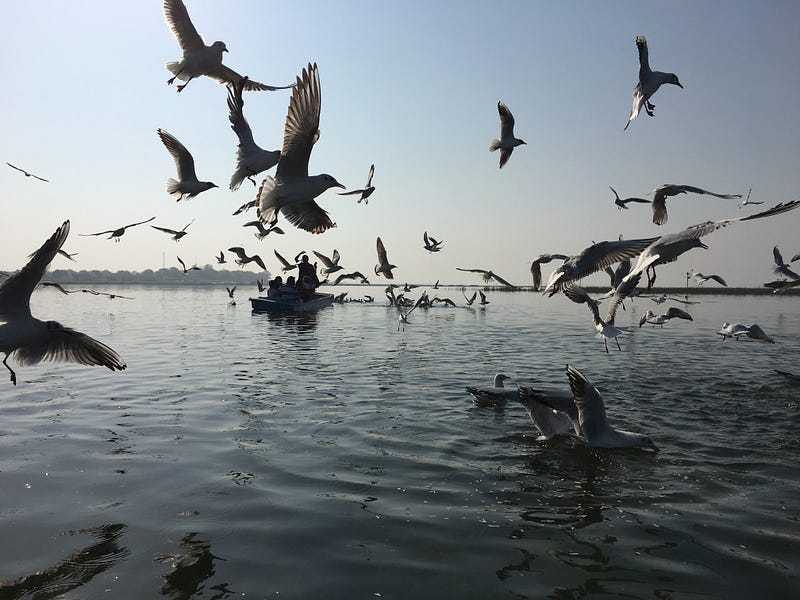
In his 1928 book The Outermost House: A Year of Life on the Great Beach of Cape Cod, nature writer Henry Beston contests the stranglehold of Descartes’ legacy on our conception of nonhuman animals. For example, while watching a flock of birds, Beston writes:
“By what means, by what methods of communication does this will so suffuse the living constellation that its dozen or more tiny brains know it and obey it in such an instancy of time? Are we to believe that these birds, all of them, are machina, as Descartes long ago insisted, mere mechanisms of flesh and bone so exquisitely alike that each cogwheel brain, encountering the same environmental forces, synchronously lets slip the same mechanic ratchet? or is there some psychic relation between these creatures?”
When I read this, I imagine “this psychic relation” between birds that Beston describes is his attempt to break the spell of Descartes’ human exceptionalism: a misguided notion of human superiority that silences the nonhuman world and renders the earth merely an inert stage for human dramas to unfold.
To counteract Descartes’ spell, Beston’s writing is a kind of magic that aims to reposition ‘Nature in the Active Voice,’ as Val Plumwood writes.
Or, in the words of naturalist Sy Montgomery, we need a language that enables us to experience how…
“Our world, and the worlds around and within it, is aflame with shades of brilliance we cannot fathom — and is far more vibrant, far more holy, than we could ever imagine.”
In the end, Beston comes to the conclusion that to mend the rupture caused by the Cartesian split, we need a radical reconceptualization of what it means to be human in a more-than-human world; we need to dispel the illusion that we were ever separate from nature; we need to refuse at all points the denial of interdependence with nonhuman nature that Descartes championed; we need a way to remain open to the mystery of this ecological interdependence with other plants and animals: In sum….
“We need another and a wiser and perhaps a more mystical concept of animals. Remote from universal nature and living by complicated artifice, man in civilization surveys the creature through the glass of his knowledge and sees thereby a feather magnified and the whole image in distortion. We patronize them for their incompleteness, for their tragic fate for having taken form so far below ourselves. And therein do we err. For the animal shall not be measured by man. In a world older and more complete than ours, they move finished and complete, gifted with the extension of the senses we have lost or never attained, living by voices we shall never hear. They are not brethren, they are not underlings: they are other nations, caught with ourselves in the net of life and time, fellow prisoners of the splendour and travail of the earth. For the gifts of life are the earth’s, and they are given to all, and they are the songs of birds at daybreak, Orion and the Bear, and dawn seen over ocean from the beach.”
–Henry Beston, The Outermost House: A Year of Life On the Great Beach Of Cape Cod