

The Writer’s Way — Submission Guidelines
Updated — 5/3/2024
This is the official Submission Guideline page for publication The Writer’s Way. Learn more about the publication or become a writer here.
View the non-member version of this page here.
What To Submit
The Writer’s Way currently features two categories and one subcategory in which our writers can submit their work. All submissions must fall into one of these categories below:
- Writing Advice: Personal stories and/or advice concerning various aspects of writing.
- Writer’s Life: Personal stories concerning various aspects of life.
- Writer’s Journal: a short-form styled category where writers recount their daily life experiences and jot down their thoughts/ideas.
Topic & Style
- “Writing advice” can include, but is not limited to:
— Tips on how to write consistently and make progress
— Guidance on dealing with rejection, writer’s block, self-doubt, etc.
— Personal stories about achievements and positive impact of writing
— Style examples: Listicles, How-To Guides, personal narratives, etc.
- “Writer’s life” can include, but is not limited to:
— Relationships
— Mental Health
— Habits & Productivity
— Travel & Adventure
— Style examples: poems, memoirs, personal narratives, etc.
- “Writer’s Journal” can include:
— All topics possible in “Writer’s Life”
— Personal thoughts and observations
— Recounts of daily life experience
— Style examples: journal entries, diary entries, flash nonfiction, etc.
Guidelines For “Writing Advice”
1 — A written piece that might be about writing but cannot be clearly determined so may get put in another category or rejected.
2 — Work that features the business side of writing (e.g., “How much I made in February writing for Medium”) may be accepted.
However, we will reject that kind of work if it exists for the sole purpose of fishing for more views and claps, and if it uses numbers to sensationalize it but contains shallow advice and false promises.
Guidelines For “Writer’s Life”
1 — The recounted story must be about you. Aspects like what you have learned and how your experience has shaped your life should be the main factor that drives the story forward.
2 — A story consisting of a train of thoughts and opinions will not be accepted. It should at least have a clear setting, a character (you), and some plot.
3 — Your story should be able to stand alone as complete and give readers a sense of closure.
Guidelines For “Writer’s Journal”
1 — You are not supposed to do research for this category. It is just you, your experience, and the world as you know it. If any claim is made, back it up with your knowledge and personal experience.
2 — Please strive for 1 to 3 minutes in length, and do not exceed 4 minutes.
Question you may have: How do I distinguish between “Writer’s Journal” and “Writer’s Life”?
Nonfiction Only
1 — Your stories, including any advice and events, should be based on the real world.
2 — For the sake of storytelling, let your mind fill the gap with reasonable–and enjoyable–made-up details. The point is not to fabricate anything but to conveniently deliver a message through verifiable experience.
Use of AI
1 — Various AI tools, such as ChatGPT and Grammarly, may be used to generate ideas, organize your piece, and proofread your final draft.
2 — Any work that is blatantly generated by AI — or has a reason to be suspected of being generated by AI — will be outright rejected.
Heading Format
1 — Your work should always contain a title, a subtitle, and an image to ensure the consistency of display quality in our publication.
2 — The subtitle is recommended to be no longer than two lines, and the headline image may be above or below your title.
Kicker
1 — A kicker is the text line above the title.
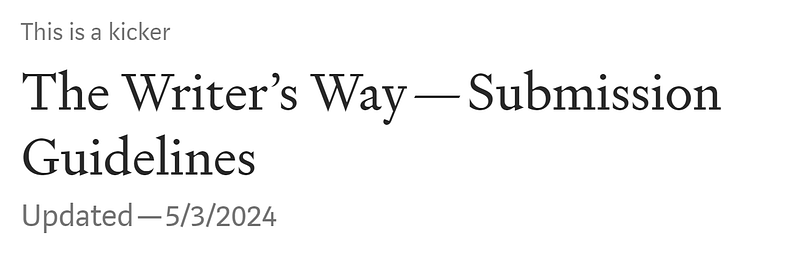
2 — The kicker is reserved for our editor who will use the text to categorize your submissions. Currently in-use kickers are Writing Advice, Writer’s Life, & Writer’s Journal.
Sparse Paragraphs
1 — Except for poems, submissions that overuse one- or two-line paragraphs may get rejected. Your work must show a clear connection between thoughts, evidence, and analysis to ensure flow and readability.
2 — For the sake of artistic expression, continuous one-line paragraphs may be considered on a case-by-case basis.
Basic Grammar and Punctuation Rules
1 — Basic grammar and punctuation rules should be met.
Proper Citation
1 — Any mentioned quote and data should be linked to the source it is pulled from, using a hyperlink like this.
2 — Any image used in your work should be owned by you, licensed, or copyright-free (view Medium’s copyright policy).
Word Count Requirement
1 — Except for poems and regardless of the category, all submissions should be no shorter than 200 words (~1.03 minutes).
Draft Submissions
1 — Draft submission is optional, meaning you can submit an already-published story to The Writer’s Way.
However, depending on how long ago that story was published, it may not receive the most exposure due to the most recent-to-oldest order in which articles are arranged.
Consent to Editing
1 — Your work must be fairly polished before being submitted. A poorly formatted piece below our standards may get returned.
2 — If possible, we may conduct an editing session for your work.
Changes may be major, but we will provide a list of details for any change we have made and suggestions for improvement. Repeated failure to adhere to suggestions left in the private notes may get your future work rejected.
Because the publication is in its earlier development, these submission guidelines are subject to changes. To ensure you have the most up-to-date information concerning news and updates, go to https://medium.com/@ArtisKev/list/the-writers-way-publication-news-updates-45b2fcd8c2b0 and save the list.
We welcome writer contributions! If you’re interested in submitting your work, please reach out to us here. Thank you for considering The Writer’s Way!
