
Three Quivering Moments I Never Thought I’d Share
When vulnerability is stronger than all other teachings.
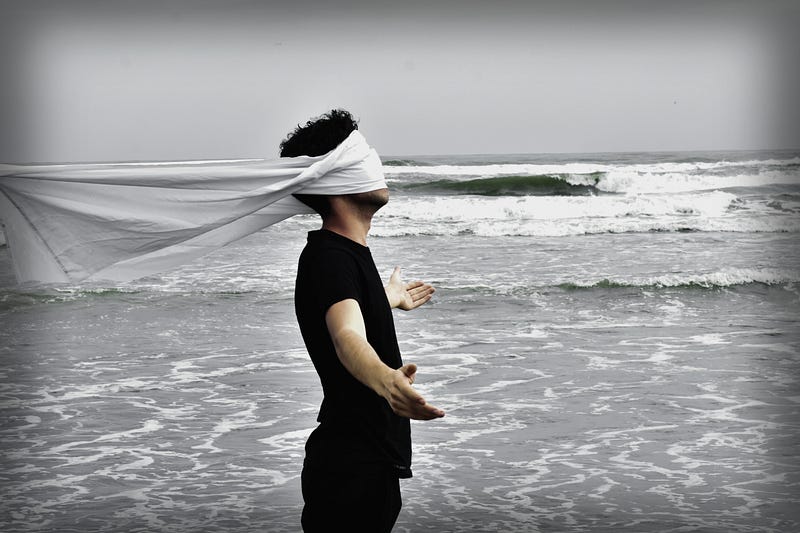
I’ve been hiding behind the self-improvement shell for a very long time now.
As humans, we have the capacity to avoid draining thoughts just by sending them into oblivion. We think that if we hide them behind a stack of good habits and good deeds, one day they’ll be gone.
But they are always there, haunting you, even if you play amnesia. And they do an awful lot of fucking you up.
I can guarantee that.
And I can also guarantee you that playing amnesia is the definition of being a coward.
Because you need courage to transform yourself.
Courage is indispensable if you want to look at yourself without shying away. To admit, address, or fix your own flaws with brutal honesty. Without courage, you cannot practice any other virtue with consistency.
And there’s the self-improvement fallacy: without courage, there’s no consistency; with no consistency, no self-improvement.
Virtue isn’t pointing fingers at bad things that are none of our business and making yourself feel good by contrast. True virtue is looking inward, at your own imperfections and itches, and facing the soggy, saturated, and vulnerable parts of yourself.
So, for the first time, I’ve decided to reach into oblivion and bring back these three moments of my life when I felt the most vulnerable.
It’s time to be brave for once.
1. The reason I learned to drive when I was 14
I’m far from obsessed with cars and mechanics. In fact, I barely know how to check water and oil levels, and that’s it.
But during the summer of 2005, my widowed mother gave me the most powerful reason to get early permission for a driver’s license.
We went on a 1-hour drive to our favorite fishing spot here in Patagonia. We arrived at twilight, perfect timing for the eager trout in the river. But this time, she decided to skip the fishing.
“Awkward,” I thought to myself.
She is as competitive as they come, and we had the tradition of betting that the one who caught the least fish would wash the other’s equipment. Instead, she stayed far away on the coast, in silence. And she would stay like that for the most part of our long drive back home, hiding behind loud music.
It was only when I asked if she could lower the volume that I noticed some bubbling in her voice. I was in the rear seat, so I couldn’t see her properly. But I was pretty sure I also heard some clanking.
That’s when the nightmare started.
I remember coming down a dirt road, surrounded by bushes that seemed to be creeping on us. As if we were in an earthquake, the car swaying from side to side. But it wasn’t an earthquake making the car shake: it was my mother’s incoherent hands.
Just when I thought we were doomed for an inescapable accident, I managed to grab the steering wheel right before hitting a tree. And in a second of clarity, my mother slammed on the brakes, and the car turned off.
She could barely speak, drunk out of her mind on, what I later learned, were vodka and pills. And we were still a good 5 miles away from home. And living in 2005 with no cell phones to call for aid.
What happened after this is blurry.
Somehow, my mother drove us back home without killing us.
On the rocky stairs that led to the house, she tripped over and opened a harrypotteresque dent on her forehead.
But now I had a phone within reach.
If I close my eyes, I still visualize the phone, my fingers moving in slow motion, dialing 911. The scene continues as I look out at my mother, sitting on the stairs, blood dripping from her forehead to her face, spitting drops as she tries to convince me that she’s OK, that is just a scratch. Then, I close my eyes and promise myself I will never ever be in a car with a drunk driver again.
And kept my promise since then.
Much easier than having the courage to assume my mother was an alcohol and pill addict.
Even if I was only 14.
2. Why I don’t go out for pizza on Sundays anymore
My grandfather was a man of traditions. During my student years in Buenos Aires, one of them was having family pizza nights every Sunday.
He never suspected this would be the last.
We went out in two cars: me and my cousins in one; my grandfather, Uncle Diego, and my sister Azul in the other. We found a parking space nearby. My grandfather is left at the door with his wheelchair, and my uncle and sister go to park the car.
We ordered drinks. They came. We ordered pizzas. They came too.
But the ones who didn’t come anymore were my sister and my uncle.
It was only between mouthfuls of mozzarella that my Uncle Diego appeared, desperate and agitated, screaming his lungs out, looking for me:
“They took her. They took the car. I escaped, but they took the car. And they took your sister!”
Guided by instinct, I ran out the door. And unbelievably, at that precise moment when I step outside, my grandparents’ car passes by the door of the restaurant. Desperate, I raced 2–3 blocks behind the car, not knowing what to do but running with a magnetic impulse.
Until I reach a corner where the kidnappers, respectful drivers, stop at a red light. That same frenetic impulse leads me to jump on the car, start banging on the door, the window, unaware of what could happen.
I will never forget the guy dressed entirely in a white tracksuit, his gun cocked at me, his threat of “the other one escaped but we’ll kill this one”, the eternal seconds in which they talk about something I can’t make out while I see how they hold my sister in the back seat, aiming at her.
And then they decide to let her go, handing her over to me, and she falls, fainting on the sidewalk. The car appeared miles away after the police had a shooting encounter with the kidnappers.
Since that moment on, I’ve had a city-phobia.
I’ve been learning to live with it and been able to visit from time to time, after moving back to my more-secure, less-crowded hometown in Patagonia.
The only thing I didn’t get back is Sunday pizzas.
And I’m not interested in it either.
3. Sometimes you can fake it but never make it
I was a straight-A high-school student destined to be a legend. On my mind, and on everybody else’s around me, there was only a future where I would find a cure for cancer or something close to it. So I went full-throttle into Med School, in search of all the success that destiny had in store for me.
- First-year was the anticipated piece of cake — straight A’s.
- Second-year, again: me living up to the expectations.
- Third-year…Well, that’s when I started wandering on park benches.
I’ve always been a bit chaotic and lousy at bureaucratic procedures. And in my third year, after a summer break working abroad as a ski instructor, I messed up.
I missed the inscription dates, plain and simple.
But instead of assuming my silly mistake, I decided to create my own snowball and start to bury myself in it, little by little. To my friends, my family, my girlfriend, and even my sister, who I was living with, I was going to classes. The usual and expected.
I would dress up in my scrubs, put the books in my backpack, and leave the apartment. But I never took the bus to the university or opened any books. I would walk 8 blocks to the park, where I would change into sports clothes and sweat out my frustration and lies until I couldn’t take it anymore. Or until I knew my sister was no longer at home.
Then I would come back, bury myself under the sheets, and watch Breaking Bad, thinking Jessy Pinkman was a failure when, in reality, I was the failure who, instead of assuming a stupid mistake, was sinking deeper every day in a labyrinth of lies.
This lasted for almost 3 excruciating years.
It was as if I was living locked up, frozen and unable to move from where I was. The only thing I did was lie and keep traveling during summer breaks to work as a ski instructor.
Today, with the perspective of time, I think I used the same defense mechanism as my mother and her addiction: locking myself up, denying everything, and not asking for help. Not saying that it was her fault, only what I took as a template.
It is no surprise that my girlfriend left me.
Or that my friends stopped trusting me.
Or that my sister couldn’t look me in the eye anymore.
As they say, lies have short legs.
And during those three years, I left undeniable traces that my story of the student who kept getting perfect A’s was not such.
The story ends with a lapsus of my unconscious.
One fine day, while visiting my mother’s house, I asked her to wash a bag for me. I didn’t even take the time to check the pockets for anything inside, so it wouldn’t get wet.
My mother is obsessive about pockets. I always knew that.
And so it happened that in one of those pockets was hidden my college notebook. With all the high grades, yes. But no grades for the last three years. As if I wanted her to finally know the truth.
My failure and my lies triggered a family crisis. And a crisis of my own identity that I still struggle to solve these days.
After years of doubts, of not believing myself worthy of any confidence, of finding love again without prejudice, of opening up and learning how to speak the truth, and of rediscovering my vocation without scrubs but with mental health, I am back on my feet.
Some virtues are hard to recover.
Being reliable to yourself and to others, seems to be one of them.
Growing Vulnerabilities
When everything goes well, there’s no growth but stagnation.
Because to grow, you need to change. Because growth is change. That’s why, when you face hard times, you evolve.
That’s the definition of crisis: vitally important or decisive state of things, point at which change must come, for better or worse.
I’ve faced my ghosts, taken lessons from visiting my past, and come out of this written piece a more unguarded but also more integral person.
What happens in our most vulnerable moments never escapes us. It shapes our lives in both positive and negative ways.
My most vulnerable past memories now have a name. They are no longer fading into oblivion. And I’ve learned to appreciate it.
“Suffering has been stronger than all other teaching, and has taught me to understand what your heart used to be. I have been bent and broken, but — I hope — into a better shape.”
Charles Dickens, Great Expectations.