avatarElder Taoist

Free AI web copilot to create summaries, insights and extended knowledge, download it at here

3640

Abstract

That makes it very easy. Just run a bunch of hoses and let gravity do the rest of the work.</li></ul><p id="b0c1">Here are pictures of the tanks:</p><figure id="c701"><img src="https://cdn-images-1.readmedium.com/v2/resize:fit:800/1*WW9IZtkP_iN8KAIde24ZBg.jpeg"><figcaption></figcaption></figure><figure id="6465"><img src="https://cdn-images-1.readmedium.com/v2/resize:fit:800/1*drvSIgVuiRbyR-yM7XjR3w.jpeg"><figcaption></figcaption></figure><figure id="8992"><img src="https://cdn-images-1.readmedium.com/v2/resize:fit:800/1*qjb7lncu-PfYovcmh75YKQ.jpeg"><figcaption>Author’s photos. On the left, the 400 gallon garden tank fed from the main house roof. In the centre, the 1,500 gallon woodshed tank. On the right, the 2,000 gallon tank behind the studio that fills the garden tank when it runs dry.</figcaption></figure><p id="a9e0">In my optimism, with all the water I had in the tanks, I expanded my garden this spring by nearly double. It turns out I really needed the stored water.</p><p id="2f6e">While not as hot as last summer, it has been very dry. There’s been little appreciable rain since mid-June. When August rolled around I was beginning to wonder if the water would last.</p><p id="9da5">As of early as September, I’ve used about 80% of the total 3,900 gallons. I’m optimistic there will be significant rain in the next few weeks. That, combined with cooler weather, should make sure I don’t run dry. But it is a close-run thing!</p><h1 id="6b27">What did I learn from all this?</h1><ol><li>When you move to the country, things you are used to getting easily in the city take more planning and work, like reliable clean water.</li><li>You get more in touch with nature and the weather. For example, while it is not cold enough here to freeze the tanks enough to break them, it does get cold enough to freeze and crack the valves that control the tank water flow. Once they thaw, all the water drains out! I thought I had insulated them properly but was mistaken in the case of the woodshed tank.</li><li>The quality of the soil affects how much water one needs. My garden soil is somewhat sandy. As a result, it doesn’t hold water very long. This means I have to water more frequently than if the soil had more clay and loam to hold the water. In the coming years I will be working to build up the quality of the soil which should reduce water consumption. It should also mean better quality vegetables, though they have mostly turned out fairly well.</li><li>If you have the opportunity to use gravity to move water around, use it! It makes everything so much easier.</li><li>Even with 3,900 gallons, I may not have enough water to properly irrigate the garden in a hot, dry summer like 2021. I’m planning to add more capacity in the next year.</li><li>Having lots of stored water as a backup to the well is sounding like a good idea. I have one neighbour that has 12,000 gallons of water storage and most years he uses almost all of it as his well gets brackish by the end of the summer.</li></ol><p id="6315"><b>What does all this have to do with the Tao?</b></p><p id="3739">Taoism teaches ways to achieve harmony with the unplanned rhythms of the universe. In the case of managing water availability for my garden, this means working with the tempo of nature, the flow of gravity, and the vagaries of the climate, the weather, and the seasons.</p><p id="1345">It is my wish to understand what is necessary for developing a simple, healthy garden while working with the natural rhythms of the land while respecting the needs of the plants, birds, and animals with which I share this beautiful place.</p><p id="9d2a">So

Options

that’s what I learned in my first year of harvesting rainwater. Please let me know if you have any questions.</p><p id="b38e">Thank you for reading my article. If you found it interesting, here is another of my recent pieces that I really enjoyed writing. If one has sufficient rain, the opportunities for rainbows multiply:</p><div id="6497" class="link-block"> <a href="https://readmedium.com/when-one-rainbow-wont-do-64beb398ecb0"> <div> <div> <h2>When One Rainbow Won’t Do</h2> <div><h3>The Universe can provide a double rainbow!</h3></div> <div><p>medium.com</p></div> </div> <div> <div style="background-image: url(https://miro.readmedium.com/v2/resize:fit:320/1*FTCavTjMsPDqDs93BmrVQQ.jpeg)"></div> </div> </div> </a> </div><p id="8d55">Here are some articles by writers who inspire me to write. If you enjoyed my article, perhaps you will also enjoy theirs:</p><p id="a66e"><a href="https://medium.com/@neera55-h">Dr. Neera Handa</a> wrote a lovely article that talks about her personal relationship with nature:</p><div id="275a" class="link-block"> <a href="https://readmedium.com/nature-a-gift-e65cacb7c72a"> <div> <div> <h2>Nature A gift</h2> <div><h3>that keeps on giving</h3></div> <div><p>medium.com</p></div> </div> <div> <div style="background-image: url(https://miro.readmedium.com/v2/resize:fit:320/0*sq7YqmSShhpY266t)"></div> </div> </div> </a> </div><p id="d566"><a href="https://christinamoog.medium.com">Christina</a> has a wonderful piece about writing authentically with kindness and positivity:</p><div id="9692" class="link-block"> <a href="https://readmedium.com/to-write-authentically-or-feed-the-beast-fb62dc9ec6a1"> <div> <div> <h2>To Write Authentically or “Feed the Beast”</h2> <div><h3>I refuse to take part in the black cloud of emotion that is seeping into our psyches from every corner. — Jillian Amatt…</h3></div> <div><p>medium.com</p></div> </div> <div> <div style="background-image: url(https://miro.readmedium.com/v2/resize:fit:320/0*lIZIishNJM2XLDVj)"></div> </div> </div> </a> </div><p id="7ef7">And here is another excellent article from <a href="/@preetisingh15">Dr. Preeti Singh</a> about how important it is to build mutual respect in relationships and community:</p><div id="1773" class="link-block"> <a href="https://readmedium.com/how-mutual-respect-magnifies-the-value-of-love-392a0a1c45c8"> <div> <div> <h2>How Mutual Respect Magnifies The Value Of Love</h2> <div><h3>Mutual respect brings love and happiness between people.</h3></div> <div><p>medium.com</p></div> </div> <div> <div style="background-image: url(https://miro.readmedium.com/v2/resize:fit:320/0*V34IPDXzws6bR9Nt)"></div> </div> </div> </a> </div><p id="c783">If you enjoyed these articles, please remember to let the authors know. We who sit alone and write can always use encouragement.</p><p id="9e1f">Thank you for spending your time with me.</p><p id="c278">I wish you well!</p><h1 id="c8e0">The Elder Taoist</h1></article></body>

The Tao of Rainwater Harvesting

Where I live on the west coast of Canada seasons tend to be reasonably temperate with lots of rain in the winter and intermittent rain in the summer. This has worked well for gardens allowing harvests most of the year. However, the climate is changing and one must adapt. This includes managing the rainwater for the garden.
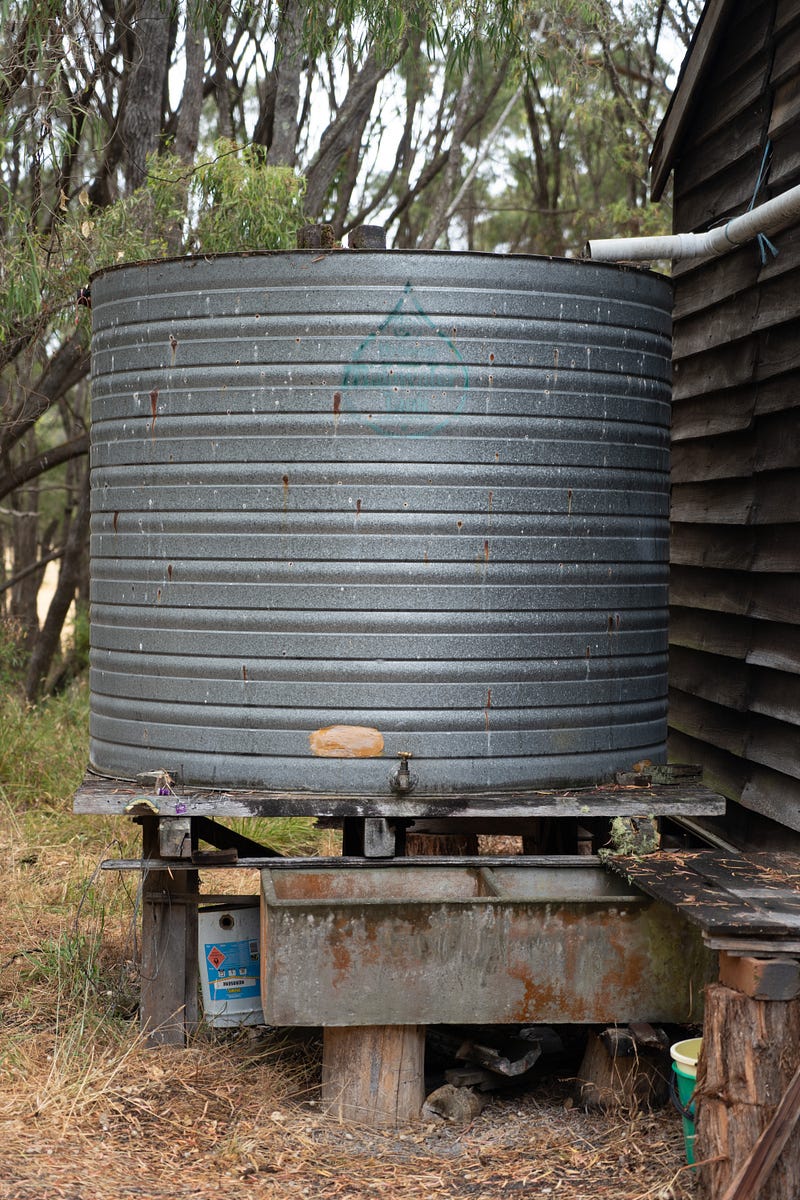
Photo by Harry Cunningham on Unsplash

I moved into my new home on 1.5 acres in January 2020, shortly before Covid-19 isolation kicked off. Since none of us knew then how the pandemic would evolve (and in my opinion still don’t), and being a worrier by nature, I decided that putting in a vegetable garden was a reasonable idea.

One concern I had was irrigating the garden. We get our water from a well and are located next to the ocean. Some neighbours had reported that their well water sometimes became brackish by the end of the summer due to running down the water table.

Since I didn’t want to run our well down to where seawater might intrude, I planned to irrigate only from an existing 400-gallon rainwater capture tank. I figured that with the normal summer rains this might work.

While there was a lot of work building raised beds and moving in soil (the property is very rocky with no good soil), the 2020 summer weather was kind so I was able to irrigate the garden from the existing water tank.

2021 was not so benevolent.

Along with a two-month drought, we had a heat dome that endeavoured to cook the garden. Even with rationing my water tank ran dry. A few drought-hardy, deep-rooted crops did okay but many were lost.

I decided it was time to install additional water storage.

Along with our main house, the property has an art studio and wood shed. From the roofs of these last two, I believed I could easily fill an additional 3,500 gallons of tankage from our winter rains.

It turns out that there is a lot to consider when putting in water tanks:

  • Where should it be located? In my case, one is behind the studio and a smaller one is behind the woodshed. In these locations, they would be minimally visible and not make the property look like an industrial site.
  • Is the roof high enough to feed the tank just from gravity? In one case I had to dig down 12 inches and in the other, since I measured wrong (oops!), I had to raise the woodshed roof four inches after installing the tank.
  • Is the ground level even enough to support the tank’s weight when it is full? The 2,000-gallon tank would weigh about 20,000 pounds. To install that one I had to remove a stump behind the studio and dig an extra six inches to add the sand that could be properly compacted. The 1,500-gallon tank would be on a gentle slope so I had to build a level foundation.
  • Will I need to move water between tanks, and if so how? Our property is sloping with a big drop-off to where the garden is located. The biggest tank is at the highest point on the property. From there I can gravity feed both the woodshed tank that waters my greenhouse and herb garden and the 400-gallon next to the main house that waters my vegetable garden. That makes it very easy. Just run a bunch of hoses and let gravity do the rest of the work.

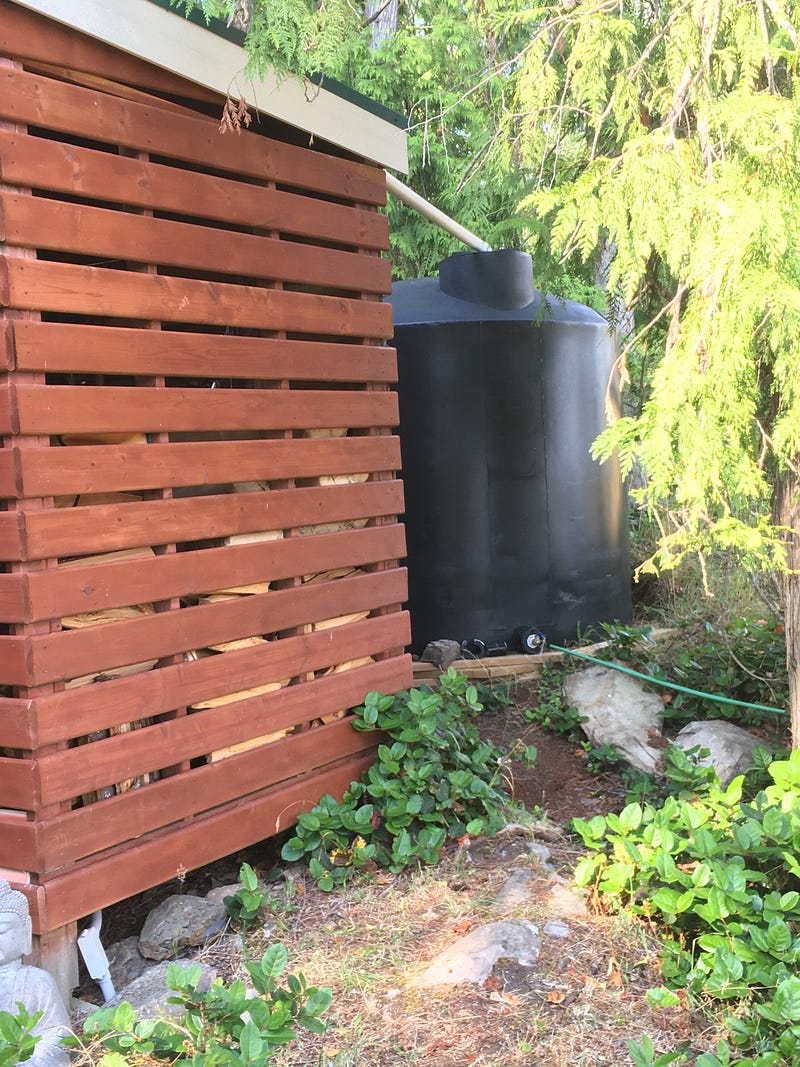
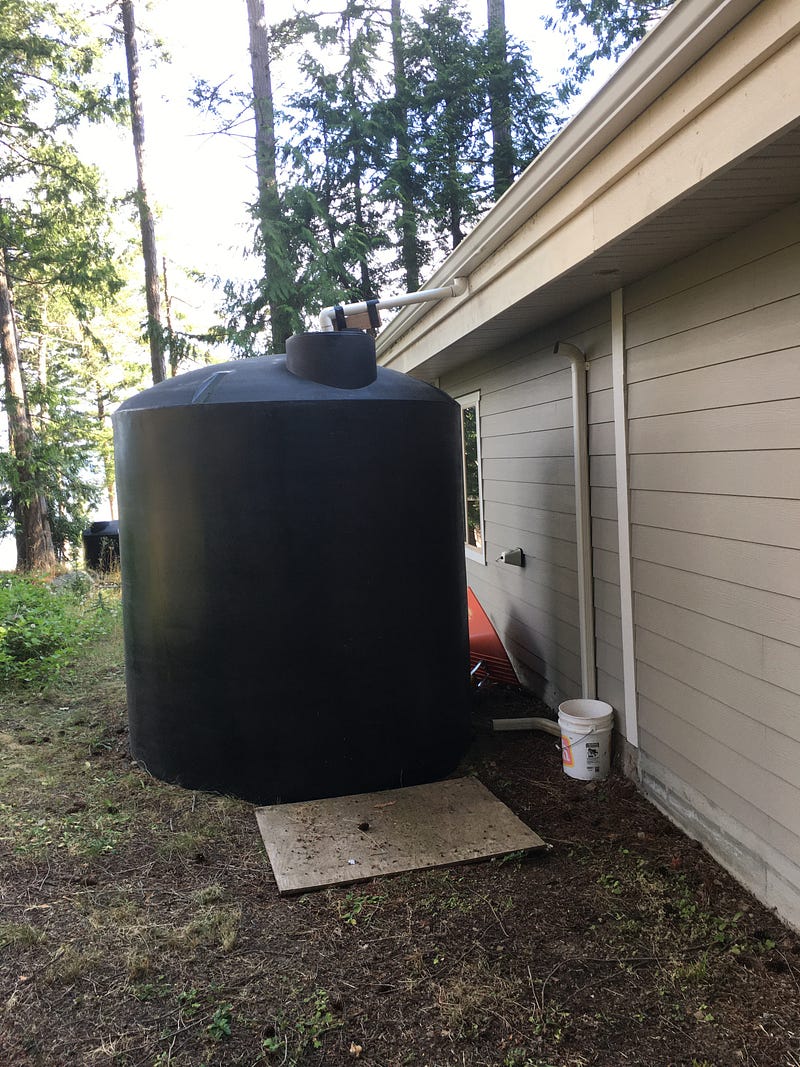
Here are pictures of the tanks:
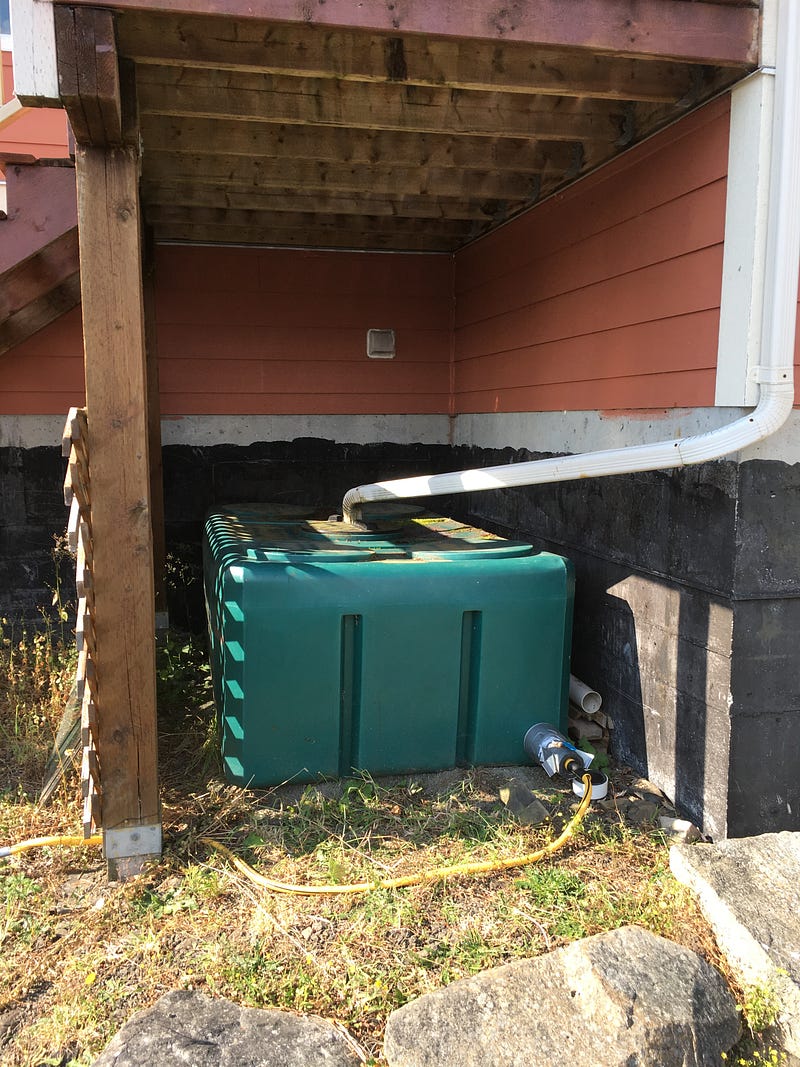
Author’s photos. On the left, the 400 gallon garden tank fed from the main house roof. In the centre, the 1,500 gallon woodshed tank. On the right, the 2,000 gallon tank behind the studio that fills the garden tank when it runs dry.

In my optimism, with all the water I had in the tanks, I expanded my garden this spring by nearly double. It turns out I really needed the stored water.

While not as hot as last summer, it has been very dry. There’s been little appreciable rain since mid-June. When August rolled around I was beginning to wonder if the water would last.

As of early as September, I’ve used about 80% of the total 3,900 gallons. I’m optimistic there will be significant rain in the next few weeks. That, combined with cooler weather, should make sure I don’t run dry. But it is a close-run thing!

What did I learn from all this?

  1. When you move to the country, things you are used to getting easily in the city take more planning and work, like reliable clean water.
  2. You get more in touch with nature and the weather. For example, while it is not cold enough here to freeze the tanks enough to break them, it does get cold enough to freeze and crack the valves that control the tank water flow. Once they thaw, all the water drains out! I thought I had insulated them properly but was mistaken in the case of the woodshed tank.
  3. The quality of the soil affects how much water one needs. My garden soil is somewhat sandy. As a result, it doesn’t hold water very long. This means I have to water more frequently than if the soil had more clay and loam to hold the water. In the coming years I will be working to build up the quality of the soil which should reduce water consumption. It should also mean better quality vegetables, though they have mostly turned out fairly well.
  4. If you have the opportunity to use gravity to move water around, use it! It makes everything so much easier.
  5. Even with 3,900 gallons, I may not have enough water to properly irrigate the garden in a hot, dry summer like 2021. I’m planning to add more capacity in the next year.
  6. Having lots of stored water as a backup to the well is sounding like a good idea. I have one neighbour that has 12,000 gallons of water storage and most years he uses almost all of it as his well gets brackish by the end of the summer.

What does all this have to do with the Tao?

Taoism teaches ways to achieve harmony with the unplanned rhythms of the universe. In the case of managing water availability for my garden, this means working with the tempo of nature, the flow of gravity, and the vagaries of the climate, the weather, and the seasons.

It is my wish to understand what is necessary for developing a simple, healthy garden while working with the natural rhythms of the land while respecting the needs of the plants, birds, and animals with which I share this beautiful place.

So that’s what I learned in my first year of harvesting rainwater. Please let me know if you have any questions.

Thank you for reading my article. If you found it interesting, here is another of my recent pieces that I really enjoyed writing. If one has sufficient rain, the opportunities for rainbows multiply:

Here are some articles by writers who inspire me to write. If you enjoyed my article, perhaps you will also enjoy theirs:

Dr. Neera Handa wrote a lovely article that talks about her personal relationship with nature:

Christina has a wonderful piece about writing authentically with kindness and positivity:

And here is another excellent article from Dr. Preeti Singh about how important it is to build mutual respect in relationships and community:

If you enjoyed these articles, please remember to let the authors know. We who sit alone and write can always use encouragement.

Thank you for spending your time with me.

I wish you well!

The Elder Taoist

Reciprocal
Water
Nature
Personal Story
Environment
Recommended from ReadMedium