
The Suburbs Are Marching
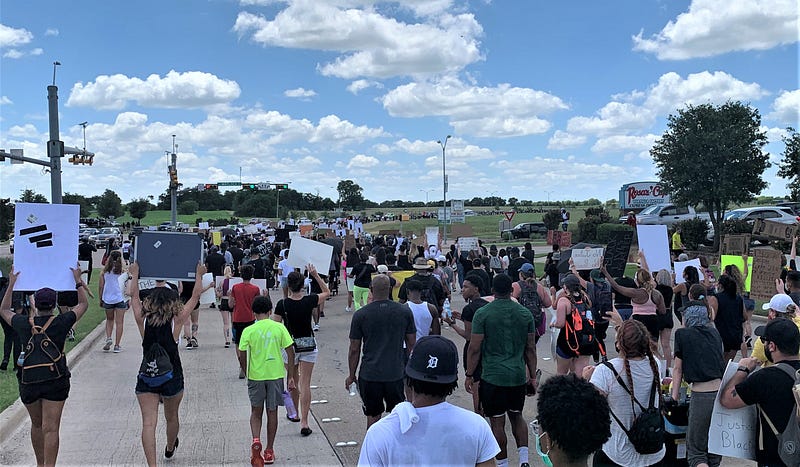
At 51, I joined my first protest. This is how paradigms shift.
The United States is coming to a new understanding of race. Riots and looting capture the attention of the yellow media as they try to bludgeon one side or the other as if race and justice are a partisan issue. Meanwhile, in fifty states across America peaceful marches and demonstrations demand change. Black America is hurting, and the rest of the country has finally begun to hear the pain.
Today I joined a march for racial justice, along with my wife and my daughter, but the story isn’t about us. The more important story concerns what motivates suburban families led by middle-aged white guys to get off the couch on a 95 degree Texas afternoon.
I could be wrong; maybe I’m just excited to be a part of something. Maybe it seems more important than it is because I became personally invested. But this seems more real. I dismissed the last round of protests after President Trump was elected as incoherent liberal whining in far off Austin. It’s hard to take someone on the news wearing a genitalia hat seriously.
Now, in suburban Trump country, a crowd of thousands that was probably forty percent white took to the streets in protest. Together we marched from Mansfield High School to City Hall and back. The crowd was about ten times larger than the mostly black protest I watched in downtown Fort Worth on May 30th. Does this signal a Kuhnian paradigm shift? It might.
I’ve written previously about the sordid history of race in my town of Mansfield. In the late 1950s and early 1960s, whites demonstrated against integration and the schools. Native son John Howard Griffin was hung in effigy and run out of town for writing Black Like Me. That makes today’s march all the more poignant.
Sixty years ago no one would have predicted a march organized by Black Students Associations at the Mansfield high schools would draw two thousand suburbanites out of the AC. Sixty days ago, in the most fearful days of the pandemic, no one would have predicted it. Gen Z youth have found their voice, and they are nudging Gen X and Gen Y out of their apathy and onto the front lines.
Kuhn and the paradigm shift
Thomas Kuhn developed the idea of a paradigm shift, though he was applying the concept to the natural sciences. Scientific consensus of natural laws and concepts gain momentum and become the basis for entire bodies of thought. These agreed-upon concepts shape how research is done. Sometimes, however, unexplainable anomalies force science to re-evaluate fundamental theorems.
The only way to reconcile the inconvenient facts is to come up with a new theory, to divine new natural laws. Heliocentrism replaces geocentrism. Natural selection replaces spontaneous generation. A time of instability ensues as scientists try to map the boundaries of what they know. Eventually, the turmoil subsides and a new consensus forms. This new paradigm remains in place until some other inconsistent facts are recognized, forcing yet another re-evaluation.
Social scientists like to use Kuhn’s concepts too. It provides a handy framework to analyze issues. I see there paradigms, with the last possibly ending soon.
Founding and Pre-Civil War Era: Many of the founding fathers, even the ones that owned slaves, were not particularly fond of the institution of slavery. Pennsylvania, with its Quaker sensibilities, passed an act to gradually abolish slavery in 1780. Massachusetts abolished slavery in 1783, and other states started to follow suit. Perhaps slavery would have faded had it not been for Eli Whitney’s cotton gin in 1893. Mass cultivation of cotton fueled massive wealth in Southern states, and the paradigm was set.
From the perspective of Kuhn, the dominant social paradigm was a compromise with slavery, which many found distasteful but acceptable. Eventually, though, an abolition movement arose. Much of the country came to the conclusion that slavery was fundamentally incompatible with the principles the nation was founded upon. Abolitionists helped elect Abraham Lincoln as president, and most of the slave states rebelled.
The Jim Crow Paradigm: After the Civil War settled the slavery question, there was a brief flourishing of freedom. Everything was new, everything was possible. Around the 1880s, though, the country settled into a less hopeful status quo. Restrictive laws were passed across the southern United States. Former slaves were now tenant farmers, with the sharecropping system still closer to slavery than true freedom.
The country had assuaged its conscience by banning slavery. The 13th, 14th, and 15th amendments provided technical equality, though not generally equality in practice. This paradigm stayed in place until the country as a whole came to the realization equality on paper was not true equality. Inconvenient facts surfaced, like the reality of segregated schools revealed in Plessy vs Ferguson. The new media, the television, brought America the story of unarmed marchers being attacked by state troopers on the Edmund Pettus Bridge in Alabama.
The Post Civil Rights Paradigm: The 1960s and early 1970s saw a flurry of reform. Civil Right Acts, Voting Rights Acts, the Fair Housing Act, the 24th Amendment, and other federal and local acts effectively ended formal, state-sanctioned discrimination. The country settled into a new routine.
This new construct ended formal discrimination, and middle America went back to sleep. Lawsuits and court cases increased minority enrollment in colleges and black voting is routine. America again assumed that the work was complete.
The new paradigm was actually still a compromise. The country accepted or ignored that black Americans are routinely stopped by the police. The country accepted or ignored disparities in the justice system. The country exacerbated the problem with stop-and-frisk policies, disproportionate sentencing, and tough on crime laws. A black teen stopped and frisked on the street by police every other week doesn’t feel free and doesn’t feel equal.
Are we shifting again?
Goerge Floyd presents a symbol. His death is a spark. If we lived in a world where the day to day experience of black Americans was being treated fairly by the police, we would see no protests, no movements. We don’t live in that world.
What’s new and unique this week, though, is the breadth and scope of protest. Middle America, through the clear and unambiguous case of George Floyd, has now been forced to recognize inconvenient and uncomfortable facts.
Black America hurts. With George Floyd, the other eighty-seven percent of the country, especially the white sixty percent, can no longer rationalize away a particular case. In confronting George Floyd, we are then also forced to confront the realities of the black experience in America.
A fifty-one-year-old white guy moves from the couch to the street because we need a new accommodation, a new and more fair paradigm. A country where George Floyd lives. A country where Breonna Taylor lives. A country where teenagers like Kalief Browder don’t spend 961 days in prison without trial for refusing to plead guilty to stealing a backpack.
You might also like:
Brian E. Wish works as a quality engineer in the aerospace industry. He has spent 29 years active and reserve in the US Air Force, where he holds the rank of Colonel. He has a bachelor’s from the US Air Force Academy, a master’s from Bowie State, and a Ph.D. in Public and Urban Administration from UT Arlington. The opinions expressed here are his own. Learn more at brianewish.com.


