
The Stock Market Is Due for a Correction
History shows why we could lose 10% this month

The stock market has been on a tear for the last year and a half.
Following the crash in Spring 2020, prices rebounded and closed out 2020 at new highs. The gains didn’t stop there. Year to date, the S&P 500 is up 20% for 2021.
But trouble is just around the corner.
There are two historical trends and several current economic reasons why a correction is likely.
Historical Trends
Market corrections occur every 17 months, on average.
Doing some quick math, the crash from Spring 2020 was 17 months ago.
That means we’re due. Likely sometime soon. A 10% correction occurring every 17 months isn’t precise, it's an average. There was a stretch of five years without a correction. And times when they’ve occurred less than a year apart.
Timing the market is impossible, but being prepared for what could come is smart investing.
The other historical trend working in favor of a correction: September is historically the worst month of the year.
From 1980 to 2019, the S&P 500 in September has returned an average of -0.70%.
Below are the returns for each month.
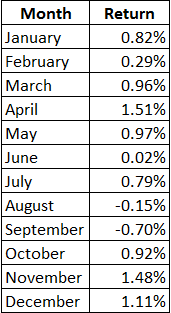
And for 2021 so far, September hasn’t been a great month, as it is currently down 1.6%.
Maybe we’re already in the beginning of a market correction?
Why a Pullback Can Happen
The Federal Reserve has been the “extremely visible” hand helping the market and economy out of the crash. Between the money they printed and their buyback programs, the Fed has made an impact. But kindness can’t last forever. At some point, the Fed will need to tighten its policy.
If investors believe that the Federal Reserve will soon ease up on their easy economic policies, they will start selling the market. Conveniently the Fed meets September 21–22. There could be some moving and shaking in the market those days.
Another reason for concern is the declining consumer sentiment. Consumer sentiment measures how people feel about the economy. The more confident they feel, the more they are willing to spend.
August was a terrible month for this indicator. Consumer sentiment declined 13% since July and is down 5% since August 2020. Not promising results for where people think the economy is headed.
Inflation is another issue, not just for the market but for life in general. But for stocks, high inflation reduces expectation of future earnings growth. It also increases borrowing costs and input costs for companies.
What Should You Do About It?
Nothing.
While corrections are common, the market always recovers. It will likely take a couple of months for the market to regain what it lost, but eventually it will.
With this knowledge there's no need to alter your investment strategy.
If you put some money in the market every week, keep doing so. The correction might start tomorrow, or in three months. It’s impossible to time. You don’t want to miss out on notable gains for fear of a correction that no one knows when will occur. Maybe it ends up just being a 5% pullback instead.
The best thing to do is make sure you have a small pile of cash available and a list of stocks you are interested in. If you see a stock, or the general market, down substantially over a week, or several weeks, start buying in with that pile of cash.
Corrections should be viewed as great buying opportunities, not fearful times to sell.
The above references an opinion and is for information purposes only. It is not investment advice.