
INK, BUT NOT FOR WRITING
The Souvenir I Take Wherever I Go
My souvenir artwork can be from only one place
We are the sum of our experiences. The right souvenirs are tokens of additions towards that summation, tokens of experiences that contribute to who we are.
For me, the right souvenir is also a portal back to moments abroad. Aside from photographs and anything gifted to me, artisanal crafts are my favourites.
A compromise of souvenirs is that adding anything to my essentials-oriented travel pack quickly unsettles it. Yet one of my favourites took up no space in my pack and is so light that I still take it everywhere I travel.
I’ve weighed the sentimentality of a keepsake against packing light since the first night of one of my earliest overseas trips. The August after university, I touched down in Shannon, Ireland. I unpacked my touring bicycle, affixed my panniers laden with only what I’d need, and set off south en route to ferries to Europe.
Jet-lagged and overwhelmed at my undertaking, I didn’t cycle far before pulling off the roadway to take a nap behind some bushes in a deeply grassy field. I awoke a few hours later in the late afternoon sun, disoriented and covered in happy little crickets. It was soon evening, so I stopped at a pub for dinner and a pint.
Inside, I was surprised at how closely reality matched the stereotype of an Irish pub. Regular patrons enjoyed animated after-work conversation; a trio played lively music for a time; and behind a grand but well-used wooden countertop, a barman offered Murphy’s on tap. My accent gave away my tourist identity. He asked about my reason for dropping by, and I told him it was the first stop of my open-ended journey. An hour or two later, when I left to go for the evening, he called me over, wished me well, and handed me a Murphy’s pint glass.
I couldn’t believe it—such a thoughtful gesture. My next thought was, whatever was I to do with a fragile glass souvenir during a forthcoming daily ritual of packing and unpacking panniers?
My second night’s accommodation was a popular youth hostel not far from Cork. I was getting my bearings by walking through the hostel’s common spaces and taking in the scene. It was serendipitous, almost a bit Truman Show, that Irish rockers U2 played on the radio. Curiously, it wasn’t just one track, but a live broadcast. I asked another guest, a local, who explained that U2 were deep into a world tour and were playing three nights at home in Dublin and Cork before continuing on.
A year later, after my cycling trip, I started a job with a company with clients overseas. I was on my lunch hour in Hong Kong on a business trip, in a sprawling music store, absent-mindedly perusing an expansive collection of media. A U2 concert double disc caught my eye. I picked it up and nearly fell over from the price. But, despite my meagre salary, I coughed up for the most expensive CD I’d ever buy. It was the mixing board recording from their Ireland stop. It proved there was no faster way back to the start of my cycling trip than through my ears.
How I procured my souvenirs enhances the memories they provide. I am rewarded for dropping my default, western-style transactional approach to buying things abroad.
I was in Kinshasa, Zaïre (now the Democratic Republic of the Congo) at an informal outdoor market where I found a style of craft in which cattle horns are bent and polished into graceful embodiments of birds. I bought a pair evocative of herons which sit on the bookshelf behind me now.
A year later, I was again in Kinshasa and returned to the same market. To my surprise, there was nothing made of horn. A vendor tried to interest me in the endless array of gorgeous malachite carvings, but I was after another set of birds. Through gesticulation, drawing, and clumsy attempts at French, I was able to describe what it was I’d purchased the year before. One vendor spoke with another. They indicated to come back the next day. The two blonde-coloured birds they found for me still grace a bookshelf at my parents’ home.
I’ve chatted my way into fantastic mementos of my travels, commonly leading to my trying to protect them from myself or cavalier airport baggage handlers.
However, one of my most distinctive souvenirs required no protection in shipping, and took up no space on a bookshelf.
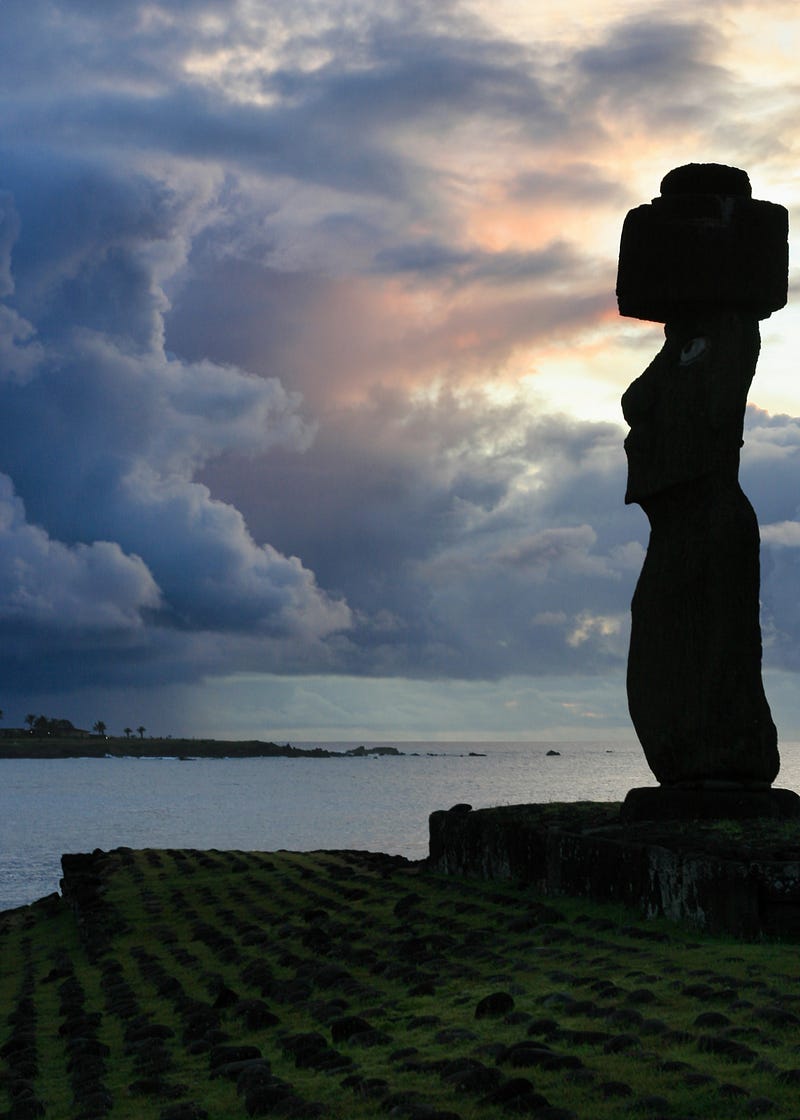
Since before Thor Heyerdahl visited her college, my wife had wanted to visit the moai (statues) of Rapa Nui, a.k.a. Easter Island. She came up with a subversive idea — when most of America would celebrate Thanksgiving, we’d escape. “Thanksgiving on Easter,” she quipped. So we hatched a plan.
One of our guidebooks noted that “the souvenirs of Easter Island are generally too big for backpackers. But… you can buy a souvenir that reflects the heart of Rapa Nui culture.” The authors were talking about getting a Polynesian tattoo. I’d already trialed temporary henna tattoos; once on the island, I’d decide if to get a real one.
The island is a 2,340 mi / 3,766 km flight over open ocean from Chile — there’s no quick way to get there. We were lucky to make our trip there in just three flights and 22 hours of travel.
The island is small and hauntingly desolate. Despite facing what presume is relentless financial temptation, the locals have kept major hotel and restaurant chains at bay. Arguably, it limits the support of visitors, but those who make the journey are rewarded with a purity of experience. If you need Starbucks, a Hilton, and great WiFi, that’s fine — they will be there when you get back.
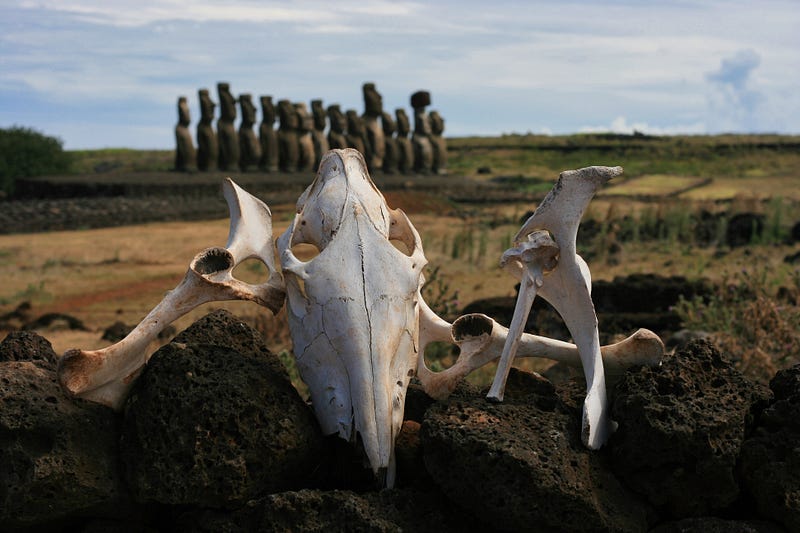
We spent several days drinking in the tranquillity. It is a UNESCO World Heritage Site, and yet at the right times of day, we had fields of ancient, mystical-feeling statues to ourselves.
Visiting ancient sites around the world, with their markers of collapsed societies, is powerful. Each has a unique feel, with traits that reach across centuries. Rapa Nui’s place in the middle of the great ocean, with its massive moai which had once looked over its people, affected me.
On our penultimate day there, we walked into the upstairs studio of a local tattoo artist. He had books of “stock” designs. I wouldn’t have believed how many hackneyed versions of barbed wire and roses there could be, had I not recently been to an outdoor concert in California where I’d seen many. These were a turn-off.
The artist’s space was otherwise an open room plastered in artwork — decorative business cards, postcards, and posters. My wife noticed a subtle feature: the room was circumscribed by patterns painted onto the wooden floor. We asked the artist about it. He explained it was his own design, incorporating primitive elements. I asked if he could use it as inspiration for me.
He thought for a while. He used a ballpoint pen to sketch his concept on paper to ensure he and I aligned. He moved the design to my selected location, then moved on to his needle, his work culminating in my first and only tattoo. He’d woven together symbols from the South Pacific — tiki, koru, and a tern-like icon based on the petroglyphs of the tangata manu (birdman cult), which are found only on rocks between a caldera and thousand-foot drops into the ocean, on the coast of Rapa Nui.
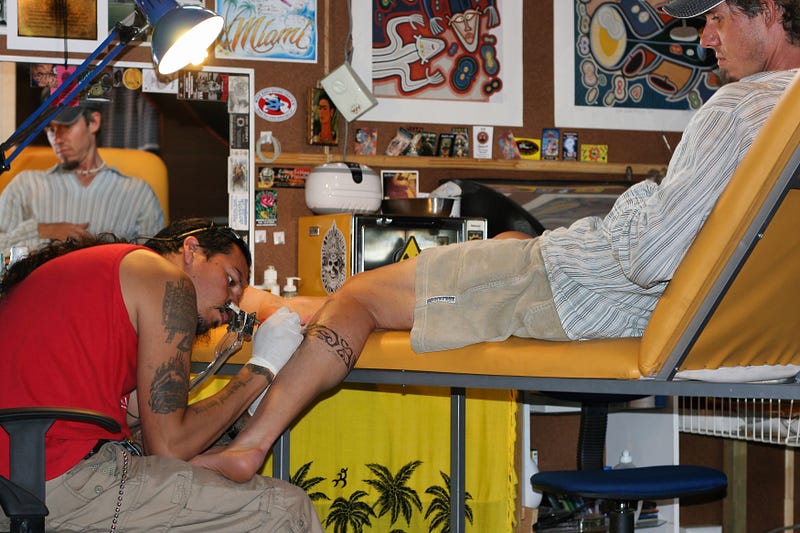
My region-based artwork remains my favourite souvenir. It has travelled to many places, its stylized South Pacific symbols obvious only to me and my wife. Does life imitate art? I don’t know, but since then I became a citizen of an island nation in the South Pacific. It makes me wonder if, on some level, I was a citizen all along.
Tip of the hat to Anne Bonfert at Globetrotters for this month’s writing prompt of souvenirs. A shout-out to Sharika Hafeez and her Hunza descriptions for instilling a seed to go to that region of Pakistan someday, and to Joel R. Dennstedt for his words of introduction to his brother’s exquisite B&W photographs from their travels in Eastern Europe.