
TRAVEL
The Siq — Entryway to Petra
The gorge that needs to be talked about more
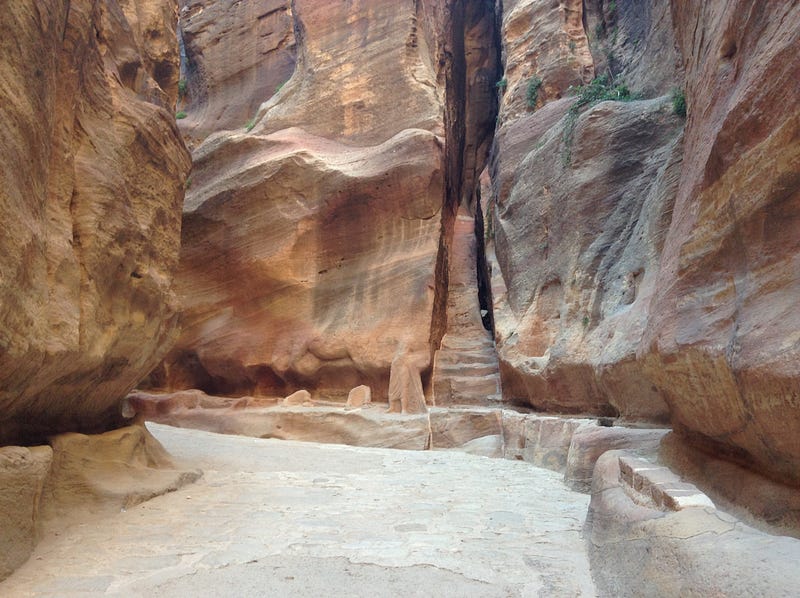
There is a lot of literature about the ancient city of Petra, and justifiably so. There isn’t enough about the Siq — the walkway to Petra. This is a wrong and it needs correcting.
Petra is a UNESCO World Heritage Site and has captured the imagination of millions of tourists, especially after it was elevated as one of the New 7 Wonders of the World. Today it is the face of Jordan and is its most-visited attraction.
Jordan itself is a small, adorable country tucked away in one of the most volatile regions of the world. Russell Peters, the Indo-Canadian comedian once said, it is almost as if Jordan is telling the world, shhh, don’t tell anyone we are here. It has much to offer to the history buff, to the nature lover and to the food-obsessed, to mention but a few of its delights.
I understand why there are so many paeans to Petra. From that first glimpse of the magnificent Treasury to the panoramic view from the heights of the Monastery, Petra will take your breath away several times over. A trip to this ancient city of the Nabateans, despite being hard on your walking shoes, is highly recommended.
However, I would like to see more words devoted to the narrow, winding gorge that takes you from the valley into the city, the Siq. When people write about Petra, they tend to rush past straight to their feelings when they first saw the pink columns of the Treasury. Their memories of the Siq are tamped down by those of the city. That is an injustice to its beauty.
The first stop for most tourists to Petra is the visitor center that sits on one side of a small square. The other sides are ringed by shops peddling souvenirs along with the basic necessities of life — water and packaged crispy snacks. Once you are well stocked up, you set off toward the city proper.
Off to the left is the Bab al-Siq (Bab as-Siq), a wide valley with squat brown hills on either side. There are monuments cut into the rock here, a taste of what you will see soon inside the city. The path is wide and dry, bounded by neat rows of marker rocks, with the occasional greenery beyond them. About 15 minutes of a stroll down the gentle slope (with time for pictures) the path narrows and dips a little. There is a signboard set off to the right within a brown metal frame. It modestly informs you that “you are walking through the Siq”.
And then you enter this corridor of stone. It is a little over a kilometer in length, about three quarters of a mile. Sometimes it widens to forty feet and feels more like a high-ceilinged room than a road. Then it thins to about ten feet wide and you can barely see the sky. The rocks are pockmarked with age but some areas look almost smooth and painted by the various minerals in the stone in shades ranging from brown to beige, orange to black. There are several archaeological features like sacred niches and water channels, carved by the Nabateans into the sandstone.
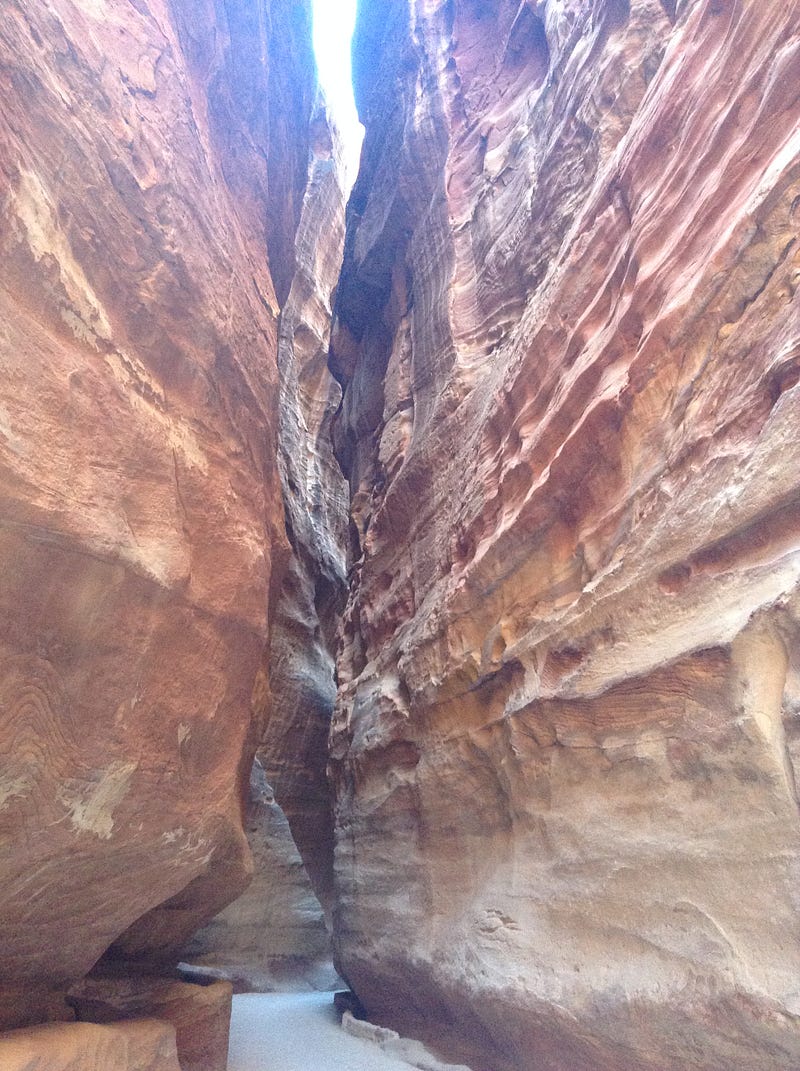
A brisk walk through the Siq might get you to Petra in about 20 minutes. But it is better to take your time and amble. Linger in the cool shadows. Peer into the dips and hollows of the rock walls and try to decipher who made them — Nature or the Nabateans. Stop to picture how this must have looked and felt to the millions who passed by before us.
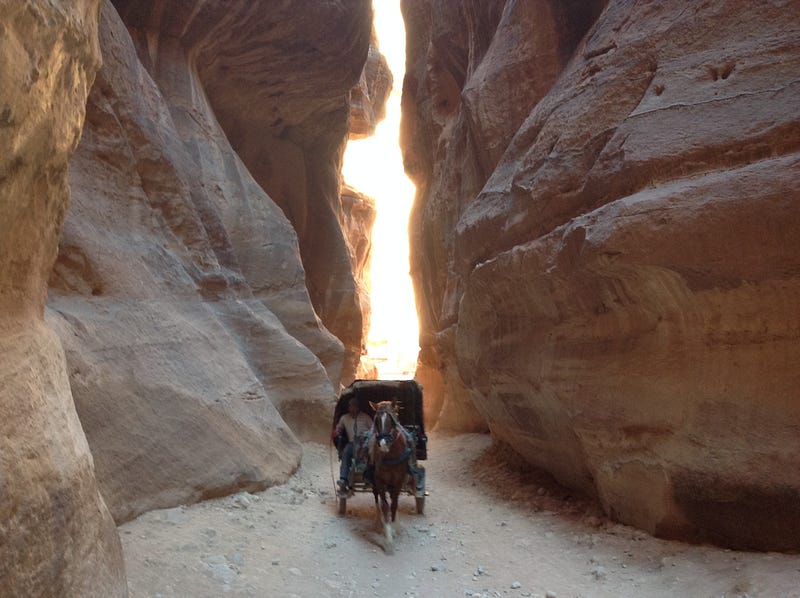
You might get a taste when you hear a warning shout and a horse-drawn carriage trundles by. The sounds of the hooves keep bouncing off the walls long after the vehicle has passed, taking you back millennia when this would have happened much more frequently.
After you spend the day at Petra, I then urge you to come back in the evening, for the Petra By Night show. You will walk the same route, but by the light of thousands of candles set by the sides and in the nooks. I found we got quieter as we went deeper, almost meditative as the candles cast flickering shadows up the walls and down the path. Arriving at the end to a carpet of candles set in front of the Treasury is a magical sight.
I would like to believe that the Nabateans had a finely-honed sense of theater. After all, they designed the imposing pillars of the Treasury to be the first thing you saw as the Siq opens up to the city proper. They knew the effect it would have.
Imagine yourself as part of a caravan, two thousand years ago. It has been a long and dusty journey over many miles. Maybe there is water under the bridge at the end of the Bab al-Siq, and your camels and horses get some rest and rehydration. Meantime you wait your turn to enter the city, and exchange notes with fellow travelers, maybe grumble about the time it is taking nowadays to get into Petra, unlike the good old days.
Eventually you get the go ahead. The end of the journey is near. There is delicious anticipation. Of a warm bed, of fresh food, of rekindling old friendships, of good money.
You rush your entourage into the Siq through the grand archway, wanting to get this done with, the end of another successful trading trip.
But you can only go so fast as the path winds its way between the steep rock walls on either side. It forces you to slow down and your thoughts start to wander. You go through your negotiation strategies. You work down the list of buyers you need to go to, in order of priority. You remind yourself of what’s at stake if you are unable to get the best prices for your wares.
But you need to keep your eyes on the crowded road, however surefooted your mount is. You also need to pay your respects at the shrines and give thanks to the powers that be. The rocks are cool to the touch and feelings of gratitude cleanse your soul. You are now fully immersed in the Siq.
You notice the rocks with their multicolored striations that almost animates them. The sun and shadows play their games as the cliffs close above you. The sky is a slice of blue.
You pass by the two caravans carved into the walls on either side. You might as well be looking in a mirror. The city knows how important you are to her, they seem to say.
The rock massifs close in on you and it is dark even though it is the middle of the day. You ride on. Suddenly the walls are parted by a thunderbolt of light and despite having been here several times now, your heart skips a beat as always. The first pillars of the Treasury come into view through that sliver of light. The weariness falls away as you get enveloped in the hustle and bustle of the metropolis.
The destination is spectacular, but it is the journey that makes it so.
Thank you for reading!
There are plenty of wonderful stories about Petra on Medium. These are just a few of them.
Rhonda Carrier takes you back a couple of decades to her first visit
Darren Weir gives a detailed overview of all that Petra offers
JetSetterJournal takes a look at the monuments, the people and the environment of Petra
If you want to know more about the Nabateans and how far their influence spread, read this article by Brad Yonaka


