
HISTORY | NABATAEANS
The Forgotten Merchants Of Frankincense
The unlikely rise of the Nabataeans
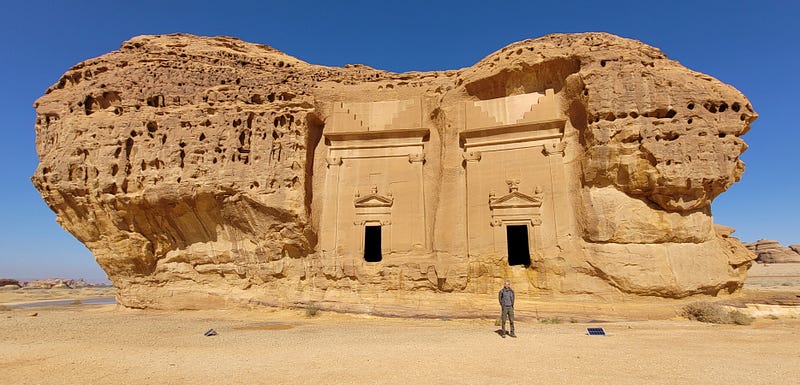
One year ago, I visited a few major Nabataean archaeological sites as part of a much more extensive Middle East itinerary. This article uses photos sourced from that trip.
Going back far enough in time, the history of any nomadic group becomes confused and uncertain. That is the nature of nomadic culture: transient, adaptive, and often existing without a written record.
The Nabataeans, who lived near the Dead Sea and in the Arabian Peninsula, only came to the attention of the Greeks and Romans because they traded frankincense. This aromatic resin is collected from the Boswellia sacra tree, native to Yemen, Oman, and the Horn of Africa.
Frankincense was immensely popular in ancient times, burnt as incense in religious rituals. It permeated pagan Rome as enthusiastically as it served Christian Byzantium. Its intoxicating smell subsumed the foul odors of urban places and allowed worshippers to feel more connected with the spiritual. It is mentioned in the New Testament as a gift from wise men to the newborn Jesus (Matthew 2:11). That it was presented along with gold gives an idea of its perceived value in the ancient world.
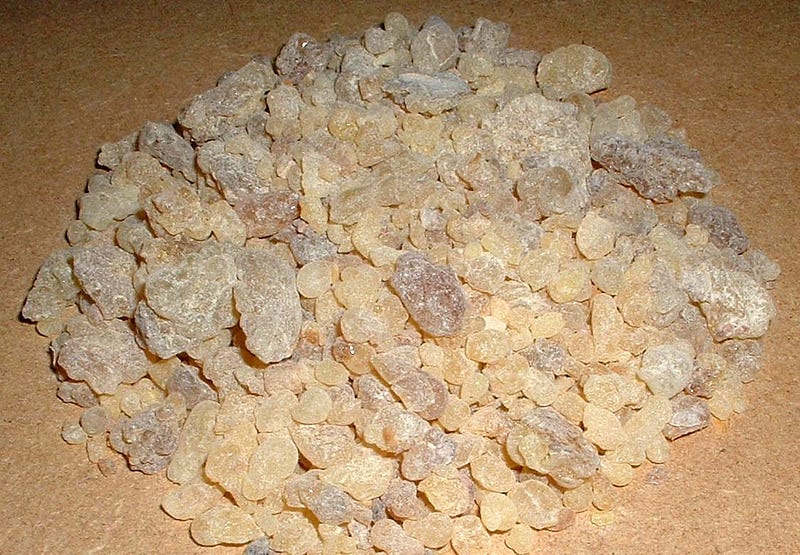
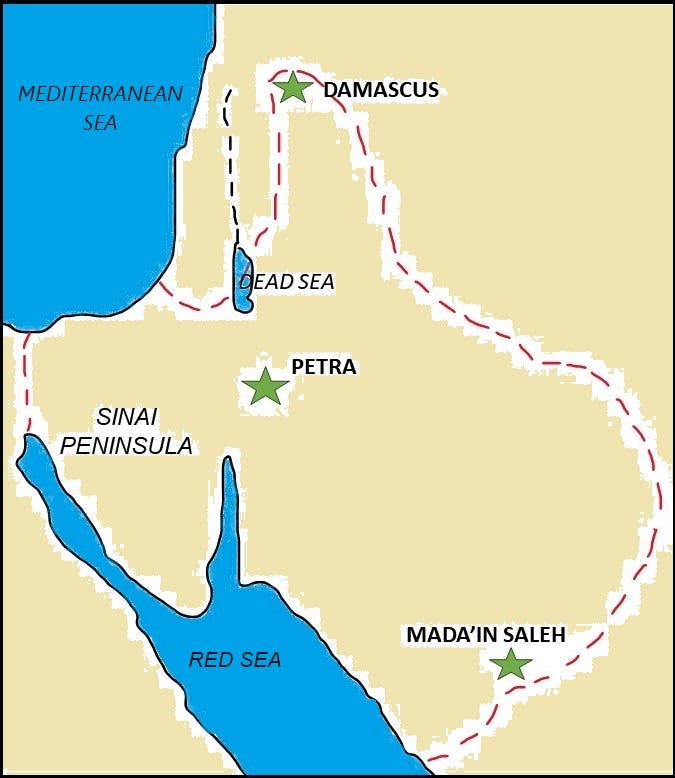
The Nabataeans didn’t live in the areas native to the Boswellia tree. Through happy coincidence, they occupied a stretch of land on the east side of the Dead Sea, extending south to the Gulf of Aqaba. Any trade from further east along the Red Sea and the Arabian Peninsula passed through their territory. They became the exclusive frankincense middlemen and, over time, lost their nomadic roots and grew so wealthy that we can view their extravagance today.
The Origins
One thing we can safely assume about the early Nabataeans is that they were hardy desert dwellers, able to cling to lands too hostile for invading foreigners to occupy. They survived by being opportunists, trading or raiding as necessary.
Just east of the north-south valley that connects the Dead Sea to the Red Sea, there is a steep escarpment with many narrow valleys. It is here that the Nabataeans were in their element. It was land they knew how to control.
In the valley itself were the Edomites of Biblical fame. We don’t know if the Nabateans were just one faction of the Edomites or another group altogether. They either pushed them out or merged with part of them to control the entire area, opening the way for singular dominance of the Arabian trading routes.
Greek historian Diodorus Siculus penned the first entry of the Nabataeans into history books. He compiled the eyewitness accounts of Hieronymus of Cardia of a battle fought in 312/311 BCE between Nabataean forces and those of the Macedonian general Antigonus. Antigonus was one of the competing successor kings of Alexander the Great’s fragmented empire. Unfortunately for Antigonus, he was not as acquainted with the craggy desert mountains as his foe, and the Nabataeans delivered him a miserable defeat.
Ascent to Kingdom
Somewhere between the 4th and 2nd centuries BCE, the Nabataeans developed a complex civilization and ceased to be nomadic. The frankincense trade alone yielded immense wealth, along with myrrh, a resin from a different tree but with a similar geographic origin. Coincidentally, myrrh was also cited as a gift to the infant Jesus.
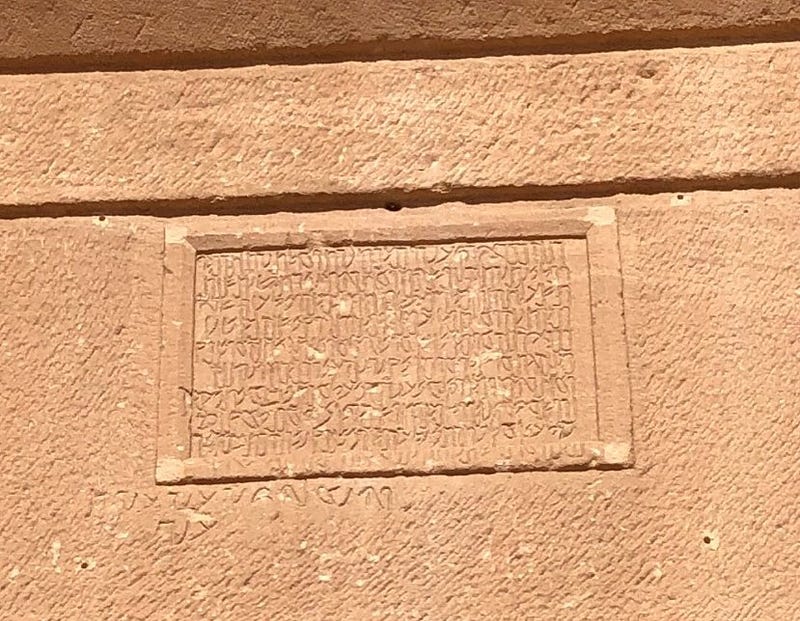
Around 150 BCE, the Nabataeans began leaving written records. They used the Aramaic language, writing with a modified Aramaic alphabet. This was a logical choice for them, as Aramaic was the lingua franca for Middle Eastern traders.
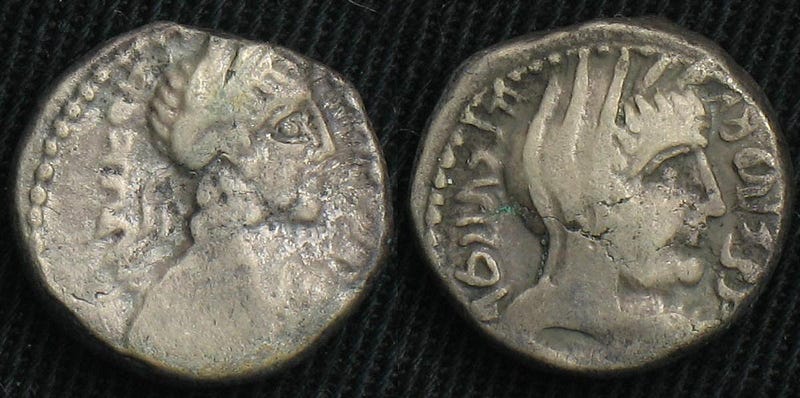
The Nabataean kingdom expanded eastward through the mountainous southern region of the Arabian Peninsula, overlapping the primary incense trading route from Arabia Felix (Yemen and Oman). They began minting copper and silver coins as a testament to their economic power.
The first known king of the Nabataeans, Aretas I, is named in the deuterocanonical book Second Maccabees. His name also appears on an inscription in the Nabataean ruins of Halutza (in the Negev Desert) dated to around 150 BCE. However, there is some debate about the inscription’s age and whether it might refer to a later king named Aretas.
The Nabataeans waged a successful war against Seleucid armies in 86 BCE, eventually pushing north through the Transjordan and ruling Damascus for a time — quite an accomplishment for what began as a rabble of nomadic raiders.
Rock City — Petra
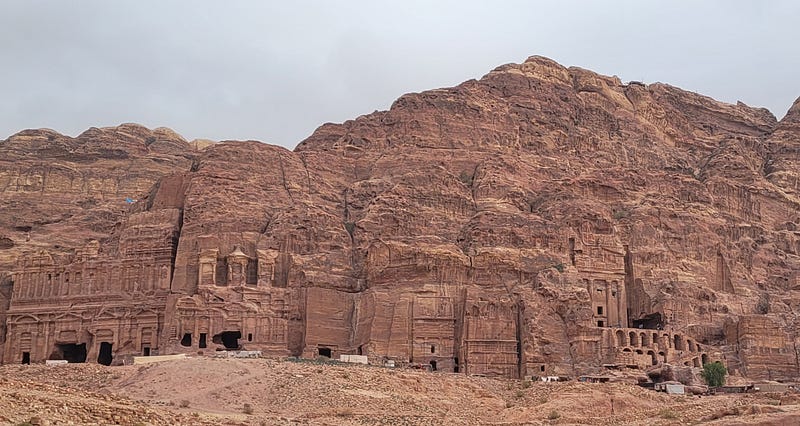
What is truly impressive about the Nabataeans is what they wrought from cliff walls: the rock homes and tombs of Petra and Mada’in Saleh.
Petra, located in southern Jordan, is the most famous site. It became the capital of the Nabataean Kingdom in about the 2nd century BCE. Its real name was Raqemo, ‘Petra’ being a Greek word given to it later, meaning ‘rock.’
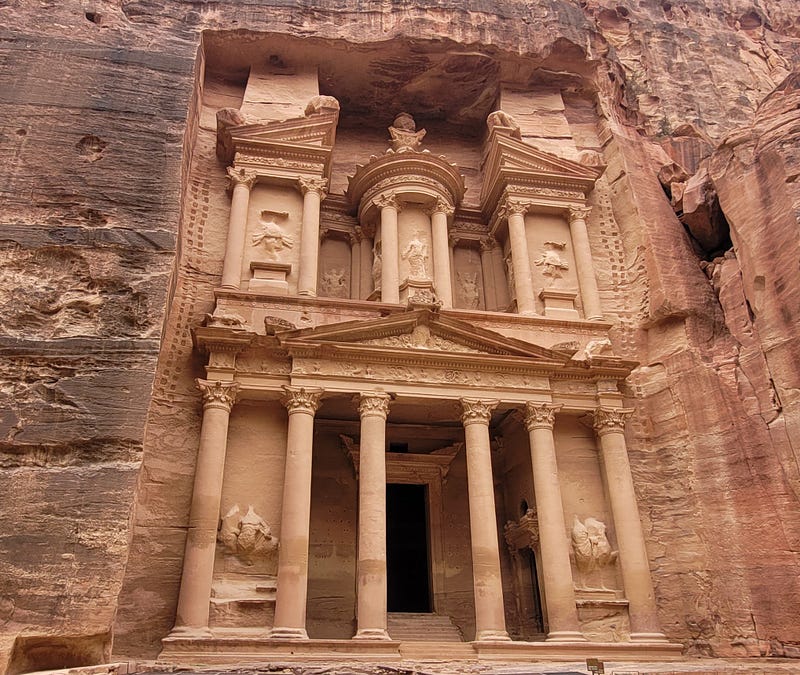
Besides trading, the Nabataeans had two other skills: rock carving and water harvesting. These latter two skills were used harmoniously to create the rock city of Petra. The narrow valleys of the area, eroded vertically through sandstones, were well suited to carving out large, sheltered structures that remained cool inside. Not as visible but just as elaborate was a system of channels and pools to collect and store the sparse rainwater.
I have visited Petra twice and have yet to come close to exhausting the wealth of trails leading to the hundreds of rock-carved structures. Small valleys and ravines all over this UNESCO World Heritage Site hide many façades and cave-like rooms. It would take several days and many kilometers of hiking to see them all.
Rock Tombs — Mada’in Saleh
The second-largest archaeological remnant of the Nabataeans is Mada’in Saleh (also called Hegra) in Saudi Arabia. They sought similar sandstone cliffs to carve their characteristic elaborate entranceways and rooms.
Several groups, namely the Dadanites, Liyanites, and Minaeans, had lived here for centuries. The area, also a bleak desert environment with extreme summer heat, was amenable to settlement due to a shallow water table. The Nabataeans became dominant here in the 2nd century BCE, the region’s wealthiest and most militarily powerful group.
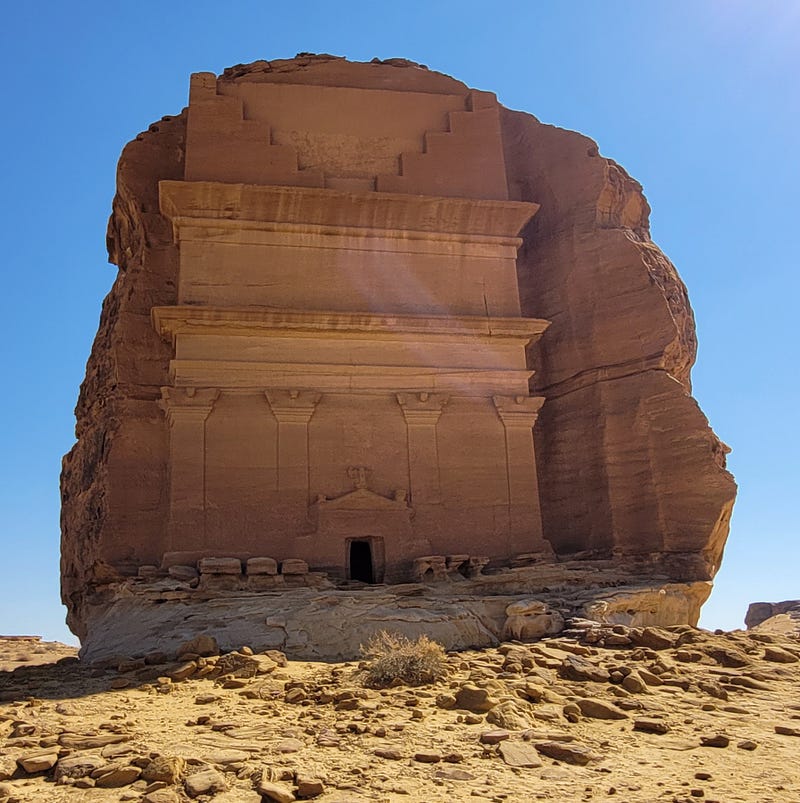
What is preserved in Mada’in Saleh is just the necropolis. Rather than narrow clefts in deeply eroded canyons, the structures were carved into isolated sandstone spires and outcrops on a much more open terrain than at Petra.
I visited the site for three days, during which we saw many of the larger tombs, and locations where notable events were recorded in cliff walls, in either the Nabataean or related Semitic alphabets from earlier inhabitants.
The Saudi government has restricted access to the various sites by herding people to them on scheduled buses, with guides included. The archaeological work at Mada’in Saleh is in its infancy, and new structures that are likely the foundations of towns and cities are emerging from the desert floor. Keeping tourism under tight control allows these discoveries to be properly excavated without disturbance.
Adaptive Style
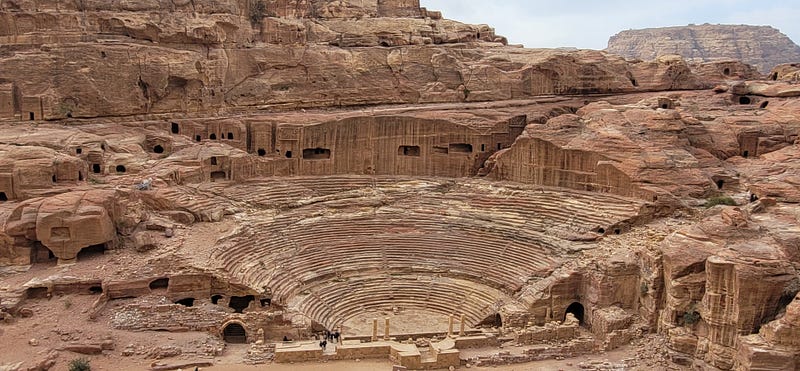
A striking difference between Petra and Mada’in Saleh is the contrast in architectural style. Petra displays clear Hellenistic influences, notably in the use of Corinthian columns. This mimicry only increased during Roman times. The style of the Petra Theater (built during the reign of Aretas IV in 9 BCE to 40 CE) mirrors that of Roman amphitheaters. It was undoubtedly influenced by contemporaneous building projects of Judean King Herod the Great, who himself had possible Nabataean ancestry.
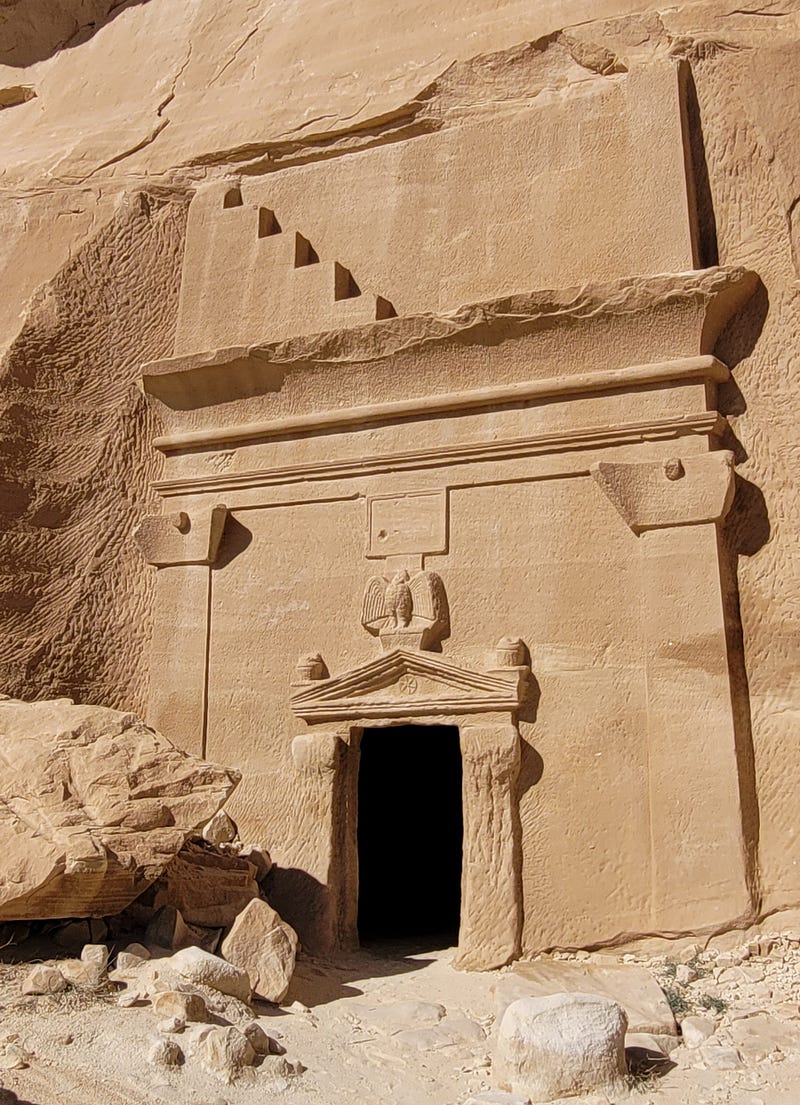
Mada’in Saleh, in contrast, shows a much more blocky, repetitive style across the 111 tombs scattered throughout the valley. Some features appear in virtually all: an eagle above the door, symbolizing the pagan god Dushara, and five-step crowsteps above the cornice.
A Kingdom Annexed
After centuries of charging what the market could bear for frankincense and other rare commodities such as bitumen and myrrh, the Nabataeans eventually called too much attention to themselves. Rome, now near the apex of its power, did what the weakened Seleucid rulers before them could not: step in and annex the kingdom during the reign of Trajan (98–117 CE).
It is unknown whether the Romans threatened a military campaign to subdue them or if they took advantage of a Nabataean king’s death (Rabbel II) to present the terms of vassalage. Either way, the deed was done by 106 CE. The Nabataeans carried on supplying the Mediterranean with frankincense, but now as a Roman province named Arabia Petraea.
Forgotten and Rediscovered
The Nabataeans, as a distinct culture, faded after Roman domination. Many converted to Christianity, and they lost their monopoly over the incense trade as routes to the source multiplied. Later, Muslim invasions altered and rebranded many of the old cultures of the Levant and the Arabian Peninsula. The previous scripts were replaced with Arabic, rooted in those older Semitic alphabets. The city of Petra faded into obscurity, though it never ceased to be inhabited by a few nomadic shepherds.
A few centuries ago, it was brought to the world’s attention as an archaeological site. In 1812, it was recorded by Swiss explorer Johann Ludwig Burckhardt. Since then, it has become the most prominent tourist attraction in Jordan.
Mada’in Saleh, due to its location in the insular Kingdom of Hejaz and later (and just as insular) Kingdom of Saudi Arabia, was almost unknown to the public outside of the Muslim world until recently. Under the mandate of Saudi Vision 2030, the Saudi government has made Mada’in Saleh a priority visitor destination and has built a sizable supporting tourist infrastructure around it.
The Nabataeans are an interesting example of how opportunities can transform societies in unforeseen ways. They lasted long enough to leave us with a substantial legacy in stone and are inspiring in the prosperity they attained in an environmentally challenging part of the world. It is not difficult to see vague parallels between the wealth of the Nabataeans in Biblical times and the rise of cities like those in the United Arab Emirates today. Both were and are entirely due to the control of immensely popular commodities.
Thank you for reading! And thank you to the editors at Teatime History. Please check my profile for other articles at Brad Yonaka.
For an earlier article from the author about sites of interest in Jordan, please read:
References
Barkay, Rachel. Coinage of the Nabataeans. Jerusalem: Institute of Archaeology. Hebrew University of Jerusalem, 2019.
Jane, Taylor. Petra and the Lost Kingdom of the Nabataeans. London: I.B. Tauris, 2001.
Waterfield, Robin. Dividing the Spoils: The War for Alexander the Great’s Empire. Oxford University Press, 2011.


