
Lockdowns didn’t make kids suicidal, but going to high school does.
In early 2020, people warned that covid lockdowns would destroy people’s mental health, that suicide rates would soar, that the lockdowns would be worse than the virus itself.
When looking into covid death numbers, I noticed a different result: suicide rates were identical in 2020 as 2019.
I still see articles saying that teens in particular struggled with mental health, during the pandemic. We have scare pieces in Fox News:
And we have this recent substack article from Suzy Weiss:
The Weiss article has alarming statistics like this one:
“The CDC said that, from 2019 to 2020, the incidence of girls ages 12 to 17 who were rushed to the Emergency Room after attempting suicide jumped by 51 percent.”
Clicking through to the linked CDC data, I found this graph:
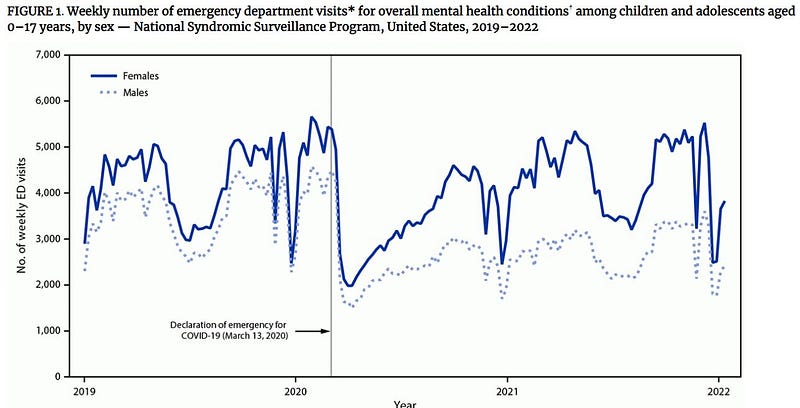
Emergency department visits for mental health were clearly lower in 2020 than in 2019, for both boys and girls.
2021 looks like it’s back to about the same as 2019, for girls. Boys are still going to the hospital less than before the pandemic.
Even more interesting is the shape of the graph in 2019. Notice how hospitalizations drop during summer? And again near the end of the year?
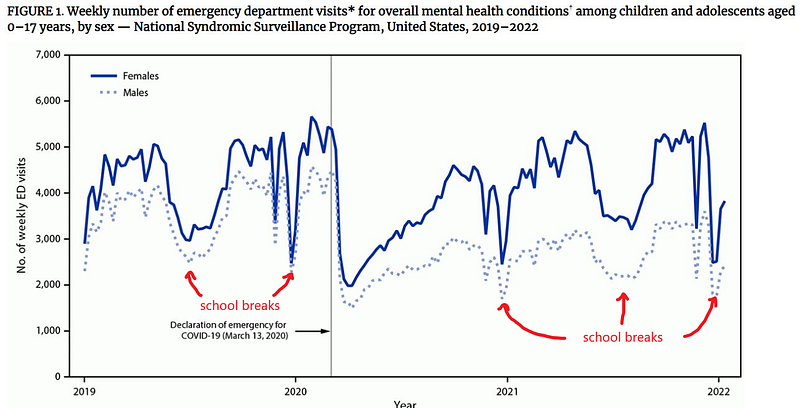
These are when kids are on summer vacation or winter holidays. It looks like you can even see a separate dip for both Thanksgiving and Christmas, every year. Even having 4 days off seems to be a life saving break from school.
We have all this hand-wringing about how awful it is that we took kids out of high school for the pandemic. The reality is that high school makes kids suicidal, and they’re happier in summer when they’re not in class.
Maybe the numbers actually dipped in spring 2020 because we pulled kids out of school.
Okay, that doesn’t prove that there was no mental health crisis. Those are just emergency department admissions. That just proves that kids were going to the hospital less.
Maybe it’s scary to check yourself into the hospital during a pandemic. Maybe it was especially scary to check yourself in early in spring 2020, when we were in full lockdown and people were especially scared of covid.
To double check, let’s look at actual completed suicides, maybe kids really were desperate during the pandemic, but they killed themselves at home?
Vancouver doctor Tyler Black compared the 2020 school year (red line) to the average of the 2 years prior (blue line).
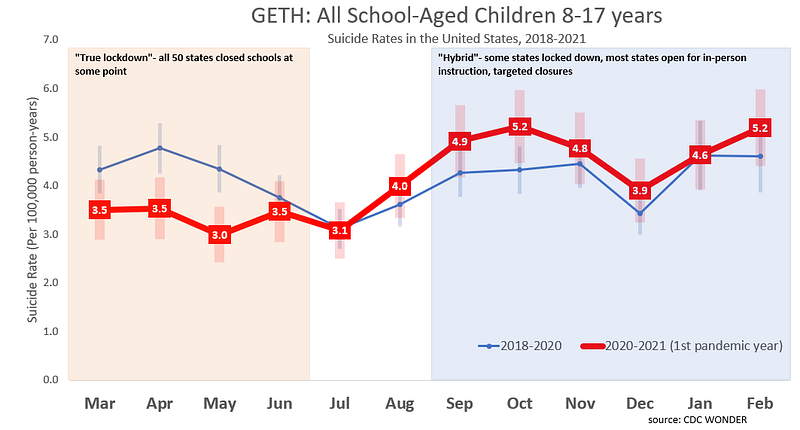
During the hard lockdowns of spring 2020, less kids killed themselves than usual. The suicide rate was the same as during a summer vacation.
In his research, there was a spring school season spike in suicide rates every year for the last 21 years, but it didn’t happen in 2020.
Looking over 20 years, Tyler Black even found a pattern on which days of the week kids are most likely to kill themselves:
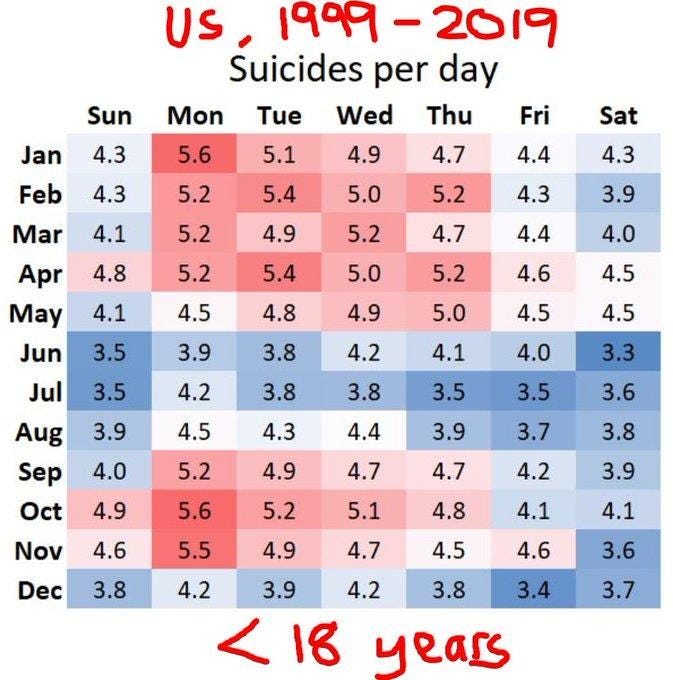
Kids are most likely to kill themselves on Monday of a school week, then things get better as the week goes on.
There was an increase in children’s suicides, in fall 2020. The situation there was more complex than spring 2020 — many states sent kids back to school, now making it even less pleasant, with masks. Some had hybrid schedules. Perhaps a few continued with remote schooling.
None of this surprises me. I hated middle and high school.
Weiss’ article decrying lockdowns waxes nostalgic about what high school was like:
“The tangibleness of high school — sweaty locker rooms, polyester prom dresses, the cool metal of a first-place trophy, the puff of a contraband cigarette — was gone. It no longer mattered how high schoolers dressed, or whether they dressed, or even whether they showered.”
Maybe the author remembers childhood more fondly than I do? I hated all of that. I hated being judged for how I dressed. I hated the status contest. I hated walking the gauntlet of bullies between classes. I’m try to imagine what it would be like in 2020, if I could have done my work online and then just talked to my friends on zoom. That sounds pretty awesome by contrast.
On the other hand, throwing me back into that, during an ongoing pandemic, unvaccinated, with a mask on all day? That sounds like torture.
That was fall 2020 and 2021 for most kids, and there was a small increase in suicide rates. Which dropped off again during school breaks.
It’s a big allegation, to say that high school kills students.
Just to be clear, let’s consider one alternative explanation: maybe suicide rates are just lower in the summer, for everyone? Maybe sunlight just makes people happier?
Here are the suicide rates for all age groups, from 2018 through 2020.
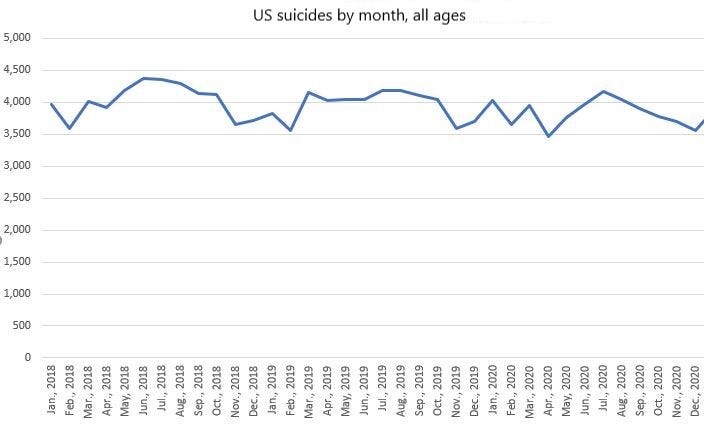
For adults, suicide actually goes up in the summer and down in the winter.
We can even see how this evolves, as people get older.
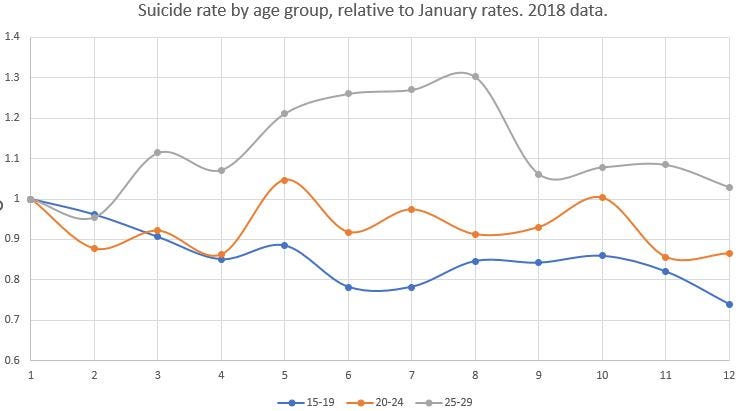
Just using data for one pre-pandemic year (2018), we can see a summer drop in suicide rates for 15–19 year olds. For 20–24 year olds, the rates are more or less flat, across the year. By 25–29, we’ve got a summer spike in suicide.
The summer spike for adult suicides shows up in many countries, with the peak in either late spring or early summer.
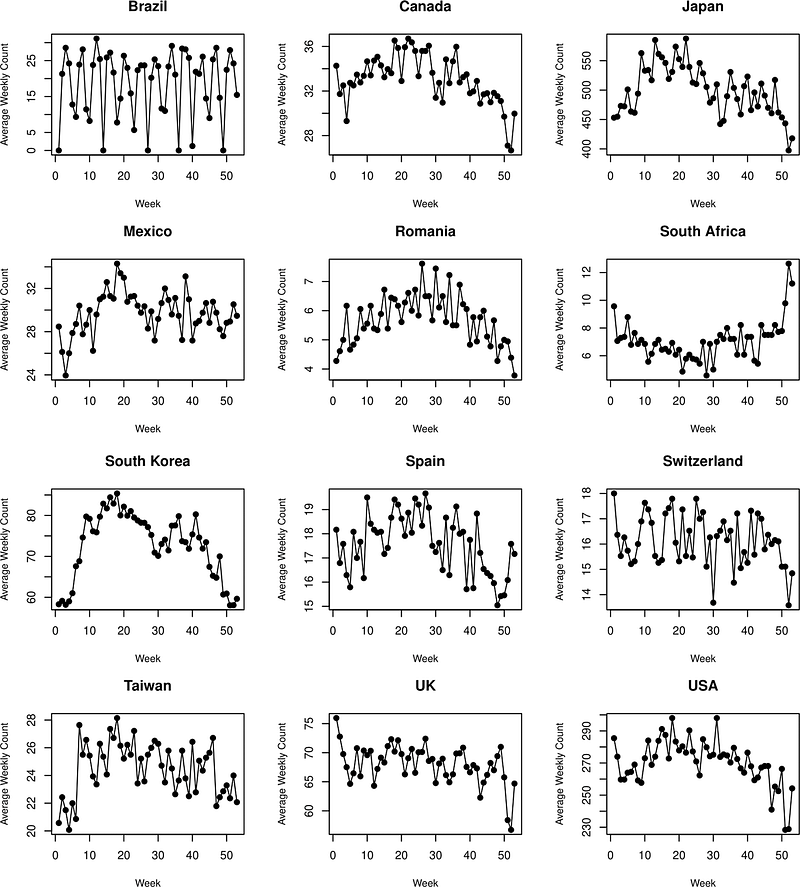
There’s a strong reason to think this is seasonally driven. We can see that the seasonality is reversed in South Africa, in the southern hemisphere.
Australia is omitted, here, but we can pull up data from another study and find the suicide peak is in November, in late spring/early summer.
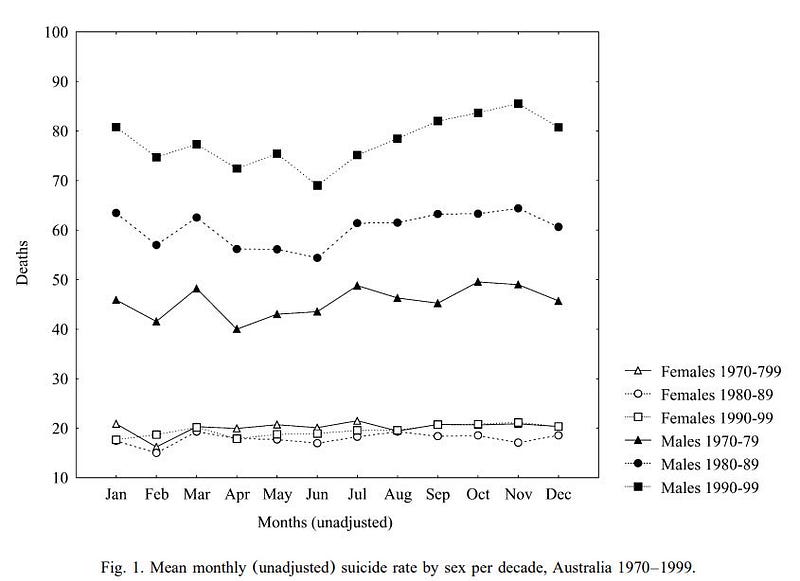
For most countries, the seasonal variation is stronger in women than men, and for older people more so than younger people.
Just like the data on school causing suicides, I think this also goes against popular wisdom. Most people think of winter as depressing and summer as uplifting. When it comes to suicide, the numbers appear to be the opposite.
I’m not sure what drives the late spring/summer peaks. Some researchers speculate that daylight drives a change in serotonin, and the increase in serotonin is difficult for someone who’s otherwise been depressed (kind of like the way that antidepressants lead some people to commit suicide, soon after they start). There could also be increased rates of mania in summer.
Some studies report that suicide rates are worse the further north you go. Intuitively, you’d think that’s the long winters, but the peak rates are still in May or June.
I glanced at some maps, but the effect isn’t obvious. Here’s county by county in the US:
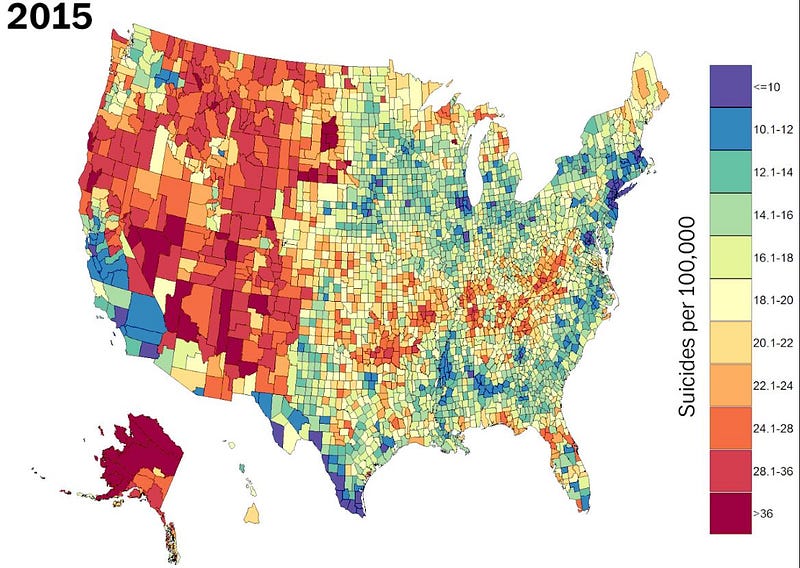
Alaska fares very poorly relative to the rest of the country. It looks like the rates are higher in places like Maine or Michigan’s upper peninsula. But things other than latitude seem more important. The mountain west is very high for suicide, that’s probably related to high gun ownership, but might also have something to do with rural isolation. Alaska itself might have high rates for the same reasons.
There’s some also confounding with race — both Black and Hispanic adults commit suicide less, and that shows up in the maps, you can see the heavily Hispanic region along Texas’s southern border and the thin band where the most black people live in the south.
Worldwide, the latitude effect also isn’t that obvious:
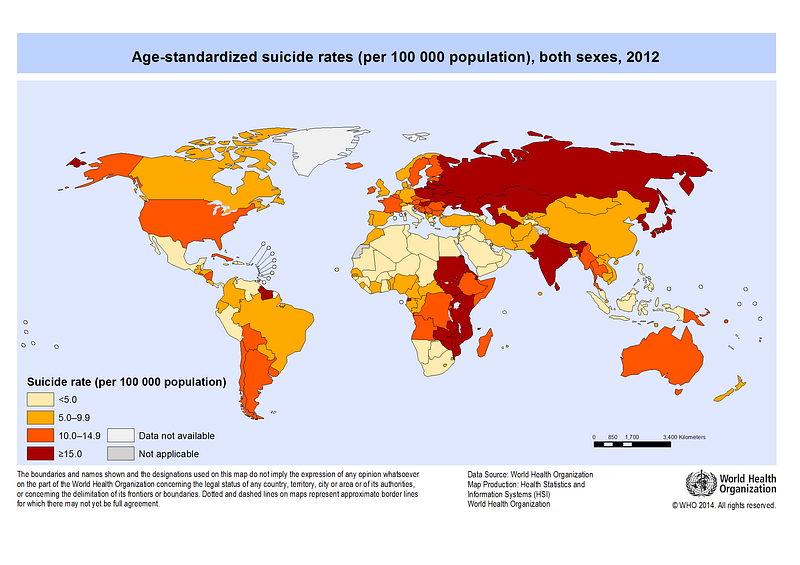
It’s hard to say what the pandemic did to children’s mental health. I don’t think we know what growing up on social media does to kids, either — it’s widely speculated that it’s especially harmful to teenage girls.
I think we can only understand these problems by listening to the kids or by looking at data objectively, unfiltered by ideology.
The results are complicated and vary by disorder. Boys are doing better with ADHD, since before the pandemic started. Girls are doing worse with anxiety and eating disorders.
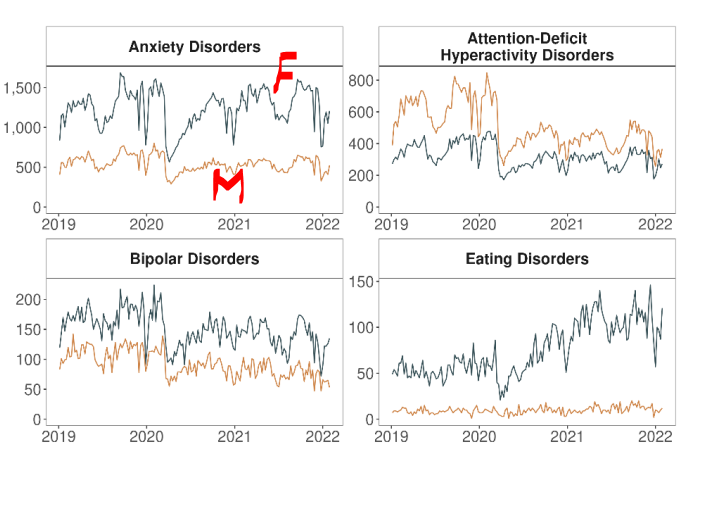
There was an increase in suicide attempts by girls. It wasn’t lockdown related, it got worse in 2021 than in 2020.
We also have data suggesting more kids reported being sad every day, albeit not more suicidal:
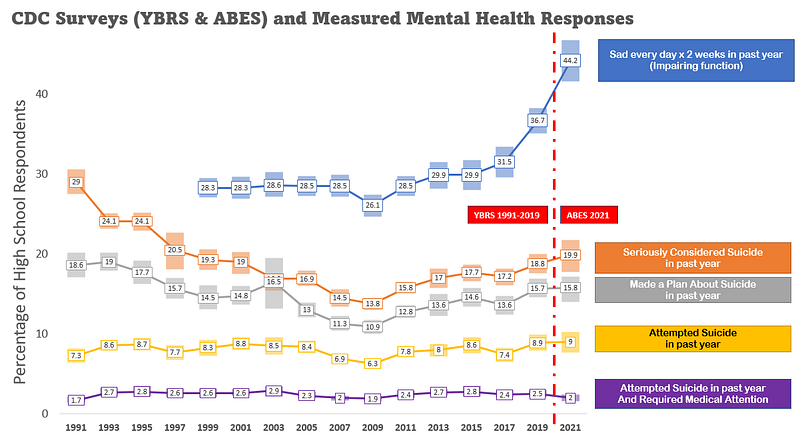
The most common factors that lead them to be sad weren’t generally the pandemic or social media:
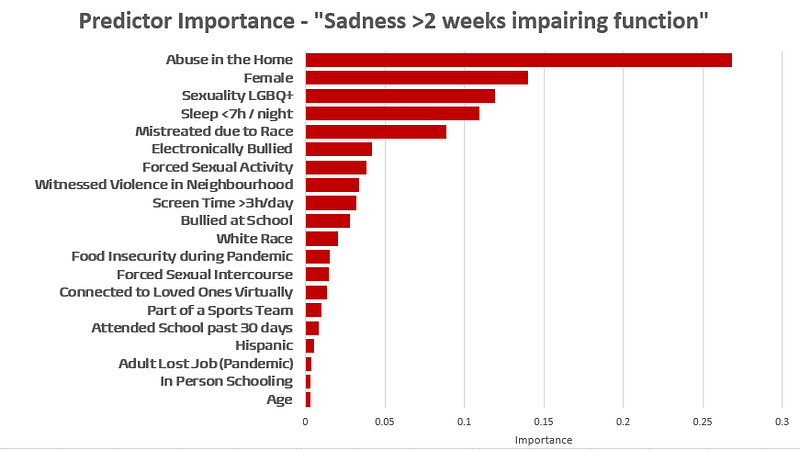
The biggest ones are things you’d expect to matter before the pandemic — abuse in the home, being bullied for race or LGBTQ identity. But there are some new ones, like their parents losing a job during the pandemic or food insecurity. Some of these things are less common but more harmful when they do happen. Forced sexual intercourse tops the list as worst. Being bullied is high. Using a screen too much is harmful but nowhere near that bad.
Likely, the pandemic was a bit different for everyone. Introverted kids maybe enjoyed the lockdowns, like I think I would have. Extroverted kids were probably driven mad. Kids in abusive families faced more abuse now that they were stuck at home, without school as a temporary way to escape.
Republicans latched onto “Lockdowns kill kids”, because the pandemic got politicized, Republicans found lockdowns obnoxious, and they wanted to reach for some reason to prove that lockdowns were bad. Fox News gladly obliged with some manipulated stats to feed into that belief.
And Fox News likely just wanted to keep the economy open, because they’re pro-business, and covid cost businesses a lot of money. Better to kill 1% of your customers than to lose most of them.
The actual things kids are struggling with are different, and complicated. There’s no Fox News report on bullied LGBTQ teens, nor is their one on kids bullied for their race, nor one on abuse in the home, nor is there any effort to address poverty that might contribute to abuse.
The covid lockdowns reduced teen suicides. Now that kids are back in school, suicides are up again. We’re also back to hearing horrific stories about school shootings.
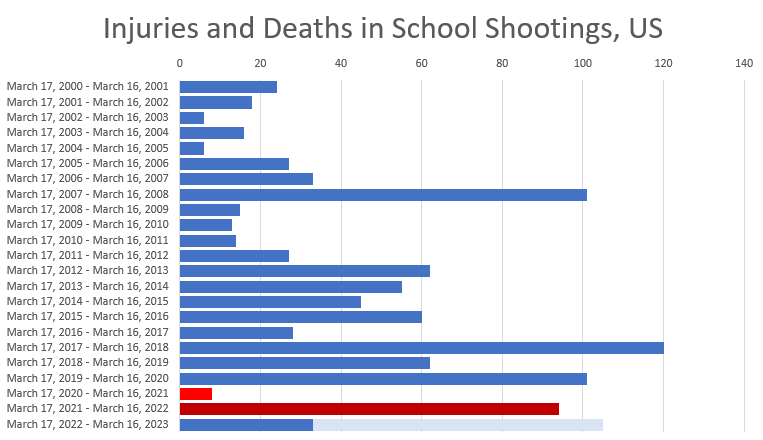
Maybe, instead of worrying about what the lockdowns did to children, we should be asking why our high schools make kids kill themselves and others.