
War of the century.
The Rise of Machines: Can Humans Win the Battle for Artificial Intelligence?
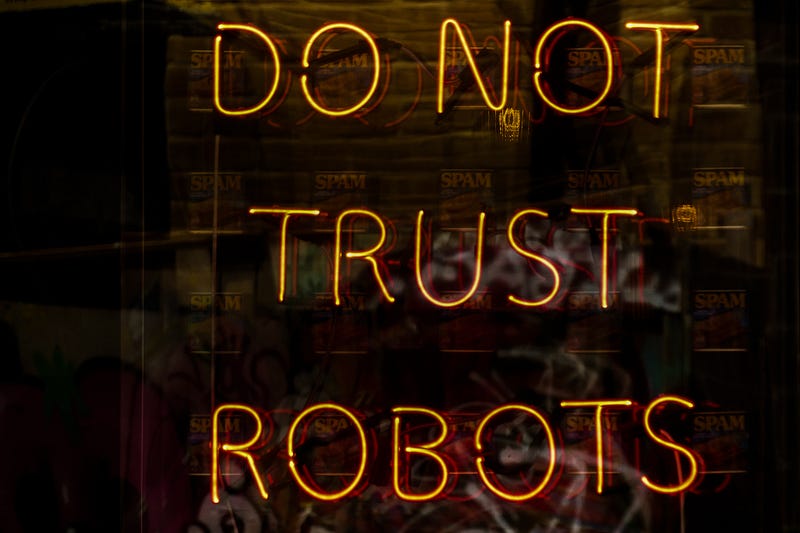
Do not trust robots!
We are now living in a world where the ‘real’ and the ‘not so real’ are becoming so blurred. In the 18th century, people couldn’t have dreamt of many things that we have today. And from the multitude of them in the last decade, we created the most valuable and frightening at the same time: Artificial Intelligence more commonly spelled AI. As much as we will take all the advantages we are still debating certain questions. How safe will it be with these let’s call machines? Can AI be trusted in the real world? Are we sure that this technology wouldn’t overpower humans? Will AI take our jobs?
AI systems share common attributes with humans: the ability to ingest data; the ability to adapt and react to data in their environment; and the ability to project multiple steps into the future. Only had 20 years passed since a computer beat world chess champion Garry Kasparov, but in the last 3 years, artificial intelligence has defied expectations. In June 2016, the DeepMind team (London AI lab now owned by Google) demonstrated the power of AI. They put the AI to manage a Google data center even if the managers were all skeptical. Holy crap! As soon as the team turned over control to AI, data center performance improved not by a little, but by a lot. Overall energy efficiency, decreased by 15% and the cooling bill fell by 40%. Something that we humans cannot do properly, — resource management — AI had made it almost perfectly.
Machines already fly airplanes, drive cars, and control spaceships. But still could machines ever really think? It’s AI human creative? Some researchers and believers are growing the utopia that AI will provide all labor so that humanity could live a carefree life of art and leisure. Diseases will be cured, wars will be prevented, the poor will be fed, and our brains will be integrated with AI and ultimately cheat old age and become immortals. Hell NO!!
“Something that seems so good cannot be that good. Tasks that appear to display great intelligence actually require minimal intelligence, while other tasks that are trivial are not so easy to be obtained.”
So the ultimate goal of AI is to produce a machine that can perform research that will enable it to reprogram itself. This means that when this happens, humans will no longer be the most intelligent being on this planet. In this regard, there are several people concerned and they postulated the threat like our biggest existential devil. In 2015 many researchers in AI signed a letter promoting that we had to focus only on making AI systems ‘do what we want them to do’. Until now we have been building AI to do the opposite. No!!… They are frightened that AI could recognize analogies, create new ideas, and be self-aware. But AI already is doing this far better than humans. After billions of years of life, millions of years of the genus Homo, 10.000 years of civilization, and 500 years since Enlightenment we are very close to building an intelligence greater than our own and we are still debating?! What an amazing time to be alive and to be aware.
AI is already being deployed in synthetic biology, cancer research, climate science, and material science. Progress has also been made in connecting electronics to our nerve cells. It will be soon possible to implant AI in our bodies and control them with our minds. We could have gigabytes of reliable memories available to us in a way that feels like our own memories. Or we could have other people’s memories implanted in our own minds to make us feel better. This line of thinking is referred to as the “rapture of the geeks” and they all believe in singularity. The term was applied first time in a NASA symposium reshaped by Kurzweil to describe the ever-accelerating rate of technological progress. Extrapolating singularity means that we are growing technologically extremely fast. But even with this in mind, there are more practical problems for AI to overpower humans. One of them is the impossibility to recreate the combination of 86 billion neurons that produces intelligence in our brain. Human reasoning cannot be represented in pure logic and AGI (Artificial general intelligence) has not realized it yet. However just because we didn’t make it today is not an argument that we cannot build it tomorrow or in the future. Another problem concludes that the difficulty of producing an AGI becomes exponentially more challenging as intelligence increases.
According to some survey results, machines are predicted to be better than humans at translating languages by 2024, running a truck by 2027, working in the retail sector by 2030, and can completely outperform humans by 2060. (my predictions are even more optimistic and machines will outperform humans by 2045.)
Even if AI researchers are trying to replicate our brain functions with no luck so far, many people are scared that AI will overcome them very soon. This basic lack of understanding leads to predictions that may make good movies but do not say anything about our future reality. On the surface, these victories are incremental and minor. Wariness surrounding powerful technological advances seems novel to a child. There are dangers that come with the creation of such powerful and omniscient technology, just as there are dangers with anything that is powerful. This does not mean we should assume the worst based on that fear. Yes, it’s a matter of time until hundreds of jobs such as drivers, costumers services, support, and cashiers are facing substitution with AI. (timeframe — in the next 10 years) But job losses due to technological advancement had been for ages, and we have been able to retrain and create entirely new professions from scratch.
You can train a machine to behave like you, but you cannot train it to develop its own personality, yet.
A McKinsey Institute analysis of 750 jobs concluded that “45% of paid activities could be automated using currently demonstrated technologies’ and . . . 60% of occupations could have 30% or more of their processes automated. Even if the job ramifications lie more at the low end of disruption, the political consequences still will be more severe, because armed bands of young men with few employment prospects will start to behave violently. As innovation accelerates and public anxiety intensifies, right-wing and left-wing populists will jockey for voter support as you can see already in the EU and US. It is safe to predict that politics will be chaotic and turbulent during the coming decades. Right now is a gradual transition with many nuances that cannot be accurately distinguished. But the gap is not due to technology, but rather to the corruptness of the moral state of much of society as we know it. The core of such automation anxiety is that technological change has distributional effects between groups in society, meaning that the benefits of technological change are not spread equally. Politicians’ instincts will be to focus on bringing back lost work rather than allowing people to do less. The reason is that fear and anxiety about automation alone are sufficient to radically alter people’s political attitudes and increase the pressure on governments to take action.
Adapting to a world of powerful AI means revising “full-time work” to something much less than 40 hours per week or even better. More people will have other activities and they will search for purpose and for ways to spend their time. In principle, more money for less work would seem to be a good thing. But governments will need to provide more benefits directly, and the overall level of redistribution might need to rise considerably. Such dramatic reforms are harder to come so we will face history again. Across much of the industrialized world, it took the brutal years of 1914 to 1945 — the Depression and World War II, in particular, to foster broad acceptance of high tax rates, weaken the established elites, and build consensus in favor of social safety. But over time, as pressure builds, the politics and the governments will face many powerful challenges. We will be back in those early years, struggling to understand what needs to change and how to make those changes without creating errors or launching new world wars. In fact, it may just be that the AI change that’s shaking up our world will lead the way to its healing.
Life in the digital age is itself nearly the definition of transparency. And transparency means a stronger democracy. There’s a lot to build on here. It will be hard for a better future. We make mistakes and learn, but in the end, we find ways to protect ourselves from things that are dangerous to us. Instead of us adapting ourselves to tech, the tech will adapt to us.
So apart from information processing capabilities, there are other aspects that make us far superior to any AI until now and we are still leading the game. Like we make our own energy to live, we don’t need any battery. Like we have emotional energy which propels us beyond the logical limits of possibilities. Like we are alert to any impending dangers, intuitively because we carry the knowledge across all forms of life from which we have evolved. So rather than obsessing over who’s smarter or irrationally fearing the technology, we need to remember that AI is designed to improve our lives. The trick is ensuring that “helping us” remains their prime directive.
Never ever let your fear decide your future!
This work here is entirely reader supported so If you enjoyed reading it please consider sharing it around and SIGN up here to get all my future articles directly to your inbox. Also if you feel like you can throw some money into the tip jar gladly will be accepted. Thank you for the support!