
The Reliability of Jesus’ Birth Narratives in the Gospels
There are telltale signs suggesting that they were invented
The stories about Jesus’ birth in the Gospels of Matthew and Luke are well-known to many people in the Western world. They include details like Mary’s miraculous pregnancy, Joseph and Mary traveling to Bethlehem, the visit of the Magi, and King Herod’s plan to harm baby Jesus. People often assume that these stories are based on factual and reliable sources, which makes them historically accurate.
However, I’d like to suggest a different perspective. It’s more likely that these narratives were not primarily intended to be historically accurate records. Instead, they were crafted to create a special and remarkable image of Jesus of Nazareth. The authors’ main goal was to develop a kind of Christology that would strengthen the faith of their fellow believers, rather than to provide an objective historical account.
In simpler terms, the authors of these Gospels took some creative liberties with the stories to highlight the significance of Jesus’ birth. This doesn’t mean that the stories are entirely fictional, but that they have been shaped and embellished to support a particular message.
The artificial nature of the so-called fulfillment of the prophecies
Many Christians claim that Jesus is the Jewish Messiah who was foretold for a long time in the Old Testament. They say this is shown by how he fulfills many prophecies from the Old Testament, and you can find references to these prophecies in various parts of the Gospels. Here are some examples from the Gospel of Matthew alone:
- All this took place to fulfill what the Lord had said through the prophet: “The virgin will conceive and give birth to a son, and they will call him Immanuel” (which means “God with us”). (1:22–23)
- So he (Joseph) got up, took the child and his mother during the night and left for Egypt, where he stayed until the death of Herod. And so was fulfilled what the Lord had said through the prophet: “Out of Egypt I called my son.” (2:14–15)
- [A]nd he went and lived in a town called Nazareth. So was fulfilled what was said through the prophets, that he would be called a Nazarene. (2:23)
If you’ve taken the time to fact-check these references, you might have noticed that some of the Old Testament verses mentioned in relation to Jesus have been twisted.
For instance, let’s talk about the virgin birth of Jesus. In the book of Isaiah in the Old Testament, there’s actually no mention of a virgin. The Hebrew word almah in Isaiah 7:14 has been misunderstood by the Gospel writer to mean “virgin,” when in reality, it simply means “young woman.”
When you look at the context, it becomes clear that the focus isn’t on the miraculous aspect of the conception but on the idea that there’s a short time frame before a military threat will disappear. Isaiah 7:16 says,
[F]or before the boy knows enough to reject the wrong and choose the right, the land of the two kings you dread will be laid waste.
This passage doesn’t portray the child as the Messiah; instead, it describes an ordinary child born to a young woman. You can find more details in my other article on the virgin birth of Jesus at the bottom of this page.
Likewise, in Hosea 11:1, the verse that Matthew 2:15 mentions, there’s no prophecy about the Messiah. In fact, it’s not a prophecy at all. Here’s the verse:
When Israel was a child, I loved him, and out of Egypt I called my son. (Hosea 11:1)
Some Christian scholars have tried to make the case that it can be seen as a kind of prophecy. I won’t delve into those details. What’s clear is that if we didn’t have the Gospel of Matthew, most people wouldn’t read this verse and think it’s talking about a future Messiah. It’s evident that the passage refers to the historical event of the Exodus, not a future Messiah.
The idea of a prophecy about the Messiah being called a Nazarene is the weirdest one because there isn’t any such prophecy in the Old Testament. People have speculated about which Old Testament passage Matthew might have had in mind. One suggestion is that Matthew might have been playing with words, connecting the Hebrew word netser (meaning “shoot”) in Isaiah 11:1 to “Nazarene” (Nazarenos in Greek) because they sound somewhat similar.
A shoot will come up from the stump of Jesse; from his roots a Branch will bear fruit. (Isaiah 11:1)
If this interpretation is correct, it only goes to show how desperate Matthew is.
To illustrate how amusing this situation is, let’s consider an analogy. Imagine there’s an old text that says a Hungarian would emerge as the world’s Savior to rescue everyone from global disasters. Now, I come forward and assert that I am that Savior because I’m always “hungry.” What would your reaction be? You’d probably burst into laughter, right? If you took my claim seriously, something is wrong with you.
Surprisingly, though, many biblical scholars consider similar wordplay legitimate if that’s what Matthew intended with his reference.
Invention of historical events
Another significant reason why it’s probable that the stories about Jesus’ birth were made up is the way they inaccurately depict historical events. One clear example of this is found in Luke’s version of the story, which involves a census that supposedly led Joseph and Mary to travel from Nazareth to Bethlehem.

Everything is wrong with this account.
First, Luke mentions that this census happened when Quirinius was the governor of Syria (AD 6–7,) which was about 10 years after King Herod passed away (4 BC). So, there’s a contradiction here. Either Luke is mistaken about Mary still being pregnant with Jesus during Quirinius’ time, or Matthew is incorrect in saying King Herod wanted to eliminate baby Jesus.
Second, it doesn’t really make sense that a census would require people to return to their ancestral towns. King David, who was Joseph’s ancestor, lived about 1,000 years before Joseph’s time. Imagine a census in your own country where you’re asked to go back to where your ancestors lived 1,000 years ago. It just doesn’t add up.
If we consider that Luke used the census as a literary device to portray Jesus as born in Bethlehem, it begins to make more sense. Although Luke doesn’t directly quote the Old Testament regarding the Messiah’s birthplace, Matthew and John do, indicating that the idea of Jesus being born in Bethlehem was already known when Luke wrote his Gospel. To fit this narrative, he created the census story.
When we realize that the Gospel writers could invent historical events like the census, it prompts us to question what else they might have fabricated in their accounts.
Other accounts that make no sense
Consider the conversation between King Herod and the Jewish leaders in Matthew 2. How did Matthew have access to such specific details about this privately held discussion? The way the story is presented resembles a work of fiction, with the narrator seeming to know everything.
Some Christians might argue that Jesus shared these details with his disciples, and since Jesus is believed to be all-knowing, these accounts must be accurate. However, this raises a puzzling question: if Jesus indeed shared this information, why couldn’t Matthew and Luke agree on the year of Jesus’ birth and other details?
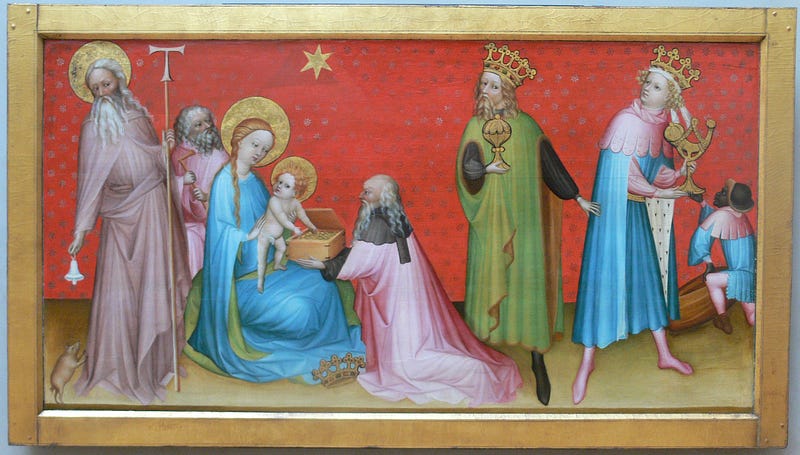
Let’s not forget that there’s something puzzling about the story of the Magi coming to see Jesus. According to Matthew, the Magi followed a star to a specific house.
[T]hey (the Magi) went on their way, and the star they had seen when it rose went ahead of them until it stopped over the place where the child (Jesus) was. (Matthew 2:9)

Now, I’m no astrology expert, but common sense suggests that you can’t pinpoint which house a star stops over. Unless that star is extremely low in the sky, like 50 feet above the ground, it’s impossible to determine. Just try looking up at the night sky and selecting a random star. You could even pick the moon, the closest celestial body to Earth, and try to figure out which house it’s hovering over at 11:30 pm on any given night — it’s a real challenge!
If you still find the idea that a star guided the Magi to Jesus’ house entirely logical and likely to be true, I’m afraid there’s not much more I can say to convince you otherwise.
More contradictions
When you read the birth stories of Jesus in the Gospels of Matthew and Luke side by side, you’ll quickly notice some inconsistencies. One of the most obvious differences is in the genealogies presented in Matthew 1 and Luke 3. In Matthew, it says that Jacob is the father of Joseph, but in Luke, it states that Joseph’s father is Heli. And not only that, all the names in the genealogies, going all the way back to King David, are completely different.
Some Christians have suggested that one of these genealogies traces Mary’s lineage, while the other traces Joseph’s lineage. However, it’s essential to point out that this is just a guess without any concrete evidence from the text itself. If you read both genealogies, you won’t find any clear indication of which one is supposed to be Mary’s and which one is supposed to be Joseph’s.
We’re not dealing with minor discrepancies among hundreds of records within the same family tree. Instead, we have just two genealogies, and they differ in significant ways. What’s even more challenging is that there’s no way to confirm the accuracy of either of these genealogies using independent sources. Both versions were penned by anonymous writers who were not part of Jesus’ family.
Given these uncertainties, it raises a valid question: How can we be certain that Jesus truly descended from King David?
Here’s another instance of contradiction in the sequence of events immediately following Jesus’ birth. In Matthew’s version, Jesus’ birth is shadowed by King Herod’s sinister plot to kill the child. After the Magi visit, an angel appears to Joseph and instructs him to take his family and escape to Egypt. They remain there until Herod’s death, only returning to Palestine afterward and settling in Nazareth.
However, when we turn to Luke’s account, King Herod is nowhere to be found in the story. After Jesus is born in Bethlehem, a group of shepherds comes to visit the family. Then, on the eighth day, Jesus’ parents take him to the temple in Jerusalem for customary rituals. After that, they return to Nazareth. These two accounts present quite different sequences of events.
Conclusion
Many Christians have gone to great lengths, engaging in various mental gymnastics, attempting to reconcile the differences between the birth accounts of Jesus and to validate how Old Testament passages are interpreted in them.
I’m not saying it’s impossible to find ways to make these accounts align, especially when one is determined to do so. However, let’s be honest with ourselves. I’ve presented compelling reasons to believe that these accounts were fabricated and cannot be relied upon as historically accurate. Even if some of these reasons can be somehow explained away, the fact remains that we have no means to verify the reliability or historical accuracy of these accounts. We are left taking their word for it.
If the Holy Spirit played a role in the composition of these accounts, it might have intended for readers to question their reliability rather than accept them unquestioningly.
It’s possible that the real God didn’t intend for people to view Matthew and Luke as products of His direct revelation. If that were the case, one might think that God could have conveyed His message more clearly. Claiming that God inspired the Gospel authors could almost be seen as insulting God’s intelligence.