
The Queerest Catholic Saint?
Francis of Assisi deconstructed manhood—and changed the world
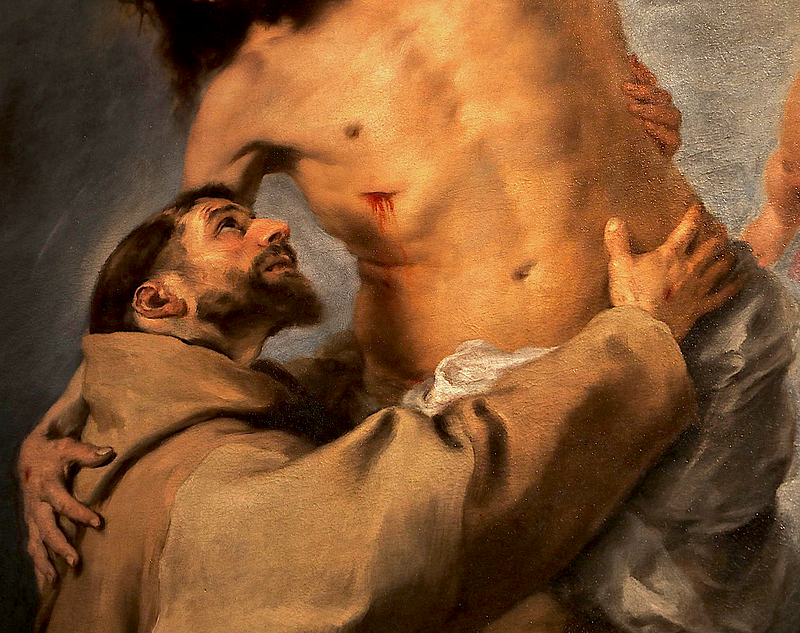
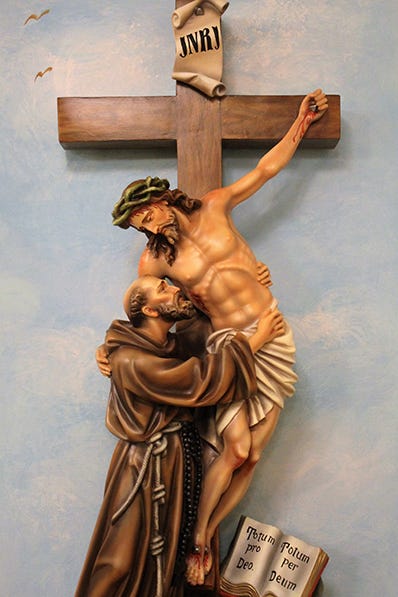
All over the world, he’s that sweetly serene guy who’s out with the birds and wolves, or holding Jesus in an oddly intimate embrace.
I’m reading up on Francis of Assisi, who must be the queerest Catholic saint?— despite all the competition. A Medieval figure, he’s oddly contemporary. He was a male who wasn’t exactly a ‘man’.
Born around 1182, he was the son of a cloth merchant in the small town of Assisi, Italy.
There are no portraits of him. He was said to be small-statured, with black hair, not ‘handsome’. He was theatrical, highly attuned to the use of clothes and music. His was his mother’s favorite son, and didn’t want to be like his father, said to be violent and domineering—otherwise known as a ‘man’.
A few weeks before he died, Francis dictated an account of his life. The ‘Testament of Saint Francis’, as it’s called, begins his life with the scene of his noticing the lepers. As he writes:
“And the Lord himself led me among them, and I pitied and helped them. And when I left them I discovered that what had seemed bitter to me was changed into sweetness in my soul and body.”
This wasn’t just an effort to help sick people.
Francis leaves the suggestion that the lepers revealed him to himself. A 2012 biography by Andre Veuchez explains that he’d seemed to view himself as having an “analogous condition,” as if the lepers “acted on Francis like a mirror of his own condition of sin.”
As not noted in Catholic sources, leprosy was seen as an STD. As Jonathan Hsy notes, Medieval people connected it to “sexual sins including lechery, adultery, and sodomy.”
And the saint went out to minister to them.
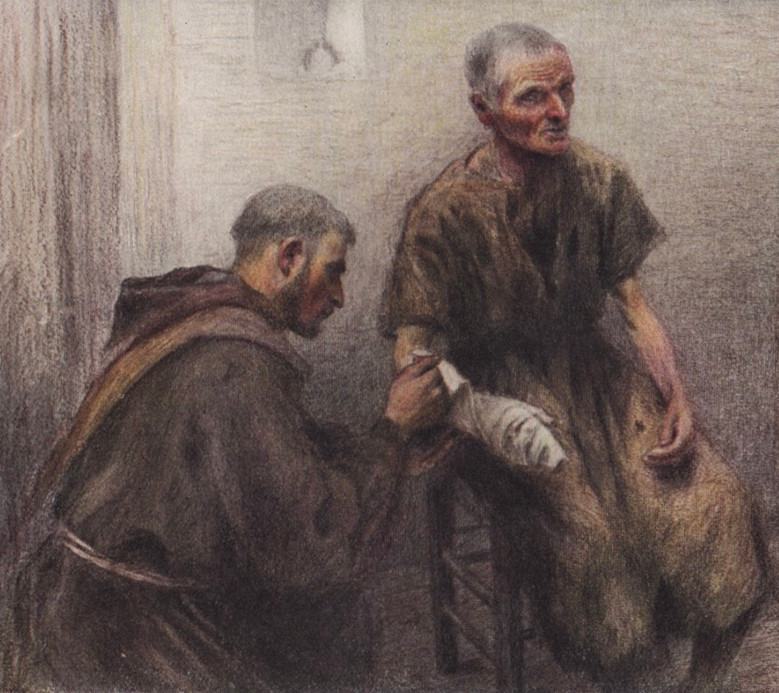
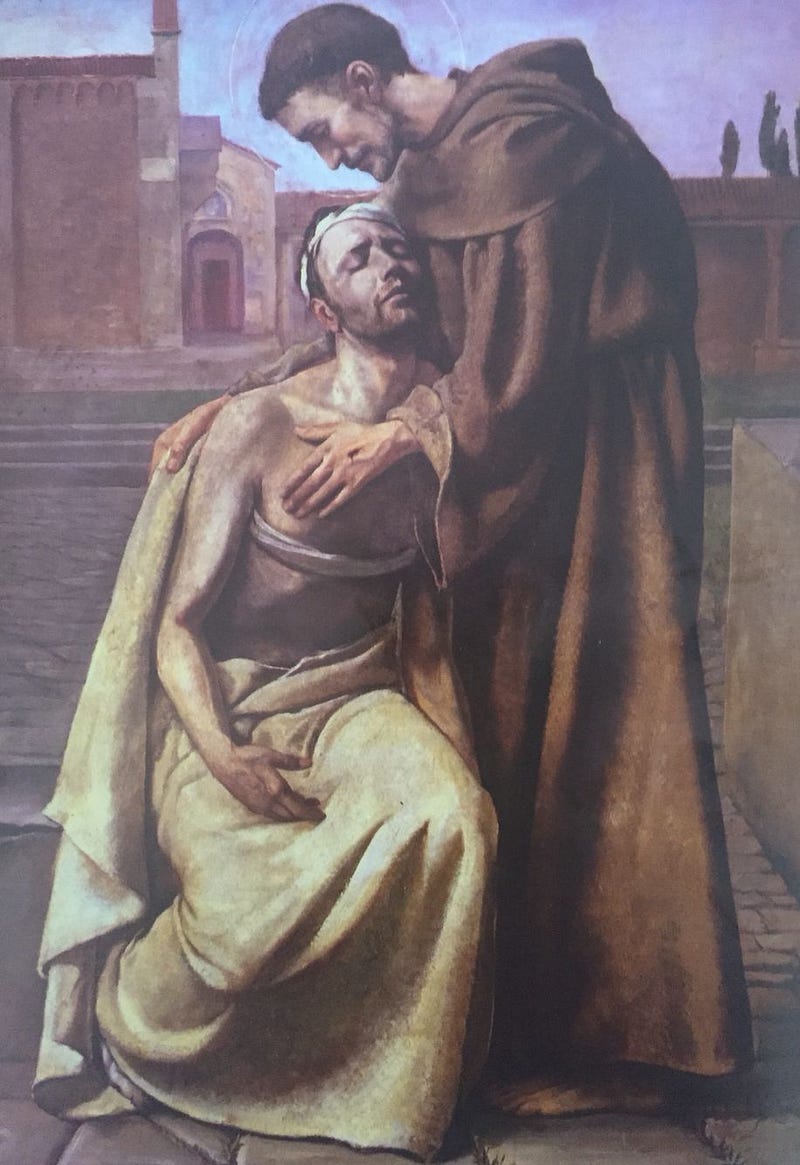
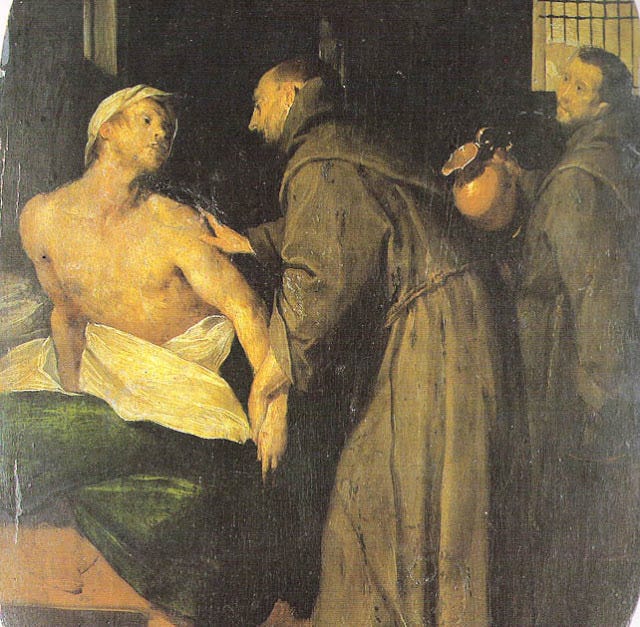
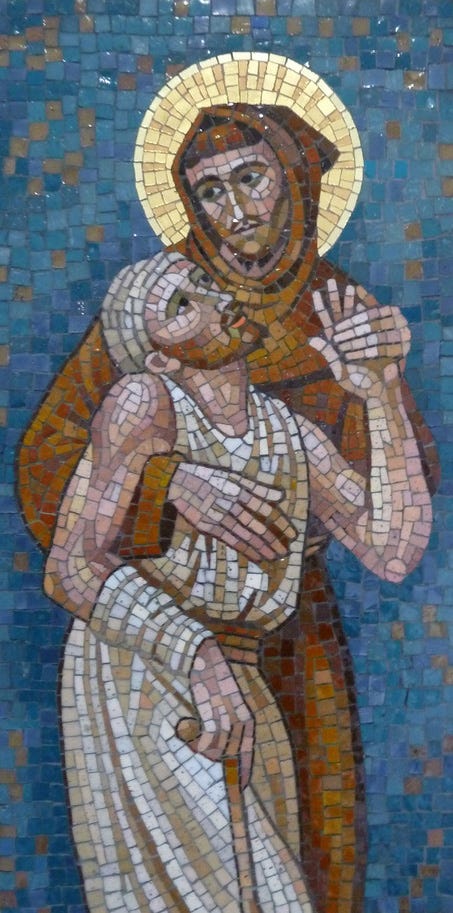
In the next story, Francis sells cloth he got from his father to give to the church.
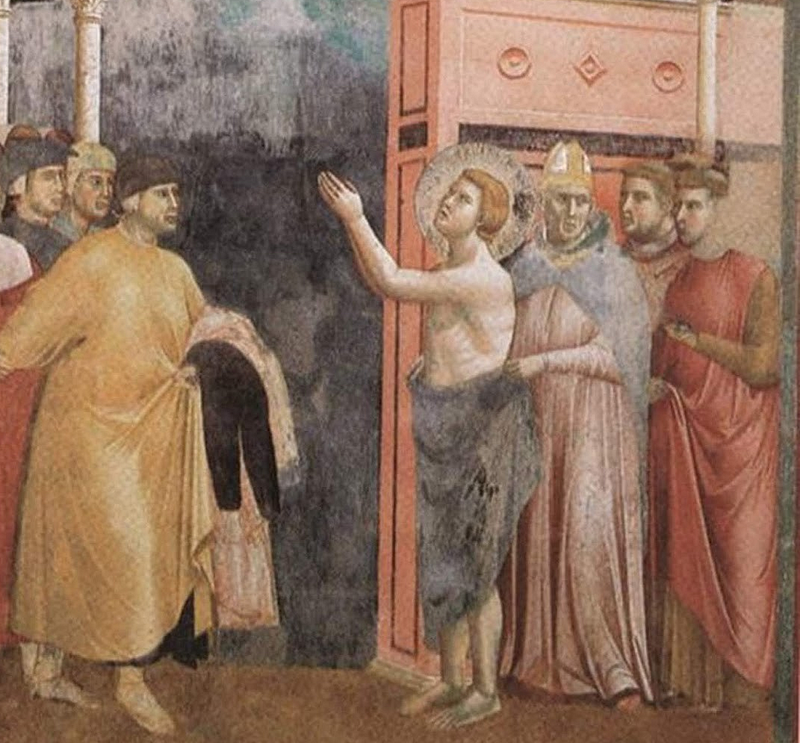
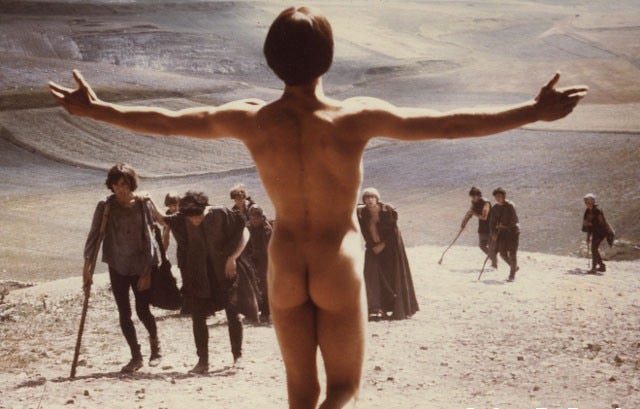
Horrified, his father disowns him. In a dramatic scene, Francis then strips naked—returning to his father even the clothes on his own back.
The moment is represented in a cycle of paintings (c.1300) attributed to Giotto di Bondone, where Francis is discreetly covered. In a 1972 movie about Francis, Brother Sun Sister Moon, directed by Franco Zeffirelli, it’s an almost rapturous nudism.
Francis kept on stripping naked.
As Veuchez writes, there were “numerous episodes” of Francis giving his clothes to a beggar, and then “sometimes he stripped himself publicly to represent the nakedness of Christ on the cross and shocked his audiences so as to lead them, in their own way, to ‘follow the naked Christ’…”
That is to say, nakedness and even nudism were spiritual practices, and Francis found them in early Christianity that later Christianity was forgetting. Early Christian baptism was done naked, as Jesus was a famously naked figure—on the cross and often in the gospels.
But the nakedness of Christ had been seen as Edenic, paradisiacal—the recovery of the original state of humanity.
Francis of Assisi revived this lost language of nakedness as a spiritual practice as he stood before the world, once again, as ‘naked and unashamed’.
In one story, he was asked who he would to marry
He replied that she would be a “bride far surpassing others in beauty and wisdom.” This become his great inspiration, ‘Lady Poverty’.
If these are standard moments in a Catholic hagiography, we might have notice as well that it was an evasive move characteristic of homosexuals, when asked, as so often, when they were going to ‘get married’.
Francis embarked on a new spiritual practice. His ‘poverty’ was an effort to discover himself in a radical new way. Humans tend to be identified with the things they own. As Prakash Kona writes in a study of Francis:
“There is no other way of knowing who you are or for you to discover your spiritual self except through rejecting a life built around objects. The poverty of Francis is about performing such a love.”
He founded a community of monks.
A circle of men — tradition says twelve at first — became the basis of a new order, the ‘Franciscans’. As Francis narrates in his ‘Testament’:
“And after the Lord had given me brothers, no one showed me what I had to do, but the Most High Himself revealed himself to me that I was to live according to the form of the Holy Gospel.”
They would embrace poverty and wear minimal attire—a single tunic.
A genderless effect began to occur among the monks. Francis was called ‘mother’ — as were all monks who cared for others.
Catherine M. Mooney documents the references in a 2006 paper, “Francis of Assisi as Mother, Father, and Androgynous Figure.” For Francis, as she notes, all humans are to be “brothers and sisters,” as a mother is one who carries Jesus within, and “gives birth” through divine service.
Francis instructs: “And let each one love and nourish his brother, just as a mother loves and nourishes her child…”
The mother was for him the authentic Christian image. Mooney writes: “Mothers, according to Francis, are not, like fathers, hierarchically positioned above the brothers. They are not authority figures at all.”
The Catholics in Rome made him take out the language suggesting the monks weren’t ‘men’.
For the ‘church’, that was required. The religion was seen as a rule by God through men. But for Francis, a radical deconstruction of maleness seems to have been occurring.
As Prakash Kona writes, “Francis shows that manhood is a construction more than anything else.” In not being a ‘man’, he adds, Francis “renounces his masculine, sexual self.”
Francis was submissive to Catholic authority. But it’s not clear he was ever really in agreement. He seemed very averse to the idea of fatherhood, which characterized clerics.
Mooney notes: “He never refers to himself or any of the friars as ‘fathers’.”
It’s not clear that Francis viewed ‘God’ as male.
In a 1979 biography, Ignacio Larrañaga writes the word ‘father’ for the deity isn’t embraced in Francis’ writings:
“This word meant little to him, and subconsciously evoked the figure of an egotistical, domineering man who lingers in the darkest memories of life. Francis could very well have addressed God using the word ‘Mother,’ but the sound of it was startling. Such a word would have been in complete harmony with every fiber of his personal history.”
Francis followed a female spiritual path, a feminine Christianity. This became a key to his work with the church.
“Francis renewed the church,” Catherine M. Mooney explains, “by introducing into it feminine qualities, transforming an eminently male institution into a more androgynous institution.”
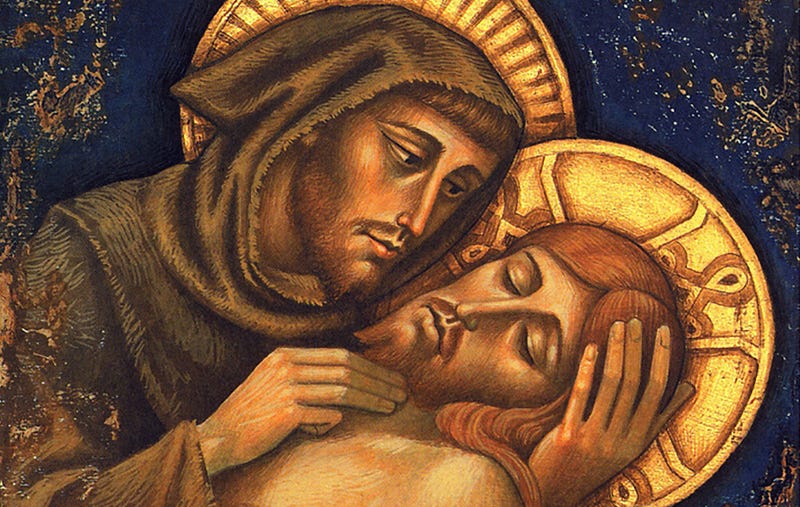
He started to rewrite Christianity.
Francis wasn’t religiously educated in any way. He just began to speak.
Stella Grace Lyons notes:
“He brought the stories of the Bible to the Italian masses in a radical and original manner — through preaching, drama, acting and storytelling. He communicated biblical events in a way that was, for the first time, accessible. His Christ and Mary weren’t presented as divine deities. They weren’t otherworldly and unreachable. Instead they were presented as real people.”
Francis preached even to animals. All Creation seemed, suddenly, to be included in divine speech, and so to be speaking to itself.
Gender is unstable at every step of the way.
Francis is just a very, very queer figure. Every moment of his being is infused with unexpected sexual suggestion.
In the famous scene of “receiving the stigmata,” the wounds of Christ manifest in Francis’ own body. But to the Catholic mind of the time, this was a maternal experience.
As Christina Cedil explains in a 2015 study:
“Stigmata signify maternity by reproducing the wounds through which Christ is said to have lactated and birthed the church. As the first recorded stigmatic, Francis professed that his side bled frequently; he also claimed to have seen himself breastfed by Christ.”
Francis had a sort of female alter-ego, Clare of Assisi, a local girl who was fascinated by him, and they kept up an association. She famously had a vision of being breastfed by Francis—as he was breastfed by Jesus.
Through her association with him, Clare went on, as Jacques Dalarun notes in a 2005 study, to “accomplish an incredible feat: For the first time a woman draws up the rule under which her sisters would live.”
There would be ongoing gay suggestion.
Francis superfans tend to be gay—like Franco Zeffirelli, who notes in his memoir that the bio-pic he made was widely disliked, though Tennessee Williams was “loud in defense of the picture, writing in the newspapers that he was ashamed people could not appreciate beauty and innocence…”
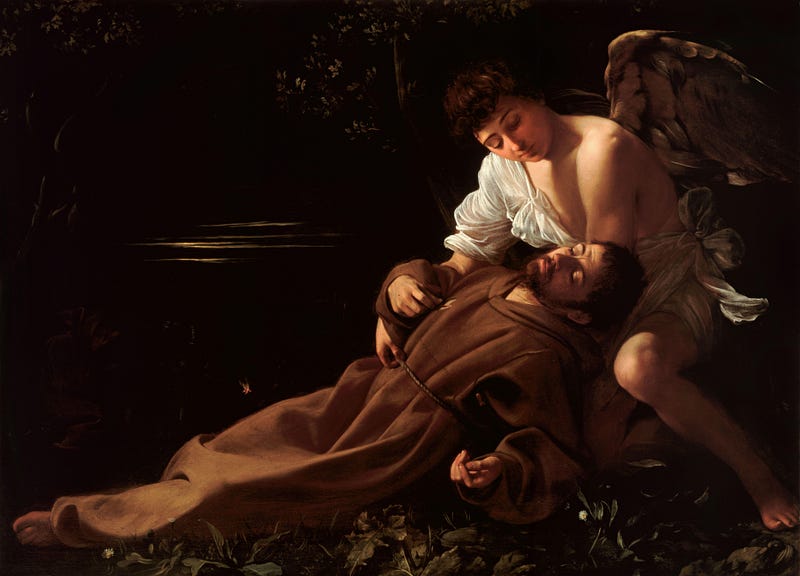
We might see gay fandom all the way back in Caravaggio’s 1595 painting, Saint Francis of Assisi in Ecstasy. The vision of the stigmata has been revised into a scene which, as John Champagne writes, “provokes a homoerotic reading.”
It’s a striking tenderness between males—and a new, intimate spirituality. A ‘religion’ of being held by God.
Francis remains an icon to anyone who is ‘different’.
Donald L. Boisvert in Sanctity and Male Desire: A Gay Reading of Saints, writes an evocation:
“Francis, the ultimate outsider, the one who, like so many of us, rejected family because they could not understand, and he did not want to be weighed down with their bankrupt values.”
He’s an icon of stripping—a stripper saint. All that burdens, all that is earthly, is removed, leaving him naked before his Creator.
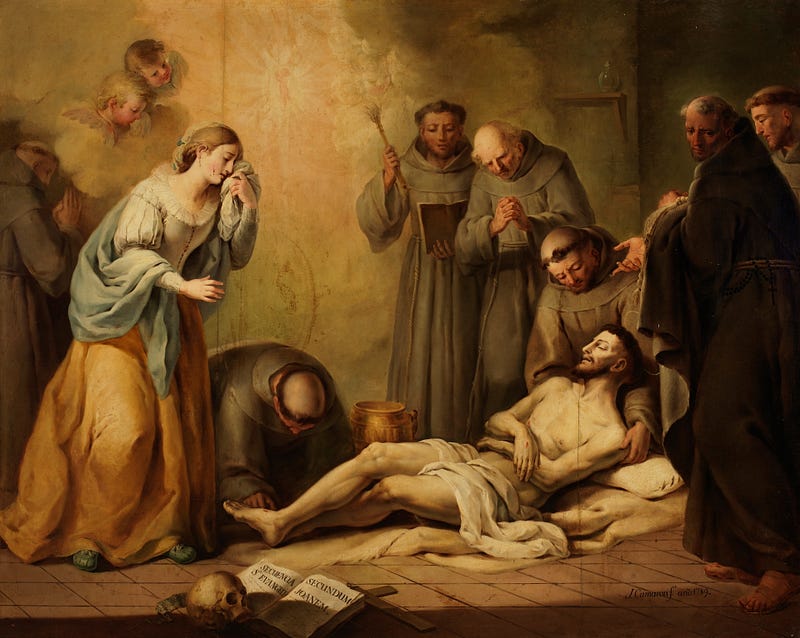
Just before he died, Francis asked to be stripped and laid naked on the earth. Paintings of the scene tend not to show that detail, but José Camarón, in The Death of Saint Francis in 1789, comes closest.
He didn’t preach from a cathedral, but from Creation.
He talked to all people, to the animals, and to God.
He hadn’t married a woman, but rather, life itself.
He had no children—but birthed a new future for humanity. 🔶


