The queer Evangelical hero?
Jim Elliot has been the religion’s icon of sexual ‘purity’. His reality is oddly unclear.
To grow up Evangelical in America, you knew about Jim Elliot. He was one of five missionaries who became a martyr in Ecuador in 1956.
Nobody was closer to God than Jim, except maybe his widow, Elisabeth Elliot, who wrote “classic” books about him like Through Gates of Splendor in 1956, and in 1958, Shadow of the Almighty.
He was the man who was truly ‘on fire’ for God.

For an Evangelical child, Jim was everywhere.
There were kids’s books and videos. Comic books. YA biographies. Was he married? Maybe, but with Jim, there’s no girls around. He was a teen idol, a boy band, a pin up.
He was smiling, alone, and always so happy to see you.

He was there to guide you into proper dating.
For that Jim, you had Passion & Purity, the book that Elisabeth Elliot wrote in 1984 that remembered their love affair. They were so in love! — always making sure to not have premarital sex.
Jim had all the right views on everything — like homosexuality. There he was in his journal being oddly emphatic in the days leading to his marriage.
“When God saw that it was not good for man to be alone, He saw something that is terribly obvious, and He did not meet the need by making a second man!”
Generations of Evangelical kids struggled to be as good as Jim. That book was re-written into Joshua Harris’ 1997 book I Kissed Dating Goodbye. Jim’s personality, always so in control of himself, became the “Purity Culture.”
Elisabeth Elliot died in 2015, and a book of letters she’d exchanged with Jim was published in 2019. I read it, puzzled. Page by page, these seemed to be two very unusual people thrown together by circumstance. It often wasn’t even clear they liked each other.
Jim seemed to be in overwhelming conflict, especially with sex. It wasn’t clear either of them really liked each other. They needed each other to function socially, seemed to be the idea. I wrote a post, “The ‘Purity’ Hoax,” which suggested both the Elliots had “unclear psychosexual profiles.”
Jim had never been too interested in women.
That much would seem clear, and I was struck by the fact that if he was a ‘secular’ figure — a poet or a novelist — it would be easy to regard him as ‘queer’. He just didn’t seem too into women, at least.
In Shadow of the Almighty, a friend is quoted:
“Jim was extremely wary of women, fearing that they only intended to lure a man from his goals. ‘Domesticated males aren’t much use for adventure,’ he warned me.”
Teenage Jim refuses to go to a high school dance, citing religious objections. It might have been more complicated? Going to Wheaton College in 1941, he became known as a “woman hater” — a category that now seems ‘queer-coded’.
But then he had a girlfriend in college. Though that was a strange story. The plot of Passion and Purity is that he knew ‘Betty’ for a few years. A few days before she was to graduate and leave for parts unknown, he told her he loved her — and offered that they could sometimes write letters.
As reported in Shadow of the Almighty, he’d written his family that he was seeing a girl, as he put it, “not on account of a fine-featured face, a shapely form, nor even on account of rare conversational powers. Of the former two she possesses little of appeal.”
His journal, on reflection, is full of ambivalence about Betty.
“I cannot tell whether or not I love her,” he writes on June 25, 1949.
He often refers, vaguely, to something amiss in his inner self.
“Much oppressed with vile thoughts these past few days,” he writes on December 4, 1949. It might not have seemed much like a ‘Christian hero’ — except I wasn’t sure anyone ever really read his journals, or knew much about Jim Elliot.
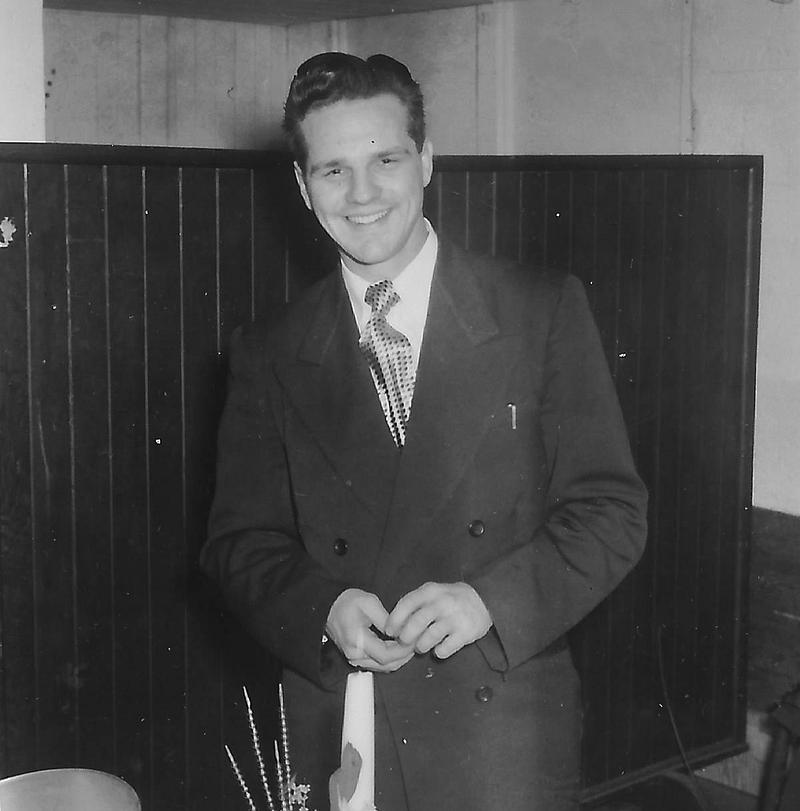
I turned back to when we meet him.
There’s Jim in the first pages of Through Gates of Splendor, the young missionary sailing to Ecuador.
“He was a young man of twenty-five, tall and broad-chested, with thick brown hair and blue-gray eyes. He was bound for Ecuador — the answer to years of prayer for God’s guidance concerning his lifework.”
In 2019, a chunk of the Elliots’ correspondence was published in the book Devotedly: The Personal Letters and Love Story of Jim and Elisabeth Elliot.
It all read strangely. A letter is included that ‘Betty’ wrote Jim when he was sailing on the ship. She suggests he’s gotten fat, and wonders why he’s using the cologne the ship provides. “The very idea is revolting to me,” she writes. “It goes along with suede shoes and greased pompadours. Let me know when you start polishing your nails.”
In 2020, an official biography, Becoming Elisabeth Elliot by Ellen Vaughn, including surprising details. Betty had all but hunted Jim. Even in view of his reluctance, she was determined to marry him. She sailed to Ecuador without any commitment, just to be a fellow missionary. She seemed lost in an erotic dream. “When I think of his manliness, his strength, his kindness, tenderness, and oh-so-undeserved love . . . I am prostrate with gratitude to God.”
She writes her mother:
“Sometimes I feel that I cannot stand it any longer, that I literally cannot live without him. . . . I cry at the drop of a hat. . . . When I am in bed, I want him desperately. It is as though every inch of my body just aches for his.”
But Jim was perpetually unsure.
At times a marriage seemed all but assured — then he’d recoil, rethink. He’d spend hours reading the Bible, trying to understand what to do.
A letter from Pete is quoted: “Jim said late last night he and Betty spent more time crying than talking and it was really a heart-rending time.”
Then, suddenly, he seemed to warm up to her. His entry of May 7, 1952:
“All I know is that it doesn’t matter if her breasts are small, or her shoulders are slight, or her nose not finely shaped, or her front teeth set apart. I wouldn’t like her any more if they were all ‘ideal,’ partly, I think, because she would not be what she is psychologically if she were anything but what she is physically. ”
He seemed drawn to female anatomy?
Or he was sure he would be—when he married. Until then, he seems in his journal to view the female body with nearly scientific interest. He writes the following September 28th:
“The female breast has been so long and so intensely interesting to me that I cannot now explain my ‘calloused’ thoughts about it as I could not formerly explain my fascination. Twice this past week I have, in medical work, fingered the breasts of young Indians. I confess, with a great deal of surprise, that it does not now raise the slightest suggestion of lust for me. It is not that I have sort of depreciated the breast for having seen it suckled and noted it in all its shapes (U.S. women are brassiered into disgusting uniformity), or that I will not be aroused by her breast when the time comes for it.”
In his journal Jim could seem sure of the marriage, but Vaughn’s biography showed him vacillating more often. Fellow missionary Pete Fleming wrote in a letter: “Jim said late last night he and Betty spent more time crying than talking and it was really a heart-rending time.”
Vaughn’s narrative shows Jim, in some kind of panic, trying to find information from the Bible. I read along, wondering:
“I cried too,’ wrote the sometimes obtuse Jim, who had spent hours feverishly studying the apostle Paul’s writings in the original Greek, trying to discern if he was being disobedient or obedient in his interactions with Betty. He wrote of ‘wanting to be fair to her, wanting to marry her, wanting, wanting’ . . . but he felt ‘no guiding from God, not even for engagement.’”
What issue in the Bible, one wonders, could he have been studying?
Vaughn notes that the Elliot marriage, so long put off, had happened only because a job came available for a married couple, and they needed the money. “How soon can you marry me?” Jim asked her.
And so they married. Was it love? Betty, of course, was a gifted linguist, and Jim was in Ecuador with a specific purpose: contacting a remote tribe in the rainforest.
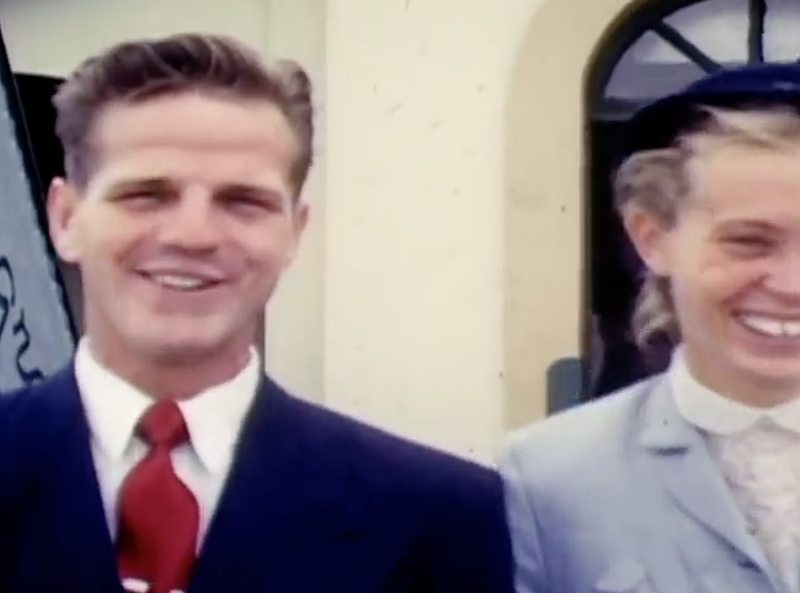
I sat thinking about strange passages in his journal.
After they married, for example, Jim seemed to go into some sex-fueled spiral. He writes in his journal:
“I don’t understand what there is about loving her that makes me such a damned woman. I can hardly begin to describe it; I only know that I feel it strong and that I can’t talk of it without twists coming to my mouth. Lips get try and tears seem to brim at my eyes, and there is a crushing sense in my chest. At the bottom of it is a tremendous weight of sheer unworthiness. I don’t feel fit to be in her company . . .”
Then the photos. Jim was often photographed in states of undress—shirtless many times. He stands, looking at someone with the camera.
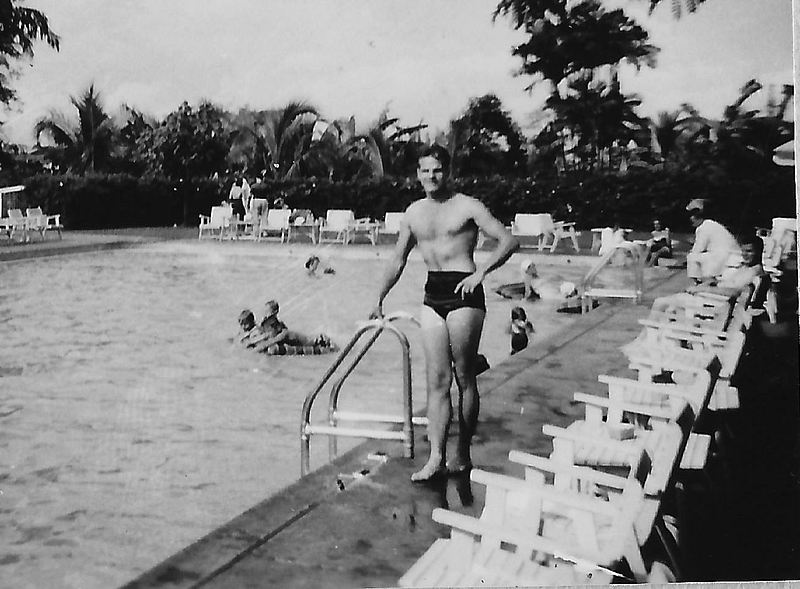

Someone was photographing Jim.
The way he’s photographed has an intimacy that suggests the photographer was his wife.
In January 31 2023, Elisabeth Elliot’s organization posted to social media a previously unseen photo of Jim in a bedroom, saying it was “taken by Elisabeth after their wedding in 1953.”
Betty learned to operate a camera after he died.

In a photo file in the Elliot archive there were two shots of Jim in Ecuador I had never seen — and a Jim I had never seen.
But I take them to be the same photographer as the hotel shot.


There was more to the journal.
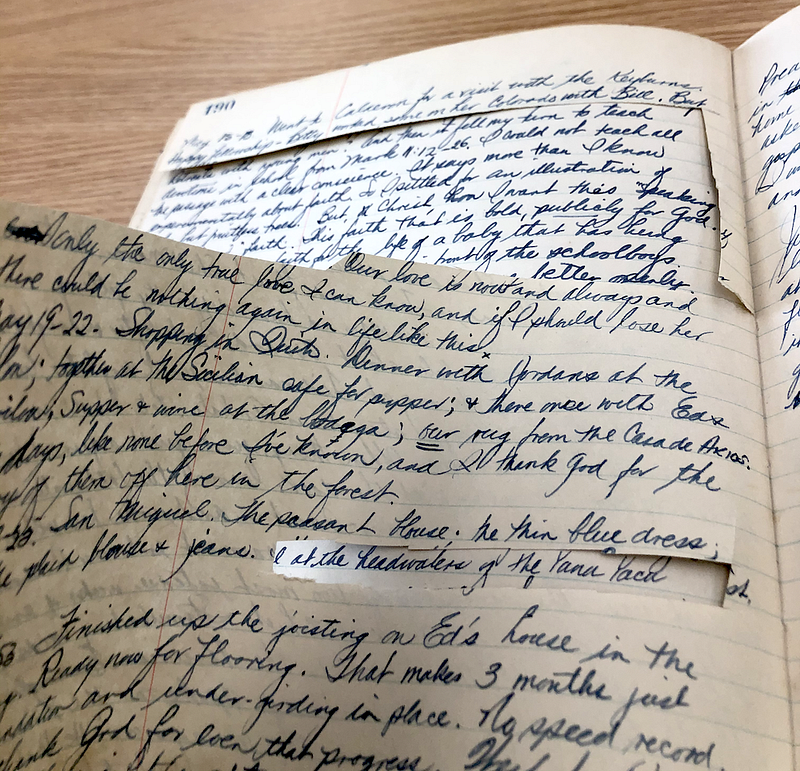
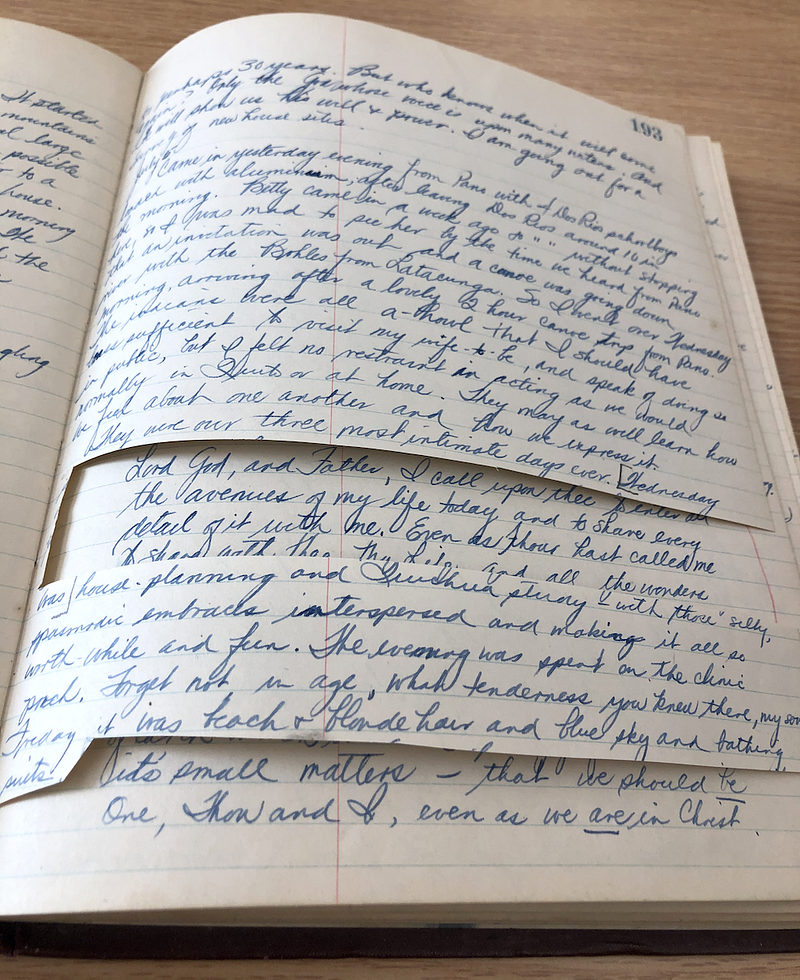
The last entry of Jim’s journal, of December 31, 1955, had been withheld for years. Never referenced in Elisabeth Elliot’s writings, it was included in the 1978 published book, but in a censored version.
I sat looking over the full text, trying to feel Jim’s pulse as he writes on the edge of his journey into the jungle to meet the fabled Auca.
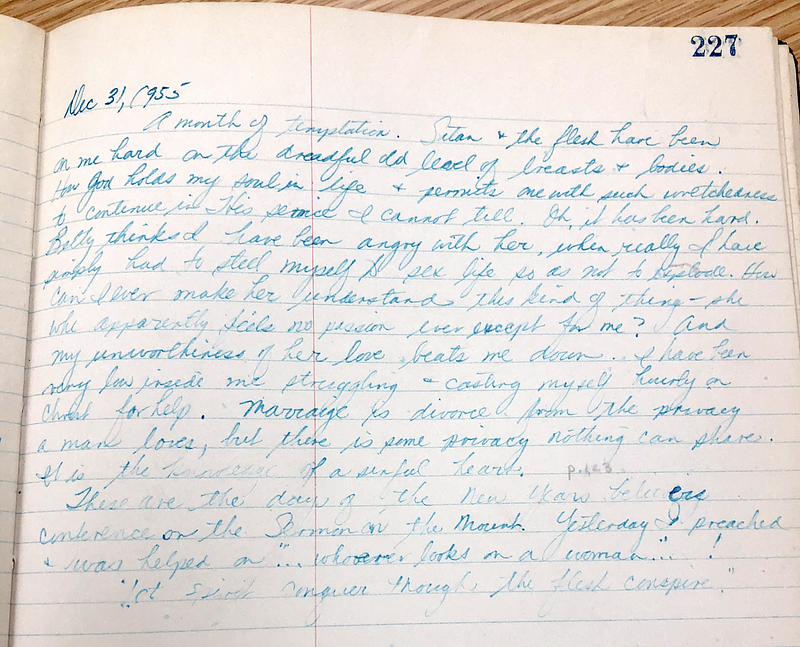
I’ll boldface what was removed from the published copy:
“A month of temptation. Satan & the flesh have been on me hard on the dreadful old level of breasts & bodies. How God holds my soul in life and permits one with such wretchedness to continue in His service I cannot tell. Oh, it has been hard. Betty thinks I have been angry with her, when really I have simply had to steel myself to sex life so as not to explode. How can I ever make her understand this kind of thing — she apparently feels no passion ever except for me? And my unworthiness of her love beats me down. I have been very low inside me struggling & casting myself hourly on Christ for help. Marriage is divorce from the privacy a man loves, but there is some privacy nothing can share. It is the knowledge of a sinful heart. These are the days of the New Year’s believers’ conference on the Sermon on the Mount. Yesterday I preached and was helped on ‘whoever looks on a woman . . .’! ‘Let spirit conquer though the flesh conspire.’”
Jim was thinking very darkly about a sexual problem as he went to his doom.
There was some kind of sex problem.
I wasn’t sure how much more we’d ever know. The Wheaton archive had some of the letters in Devotedly — but not all. And letters that were included had been re-written…with scissors.
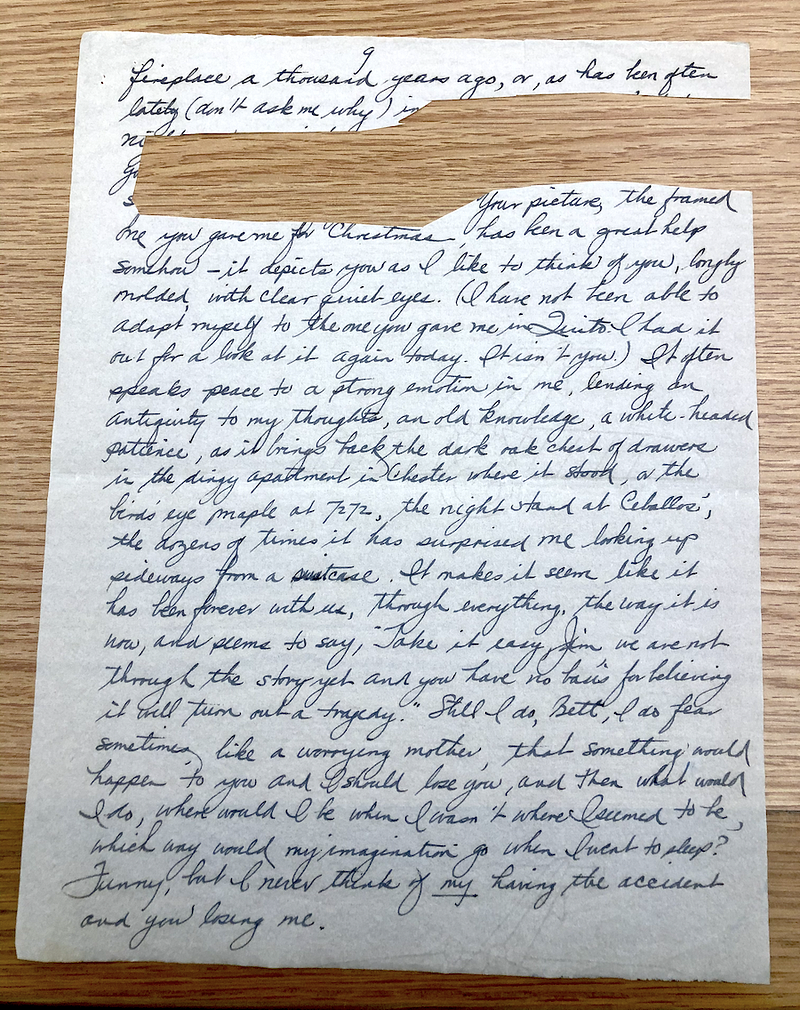
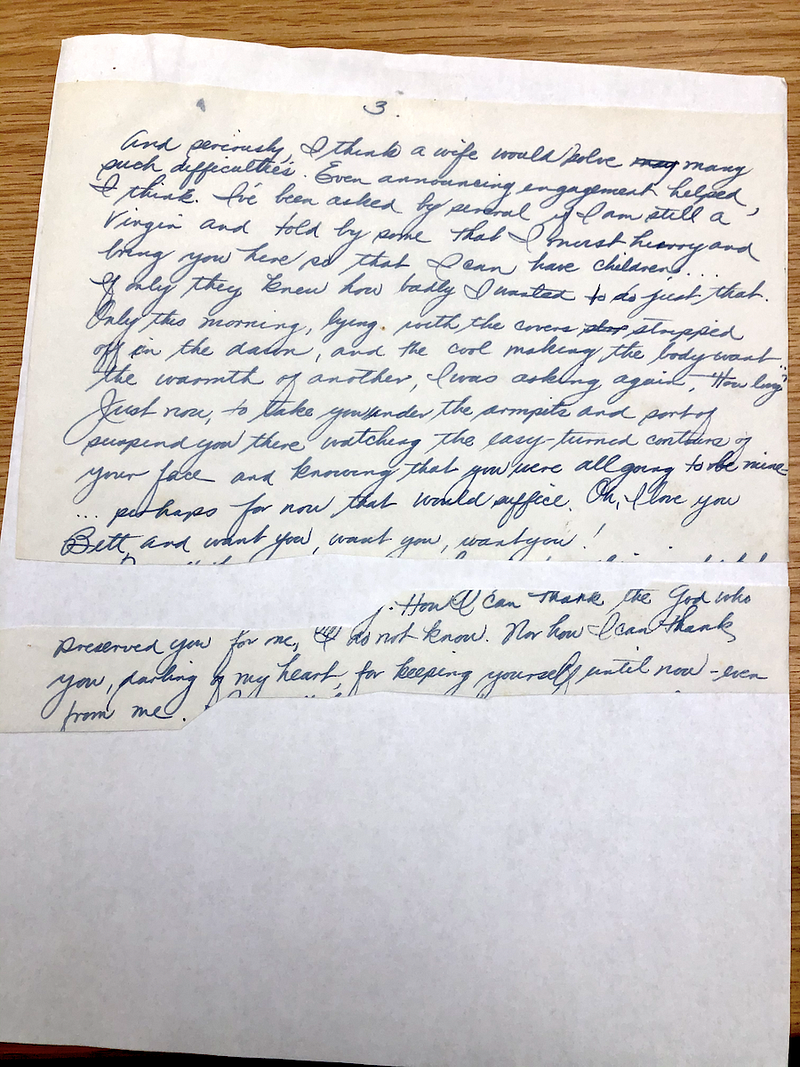
Jim’s journal, likewise, had been censored—oddly, when he seems to be talking about sex.
His poetry was a discovery.
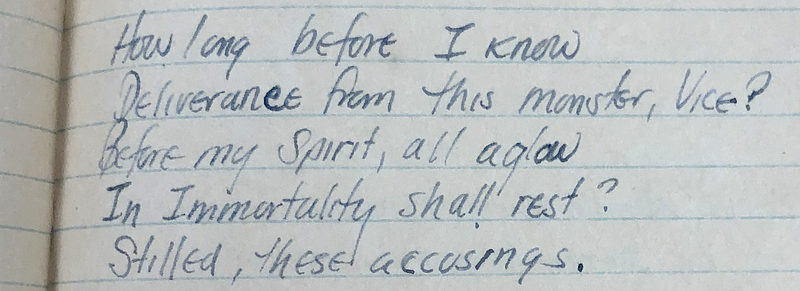
In the Wheaton archives is a volume of Jim’s poetry, which seemed often to be autobiographical, just in verse. An entry dated December 10, 1949 is a long attack on himself:
“How long before I know Deliverance from this monster, Vice? Before my Spirit, all aglow In Immortality shall rest? Stilled, these accusings.”
He never says what he’s accusing himself of.
Elisabeth Elliot liked to pitch Jim as a ‘hero’.
“Kids need heroes, here’s one,” is how she’d autograph copies of The Journals of Jim Elliot. Was it clear she actually admired him? Her later book on ideal male character, The Mark of a Man, scarcely mentions him.
It leaves one…to wonder? 🔶