
When Jim Elliot worked in a syphilis ward
An Evangelical hero in a censored scene
To grow up Evangelical Christian, you know about Jim Elliot. He’s the religious hero who was the most virtuous of all—a saint, deeply driven to obey God!
That was the story the religion told, but as went digging into Jim’s life, some details seem to have gone missing along the way. I found a scene never discussed before: when Jim worked with syphilis patients in a Maryland psychiatric hospital.
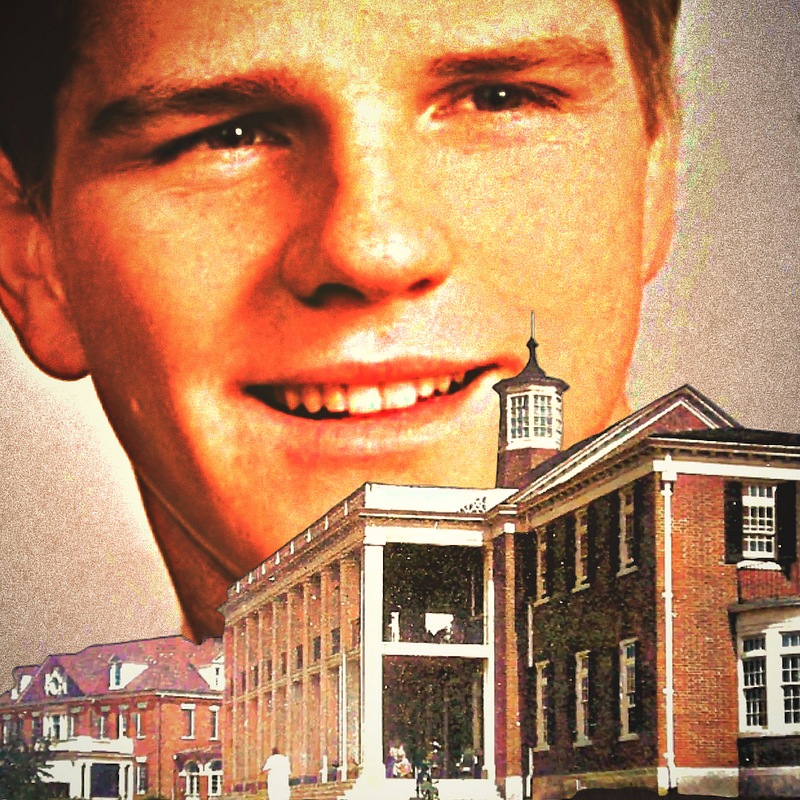
His widow was a source for all information about him.
You’d learn about him in Through Gates of Splendor, the 1957 bestseller that told how he’d died, and Shadow of the Almighty, her 1959 biography. In Passion & Purity in 1984, she told the story of their godly courtship.
There were Jim Elliot-themed children’s books, comic books, and YA biographies. There was no talk of syphilis, of course.

One independent source emerged in later years.
In 1971, a friend of Jim Elliot’s parents in Portland, Oregon was told of recordings of Jim giving speeches. Robert Lloyd Russell assembled the technology to listen to the tapes, and in 2010 released transcripts in the book Jim Elliot: A Christian Martyr Speaks to You.
In 2020, he re-released it as Jim Elliot: Recorded Messages.
There was no notice of either book in the Evangelical world—including from Elisabeth Elliot’s organization.
When I was searching for Jim information, I noticed the book, and a passage leaped out. In a 1950 speech titled “The Effects of Sin,” Jim spoke to junior high school students about STDs. As he begins:
“I don’t know if you’ve ever had the opportunity to notice what venereal disease can do to a human being. I worked for a while in a mental hospital in the East, and there we used to give men malaria to raise their temperatures way up high in order to kill the syphilis germs and some other ones. I’m telling you, I’ve never seen anything so terrible as a man who has been eaten away with syphilis. Nothing so agonizing. Nothing so wild! Nothing so horrid and demonic that I know of, than to see a man whose body is affected with sin. Sin is a cancer!”
The Elliot literature had no suggestion Jim worked in a mental institution.
I thought about the plausibility of the story.
A treatment for neurosyphilis was done in hospitals into the early 1950s. Patients were infected with malaria, as the resulting fever was curative in a majority of cases.
I had no other details until getting to the Elliot archives at Wheaton College. I’d been eager for evidence, in particular, about Jim’s sexuality, as the published record suggested he may not have been heterosexual.
The archive was often disappointing. There was no manuscript or research files for Shadow of the Almighty. Jim’s journal had passages physically cut out. Letters I’d hoped to see weren’t there.
Note: Elisabeth Elliot did keep a lot of her fan mail.
But there was one interesting note.
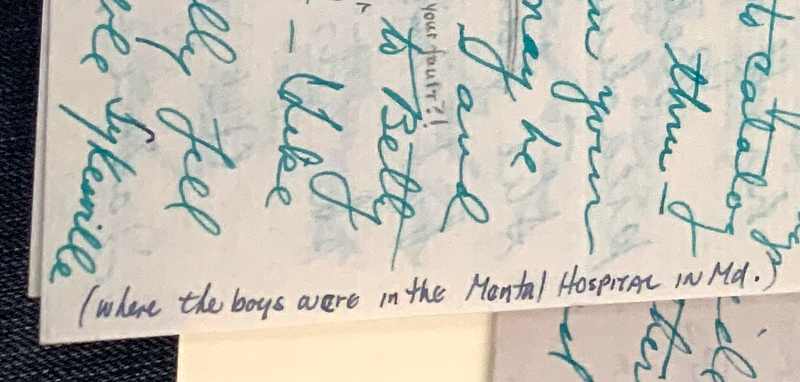
In a letter from Jim’s mother, dated September 30, 1948, Clara Elliot had mentioned his brother’s Bert’s work in Sykesville, a town in Maryland.
Elisabeth Elliot annotated the letter. Next to ‘Sykesville’, she wrote: “where the boys were in the Mental Hospital in Md.”
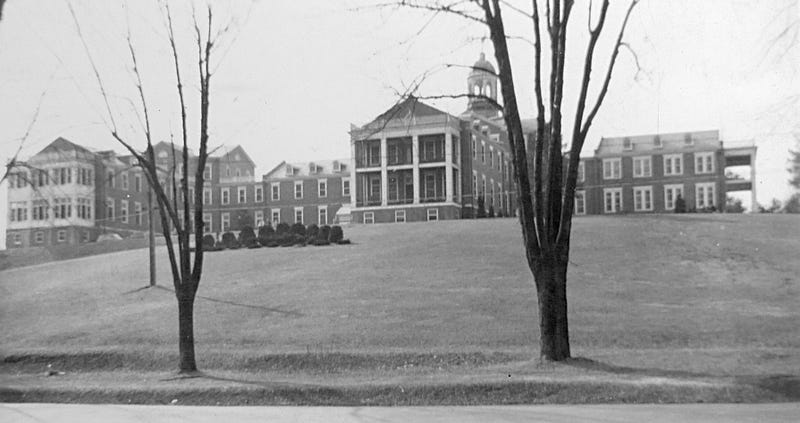
This would seem to be the Springfield Hospital Center.
It was a well-known institution in Sykesville, a state mental hospital that treated a range of maladies, including syphilis.
Syphilis was a standard treatment at a mental hospital as a large number of psychiatric cases had been found to be neurosyphilis.
With this information, I saw that Jim refers to this period in his journal.
On February 15, 1955, when Elisabeth Elliot or ‘Betty’ was feared to have Tuberculosis, Jim adds:
“I remember how horrible was the emaciated form of the woman whom I saw autopsied at Sykesville, how utterly unlovable her form. She died of T.B.”
So it appears Jim worked as an attendant or orderly at a hospital in Maryland. His wife knew of it — and erased the scene from his life.
The experience had clearly left a range of horror images on Jim’s mind. The young Christian man was seeing “sin.”
More might be said about Springfield Hospital.
In 1949, it was the subject of a notorious exposé by the Baltimore Sun, titled “Maryland’s Shame”—a tragic portrait of a hospital run on a shoestring budget, staffed mostly by non-medical attendants.
News coverage would continue for years. In 1958, an assessment went: “The conditions under which these wretched, deranged human beings are obligated to live are shocking beyond belief.”
Jim would’ve seen every kind of illness, physical and mental. But he’d focused on syphilis, and mentioned it, I had to notice, in a specific context.
After mentioning the syphilis victims in the 1050 speech, he continues:
“The Lord said some terribly sobering things in the first chapter of Romans. In that chapter we find that men love sin, and they persist in sin. They knew God, but they did not obey. Instead they just went ahead and did as they pleased. They gave up on trying to do as God wanted them to. And so God gives them up. And what does it say? It says God gave them up to their own lusts that they might receive in themselves the fruit of their own doing. God just said, all right, let sin take its course. It wasn’t that God pronounced any judgment on them, it wasn’t that God brought curses into their lives. He just said, all right, I’ll just leave you to sin.”
For Jim, the ruined bodies of syphilis victims were bearing God’s punishment for the “sin” of Romans 1. He is euphemistic, but the subject was clearly homosexuality.
Had he read a syphilis patient at the hospital as gay? It’s a definite possibility, as syphilis was a scourge on gay men for centuries.
When did Jim work at the mental hospital?
The letter from Clara Elliot wasn’t specific, but suggested that Jim had worked with his brother Bert at the hospital, but only briefly.
This was prior to September 30, 1948. As Jim was in college around that time, it would have to be on summer break.
In Shadow of the Almighty, his summers of 1946 and 1948 seem busy. In 1948, too, he was often writing in his journal, and makes no reference to the hospital then.
The summer of 1947 seems to be in view. As per Shadow of the Almighty, Jim had left Wheaton for a six-week trip to Mexico, but the latter half of the summer is undescribed.
It might be interesting to note what happened not long after.
As a junior returning to Wheaton College, Jim seems to have been motivated to make a big change in his life. In Shadow of the Almighty it’s reported as “one day in October…”
Jim asked Betty Howard on a date.
The archive has odd hints that Betty didn’t much like Jim. This is not the narrative of Passion & Purity, but there are repeated notes that Betty was actually not impressed or interested in him.
The origins of the famous relationship remain a bit murky. One letter was quoted in Through Gates of Splendor. Jim wrote to his parents about meeting his future wife, or as he called her, “a tall, lean girl, far from beautiful, but with a queer personality-drive that interests me.”
Jim had written to his mother about the new relationship.
That is seen only in letters months later, as the letters with such discussions are not in the archive. But we see Clara Elliot taken aback by whatever Jim told her about Betty. She frets at the possible match:
“Jim in re reading your description of Betts last spring you say she is critical and bossy — after naming several virtues — I suppose the virtues outnumber — but bossy women aren’t easy to live with.”
The story seems to be that Jim worked at a mental hospital in the latter half of the summer of 1947. Back at Wheaton College, entering his junior year, his mind was fresh with the horror of syphilis victims as he read to have implications for homosexuality
In that context, he asked the most ‘difficult’ girl on campus, a girl with no marriage prospects, on a date.
Maybe he’d been scared ‘straight’. 🔶


