
Science, Innovation, Technology, and Health
Be an Innovator, Not a Laggard
Insights into the practical use of the “Diffusion of Innovations” theory for better public health in every country
Non-members can read this inspiring story using my friend link.
Drawing insights from the success of four past diffusion initiatives that changed our lives, we can accelerate the diffusion of four emerging health practices that can enhance our healthspan and lifespan. I believe this story will inspire you to be part of this global transformation we all need to contribute.
As an innovator and inventor myself, I work closely with innovative companies. When my clients in the tech and science sectors innovate (find new solutions to sticky problems), they ask me to craft an architectural roadmap for mass production and widespread public use of their products or services. I analyze their innovations and develop a comprehensive roadmap that guides their programs and associated projects for design, implementation, and delivery.
This strategic roadmap guides my clients, enabling them to actualize their innovations, cater to public needs, and carve out a competitive niche in the market. My compensation for this service usually exceeds my expectations, but the value my clients derive from it ranges vastly — from an initial investment of a few thousand to potentially yielding billions in returns over time.
I was recently invited to share one of my roadmaps as a case study at a closed-door science and tech seminar for innovative startups. With the client’s permission, I shared this case to serve as a compelling PR opportunity for my client and a valuable information session for the seminar participants.
During the session, one executive’s curiosity challenged me regarding the complexity of developing roadmaps that span months or even years. He wondered about the model I used to create my roadmaps for clients.
When I explained the power of a theory I had learned decades ago, it sparked an ‘aha’ moment for him, highlighting the power and efficacy of strategic planning in innovation.
What did I share this personal detail, and how does it relate to the theme of my topic?
In this multidimensional story, my goal is to introduce an established theory that has impacted the industry, explain how it is used to design the initial phases of significant and promising initiatives, introduce four successful public health campaigns, and provide perspectives on four emerging health initiatives that can change our lives like the past ones.
While it may seem ambitious to some, I aim to contribute to the diffusion of promising technologies that improve public health. I firmly believe that each of us can make a meaningful contribution, creating a ripple effect toward achieving these goals and substantially enhancing our precarious public health.
First, I will provide a brief and straightforward introduction to the theory so that the subsequent sections of this story are comprehensible. I believe you will gain valuable insights to contribute to the collective journey ahead.
Meet the “Diffusion of Innovations” Theory
The Diffusion of Innovations theory, developed by sociologist Dr. Everett Rogers in 1962, is a powerful framework that explains how new ideas, technologies, products, or services spread and are adopted within a population over time. Dr Rogers wrote an illustrated book about his theory.
The theory outlines the process of diffusion through which innovations are communicated through various channels, adopted by members of a social system, and eventually reach a critical mass of adoption.
Dr Rogers identified five key elements influencing the adoption rate: the innovation itself, communication channels, time, social system characteristics, and adopter characteristics.
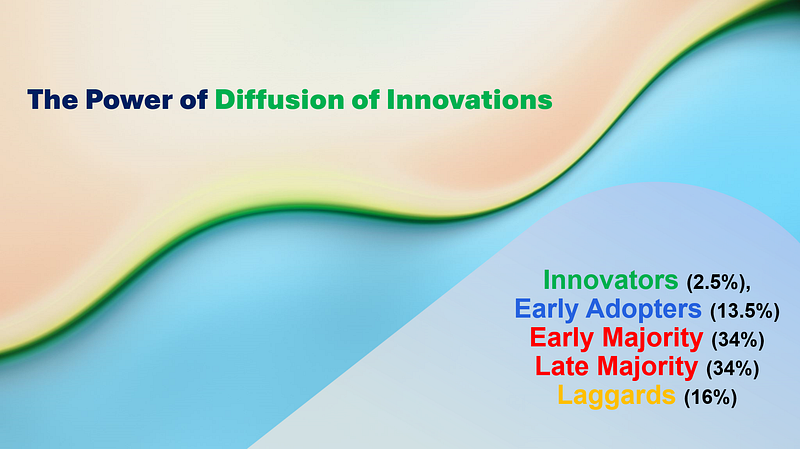
The theory categorizes adopters into five segments based on their willingness to adopt innovations. As shown in the following image, these segments include innovators (the earliest adopters), early adopters, early majority, late majority, and laggards (those who fell behind).
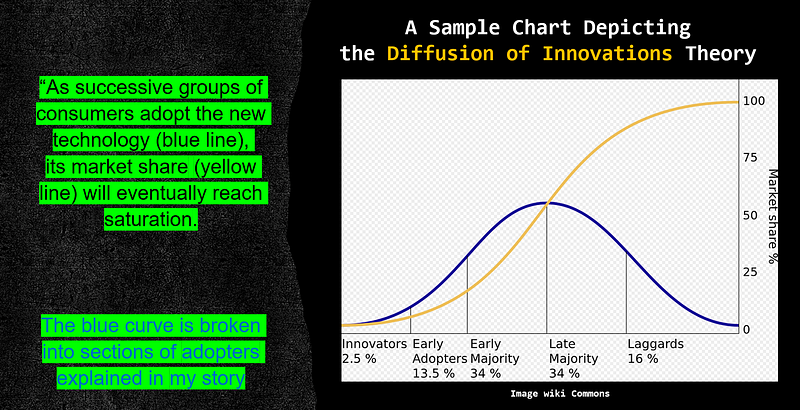

As documented in this paper, “the theory builds on a staged model of awareness, persuasion, decision, implementation, and confirmation and categorizes communities into innovators (2.5%), early adopters (13.5%), early majority (34%), late majority (34%) and laggards (16%).”
Laggards are those who are slow to adopt new ideas, technologies, products, or services compared to the rest of the population.
As the chart and text inform, the biggest contribution is made by early and late majority adopters, which should be the goal of any significant initiative that requires mass adoption.
The Diffusion of Innovations theory has been widely applied in various fields, including public health, technology adoption, social change initiatives, economic changes, and marketing, to understand and facilitate the adoption process of new ideas or practices. In this post, I only cover public health.
This 2009 paper states that the robustness of the Diffusion of Innovations derives from the many disciplines and fields of study in which diffusion has been studied, from the international richness of these studies, and from the variety of new ideas, practices, programs,, and technologies that have been the objects of diffusion research.
As documented in this 2018 paper in Health Affairs, “Aspects of the research and practice paradigm known as the diffusion of innovations apply to the complex context of health care, for both explanatory and interventionist purposes.” The paper covers principles and practice by answering the question, “What is diffusion?”
Quoting Dr Rogers, the paper informs that Diffusion is a social process that occurs among people in response to learning about an innovation, such as a new evidence-based approach for extending or improving health care. In its classical formulation, diffusion involves an innovation communicated through specific channels over time among the members of a social system.
From my experience, diffusion signifies the gradual spread of innovation across different population segments, from early adopters to later adopters, until it reaches a critical mass of adoption and becomes a societal norm.
This process might include interpersonal communication, mass media, social networks, and various other channels through which information is transmitted and new ideas are disseminated within a community or a broader population.
Dr Roger’s book chapter states, "When the World Health Organization launched a worldwide campaign to eradicate smallpox, it was engaged in diffusion. When Apple launched the iPod, it was diffusing a new product. When Bob Dylan wrote “The Times They Are A-Changin’,” he was describing diffusion.”
As documented in this 2021 paper, “Exploring the behavior change process has been of interest and importance to public health professionals in translating research into practice. The diffusion of innovations model has been extensively applied in public health to examine how innovation is passively communicated to individuals and groups.
According to academic critics, the Diffusion of Innovation Theory, while valuable, has limitations in public health contexts. It lacks a participatory approach, may not fully apply to health innovation adoption, and is more adept at promoting new behaviors than ceasing or preventing them. They believe that it overlooks individual resources and social support crucial for adopting new behaviors or innovations.
Four Succesful Public Health Initiatives
In this section, I introduce four successful examples reflecting the power of diffusion of innovation theory.
1 — Global Cigarette Smoking Cessation Initiative
The diffusion of smoking cessation programs exemplifies the spread of innovation. In the mid-20th century, awareness of smoking’s health risks grew, aided by scientific research linking it to diseases like lung cancer.
Public health campaigns like the American Cancer Society and Surgeon General reports were vital in disseminating this information and promoting cessation interventions.
As attitudes shifted, smoking cessation programs gained broader acceptance for the health benefits of quitting.
2 — Global Vaccination Campaigns
Disseminating vaccination programs is an innovative public health intervention. In the late 18th century, Dr Edward Jenner’s pioneering work in developing the smallpox vaccine marked a pivotal moment in disease prevention.
Over time, awareness of the importance of vaccination in preventing infectious diseases has grown, supported by scientific research demonstrating their efficacy.
Public health campaigns led by organizations like WHO and CDC are crucial in educating the public about the benefits of vaccination and ensuring widespread access to immunization services. The fast adoption of vaccination during the COVID-19 pandemic helped us to beat it quickly.
As attitudes towards vaccination have evolved, these programs have gained broader acceptance, contributing to significant reductions in vaccine-preventable diseases and improvements in global health outcomes.
3 — Use of Seat Belts in Vehicles
A noteworthy example is the diffusion of seat belt use as a public health intervention. Introduced in the mid-20th century, seat belts initially faced slow adoption.
However, their use gradually increased through legislative mandates, public awareness campaigns, and shifts in social perceptions emphasizing vehicle safety.
Over time, seat belt use became widely accepted and legally enforced, significantly reducing the risk of injury and death in motor vehicle accidents and increasing longevity stats.
4 — Breastfeeding and Handwashing Promotions
The diffusion of breastfeeding initiatives is significant in public health. Although breastfeeding has historical roots, its benefits weren’t widely recognized. Over time, scientific research and public health campaigns have highlighted its importance for infant health.
These efforts have increased awareness and acceptance of breastfeeding as the optimal feeding method. Initiatives like workplace accommodations and community support programs have further facilitated its adoption.
Promoting handwashing as a public health measure illustrates the diffusion of innovation. Understanding its importance in preventing infectious diseases from spreading gradually across populations.
Over time, this understanding became widespread, making handwashing a standard practice for disease prevention worldwide.
Four Promising Public Health Initiatives for Future Mass Adoption
In this section, I highlight the emerging diffusions.
The following examples illustrate the diverse and transformative potential of future innovations in public health, which advances in technology, biomedicine, and data science will drive.
These innovations are still in the early stages of development or implementation. However, ongoing research holds promise for their widespread adoption and impact on improving public health outcomes and addressing global health challenges.
1 — Digital Health Monitoring Devices
As low-hanging fruits, these devices (wearable fitness trackers and smartwatches) drive innovation in public health by providing real-time data on health parameters like physical activity, heart rate, and blood pressure.
These devices can empower us to manage our health proactively by enabling continuous monitoring and personalized tracking.
While adoption is increasing, broader integration into mainstream healthcare and population health management is still evolving, with ongoing efforts to enhance accessibility and usability for diverse populations.
2 — Telemedicine and Telehealth Services
While telemedicine has grown significantly, particularly during the COVID-19 pandemic, its widespread adoption and integration into mainstream healthcare systems are still in the innovation phase.
3 — Precision Medicine with Genetic Testing/Editing
Precision medicine and genetic testing represent an emerging innovation in public health. Precision medicine can tailor medical treatment to personal characteristics, promising personalized healthcare delivery.
Gene editing has the potential to revolutionize disease prevention and treatment by enabling targeted modifications to the human genome to correct genetic disorders. I wrote about the importance of longevity genes based on my research.
However, its integration into clinical practice is still in the early stages. Massive challenges (data privacy and ethical considerations) must be addressed to facilitate broader adoption.
4 — Artificial Intelligence, Nanotechnology, 3D Printing, Blockchain
AI can revolutionize public health practice and decision-making by analyzing vast health data sets and identifying patterns to inform disease surveillance, outbreak detection, and resource allocation.
Nanotechnology can be used for drug delivery, enabling targeted medication release to enhance efficacy and reduce side effects. 3D printing can fabricate personalized prosthetics, medical implants, and organ transplantation.
Blockchain can streamline healthcare operations, enhance patient privacy, and facilitate research collaborations across healthcare systems by improving data integrity, security, and interoperability.
Conclusions and Takeaways
Our health is the most crucial asset in life. Public health is a significant societal issue. Therefore, the diffusion of innovations for better public health is vital for addressing global health challenges and improving outcomes for individuals and communities.
By understanding and applying principles from successful past initiatives, we can guide the development and speed up the adoption of future innovations in public health.
Collaboration among stakeholders, including policymakers, healthcare providers, researchers, and communities, is essential to speed up important innovation and achieve widespread adoption and impact globally.
Understanding the diffusion of innovations framework provides a roadmap for designing and implementing successful public health initiatives. I covered successful past campaigns demonstrating diffusion's power in driving positive health behaviors and outcomes.
Emerging innovations can revolutionize public health practice and decision-making. While these innovations are still in the early stages of development or implementation, ongoing research and collaboration are essential for realizing their full potential and facilitating their diffusion into broader policy and practice.
We have many challenges and must address data privacy, ethical considerations, healthcare provider education, and accessibility to overcome barriers to adoption and ensure equitable access to innovative health solutions.
My key takeaway is that we can work toward a future where everyone can access high-quality healthcare and improve health outcomes by leveraging lessons from past successes and welcoming new technologies and approaches.
Let’s strive to be innovators or early adopters rather than laggards, embracing progress and change proactively. By being so and doing so, we can create a healthier and more equitable world by supporting innovation and collectively leveraging the power of diffusion.
Thank you for reading my perspectives. I wish you a healthy and happy life.
To inform my new readers, I wrote numerous articles that might inform and inspire you. Some of my topics include brain, mental health, cognitive function, significant health conditions, longevity, nutrition/food, valuable nutrients, ketogenic lifestyle, self-healing, weight management, writing/reading, and humor, including 100+ Insightful Life Lessons from My Circles for the Last 50+ Years.
I publish my health and wellness stories on EUPHORIA. My posts do not include professional or health advice. I only document my reviews, observations, experiences, and perspectives to provide information and create awareness.
If you are a writer, you are welcome to join my publications by sending a request via this link. I support 28K writers who contribute to my publications on this platform. I also have another profile to write and curate tech stories.
Importance and Value of Medium Friendship for Writers and Readers