
The Politics of Sexual Harassment Data
The BLS was tasked by Congress to obtain sexual harassment data from employers. Doesn’t it make more sense to obtain this data from employees?
In January 2018, 22 US Senators led by Sen. Kirsten Gillibrand sent a letter to the Bureau of Labor Statistics (BLS) requesting them to collect more data about issues of sexual harassment in the workplace. In light of the vast amount of sexual harassment the #MeToo movement exposed, these Senators posed the idea that harassment in the workplace likely results in an economic cost. They were interested in obtaining data about the cost to individuals, companies, and the US economy due to victims quitting or switching jobs to escape their harassers. Acting BLS Commissioner William J. Wiatrowski wrote back months later, in April 2018, rejecting their request. As of this date, the BLS has refused to comply with the Senators’ request, and the Senators have expressed their disappointment that the Bureau will not cooperate.
Let’s be clear: sexual harassment and/or assault in the workplace as well as any other setting is a hugely important issue to us. We think victims should be protected through the enforcement of existing laws. However, if Congress is going to act in what they say is the interest of protecting victims, their actions should be effective and not just more empty words to appease voters. We take issue with the specifics of Congress’s request, and we find many aspects of this situation upsetting. Why does Congress need statistical data to legislate against sexual harassment? What do they intend to use this data for? Even if there are reasonable motives behind their request for this information, shouldn’t they try to obtain this information from a source that will be able to collect it effectively and efficiently? Finally, what makes them think that information about sexual harassment in the workplace that is reported by the employers themselves will be accurate?
Why does Congress need this data to begin with?
The issue of sexual harassment is a very serious one. When these 22 Senators wrote the BLS to request that they “collect data on the economic costs of sexual harassment in the workforce,” Wiatrowski told them, “collecting this information would be complex and costly.” This wasn’t an outright refusal, but it wasn’t the BLS stating their willingness to help either. Why did the BLS and later the Government Accountability Office (GAO) seem unwilling to respond to the Senators’ request for this data? Was the Senators’ request unreasonable?
Before we examine the BLS’s response, let’s try and understand why this data is needed in the first place. Senator Gillibrand responded to Buzzfeed’s request for comment about this request by saying:
Harassment can inhibit a worker’s ability to do their best work, excel, earn a promotion, or even stay employed … We need to calculate the real economic cost of workplace harassment, and I’m going to keep fighting for this data until we have it.
In the written exchange between these 22 Senators and Acting BLS Commissioner William J. Wiatrowski, we learned that the Senators are interested in learning about the economic costs of sexual harassment in the workplace “to better inform policy and procedure.” This broad statement doesn’t tell the BLS or the American people what their intentions are with the data. What is the importance of obtaining these specific statistics?
If obtaining this narrow data from the BLS specifically will lead to federal protections being enacted for victims, then we’re all for it. However, we think it’s the people’s responsibility to examine the intent and actions taken by our government in this matter. Victims have waited too long for action to be taken by our government. The issue has reached a breaking point in our society. We don’t have time to waste on more political posturing. With that in mind, we have several concerns about the Senators’ request.
Why is the economic cost of sexual harassment the focus?
To me, one of the most confusing things about this request is that it is couched in terms of economic cost. It’s an interesting aspect to think about — how much wealth individuals, companies, and the US economy as a whole have lost due to sexual harassment — but is it the most important factor? Can we measure the damage done by these acts and formulate policies that will deter future harassment merely by measuring economic data? What about the human cost of sexual harassment? Surely there are more important factors to consider here, such as how and why the harassment occurred and what, if anything, employers did in response to it. Their focus on the economic impact, without any explanation of their reasoning, seems to indicate that this information is the most relevant to the Senators.
What purpose will this data serve?
So let’s say the BLS did collect this data and provide it to Congress. We would like to know what they intend to do once they have this data. This would require them to have already stated why the need it. Are they going to attempt to support specific legislation with this data? Why do they need this data in order to pass those laws? The fact is, we all know that sexual harassment in the workplace is a problem that needs to be addressed. If Congress wanted to pass laws to protect employees and make it easier to report these issues, they could start passing them now. There are, in fact, legal procedures in place that take away employees’ rights when they are harassed or abused at work, procedures like employment contracts that contain forced arbitration agreements.
Gretchen Carlson wrote extensively about forced arbitration agreements in her book, Be Fierce. She states that forced arbitration silences women and victims. Forced arbitration is a tool to save employers money in disputes with employees, even though they already have more money and power than the employees across the table. The process also allows for employers to lobby the judge(s) involved to have a biased view towards the plaintiff due to the enormous weight of money placed in their pockets. If Congress wants to legislate to increase the flow of information coming from these cases, wouldn’t it be significantly easier to just abrogate the laws allowing for “binding” arbitration on this corporate scale in the first place?
Fortunately, Congress appears to be working toward that end. During the 115th Congress, Senator Gillbrand introduced Bill S. 2203, the Ending Forced Arbitration of Sexual Harassment Act of 2017. This bill died in Congress. In the 116th Congress, Rep. Cheri Bustos introduced Bill H.R.1443, Ending Forced Arbitration of Sexual Harassment Act of 2019, which also died in the House. In the same Congress, Rep. Hank Johnson introduced Bill H.R.1423, the Forced Arbitration Injustice Repeal or FAIR Act, which passed in the House. The Senate counterpart, S.610 was introduced by Sen. Richard Blumenthal, and is still awaiting a vote.
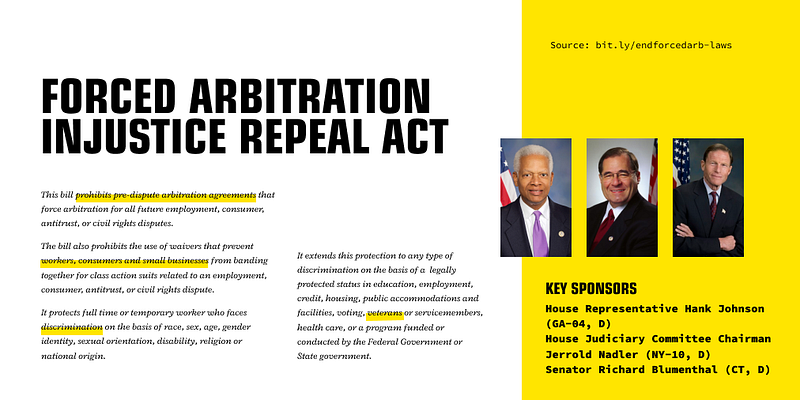
Senator Gillibrand led the request for data from the BLS and Sen. Blumenthal was a signatory, so could their request for data be tied to this legislation? It’s not an unreasonable leap to make, but it’s only an assumption, as we’ve never received further information stating their intentions. Still, what benefit could this very specific data be to passing legislation like this?
Voting on each iteration of this bill has been almost completely partisan, Republicans against and Democrats in favor (which means that it doesn’t look good for S.610 to pass in the Senate). Perhaps the Senators’ intention is that if they had concrete data from the BLS showing the economic cost of sexual harassment, they would be able to use this information to convince their GOP counterparts that this issue is severe enough to warrant legislation. However, if anyone doesn’t understand the breadth and severity of the problem we have with sexual harassment and assault in this country at this point, they never will. No statistical data is going to convince them; they obviously don’t believe the thousands of victims who have shared their stories or the many instances of powerful abusers facing consequences because of their actions, even though many of those instances have occurred within the US government itself.
But what use is data given the prevalence of alternative facts?
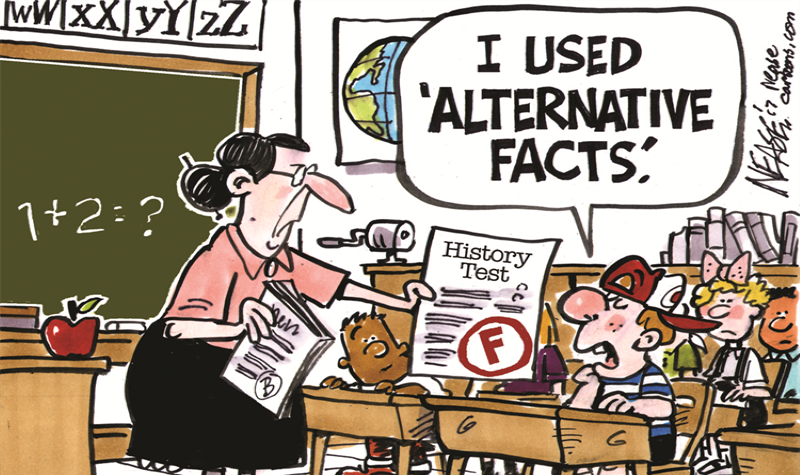
In our current political climate concrete facts are often successfully disputed with wild, nonsensical conspiracy theories. In the present reality where facts no longer hold the weight they once did, how do these Senators propose getting the GOP to accept data from the BLS? There is a lot that needs to be explained about their reasoning. Any way you slice it, it doesn’t seem that obtaining this data is going to have any measurable impact. The American people deserve to know if these Senators have sincere intentions for this data or are just paying victims lip service in an attempt to get credit for taking action without the risk of actually doing anything.
Wouldn’t accurate data be more useful?

Finally, if this data is in fact important, we need to ensure that accurate data is collected. Why would we trust employers to self-report data about sexual harassment? Sexual harassment is commonly swept under the rug by HR departments, which exist solely to protect the company, not their employees. This is particularly the case if the harasser is in upper management or even higher. The case could also be made here that if it is so easy for corporate Super PACs to have such a huge influence in many aspects of government, then what influence might they have over the collection of this data? Wouldn’t it be obvious that that same effort and funding to influence government policy is going to be applied to the statisticians, their teams, and potentially the BLS offices responsible for oversight? The key point this article attempts to make is that: the source of this data matters just as much if not more than the methodology behind how the data is gathered.
You don’t need data to know the right thing to do. At least Congress is making some inroads on legislation that addresses the problem, but it seems unlikely the legislation will be passed in the GOP-run Senate.
We don’t believe we should wait for the government to solve this problem. Instead we should give people the power to solve this problem for themselves right now.
Before we explore how to go about doing that, let’s consider the response of the BLS.
Was the BLS’s response reasonable?

Only two people have ever completed the American Ninja Warrior challenge and achieved total victory. If I had to guess which is easier:
- Training for and completing the American Ninja Warrior challenge.
- Designing a policy that would allow the BLS to collect the data requested.
I’d assume that although both tasks are pretty hard, I’d have a better chance putting together a team that was capable of achieving the first objective. Let’s see why this is by looking at the response:
Questions about workplace harassment are very sensitive in nature. Employers may have difficulty providing the data you are requesting, as such information may not always be reported by victims and the release of such information may be subject to privacy or other restrictions. Also, like most voluntary federal statistical surveys, BLS surveys have experienced declining response rates in recent years. Requesting additional information, especially information that is sensitive in nature, may have detrimental effects on survey response.
The BLS identifies surveys as an ineffective means of obtaining this data because:
- The questions being asked are sensitive in nature.
- Employers may find it difficult to provide this data.
- Victims may fail to report harassment.
- Incidents may be subject to privacy protections.
- BLS survey participation is declining and asking respondents sensitive questions will have “detrimental effects” on their ability to gather other data.
Put yourself in the shoes of the BLS for a second

If you know anything about calling up strangers and asking them survey questions over the phone, you intuitively know that what these Senators were asking for was a complete non-starter. If you don’t believe me, let’s imagine how awkward one of these conversations might sound like:
BLS: Uh hi, yes I’m calling from the Bureau of Labor Statistics and I just needed to gather some data to be compiled into our statistical reports. All of the answers you provide are completely anonymous and will not in any way reflect poorly on you or your company.
BLS: Do you have a written policy that encourages employees to report incidents of sexual harassment when they occur?
BLS: Are you aware of any sexual harassment claims which have been filed by employees of your company in the last six months? Uh huh. I see.
BLS: Can you elaborate as to whether or not any incidents of sexual assault resulted in any legal action taken by any employee or former employee against your company?
Just casually reading these questions in a blog post feels incredibly awkward. If you haven’t been convinced that this isn’t going to work yet, read these questions out loud to one of your coworkers. Ask them to imagine having to answer yes to one of these questions. How many companies do you think would answer any of these questions honestly? Does anyone think this would actually provide accurate information?
Is it possible to design a system that can collect this data:
- Without asking sensitive questions?
- Without relying on employers to provide access to data?
- When victims decide not to report harassment to authorities?
- While still maintaining privacy protections for the victims?
- Without bothering BLS to help in data collection?
The answer, surprisingly, is yes.
How do you get this data without conducting a survey?
Victims of sexual harassment and abuse should be protected by the US government, their employers, and our society at large. Not enough has been done to address these issues. However, while we’ve been waiting decades for these slow-moving bureaucratic entities to take action, this post is in favor of finding solutions that individuals can use to protect themselves now. What we present here is neither just nor is it fair, but it’s our shared view that it’s better to take realistic action however possible to make a difference. If government agencies are going to insist that having more data is a prerequisite to crafting meaningful legislation then this post offers a meaningful solution. If this data is needed to rectify workplace sexual harassment it matters that policy makers get the right data from the right source.
Keeping this in mind, we’ve come up with one way for victims and potential victims of sexual harassment and abuse in the workplace to protect themselves now. If there was a way for communities of at-risk employees to self-insure, they could come together to form coverage groups within their company or organization. By providing each other coverage for incidents classified as sexual harassment, they could collect this data, and it would be much more accurate.
Shifting the task of reporting away from employers means that the dynamic which has led to high rates of self-censorship can finally change.
Members of these groups wouldn’t have to worry about potential retaliation from their employer or other employees when they file a claim. This is because the requirements for filing a claim within the group are separate from the formal process of filing a complaint with HR or management. Given this dynamic, victims of the group are less likely to underreport incidents of harassment.
True peer-to-peer insurance requires blockchain technology to work. For groups to avoid burdensome insurance regulations, they can use the blockchain to hold their premiums and award claim payments. A record is then created of sexual harassment incidents that would provide exactly the data that the Senators requested, without the need of any outside groups to perform subjective surveys. It would also provide the perfect level of privacy, as the only information that would be known to the public would be:
- Number of people paying premiums within the group and the monetary value of those premiums.
- Number of people awarded claims within the group and the monetary value of those claims.
No other information would be publicly available such as:
- Name of the victim or the alleged harasser
- Details of the harassment

And all of this information would be available without involving a single employer. Insurance is a force to be reckoned with, and we underestimate its power at our peril. Decentralized protocols will allow insurance to become far more pervasive to coordinate groups in society than we could have ever possibly imagined. Insurance will demonstrate the true nature of the force of decentralization. Focal Point™ is our proposed answer to the problems of employees needing protection from sexual harassment and abuse in the workplace and to Congress needing accurate data about victims.
As of this writing, Focal Point™ hasn’t been tested and made production-ready yet. Still, this is a problem we’ve been working to solve for about a year now.
So how does it work?

Many of the basic aspects of Focal Point™ work very similarly to how TandaPay works. Rather than focus on mechanics, which are covered in other posts, let’s focus on the benefits of using the software. The easiest way to understand the software is to understand it from the point of view of the different groups who will benefit from its use.
Who stands to benefit?
- Victims of abuse: Victims are much more likely to disclose the abuse to a member of their peer group than they are to HR or management. Victims may be unsure if something is worth reporting until they speak to someone whom they trust. After an initial consultation, the victim and a peer follow a fact-based discovery process. Guided by the group’s charter, they can determine if they have sufficient evidence to meet the burden of proof required. If they feel the incident meets the criteria, they can submit a claim to the group for approval. This whole process takes place among the victim’s peers and shields the victim from any form of retaliation by anyone in the company.
- Employees: They now have a tamper-proof, permanent record of history which represents their perspective. Claims are 100% approved by the group. Management + HR are not participants in the claims approval process. Privacy of the victims is completely maintained so long as the group remains relatively small (caveat: it requires everyone in the group to sign non-disclosure agreements).
- Corporate lawyers: Think corporate governance for lawsuit mitigation on steroids💪⚡. Lawyers love this product. It is not merely whistleblowing software, it is a legal record they can use in a court of law. When groups of employees reject a fellow employee’s claim, it means that the claim has no merit in the eyes of their peers. Approval of false claims have the highest penalties permissible i.e. one false claim can cause the group to terminate. A record where employees pay premiums every month but never approve any claims is a clean bill of health for a corporation. Such a record allows lawyers to defend their corporate clients against any allegations of sexual harassment. It renders any claims of sexual harassment as being either moot or patently false in a court of law.
- The government: The data that these Senators wanted is provided in a publicly accessible record. New data is released on a monthly basis, no need to wait for a yearly or quarterly report to come out. BLS is never required to perform any surveys to obtain this data. No private information is ever revealed, so securing the record imposes no potential liability risk that private information will ever be leaked. There are potential upgrades to the system that would allow a victim to submit additional information directly to the government. Without revealing their identity, they could provide information directly to policymakers that could be used to assist in their efforts to write new legislation.
- Shareholders: Shareholders love this product because it gives them real-time on-the-ground data as to how employees are being treated with regard to this issue. It prevents them from seeing huge swings in a stock price when a brand is suddenly tarnished by lurid #MeToo revelations. Long before a major lawsuit becomes public or a scandal breaks out on social media, they have visibility on the issue. Corporations can protect their brand from damage without needing to cover everything up. This is because the system imposes just the right amount of transparency initially without providing any details. This initial transparency prompts negotiations that allows for a process of deescalation by both sides. The goal is to prevent media blowups from exposing licentious details which bring damage to the brand.
Who stands to lose?
- Sexual harassers and abusers: Abusers hate this product. Now they can no longer manipulate the system to retaliate against their victims. When a claim is filed, they are unaware of any accusation of wrongdoing even after the claim has been verified by the group as being true.
- Human Resources: HR dislikes this product. This is because it falls outside the scope of what they can control. They cannot control the record or its contents. They have their doubts that allowing employees to participate might violate corporate policies in some way. They understand the world of grievances, settlements, non-disclosure agreements, and severance payments used to buy peoples’ silence.
The current system forces a victim to request help from HR. In the new system we are proposing, HR is directed by a claim to seek out a victim and offer their help.
The power dynamic has changed, and HR’s role in this new system is unfamiliar. The old system valued a victim’s silence. The new system gives victims the privilege to speak. If our goal is to give employees the ability to negotiate for a more inclusive and less toxic workplace, the way to do this is not by silencing them. Only time will tell if HR can be convinced to see the value in giving victims greater power to change a corporation’s culture for the better.
Important points to remember:

- This post doesn’t cover the complex intersection between an insurance-like platform and whistleblowing software. In this system, premiums and claims take on a completely different meaning.
- The “premium” that members pay doesn’t seek to compensate victims for the value of their “loss.” The compensation any policy could provide victims of sexual harassment is inadequate relative to the harm a victim experiences.
- In this system, money is tied to speech. Money provides speech with a value that is both meaningful to members of the group and to others within the company. Given the insistence that people should “put their money where their mouth is,” it follows that the value of a premium should be something each group decides for themselves.
- Ask yourself, “How meaningful would a claim be if it cost each member $1 when a claim was approved? How meaningful would it be if it cost each member $100 to approve a claim?” The value of a single claim is determined prior to the start of the month before the group becomes aware of any harassment. Rather than being tied to the harm inflicted upon the victim, it is instead tied to the importance this issue has to the members of the group.
- The members of the group are signaling to others outside of the group, “This claim has validity and we are willing to stake our funds to prove it.” If the value of a premium is quite high, then it gives members adequate incentive to find fault with a claim and not approve it. If the value of a claim is too low, then the members could potentially approve claims with little incentive to question a claim’s validity.
Summary:
The TandaPay protocol is a special variant of a whistleblower complaint system. It uses financial incentives to guarantee that the content of complaints submitted by whistleblowers are true. It requires that participants, within the group from which the whistleblower complaint originated, verify the facts of the complaint. In this way, TandaPay functions by combining a system for complaint validation with a system of financial incentives. This represents a new innovation which has never previously existed.
OK, but what is Focal Point™?

It’s a modification of a peer-to-peer insurance protocol that provides a useful corporate governance tool for large corporations and government agencies. The concept is to use an architecture for insurance to allow groups to reach consensus on claims. Claims which are approved by the group function as whistleblowing complaints against sexual harassment in the workplace. Using a novel method, it uses charters to coordinate people to reach fast consensus. Charters are a much longer topic of conversation, but the following is a good introduction to the concept.
Trust should be based on the social contract
The Focal Point™ protocol does something unique. It takes specific values and makes them a focal point around which everyone’s actions are coordinated. If you’ve never heard of a focal point before, it can be described as:
“The default option that people choose because they expect others will choose it.”
Julia Galef does an excellent job of explaining how this works by giving a great example from Good Will Hunting.
Vitalik Buterin, the founder of a cryptocurrency called Ethereum, when asked what advice he would give Satoshi Nakamoto, the pseudonymous creator of Bitcoin, highlighted the importance of creating explicit norms. His answer highlights how these norms govern the development of a community after its formation. This provides a real example of how Schelling points described by Julia can be applied to the practical coordination of existing communities.
Unchained Live: Laura Shin in conversation with Vitalik Buterin

Laura Shin: What advice would you give Satoshi?
Vitalik Buterin: Set explicit norms in writing. For example set an explicit direction in writing. One of the things that we did for Ethereum early on is we said, “we want to do proof of stake and sharding.” We’ve said that even all the way since 2014 and 2015 and that helped because it creates this community agreement. (This agreement is) that Ethereum is a chain that technically evolves (over time) and proposals that change (Ethereum) in the spirit of those ideas should be adopted. I think that the social contract of possible technical improvements is something that has served us very well. It probably prevented a lot of arguments that could have led to stagnation.
If those ideas had not been (clearly communicated) there could have been a much larger contingent who could have (argued against proof of stake and sharding. They could have insisted that the Ethereum community) keep the chain exactly as it is or go in some totally different direction.
So I think trying to set a more explicit path for future improvements is definitely something that (Satoshi) could have done to significantly improve the outcome.
The right values coordinate people for everyone’s benefit — trust the values first, then the people

Based on the above two examples, we have learned that:
- A good focal point is one that embodies a well-defined set of norms that everyone can understand. It implies that most people also expect others to both understand and adopt these guidelines as their own.
- By clearly defining the norms of a community in writing at its inception, we can better establish a set of shared values and reach those values together.
This is exactly what Focal Point™ does. It does so by using charters which are the social contract of a community. This social contract is the focal point for the group. A charter both coordinates and incentivizes the actions of the participants. Charters serve to put a group’s values into words, and this is how they go beyond the creation of financial incentives to focus on rewards and penalties that are non-monetary. In more specific terms, it provides the rules that allow anyone to reach a conclusion as to whether or not an insurance claim is valid.
Charters are the means by which a community gives itself the authority to award a claim that represents a community’s values.
We know that the charter will be enforced because the protocol guarantees that any group which deviates from its own charter will collapse. This is the key insight that allows the protocol to provide a service that is fundamentally different from a traditional insurance product. Every member knows that the group will terminate if a critical number of members leave. This means the group can only safely approve claims that a super-majority of users believe are valid according to the standard of the community’s charter.
In summary, charters work because they are enforced by technology:
- A charter is a focal point for a community’s values.
- Charters give communities the authority to award claims.
- Groups that deviate from a community’s values will terminate.
- Technology enforces the contractual coordination between participants.
- Funds can be held by digital contracts governed by software code.
- Communities, charters, protocol architecture, smart contract code, all these in combination produce an app where the sum is greater than the parts.
By combining monetary and non-monetary incentives, we can establish a framework of trust that allows for communities to be built with the help of decentralized applications. Participants trust “the rules defined by the protocol” first, then based on these rules they can trust other members of their community. Within the context of shared values defined by the charter and incentives created by the architecture, communities can be built on mutual trust. This trust however doesn’t require that the participants compromise on the ideals of decentralization when it comes to considering how the protocol should hold funds.
Why is trust still needed?
We are required to make an important distinction between the financial aspects and the social aspects of app architecture. The financial architecture which manages money is decentralized and requires the removal of third-party custodians. The social architecture which coordinates people has a central moderator who serves as a trusted partner to facilitate the community to reach consensus on valid claims. We want to see communities established where trust is based on the social contract which guarantees participants share the same values. Once the blockchain removes the legal liabilities associated with managing funds, communities will have a greater capacity to self-organize and award claims which represent those values.
The implications of this application are limitless. It may be difficult to wrap our heads around how this will play out in the real world, but it’s about time that we start using technology to effect social good and empowering communities to solve problems in ways that work for them.
Conclusion

Sexual harassment data is very different from other types of data that the BLS has previously been commissioned to collect. Issues of privacy, as well as the stigma associated with harassment by both victims and employers, make this data extremely sensitive in nature. The sensitive issues surrounding this data have resulted in routine underreporting of incidences of sexual harassment in society at large. Many attempts have been made to use technology to increase reporting of incidents of assault and harassment, but no technology has come to dominate the market on reporting. Traditional reporting methods should thus be viewed as inadequate for this task. Even information escrows are inadequate relative to the power of financial escrows used for reporting.
Focal Point™ gives employees the means to form small self-insuring collective groups. A group can approve claims according to a predefined set of values determined by the group. This method of self-insuring groups is likely to generate accurate reporting data on incidences of sexual harassment.
This is true because the approval of claims is simple:
- The rules which govern a group are explicitly set in writing.
- Every member of the group has the ability to determine if a claim is valid.
- If a member feels a claim is invalid, they are under no obligation to pay.
- Such a system strongly discourages fraudulent claims since they will never be paid by the group.
- Additionally, a single fraudulent claim can cause a group to terminate.
Having small self-insuring groups shifts the task of reporting away from employers. This shift means that the dynamic which has led to high rates of self-censorship can finally change. The record generated by self-insuring groups when they approve or deny claims can guarantee that policymakers get the right data from the right source.
These groups also provide:
- Protection for victims from retaliation.
- Direction to HR to seek out victims and offer their help rather than forcing victims to seek help from HR.
- Solutions to complex principal-agent problems where HR is motivated to cover up issues of sexual misconduct by other senior employees of the company.
- Guarantees that the system affords victims the right to speak to a peer whom they trust about these issues.
- A tamper-proof record of events that provides the right level of transparency while maintaining the proper protections for privacy.
The way data is generated matters. If citizens are going to be governed by laws and these laws are going to be determined by this data, then citizens have a right to decide how this data is generated.
If victims are the ones who are most impacted by government policy, then doesn’t it make more sense to obtain this data from victims rather than their employers?
When evaluating the integrity of sexual harassment data in the workplace please consider:
- What leads anyone to believe that information reported by an employer is accurate?
- Why should anyone think that data reported by employees would be less accurate than data reported by an employer?
How can a government use taxpayer money to gather data which represents a viewpoint that is entirely biased by corporate interests? When it comes to matters that we all agree on, I don’t see anything the BLS does as particularly controversial. When it comes to issues where the view of employees and employers diverge drastically, I can’t understand why it’s OK to use taxpayer money in this way. Further, gathering the data published when people use Focal Point™ comes at zero cost for the taxpayer, unlike BLS surveys. This means the way BLS would collect this data is not merely more expensive than it needs to be; it also results in data whose bias unfairly favors one class of people, namely employers.
Small, self-insuring collectives provide higher levels of mutual accountability than one might suppose. These groups are often widely misunderstood or criticized due to the predisposition for some people to think of them as “unions.” This is an inaccurate label used to malign self-insurance cooperatives by those who fail to understand the importance of upgrading information escrows using new technology. We must move beyond this bias to enter into a new age of data collection using these new types of insurance mutuals.


